


%203.svg)
Key Takeaways
- Uruguay gives US companies senior, enterprise-trained developers at 52% to 66% below equivalent US software engineer salaries, working a full day in overlap with US business hours.
- There are four ways to hire: freelance marketplaces, hiring directly (through a legal entity or an Employer of Record), a nearshore staff augmentation company, or a staffing and recruiting firm.
- Uruguay has the highest density of people with IT skills in Latin America, but the total pool is small, so a targeted search beats a volume one.
When companies hire developers in Uruguay, they get engineers who work substantially inside US business hours at salaries up to 66% below domestic rates. Uruguay has built a stable, well-regarded tech sector over the past two decades, and it's increasingly one of the markets US companies consider when other Latin American countries don't fit their specific need.
Uruguay's edge isn't scale; it's consistency. The country has some of the strongest institutional stability and rule of law in Latin America, which matters for companies weighing long-term hiring relationships, not just a single placement.
Time zone alignment is real too. Uruguay operates within 1 to 2 hours of the US East Coast, giving your team a full workday of overlap for Eastern and Central teams, and the morning for the West Coast.
In this guide, I'll cover what Uruguayan developers earn, what technical skills they can bring to your business, and the four ways to hire them. One of the routes, the easiest, is using a nearshore staffing and recruiting service company like Hire With Near.
Why Should I Hire Developers in Uruguay?
Uruguay gives US companies engineers who are trained inside multinational software organizations, working during your business day, at roughly half the cost of an equivalent US hire.
A pipeline shaped by global tech companies
Uruguay XXI, the government's investment and export promotion agency, lists Tata Consultancy Services, Sabre, Mercado Libre, Globant, Oracle-NetSuite, and PedidosYa among the multinationals running large operations in the country.
Tata Consultancy Services runs its first nearshore delivery center in Latin America in Montevideo, now with more than 2,500 people.
Add homegrown companies like dLocal, and many of Uruguay's senior engineers have learned the job on production systems held to international code review standards.
Real-time overlap with your workday
The second reason is the working day. When you hire remote developers in Uruguay, they're at their desk while your team is at theirs, whether you run on Pacific, Mountain, Central, or Eastern time. That means live standups, same-hour answers, and pull requests reviewed before you log off.
You can check how the four continental US time zones align with Uruguay throughout the year in the table below:
Hire With Near has placed engineers across Latin America for years, and our research into why US companies are hiring in Latin America found that 30% are switching from a distant offshore setup, naming time zone alignment as the reason.
Meaningful cost savings
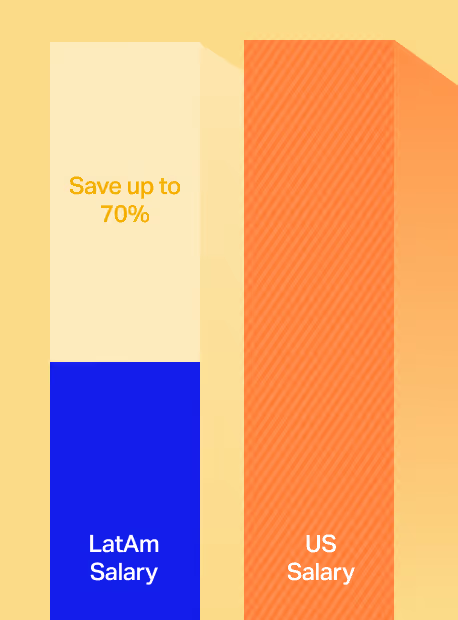
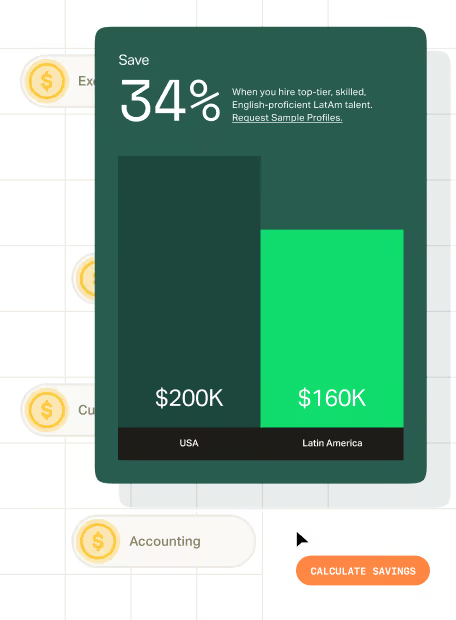
Hiring developers in Uruguay typically costs 30% to 70% less than in the US, with junior developers running about 66% less on average and senior developers 53% less.
The gap reflects the cost of living in Uruguay, not a discount on the caliber of engineer you're getting. To put that into perspective, here's how everyday costs in Montevideo and Punta del Este, the country's major economic hubs, compare with Columbus, Ohio:
Source: Numbeo.com
For the broader case for hiring across the region, our piece on why hundreds of leading US companies are hiring LatAm talent is a good next read. You can also watch the video below, where Franco Pereyra, our Co-founder and COO, explains what makes Latin American talent different:
How Deep Is Uruguay's Developer Talent Pool?
With 3.4 million people, Uruguay is a small, concentrated developer market. The country's tech sector has grown up around a dense cluster of multinational operations, so a meaningful share of the country's engineers have already worked on production systems for global companies before you ever interview them.
But the numbers hold up better than the population would suggest. A 2023 Microsoft and CUTI study of the Uruguayan IT sector counted 21,846 people with at least one IT skill, a 16% rise from 2021, which works out to 64 people with IT skills per 10,000 inhabitants. That's the highest proportion in Latin America, but still well below the United States, which the same study puts at 187 per 10,000.
For most US teams hiring one or three engineers, that's fine. But if you're standing up a 40-person engineering organization inside a year, Uruguay works better as part of a regional hiring process.
In that case, Argentina and Brazil have much larger pools. Not far behind are Mexico and Colombia, sitting closer to US Central and Eastern hours. If you want to know more about them, check our country guides about hiring developers in Argentina, hiring developers in Brazil, hiring developers in Colombia, and hiring developers in Mexico.
For markets similar to Uruguay’s, see our guides for hiring developers in Costa Rica, hiring software developers in Chile, and hiring developers in Belize.
What Technical Skills Do Uruguayan Developers Have?
Uruguayan developers work in the same stacks US product teams do, with unusual depth in backend and fintech engineering. Across the engineering roles we fill in Latin America, the languages and frameworks clients request most often are:
- Python, the single most requested, usually with Django and as the default for data and AI work
- JavaScript and TypeScript, with React dominating front-end requirements
- Java, C++, Go, Ruby, PHP, SQL, and a growing amount of Rust
- On frameworks: React, Django, Vue.js, Ruby on Rails, and .NET
Uruguay's fintech and payments sector, anchored by dLocal, has produced a deep bench of back-end developers who've worked on high-volume transaction systems. Java developers are easier to find here than the country's size suggests, and Python developers are the other deep pool.
From the editorial work I do interviewing our recruiters, one piece of advice comes up more than any other: don't over-filter on framework versions. Experienced developers move between versions and adjacent frameworks without a productivity dip, because the underlying principles carry over.
The bigger surprise for most clients is the seniority behind those stacks, which comes up constantly in IT and tech recruiting in Latin America. Julia Guillen, Senior Tech Recruiter at Hire With Near, explains:
Clients are consistently surprised with the caliber of talent that's available in LatAm. They don't expect to find senior engineers who've worked with major U.S. companies, understand modern development practices, and often have more hands-on experience with specific frameworks than candidates they'd find locally.
— Julia Guillen, Senior Tech Recruiter, Hire With Near
What Does It Cost to Hire Developers in Uruguay?
According to our benchmarks, hiring a mid-level software engineer in Latin America typically costs $54K to $72K per year, and a senior engineer $72K to $108K, which is 49–66% below the equivalent US salary ranges. Those are the regional benchmarks verified across the region, including Uruguay.
The worry behind that number is usually whether a lower salary means weaker engineers. Our own data says the opposite happens. According to Hire With Near's 2026 State of LatAm Hiring Report, 98% of the engineering roles we filled across Latin America went to mid-level or senior professionals, split almost evenly at 47% and 51%.
Here's what hiring a software engineer and other developer roles costs compared to equivalent US hires, according to Hire With Near's salary benchmarks:
For the most up-to-date figures, see Hire With Near's US vs Latin America Salary Guide.
A senior engineer in Latin America sits inside that $72K to $108K band, below what a mid-level US engineer costs to hire, which is why most companies we work with put the money into a more experienced hire. Our breakdown of IT and engineering salaries in Latin America shows the same pattern.
{{salary-guide-cta}}
Where Is Uruguay's Developer Talent Based?
Almost all of Uruguay's developer talent is in and around Montevideo, where the country's universities and its largest tech employers sit, with a smaller hub in Punta del Este.

Montevideo
The anchor is Zonamerica, the free-zone business and technology campus just outside the capital, which hosts more than 500 companies and more than 7,000 people.
A lot of senior Uruguayan developers have spent part of their careers there, alongside the multinationals covered earlier in this guide.
Montevideo also concentrates the country's university system and its largest pool of experienced tech talent, which is why most serious searches start and end here.

Punta del Este
Punta del Este is smaller and better known for tourism and real estate than tech, but it has a growing pocket of developer talent, often tied to companies serving the hospitality, real estate, and finance sectors that dominate the local economy.
It's a secondary option worth knowing about if a Montevideo search comes up short, rather than a primary hub in its own right.
The universities behind the pipeline
Four institutions supply most of Uruguay's tech talent pipeline, each with a distinct profile.
- Universidad de la República (UdelaR) is the country's oldest and largest university, founded in 1838, and accounts for roughly 85% of national university enrollment. It's public, free, and runs the Institute of Computer Science and the Center for Scientific Computing, with programs spanning computer science, software engineering, information systems, and cybersecurity. Its scale alone makes it the single largest source of Uruguayan tech graduates.
- Universidad ORT Uruguay is the country's largest private university, founded in 1996 with roots as a technical school dating back to 1942. It's known specifically for its Engineering and Systems Engineering programs, ABET-accredited in several tracks, plus a strong tech incubator and more than 100 international academic partnerships. Graduate employment rates run above 97%, reflecting how closely its programs track industry demand.
- Universidad Católica del Uruguay (UCU) is the country's oldest private university, established in 1984, with programs across computer science, engineering, business, and health sciences. It's smaller than UdelaR or ORT but has built a reputation for practical, industry-connected engineering programs.
- Universidad Tecnológica (UTEC), founded in 2013, is the newer of Uruguay's two public universities and focuses specifically on IT, data, and AI programs. It's structured differently from the others too, with regional technology institutes in Fray Bentos, Durazno, and Rivera, plus additional campuses beyond Montevideo, which spreads technical education further into the interior of the country than any other institution on this list.
A college background is a useful context, but shouldn't be a filter when hiring in Latin America. Natasha Tarapow, Recruitment Consultant at Hire With Near, is direct about this:
A lot of the great engineers in Latin America don't have a college degree, and that doesn't mean they're bad candidates. The dynamic here is that many of the best engineers started working before they graduated. They got a really good job and didn't have time to finish. We always recommend to clients that they don't make a degree a must-have, because they might be losing out on some really good candidates.
— Natasha Tarapow, Recruitment Consultant, Hire With Near
How Can a US Company Hire Developers in Uruguay?
US companies have four ways to hire developers in Uruguay: freelance marketplaces, hiring directly, a nearshore staff augmentation company, or a staffing and recruiting firm. The choice comes down to one question: do you need short-term help on a project, or a long-term, full-time developer on your team?
Here they are, from most complex to simplest:
Freelance and contractor platforms
Platforms like Upwork, Toptal, and Arc give you fast access to freelance developers in Uruguay, which suits a defined project or a short burst of capacity.
For a full-time hire, they're a poor fit: you carry the quality and retention risk, and the developer is usually splitting attention across clients.
Specialist staffing beats freelance platforms for full-time remote hires.
Hire directly
Hiring directly means you source and vet candidates yourself and take on the employment relationship. For a cross-border hire in Uruguay, that comes down to one of two mechanisms:
- Set up a legal entity: Registering a Uruguayan subsidiary gives you full control and makes you the direct employer. It also takes months, costs money upfront, and commits you to ongoing local legal, tax, and accounting support. That's the right call for a permanent presence of roughly 50 people or more, and expensive overhead for a handful of engineers, as our guide to hiring remote foreign employees lays out.
- Use an employer of record: An employer of record becomes the legal employer on paper while you manage the developer's work day to day. It handles contracts, payroll, tax withholding, local benefits, and Uruguay's statutory extras, including the aguinaldo and salario vacacional.
Either way, the gap to name is recruiting. Employer of record companies handle employment logistics, not sourcing and vetting, so you still find, screen, and convince every candidate yourself, through your network or a job board for hiring in Latin America. In a pool this small, where the strongest engineers are rarely answering job posts, that's the part most teams underestimate.
Working with a nearshore staff augmentation company
A nearshore staff augmentation company places pre-vetted engineers onto your team to work under your direction while the firm stays the legal employer. It's the model most outsourced software development shops have moved toward, and why IT staff augmentation is the path many CTOs weigh first.
Working with a staffing and recruiting firm
This is the simplest route for a permanent, full-time hire. The firm sources and vets the engineer, and once you make the hire, it handles payroll, benefits, and compliance in the background, so the person becomes a genuine member of your team rather than a resource on loan.
You describe the role and the seniority you need. The partner runs a search built around that brief and presents candidates who've already cleared a technical and communication screen, so your job is limited to interviewing and deciding, not sourcing from scratch. The best LatAm staffing firms also know local salary bands well enough to keep you from mis-offering, which matters more in a smaller market like Uruguay's than in a larger one.
If you want to compare providers, our roundup of companies that place developers in Latin America is worth reading, paying attention to how each one screens technically, not just how fast they claim to move.
Hire With Near runs nearshore staffing and recruiting for exactly this model: permanent hires who join your team and stay, with a first shortlist in three to five days.
{{prevetted-banner}}
What US Companies Need to Know Before Hiring Developers in Uruguay
Three things matter before you commit: the statutory pay rules, how you protect your code, and how competitive the local hiring market actually is.
On pay, Uruguay has two statutory items US companies don't expect: the aguinaldo, a 13th-month salary paid in two installments, and salario vacacional, a vacation bonus paid on top of normal vacation pay. Budget for both from the start. The full mechanics are in our full guide to hiring in Uruguay.
On intellectual property, the protection is contractual: NDAs and explicit IP assignment terms in the developer's agreement, signed before repository access. Uruguay is a stable jurisdiction, but no contract enforces itself across borders, which is one reason companies often prefer a partner who holds part of that relationship locally.
On competition, don't assume a small market means an easy search. The same multinationals that trained Uruguay's strongest developers are also actively hiring them, and Zonamerica's concentration of companies means several employers are often competing for the same short list of senior candidates. Moving slowly on an offer, or lowballing based on the country's cost-of-living reputation, is how a search that should take weeks stretches into months.
How Hire With Near Helps US Companies Hire Developers in Uruguay
Hire With Near sources from a pool of 160,000+ pre-vetted professionals across Latin America and runs fresh sourcing built around your specific role, then handles employment, payroll, and compliance once you hire, so you're evaluating candidates instead of managing a search.
You'll typically see a shortlist within 3 to 5 days. What happens before that shortlist reaches you matters more than the turnaround time itself.
Our recruiters build the first-round interview around one thing: whether a candidate can walk you through their own work clearly. They ask about a specific project, what the person actually owned versus what the team did, and where things went wrong along the way. Someone who can only speak in generalities, or who can't explain a decision without leaning on jargon, usually hasn't done the work they claim to have done.
If you want a technical assessment layered on top of that screen, for your specific stack, we can help build and administer it.
How a healthtech startup saved $323,000 per year with Hire With Near
Scaling from one hire to a team works the same way. A fast-growing US healthtech startup came to us with two internal recruiters, an 8-step interview process it refused to shorten, and a hiring plan its team couldn't keep up with. Hire With Near took over sourcing, screening, and coordination.
The company kept all 8 steps, still averaged 14 days to hire, and hired 7 senior engineers across backend, DevOps, QA, mobile, and frontend, plus staff-level roles, saving $323,000 a year against US salaries. That's a Latin America engagement, not a Uruguay one, but it's the shape of going from one engineer to a team.
We also hire software engineering talent in Latin America across the rest of the function, do nearshore SaaS recruiting for product teams, and handle engineering leadership hires through executive search if you need a VP of Engineering or a CTO.
Final Thoughts
Uruguay's case isn't scale, it's consistency: enterprise-trained developers, a stable jurisdiction, and a workday that overlaps yours almost entirely. It's a strong fit for one to three hires, and a smaller piece of a larger regional search once you're building a bigger team.
Getting there comes down to picking the right route: sourcing and employing someone yourself, using an employer of record if you'd rather skip setting up a legal entity, bringing in staff augmentation for a fixed-term need, or working with a staffing and recruiting partner if you want a permanent hire without managing the search.
When you're ready to move, book a free consultation to talk through your requirements with our team. You'll get salary benchmarks for the roles you're hiring for and a walkthrough of how the hiring process works.
{{latam-hiring-cta-v2}}
Frequently Asked Questions
How much does it cost to hire a developer in Uruguay?
A mid-level software engineer in Latin America typically costs $54K to $72K a year and a senior engineer $72K to $108K, which is 52% to 66% below equivalent US salaries. Uruguay sits inside those ranges.
How much do software developers in Uruguay earn?
Developers in Uruguay earn within Latin America's range of roughly $48K to $108K a year depending on role and seniority, according to our salary data. Senior back-end developers, Java, and Python specialists sit toward the top of that band.
Is a 13th-month salary required in Uruguay?
Yes. Uruguay requires an aguinaldo, a 13th-month salary paid in two installments: half by 30 June and half by 20 December. It also requires the salario vacacional, a vacation bonus on top of regular vacation pay. Budget for both from the first offer.
Do Uruguayan developers speak English well enough for daily standups?
Yes, for most engineering roles. Uruguay scores 542 on the 2025 EF English Proficiency Index against a global average of 488, placing it in the Moderate band, the 34th worldwide and 3rd in Latin America, with Montevideo at 544.
What matters for a standup, though, is whether a developer can explain why a change broke production and hold their own in an architecture review.
Is Uruguay in a compatible time zone with the US?
Yes, a developer in Uruguay works during your business hours whether your team is on Eastern, Central, Mountain, or Pacific time. Uruguay doesn't observe daylight saving and most of the US does, so the gap shifts with the season, running an hour or two ahead of the East Coast. Eastern and Central teams get close to a full day of overlap; West Coast teams share the morning and early afternoon.
What tech stacks are Uruguayan developers strongest in?
Uruguayan developers are strongest in backend and enterprise stacks, particularly Java, Python with Django, and Node.js, alongside React and TypeScript on the front end.
How long does it take to hire a developer in Uruguay through Hire With Near?
With Hire With Near, you'll typically see a shortlist in 3 to 5 days, and most companies make a hire in under three weeks. One healthtech client averaged 14 days to hire across seven engineering roles while running a full 8-step interview process.
What other developer roles can I hire in Uruguay?
Beyond general software engineers, US companies regularly hire full-stack developers in Latin America, nearshore front-end developers, remote DevOps engineers, mobile developers in Latin America, and nearshore data engineers. All five carry the same time zone overlap, and the salary table above puts these roles 30% to 70% below equivalent US salaries.


.webp)


.webp)

.webp)


%203.svg)
.avif)





%20(1).avif)

%20(1).png)