%203.svg)
Key Takeaways
- US companies hire developers in Costa Rica one of four ways: freelance marketplaces, hiring directly (through a legal entity or an employer of record), staff augmentation, or a staffing and recruiting firm. The developer pool itself is small in absolute terms but unusually concentrated.
- Intel, Amazon, and Procter & Gamble are among 250-plus multinationals operating there, so many available developers have already worked in English, on US-facing teams, inside enterprise-grade systems.
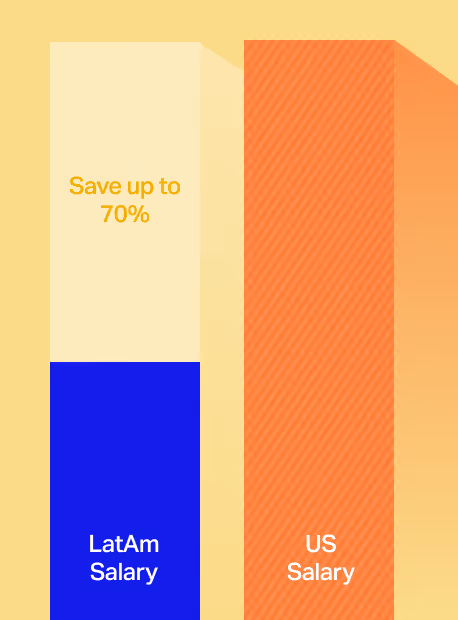
- Developer salaries run 30% to 70% below US equivalents, and a first shortlist typically lands in about five days.
Long before remote-first work transformed software recruitment, Costa Rica was establishing itself as Central America’s premier hub for international technology operations. Today, companies looking to hire developers in Costa Rica have access to a uniquely mature talent market.
With one of the highest concentrations of digital skills in the region, near-total US working-hour overlap, and a similar corporate culture, Costa Rican software talent allows tech organizations to scale fast while keeping delivery cycles on track.
In this guide, I cover everything leadership teams need to know about how to hire developers in Costa Rica: clear salary expectations, key technical hubs, skills to look for, and the four ways to hire.
Why Should I Hire Developers in Costa Rica?
Costa Rica earns its place on your shortlist for three reasons: enterprise-trained talent, real-time overlap, and a meaningful salary gap compared to US equivalent professionals.
Here’s what each looks like in practice.
Enterprise-trained talent from day one
Costa Rica’s engineering workforce was trained inside multinational technology organizations, so the developers you meet already have production experience in English on US-facing teams.
Intel, Amazon, and Procter & Gamble have run engineering operations there for decades, and the developers who came through them learned code review, release process, and enterprise security expectations on someone else’s payroll.
The adjustment period that usually follows a first nearshore engineering hire is shorter here.
Real-time overlap with your workday
Costa Rica aligns with the US Central Time Zone, so a developer there is at their desk while your team is at theirs, wherever in the US that is.
You can see how time zones overlap in the table below:
That means you don’t have to wait until the next day for a message; a blocked pull request gets reviewed the same afternoon instead of sitting overnight; and a standup happens live, with everyone present, instead of relying on async updates that arrive hours after the fact.
In Hire With Near’s analysis of why US companies are hiring in Latin America, 30% of the 2,000-plus companies studied were moving work out of offshore locations, like Asia and Eastern Europe, to get real-time overlap.
A meaningful salary gap
Developer roles in Costa Rica run 30% to 70% below US equivalents, according to Hire With Near’s own salary data. That gap isn’t just a lower bill, it’s budget you can redirect. The same spend that covers one senior US developer can cover a senior Costa Rican developer and leave room for an additional hire, better tooling, or a bigger investment somewhere else in the business.
And the talent skewing senior isn’t a limitation. Many companies come to Costa Rica specifically because they need mid-level and senior engineers they can’t find or afford domestically, but junior talent is available too if that’s what a role calls for.
Either way, the cost difference comes down to a lower cost of living, not lower capability, as you can see in the table below:
Source: Numbeo.com
The broader argument for the country sits in why nearshoring to Costa Rica works.
How Deep Is Costa Rica’s Developer Talent Pool?
Costa Rica’s developer pool is small in absolute terms and unusually concentrated. What it lacks in size, though, it makes up for in pedigree: a high share of the engineers there have already worked for a company you’ve heard of.
Let’s start with the corporate footprint. Costa Rica’s investment promotion agency, CINDE, counts more than 250 multinational companies in the services sector alone, employing more than 117,000 Costa Ricans.
Intel has operated in Costa Rica for nearly three decades. While the chipmaker transitioned its assembly and test manufacturing to Asia during a global restructuring, it retained over 2,000 high-value engineering and corporate services roles in San José: dedicated to semiconductor design, prototyping, software validation, and global operations.
Amazon is one of the country’s largest private-sector employers, with depth in cloud infrastructure and customer-facing engineering.
Procter & Gamble runs its San José Intelligence Hub there, one of only three Global Business Service Centers it operates worldwide.
Microsoft, IBM, Citi, and Boston Scientific are present too.
The practical effect for a US hiring manager is that a large share of the developers available have already worked in English, on US-facing teams, inside enterprise-grade systems.
From the editorial work I do interviewing Hire With Near’s recruiting team, the pattern they describe is consistency rather than volume, one reason Costa Rica comes up frequently in nearshore SaaS recruiting conversations.
Julia Guillen, Hire With Near’s Senior Tech Recruiter, describes the clients’ reaction when seeing the quality of the Latin American talent:
Clients are consistently surprised with the caliber of talent that’s available in LatAm. They don’t expect to find senior engineers who’ve worked with major US companies, understand modern development practices, and often have more hands-on experience with specific frameworks than candidates they’d find locally — Julia Guillen, Senior Tech Recruiter, Hire With Near
The limit is geography: the pool outside the San José metro is thin. That binds if you need twenty engineers this year, and works in your favor for one to five.
What Technical Skills Do Costa Rican Developers Have?
Costa Rican developers work in the same mainstream stacks US teams hire for, with two areas of unusual depth: cloud infrastructure and DevOps, and embedded or hardware-adjacent engineering.
- Backend and full-stack: Deep coverage of Python, Java, and .NET/C#, with a strong pool of engineers who’ve built and maintained production systems for multinational clients. SQL proficiency is consistently strong given how many engineers came up through enterprise data-heavy environments.
- Frontend: React dominates, which tracks with demand across the region. React developers in Latin America are among the most requested profiles Hire With Near sources.
- Cloud and DevOps: This is a direct product of the Amazon pipeline. Engineers who have maintained CI/CD pipelines against real production traffic, and who know one cloud provider well enough to move to another, are easier to find here than the country’s size suggests. If deployment reliability is your bottleneck, hire a remote DevOps engineer first.
- Embedded systems and security: The Intel presence produced the other specialty, engineers who have worked close to hardware on firmware, validation, and low-level systems, plus a population trained in enterprise security operations. That’s why cybersecurity analysts in Latin America and embedded engineers surface here more often than elsewhere in the region.
One caution from the recruiters who screen these candidates: companies over-weight specific framework versions. An engineer who understands core principles and can explain a technical decision to a non-developer adapts faster than a version-matched resume suggests.
Beyond technical skills, there are also some important traits worth screening for when hiring developers. In the video below, Hayden Cohen, our co-founder and CEO, walks through a few of them.
What Developer Roles Can I Hire in Costa Rica?
The roles US companies hire most from Costa Rica map directly to the country’s strengths in cloud infrastructure, DevOps, and enterprise systems. Whether you’re building your first product or scaling an existing team, here’s where most companies start and what each role covers.
- Software engineer: Builds and maintains the core product across the full development lifecycle, from architecture decisions to shipping features. Typically the first hire for teams building out their engineering function in Costa Rica.
- Full-stack developer: Works across both front end and back end, which suits lean teams that need range without splitting the hire into two roles.
- Back-end developer: Owns the servers, databases, and APIs your product runs on. Costa Rica’s enterprise pedigree, particularly through Amazon and Procter & Gamble, makes it a strong market for senior back-end talent specifically.
- Front-end developer: Builds the interfaces users interact with. React dominates, matching demand across the region.
- DevOps engineer: Keeps deployments reliable and infrastructure costs in check. This is one of Costa Rica’s deepest specialties, a direct product of the country’s Amazon operations, with strong CI/CD and multi-cloud experience.
- Cybersecurity analyst: Protects your systems and data, drawing on Costa Rica’s enterprise security operations pedigree built up through the Intel presence.
- Remote developer: A generalist option if you’re not yet sure which specific role fits, or if you want to start with one flexible hire before defining more specialized positions.
If your team needs engineering leadership rather than an individual contributor, Hire With Near also runs executive search for roles like engineering managers and directors of engineering.
Developer salaries in Costa Rica fall within Latin America’s broader ranges, which Hire With Near benchmarks across the region. Here’s how those figures compare to equivalent US hires:
For the most up-to-date figures, see Hire With Near’s US vs Latin America Salary Guide.
According to Hire With Near’s 2026 State of LatAm Hiring Report, 98% of the engineering roles we placed were mid-level or senior, split 47% mid-level and 51% senior. Companies save an average of $35,000 to $64,000 per hire compared to US rates.
Where Is the Tech Talent in Costa Rica?
Almost all of the tech talent from Costa Rica lives in San José and the surrounding metropolitan area, where the multinationals, the free-trade zones, and the universities are. Treat San José as the market rather than the country.

Two institutions signal on a developer’s resume:
- Instituto Tecnológico de Costa Rica: Known as TEC, it’s the public technological university and the strongest engineering credential in the country. Its computing degree is accredited by SINAES, the national accreditation body, and admission is competitive: roughly 3,000 applicants named it first or second choice for the 2025–26 intake and only about 345 were admitted. Graduate employability runs close to 100%.
- Universidad Cenfotec: Built entirely for the technology sector, it offers degrees in software engineering, cybersecurity, and information systems, plus AWS cloud training. It’s a private institute, newer than TEC, positioned around direct industry partnerships, and its programs are also SINAES-accredited, which gives employers the same baseline quality signal they’d get from a public university degree.
Neither credential replaces the importance of a technical screen.
For roles outside engineering, Hire With Near’s full guide to hiring in Costa Rica covers the rest of the market.
How Can a US Company Hire Developers in Costa Rica?
US companies have four ways to hire software developers in Costa Rica: freelance marketplaces, hiring directly, a nearshore staff augmentation company, or a staffing and recruiting firm.
The right choice comes down to one question: do you need short-term help on a project, or a long-term, full-time developer on your team?
Here they are, from most complex to simplest:
Freelance platforms and marketplaces
Using freelance platforms and marketplaces like Upwork, Toptal, and Arc is the fastest route to find a contractor. They’re good options when you have a defined scope and a short-duration project.
As the downside, a freelance developer might be serving several companies at once. For a developer who has to learn your codebase, split attention is a structural problem.
That’s exactly the reason specialist staffing gives you fundamentally different results for full-time remote hires: one team, one codebase, one set of priorities. We’ll cover that shortly.
Hire directly
Hiring directly means you source and vet candidates yourself and take on the employment relationship. For hiring in Costa Rica, that requires one of two mechanisms:
- Set up a legal entity: Registering a Costa Rican company gives you full control, but it takes time to establish and carries real legal and accounting overhead: corporate registration, local tax compliance, and ongoing accounting support. This route only makes sense once you’re building a substantial in-country presence, not hiring one or two developers.
- Use an employer of record: An employer of record is a company that becomes the legal employer on paper, handling contracts, payroll, and compliance without you needing your own entity. In Costa Rica specifically, that means managing the aguinaldo (a mandatory Christmas bonus), CCSS social security contributions, and cesantía, a severance obligation that accrues based on tenure and is capped at eight years of service. The catch: an EOR handles employment logistics, not recruiting. You still source and vet every developer yourself, through job boards for hiring in Latin America or your own network.
The paperwork of employing someone abroad is what this guide to hiring remote foreign employees covers. You can also check the 10 best employer of record companies if that’s a route you’re considering.
Working with a nearshore staff augmentation company
IT staff augmentation means a provider places a vetted engineer on your team to work under your direction, while the provider stays the legal employer and handles payroll and benefits. The engineer functions like part of your team day to day, joining standups and taking direction from your managers, but the employment relationship sits with the provider, not with you.
Most firms offering nearshore staff augmentation for developers are built for short-term engagements: engineers rotate between clients as one project wraps up and another begins. That structure works well for a sprint push or a fixed-length project, but it’s a poor fit if you want someone to stay and build long-term context in your codebase.
That is the line between staff augmentation or outsourcing for software development and a permanent hire: rotation versus retention.
Further out on that same spectrum is handing the whole project to a vendor entirely, which is what outsourcing software development to Costa Rica means: the vendor owns the team, manages the work, and delivers you a finished outcome rather than a person.
Working with a staffing and recruiting firm
A staffing and recruiting partner is the simplest option for most companies hiring a long-term developer, because it combines both jobs into one relationship: sourcing and vetting the talent, and handling employment, payroll, benefits, and compliance.
You describe the role, the partner runs a search built around it, and presents a shortlist of pre-vetted candidates. Once you hire, the developer joins your team as a permanent member, not a rotating resource.
This is where most companies hiring full-time remote talent end up, and you can compare providers among the best LatAm staffing firms and the companies that hire developers in Latin America.
Hire With Near covers both ends of that spectrum. We run nearshore staffing and recruiting services for companies building permanent teams, and nearshore staff augmentation for those who need flexible capacity instead, with a first shortlist of vetted developers delivered within three to five days.
{{prevetted-banner}}
What US Companies Should Know Before Hiring Developers in Costa Rica
Three things are worth knowing before you start a search: IP and data protection, the aguinaldo, and how to read a resume without a degree.
Protecting your IP and data
Anyone with repository access, customer data, or infrastructure credentials should be covered by an IP assignment clause and a confidentiality agreement, the same as a US hire.
Costa Rica’s IP framework is broadly consistent with international standards, so this is standard practice, not a special consideration.
The Aguinaldo, Costa Rica’s 13th-month salary
If you hire an employee directly or through an EOR, Costa Rica requires an Aguinaldo, a mandatory 13th-month salary paid in December.
This doesn’t apply to every hiring model, so confirm with your partner whether it factors into your specific arrangement before you budget for the role.
Don’t gate on a degree
Many of the strongest Latin American engineers don’t have a diploma, but that shouldn’t keep you from hiring one of them. Natasha Tarapow, Recruitment Consultant at Hire With Near, explains why:
A lot of the great engineers in Latin America don’t have a college degree, and that doesn’t mean they’re bad candidates. Many of the best engineers started working before they graduated. They got a really good job and didn’t have time to finish. We always recommend to clients that they don’t make a degree a must-have, because they might be losing out on some really good candidates.
Screen for what someone has built and how clearly they can talk about it, not whether they have a degree on paper. Our guide to hiring remotely in Latin America covers contracts, payroll, and onboarding in more detail.
If you want to see what other concerns tech leaders raise before hiring in Latin America, our roundup of the questions tech leaders ask when hiring in Latin America covers what comes up most often.
How Hire With Near Helps US Companies Hire Developers in Costa Rica
Hire With Near is a staffing and recruiting company that sources and vets top software developers in Latin America, including Costa Rica. Here’s how our nearshore IT and tech recruiting process works, start to finish.
First, we talk through the role and the stack: main responsibilities, must-have skills, salary, and any other requirements. From there, our recruiters source from our pool of 160,000+ candidates and run fresh sourcing to find exactly what you’re looking for, presenting a shortlist within 3 to 5 days.
The first-round interview goes past the resume. Recruiters ask candidates to walk through a real project they’ve worked on, not just the tools they used, but what their role was and what they actually did. That walk-through shows whether someone owned the work, and it’s screened alongside English and communication ability. Our recruiters also source above the experience level the job description asks for, since resumes have never been easier to inflate.
Federico Bilello, Hire With Near’s Software Engineering Recruiter, describes what he looks for beyond technical skill:
The main thing I look for is ownership. I always look for developers who have worked in startups or smaller companies, because those are the people who probably have ownership. If you bring them a problem, they won’t ask how to solve it. They’ll try their own ideas, they’ll be creative. That’s the main thing. — Federico Bilello, Software Engineering Recruiter, Hire With Near
If you want a technical assessment or case study assignment on top of that, we can help administer it and advise on what it should look like.
Once you’ve reviewed the shortlist and made your decision, Hire With Near can handle payroll, benefits, and compliance on your behalf. The entire process takes about three weeks end to end, against a US benchmark of three to six months.
What building a LatAm engineering team with Hire With Near looks like
ParkMobile, part of the global mobility platform Arrive, shows what this looks like at scale. For years, its back-end and platform work had been handled by outside development agencies, and every time those developers rolled off, their knowledge of the systems left with them.
Working with Hire With Near, ParkMobile brought that work in-house, hiring 9 senior engineers across platform, backend, and iOS roles. The first candidate shortlists arrived within a week, 8 of the 9 roles closed in under 30 days, and the average time to hire was 24 days.
The result: $1,066,085 in annual savings, a 73% reduction against US rates. As their TA Lead put it:
Their deep understanding of the local talent landscape is what allows them to source and vet top-tier candidates efficiently. — Akshay Gokarnakar, TA Lead, ParkMobile
Conversion Logix is another example. An Inc. 5000 digital advertising and software agency, they used the same model to build out an entire team.
Working with Hire With Near, they filled 15 positions across engineering, marketing, finance, support, and admin, cutting sourcing and interview time in half and averaging a 22-day time to hire. The result was $781,000 in annual savings, a 43% reduction compared to equivalent US hires. Their Client Services Manager described the integration:
I think the main benefit of LatAm talent is the ease of integration. It’s been so easy to work together without really noticing any kind of difference from somebody that’s in the States. — Tawnya Morse, Client Services Manager, Conversion Logix
Final Thoughts
Hiring developers in Costa Rica gives US companies enterprise-trained engineers who work your hours, at 30–70% below US rates, with a partner that can both find them and employ them.
The route matters more than the country: only one of the four options covered here results in a developer who is genuinely yours long-term, rather than someone rotating off once a project ends or an engagement wraps.
If you want to work out whether Costa Rica fits the role you’re filling, book a free consultation to talk through your requirements with our team. You’ll get salary benchmarks for the stack you need and a walk-through of how hiring in Latin America works.
If you're also interested in other countries, I wrote comprehensive guides about how to hire developers in Argentina, hiring developers in Brazil, how to hire developers in Mexico, how to hire developers in Bolivia, and how to hire developers in Guatemala.
{{latam-hiring-cta-v2}}
Frequently Asked Questions
How much do software developers make in Costa Rica?
Software developers in Costa Rica and the wider region earn roughly $36K–$108K a year depending on seniority, according to Hire With Near’s salary data. Mid-level sits around $54K–$72K and senior around $72K–$108K, with DevOps and cloud roles at the top.
How long does it take to hire a developer in Costa Rica?
About three weeks end to end, with the first shortlist in roughly five days, against a US benchmark of three to six months. Costa Rica is one of Hire With Near’s fastest sourcing markets for technical roles, though hiring engineering roles runs longer than customer support roles, which are also frequently hired in the country.
Do Costa Rican developers speak English well enough for daily stand-ups?
Yes, at the mid and senior levels in San José’s tech sector. Costa Rica ranks 55th globally and 10th in Latin America on the 2025 EF English Proficiency Index, in the Moderate band.
That national average understates San José’s senior developers, who were trained inside English-operating multinationals and can survive an architecture review.
Hire With Near tests English on every placement.
What tech stacks are Costa Rican developers strongest in?
Python, JavaScript and TypeScript, Java, .NET and C#, and SQL, with React dominant on the front end and Node.js on the back end.
Two specialties run deeper than the country’s size suggests: cloud infrastructure and DevOps, and embedded engineering, both from decades of multinational engineering work there.
Is it better to hire freelance or full-time developers in Costa Rica?
The choice depends on what your business needs. Full-time is the best choice if the developer needs to learn your codebase and own part of it. Freelance works for a defined project with a defined end, but marketplace contractors usually serve several clients at once, so your priorities compete with theirs.
Does Costa Rica have strong intellectual property protections?
Yes. Costa Rica is a signatory to the Berne Convention and TRIPS, so its intellectual property framework is broadly consistent with international standards.
The practical step matters more: IP assignment and confidentiality clauses for anyone with repository access, customer data, or infrastructure credentials.
What other developer and engineering roles can I hire in Costa Rica?
Beyond generalist developers, US companies hire Angular developers in Latin America, QA engineers in Latin America, Flutter developers in Latin America, and mobile developers in Latin America from Costa Rica and the wider region.
Most teams hire a mix, because the constraint is rarely one role but the ratio of people building to people keeping it running. All of them work your business hours.




.webp)




%203.svg)
.avif)





%20(1).avif)

%20(1).png)