


%203.svg)
Key Takeaways
- You can hire developers in Bolivia at salaries within the Latin America-wide band, which our salary data puts roughly 52% to 68% below comparable US software engineer salaries. Backend-strong engineers there work almost the full US business day.
- Bolivia’s tech scene is small and concentrated in three cities, Cochabamba, Santa Cruz de la Sierra, and La Paz, so plan a narrow search for two or three hires, not a volume pipeline.
- US companies have four ways to hire there, and a specialist staffing and recruiting partner is the simplest for a long-term hire, covering sourcing, vetting, payroll, and compliance in one relationship.
When US companies look to hire developers in Bolivia, they’re often drawn to one of Latin America’s most cost-efficient nearshore engineering markets. Aligned with US business hours, Bolivia gives software engineering teams real-time collaboration without sacrificing code quality or team integration.
The country’s technical talent is anchored across a tech corridor that stretches from Santa Cruz de la Sierra to La Paz and Cochabamba. While the talent pool is smaller than in regional giants like Brazil or Mexico, Bolivian engineers are known for strong fundamentals and deep familiarity with modern tech stacks.
Whether you are looking to hire a React developer, a nearshore Node.js engineer, or building out a dedicated back-end team, in this guide, I cover everything you need to know before making your first hire in Bolivia: real developer salary benchmarks, where top technical skills are concentrated, the four main hiring models, and key compliance considerations to keep top of mind.
Why Should I Hire Developers in Bolivia?
Bolivia gives you three things: an engineering pool that skews backend, a workday that runs alongside yours, and salaries well below US rates. What it doesn’t give you is volume. This is a small, concentrated tech scene, not a multinational delivery hub.
If you need a 40-person engineering org in two quarters, Brazil and Mexico are better starting points, and Argentina and Chile have deeper pools. If you need two or three strong backend engineers who ship in your working hours and stay, Bolivia is worth a look, and far fewer US companies are looking there.
A real, if small, software export sector
Bolivia isn’t a talent pool most US companies think to check, but it has an established one. The country has more than 200 registered software companies exporting around $30 million a year in work, according to data from Bolivia's Electronic Government and ICT Agency (AGETIC), reported by Los Tiempos.
Santa Cruz de la Sierra, the country’s economic hub, accounts for roughly 35% of Bolivia’s GDP and receives more than 40% of its foreign direct investment, with more than 20 universities producing technical graduates and a growing base of local tech companies and startups.
Real-time overlap with your workday
Bolivia sits on UTC-4 year-round, with no daylight saving to track. A developer there is online through most of your business day no matter which US time zone your team runs on, which means standups happen live, questions get answered the same hour instead of the next morning, and a blocked engineer gets unblocked before the day is over.
You can check how the four continental US time zones align with Bolivia throughout the year in the table below:
Hire With Near has placed engineers across Latin America for years, and our research into why US companies are hiring in Latin America found that 30% are switching from a distant offshore setup, naming time zone alignment as the reason.
Meaningful cost savings
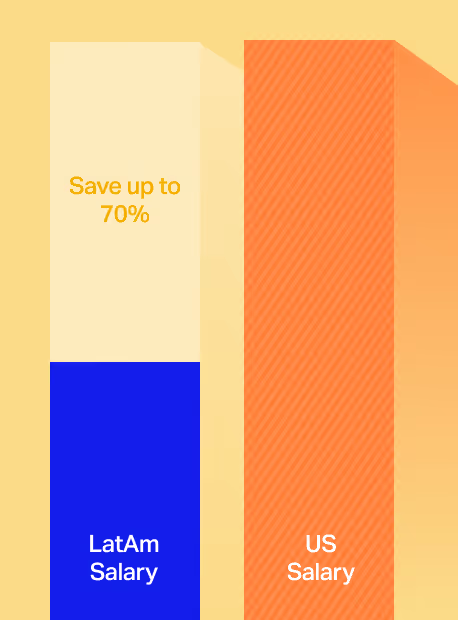
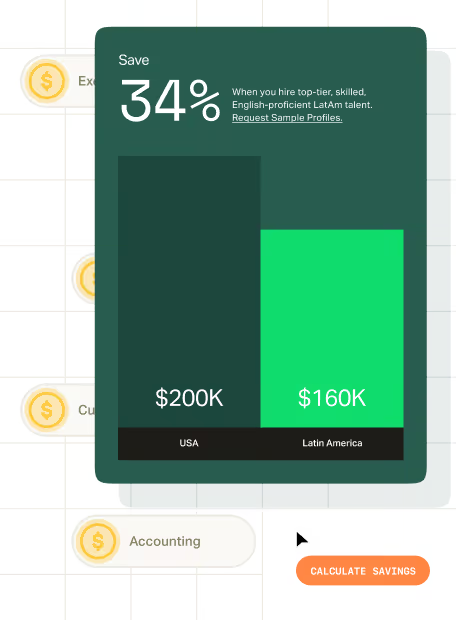
Hiring developers in Bolivia typically costs up to 68% less than in the US for junior roles, narrowing to around 53% at the senior level. These are the same regional benchmarks that apply across Latin America, not a Bolivia-specific discount.
The gap reflects the cost of living in Bolivia, not a discount on the caliber of engineer you’re getting. To put that into perspective, here’s how everyday costs in Santa Cruz de la Sierra and La Paz, the country’s two largest cities, compare with San Antonio, Texas:
Source: Numbeo.com
For the broader case for hiring across the region, our piece on why thousands of leading US companies are hiring LatAm talent is a good next read.
How Deep Is Bolivia’s Developer Talent Pool?
Bolivia’s developer pool is small and concentrated, and there’s no credible public figure for its size. Here’s our own Latin American placement data instead.
Across the 2,000+ placements in Hire With Near’s 2026 State of LatAm Hiring Report, 98% of engineering hires in Latin America were mid-level or senior and 51% of them were senior. Demand for software engineers grew 250% year over year.
The expensive, hard-to-close hire in the US right now is the experienced one. SignalFire’s State of Talent Report found new-grad hiring at Big Tech down 25% from 2023 and down 11% at startups, while mid- and senior hiring recovered.
The engineer you’re competing hardest for at home is the profile a Bolivian search is aimed at, so run a targeted search rather than a volume one.
{{state-latam-hiring}}
What Technical Skills Do Bolivian Developers Have?
Bolivian developers are strongest on the backend. The stacks that come up most often are:
- Java, usually with Spring, in enterprise and financial systems
- Node.js, in service layers and API work
- Go (Golang), in newer service and infrastructure work
- Microservices architecture, containerized deployment, and CI/CD pipelines
- Data modeling across both relational and NoSQL databases
Frontend is a smaller pool, but real, clustered around React, Angular, TypeScript, and Next.js and driven largely by the local fintech industry.
If you’re hiring a back-end developer or a platform engineer, Bolivia is a good match.
What to screen for when hiring developers in Bolivia
From the editorial work I do interviewing Hire With Near’s engineering recruiters, one correction comes up constantly: teams over-weight the exact framework version and under-weight whether the engineer understands the principles underneath it. Someone who has shipped services in Java picks up Go faster than a keyword-perfect resume match.
Our recruiting team’s default screen is one question: describe a recent project where you designed and implemented a full-stack solution, what went wrong, and how you worked around it. The clearest red flags are candidates who can’t describe their own role on a past project, or won’t discuss a mistake.
Then, one small real-world task reviewed together on a call, not a multi-round gauntlet: debug something, refactor for scale, or build a basic API with tests. These are the same screens we run across our IT and tech recruiting in Latin America.
Federico Bilello, Software Engineering Recruiter at Hire With Near, names the trait that predicts a good remote engineering hire:
The main thing I look for is ownership. I always look for developers who have worked in startups or smaller companies, because those are the people who probably have ownership. If you bring them a problem, they won’t ask how to solve it, they’ll try their own ideas, they’ll be creative.
— Federico Bilello, Software Engineering Recruiter, Hire With Near
What Does It Cost to Hire Developers in Bolivia?
Hiring a software engineer in Latin America costs roughly 52–68% less than the equivalent US hire, according to our salary data. Those are the regional benchmarks verified across the region, including Bolivia.
Here’s what hiring developers costs against equivalent US hires, according to Hire With Near’s salary benchmarks:
For the most up-to-date figures, see Hire With Near’s US vs Latin America Salary Guide.
Read the table by seniority, not percentage. A senior back-end software engineer in Latin America usually lands under what a mid-level hire costs you in the US. That’s why most teams we work with hire a level up from their original plan.
A mid-level back-end developer sits inside the wider band for IT and engineering salaries in Latin America. The same pattern runs across functions in how much US companies save by hiring in Latin America. Underpaying wastes the advantage: engineers who take a below-market offer leave for the next one.
{{salary-guide-cta}}
Where Is Bolivia’s Tech Talent Concentrated?
Bolivia’s developer talent is concentrated in three cities: Cochabamba, Santa Cruz de la Sierra, and La Paz. Each has a distinct role in the country’s software industry.

La Paz
As the seat of government, La Paz’s tech sector leans toward public-sector infrastructure, telecommunications, and large enterprise IT, which means developers there often have experience with legacy systems and government data infrastructure that other cities’ talent pools don’t build as often.
Universidad Mayor de San Andrés (UMSA) runs the oldest computer science program in the country, with particular strength in algorithms and network engineering.
Santa Cruz de la Sierra
Santa Cruz de la Sierra is Bolivia’s commercial and financial center, and its tech sector reflects that: most local software work here serves business, fintech, and logistics clients rather than government systems.
Universidad Autónoma Gabriel René Moreno (UAGRM) is the region’s primary engineering school, with tracks in computer science, systems engineering, and telecommunications that feed directly into the city’s private sector.

Cochabamba
Cochabamba produces roughly 80% of Bolivia’s software exports, according to industry analysts cited by Los Tiempos, one of Bolivia’s leading newspapers. Companies like Jalasoft and AssureSoft, both founded there, have spent decades building software for US and European clients.
The city’s engineering pipeline runs through Universidad Mayor de San Simón (UMSS), the leading public university for systems engineering in the region, and Jala University, a private institution founded by Jalasoft specifically to train engineers to international commercial standards, an unusually direct link between a local employer and its own talent pipeline.
How Can a US Company Hire Developers in Bolivia?
US companies have four ways to hire developers in Bolivia: freelance marketplaces, direct hiring, a nearshore staff augmentation company, or a staffing and recruiting firm.
Which one fits comes down to one question: do you need short-term help on a project, or a long-term, full-time developer on your team?
Option 1: Freelance and contractor platforms
Upwork, Toptal, and Arc connect you directly with freelance developers in Bolivia and across Latin America. You can typically start within days, pay by the hour or the project, and scale the engagement up or down without any long-term commitment, which makes this a strong fit for a scoped project, a proof of concept, or work with a clear end date.
The trade-off is structural: marketplace talent splits attention across clients by design, so quality control and retention fall entirely on you. On these platforms, an engineer juggling three other clients at once is the norm the model is built around.
For a full-time engineer you plan to keep long-term, specialist staffing gives fundamentally different results.
Option 2: Hire directly
Hiring directly means you source and vet candidates yourself and take on the employment relationship. For a developer hire in Bolivia, that comes down to one of two mechanisms:
- Set up a legal entity: Registering a Bolivian company gives you full control, but it takes real time and money to establish, and Bolivia’s labor framework is notably employee-protective: strict rules around termination, mandatory severance (one month’s salary per year of service), and a Christmas bonus (Aguinaldo) owed to every employee. This route only makes sense once you’re building a substantial in-country presence, not hiring one or two developers.
- Use an employer of record: An employer of record becomes the legal employer on paper, handling contracts, payroll, social security contributions, and compliance with Bolivia’s termination and severance rules without you needing your own entity. The catch: an EOR handles employment logistics, not recruiting. You still source and vet every candidate yourself, through job boards for hiring in Latin America or your own network.
Related reading: 10 Best Employer of Record (EOR) Companies
Option 3: Work with a nearshore staff augmentation company
A nearshore staff augmentation firm maintains a bench of pre-vetted engineers and places them directly onto your team, working under your day-to-day direction as if they were your own hires. The firm stays the legal employer behind the scenes, handling payroll, benefits, and compliance, while you manage the actual work: what they build, how they prioritize it, and who they report to.
That structure is what separates it from outsourcing a project to a development company: with staff augmentation vs. outsourcing, you keep control of the work itself, not just the deliverable. It’s a strong fit for scaling a team up for a defined project, covering a temporary gap, or adding capacity without committing to permanent headcount, since the engineer typically rolls off once the engagement ends.
The trade-off is the flip side of that flexibility: because the arrangement is built to be temporary, it’s a weaker fit if you want someone to stay long enough to build deep context in your codebase.
Option 4: Work with a staffing and recruiting firm
This is the simplest route for a long-term hire, because one relationship covers both jobs: finding the developer and employing them. A partner like Hire With Near, one of the specialist staffing firms for LatAm hiring, sources and vets candidates against your specific role, so you interview a shortlist of people who’ve already cleared a technical and communication screen rather than sorting through unscreened resumes yourself.
Once you make the hire, the partner handles payroll, benefits, and local compliance through its nearshore staffing and recruiting services, so you never need to set up an entity or manage an EOR relationship on your own.
The developer joins your team as a permanent employee, works for you full-time, and stays for as long as the role exists, not just for the length of a contract or a project engagement.
What US Companies Need to Know Before Hiring Developers in Bolivia
Three things about Bolivia change how you plan a hire there: English proficiency, statutory pay obligations, and how you read a resume without a degree.
English proficiency, stated honestly
Bolivia scores 521 on the 2025 EF English Proficiency Index, in EF’s Moderate band at roughly #49 globally and #6 in Latin America. That’s above the 488 global average, but down four points year over year, so it isn’t a recent improvement story.
English isn’t widely spoken across the general population, and EF’s test-takers skew toward the urban, educated professionals who are also the pool a technical search recruits from.
Neither number tells you whether a candidate can run an architecture review, so screen for three markers. Can they explain a technical decision to a non-developer unprompted, write documentation somebody else can follow, and hold their own in a design discussion?
In the video below, our Co-founder and COO Franco Pereyra explains how to test English skills when hiring in Latin America:
Statutory pay depends on the arrangement
What you owe on top of salary depends entirely on the hiring model. If someone is employed directly, whether through your own entity or an EOR, Bolivian labor law requires an aguinaldo (a Christmas bonus equal to one month’s salary) and, if the employment ends without just cause, severance obligations that add up quickly.
Other arrangements don’t carry those same obligations at all, since the person isn’t classified as an employee under Bolivian law in the first place. Confirm with any partner exactly how they engage the person and which obligations, if any, apply before you budget for the hire.
Pay in US dollars
Bolivia held its currency at roughly 6.9 to the dollar for fifteen years, then moved to a flexible exchange-rate regime in June 2026, and the boliviano has depreciated sharply since. Inflation ran about 19.5% in 2025 on World Bank figures.
That’s a real macro story, and mostly not your story. You pay in US dollars, which keeps compensation steady in the currency you’re both pricing against. The mechanics of hiring remote foreign employees are well established across Latin America.
Don’t gate on a degree
A graduate pipeline isn’t a hiring filter, though. Natasha Tarapow, Recruitment Consultant at Hire With Near, says it directly:
A lot of the great engineers in Latin America don’t have a college degree, and that doesn’t mean they’re bad candidates. The dynamic here is that many of the best engineers started working before they graduated. They got a really good job and didn’t have time to finish. We always recommend to clients that they don’t make a degree a must-have, because they might be losing out on some really good candidates.
— Natasha Tarapow, Recruitment Consultant, Hire With Near
Use the universities as evidence that the pipeline exists, but don’t make a diploma a required field. In a market this size, that filter removes most of your qualified candidates.
See also the questions tech leaders ask when hiring in Latin America and our guide to hiring remotely in Latin America.
How Hire With Near Helps US Companies Hire Developers in Bolivia
Hire With Near runs the search for you and usually has a shortlist in front of you within 3 to 5 days. We source from a pool of 160,000+ pre-vetted candidates and run fresh sourcing built around your stack, your seniority bar, and the role, so the shortlist is built for the job in front of you rather than pulled from a bench.
Our recruiters run first-round interviews built around a real project walkthrough and verify working English against how a candidate communicates under pressure. If you want a technical assessment layered on top of that, for your specific stack, we can help administer it.
We’ve helped a US healthtech startup keep its full eight-step interview process intact while cutting time to hire to 14 days, and helped ParkMobile build a nine-engineer team in Bogotá at a 73% cost reduction against US rates. Those placements were across Latin America, not Bolivia specifically.
Once you hire, we handle contracts, payroll, benefits, and local compliance. That’s part of the engagement, not an add-on. Most of the companies we hire software engineering talent in Latin America for are venture-backed product teams, and our SaaS recruiting in Latin America work is built around that profile.
For engineering leads and VP of Engineering searches, executive search covers the senior end. We’ve written more on CTOs building engineering teams in Latin America.
Final Thoughts
Bolivia isn’t the biggest developer market in Latin America. It’s a concentrated pool of back-end engineers in three cities, working almost your whole business day, at salaries well below what it costs to hire the same profile in the US.
For a team that needs two or three excellent engineers, not twenty, that’s a combination very few US companies are competing for.
To work out whether hiring remote developers in Bolivia fits your team, book a free consultation to talk through your requirements with our team. We’ll give you salary benchmarks for the roles you’re filling and explain how the search works.
If you’re also weighing other markets, our guides to hiring developers in Peru, Colombia, Uruguay, Costa Rica, Ecuador, the Dominican Republic, and Paraguay cover the same ground for each.
{{latam-hiring-cta-v2}}
Frequently Asked Questions
How much does it cost to hire a developer in Bolivia?
Hiring a developer in Latin America costs $30,000 to $108,000 a year depending on role and seniority, per Hire With Near’s US vs Latin America Salary Guide.
The US equivalent runs $66,000 to $238,000, and Bolivian expectations likely sit toward the lower end of that band, since no credible Bolivia-only benchmark has been published.
Beyond base salary, budget for equipment, statutory benefits including the December aguinaldo, and any partner or platform fee.
Is Bolivia in a compatible time zone with the US?
Yes. Bolivia sits at UTC-4 all year with no daylight saving time change, so a developer there works through your business day whether your team is on Pacific, Mountain, Central, or Eastern time. Clocks there match Eastern through the US daylight saving months and run an hour ahead in winter.
Do Bolivian developers speak English well enough for daily standups?
Yes, within the professional pool a technical search recruits from, though verify it per candidate. Bolivia scores 521 on the 2025 EF English Proficiency Index, above the 488 global average, while English isn’t widespread across the general population.
For stand-ups, the test is whether a candidate can explain a technical decision unprompted.
What tech stacks are Bolivian developers strongest in?
Is a 13th-month salary required in Bolivia?
Yes. Bolivian employers pay a full 13th-month salary in December. A second payment is conditional. Under Decreto Supremo Nº 1802, it’s owed only in years when GDP growth tops 4.5% over the twelve months to September, and it requires three continuous months of service. It has rarely been triggered since 2013.
How long does it take to hire a developer in Bolivia through Hire With Near?
You’ll see a shortlist in 3 to 5 days, and most of our clients make a hire in under three weeks from kickoff. The variable is usually your own process: four or more interview rounds means planning for longer, and a first hire in a smaller market needs extra sourcing time.


.webp)


.webp)

.webp)


%203.svg)
.avif)





%20(1).avif)

%20(1).png)