


%203.svg)
Key Takeaways
- Developers in Ecuador share a full working day with US teams and are paid in US dollars, and at mid-level their salaries run 45–64% below an equivalent US hire.
- US companies have four ways to hire in Ecuador: freelance marketplaces, hiring directly through a legal entity or an employer of record, a nearshore staff augmentation company, or a staffing and recruiting firm.
- Ecuador’s national English score sits in EF’s Low band, while Quito and the country’s IT professionals score a full band higher, so assess English candidate by candidate, not by country score.
Hiring developers in Ecuador brings an exclusive advantage compared to other Latin American countries: it’s one of only two economies in the region that runs on the US dollar. That means paying a developer there involves zero currency conversion and zero exchange-rate risk on top of the salary.
The country’s technical talent is concentrated in three cities: Quito, the capital and largest tech hub; Guayaquil, the commercial and business-process outsourcing center; and Cuenca, a smaller but growing engineering base. All three cities also sit close to the US Eastern Time Zone.
These are only two of the advantages the country offers US companies. In this guide, I’ll explain the full picture, including what hiring a developer in Ecuador costs, what skills and English level to expect, and the four ways to hire software engineers in Ecuador.
Why Should I Hire Developers in Ecuador?
An engineer in Ecuador is working while your team is working, and their salary is denominated in your currency. Beyond those two facts, Ecuador’s smaller, less-courted talent pool is worth a look too. Here’s what each of those means in practice.
You get a full overlapping workday, not a handoff
Ecuador’s mainland sits in the US Eastern time band and doesn’t observe daylight saving time, so the gap between your desk and theirs is minimal, shifting by at most an hour twice a year, depending on where your team sits in the US, as you can see in the table below:
Whether you’re on Pacific, Mountain, Central, or Eastern time, you get real overlap: live stand-ups, same-hour answers, and handoffs while everyone is online.
That’s what companies coming off a long-distance arrangement care about first. The CTO of an early-stage legal-tech and fintech startup described what he left behind:
Half my team at my last company was offshore. They were Ukrainian. The talent level was good. But the time zone thing was kind of a frustration because they would end their days at 12, midnight my time.
Research from Harvard Business School and INFORMS backs up why that frustration is so common: as time-zone distance between teammates grows, more of the work gets pushed outside normal working hours for one side of the team.
The researchers’ recommendation is to organize distributed teams north-to-south rather than east-to-west, which is exactly the US-to-Ecuador axis, and part of why AI and time zones are pushing US companies toward developers in Latin America.
Their salary doesn’t move when the exchange rate does
Ecuador dollarized in 2000, and in March 2025 the president signed a decree reaffirming the US dollar as its sole official currency. That makes Ecuador one of a small number of dollarized economies in the region, alongside El Salvador.
A salary you agree on in dollars stays that number: no exchange-rate exposure on payroll, no hedging, and no mid-year conversation because a currency moved.
You’re not competing with every other US company for the same shortlist
Nearshore hiring in Latin America concentrates heavily in the region’s largest markets, so an engineer in Quito isn’t fielding the same volume of inbound offers a peer in Bogotá or Mexico City is.
That doesn’t mean Ecuador has a bigger talent pool than Colombia or Mexico. It has a smaller one. But it’s a pool most US companies haven’t thought to look at yet, which can mean less competition for the senior people you actually want.
Our guides to hiring developers in Guatemala, hiring developers in Honduras, and hiring developers in Jamaica cover three others in a similar band.
How Deep Is Ecuador’s Developer Talent Pool?
Ecuador is a smaller developer market than Colombia, Brazil, or Argentina. But smaller doesn’t mean shallow.
Thoughtworks, a global engineering consultancy whose reputation rests on rigorous software architecture rather than headcount, has run its Ecuador operation out of Quito since 2013. Today, Thoughtworks operates remotely across the entire country with over 200 local engineers, regularly placing among Great Place To Work Ecuador’s top workplaces. A market that sustains a decade-old Thoughtworks footprint produces software engineers trained to global, enterprise-grade standards.
Data from the Development Bank of Latin America and the Caribbean (CAF) reflects this specialized ecosystem: Ecuador is home to over 265 core software development firms generating $60 million in annual software exports. Rather than hosting massive offshore call centers or low-tier IT providers, Ecuador’s tech sector is heavily focused on specialized, export-ready software development.
This software ecosystem is sustained by a strong network of local universities producing specialized engineering talent. Rather than generalist IT programs, Ecuador’s top academic institutions emphasize rigorous computer science, systems engineering, and software architecture:
- Escuela Superior Politécnica del Litoral (ESPOL): Consistently ranked as Ecuador’s premier public polytechnic university for engineering and computer science. ESPOL is renowned for its intense technical curriculum, producing high-caliber software engineers heavily focused on algorithms, systems design, and export-ready development.
- Escuela Politécnica Nacional (EPN): The historic public engineering anchor in the capital. EPN’s Facultad de Ingeniería de Sistemas is one of the most rigorous in the region, training developers with deep fundamentals in backend architecture, data engineering, and complex computational theory.
- Universidad San Francisco de Quito (USFQ): Ecuador’s top-ranked private university, famous for its liberal arts foundation combined with cutting-edge computer science labs. USFQ software engineering graduates are especially sought after by international product teams for their strong English fluency, product mindset, and adaptability to agile enterprise environments.
If you’re weighing Ecuador against its neighbors, we have detailed guides for each market it gets compared with:
- Hiring developers in Colombia
- Hiring developers in Brazil
- Hiring developers in Argentina
- Hiring developers in Mexico
- Hiring software developers in Chile
- Hiring developers in Costa Rica
- Hiring developers in the Dominican Republic
- Hiring developers in Panama
Plenty of SaaS companies building engineering teams in Latin America run one search across several countries and let the candidates decide the geography.
{{state-latam-hiring}}
What Technical Skills Do Developers in Ecuador Have?
Ecuadorian developers stand out for strong full-stack versatility, clean functional programming practices, and deep enterprise backend capabilities. Because major tech hubs like Quito and Guayaquil balance enterprise systems with nearshore export product development, the local talent pool centers on several primary stacks:
- JavaScript / TypeScript (React & Node.js): The most widespread stack in Ecuador. TypeScript adoption is especially high across full-stack developers building scalable web applications and microservices for international clients.
- Python (Django, Fast API): Widely used in API development, enterprise integrations, and data engineering. Supported by Ecuador’s strong academic focus on data science and backend systems at universities like ESPOL and EPN.
- Java & .NET: Deeply rooted in Ecuador’s local banking, telecom, and corporate sectors. Engineers with this background transition exceptionally well into enterprise-grade microservices and cloud-native backend environments.
- Functional & niche frameworks (Ruby, Haskell, Elixir): Uniquely reinforced by high-profile engineering consultancies in Quito (like Stack Builders and Thoughtworks), creating an above-average density of engineers with strong functional programming fundamentals and disciplined testing habits.
- Mobile development (Flutter & React Native): Driven by local fintech, delivery apps, and logistics startups expanding across the Andean region.
If you’re hiring a TypeScript engineer, a Python API specialist, or a versatile back-end developer, Ecuador is a fantastic match.
From the editorial work I do interviewing our engineering recruiters, the thing they push back on hardest is a spec written around a framework version. Experienced developers adapt quickly once they understand core principles, so over-specifying the toolchain filters out strong candidates for no gain.
What they screen for underneath the stack is ownership. Federico Bilello, Recruiter for Software Engineering at Hire With Near, describes the signal this way:
The main thing I look for is ownership. I always look for developers who have worked in startups or smaller companies... If you bring them a problem, they won’t ask how to solve it; they’ll try their own ideas, they’ll be creative.
— Federico Bilello, Software Engineering Recruiter, Hire With Near
The other markers hold across seniority: clean, testable code, awareness of the business reason behind a ticket, and the ability to explain a technical decision to a non-technical colleague unprompted. The loudest red flag is claimed proficiency across an implausibly wide tool stack, which is usually resume inflation. A software engineer in Latin America with three tools they know deeply beats one who lists twelve.
What Does It Cost to Hire Developers in Ecuador?
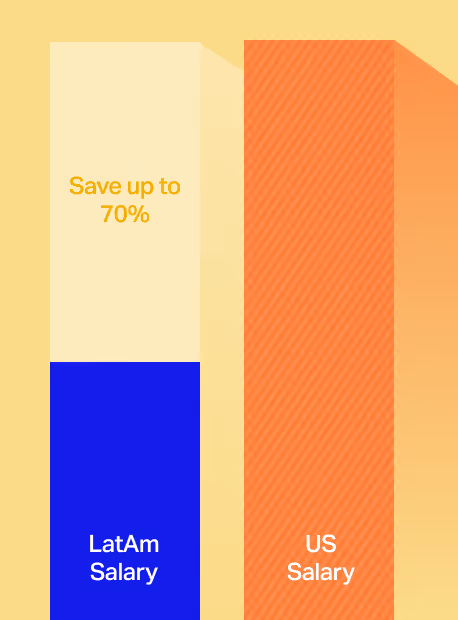
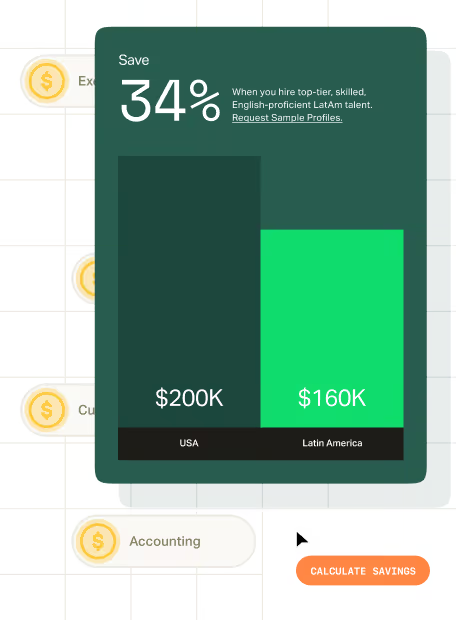
Hiring a developer in Ecuador costs roughly $30,000 to $108,000 per year, depending on role and seniority. At the mid-level, for example, that runs 45–64% below the equivalent US hire, according to our salary data.
Here’s what hiring each of the most requested developer roles costs against a US equivalent, according to Hire With Near’s salary benchmarks:
For the most up-to-date figures, see Hire With Near’s US vs Latin America Salary Guide.
These are our Latin America benchmarks. Savings run highest at the junior level, up to 71%, and settle into the 45–64% range at mid-level, which is the band to plan your budget against.
What these numbers change is how many people, or how senior a person, your budget actually buys. The same money that gets you one mid-level developer in the US can often get you two developers in Ecuador, or one senior developer instead of one mid-level.
One founder at an early-stage restaurant-tech startup gave us the practical version:
Today the engineers themselves are doing QA. If we had hired in Latin America, we could probably get a much more senior QA person relative to what we could do in the United States.
That’s why a dedicated QA engineer in Latin America or a DevOps engineer in Latin America is often the first specialist a growing team adds once a generalist full-stack developer in Latin America is already in place.
None of this is a quality trade-off. Talent in Ecuador isn’t cheaper because it’s less skilled. It’s cheaper because the cost of living in Ecuador is lower than in the US, the same reason salaries vary between US cities. A developer’s pay reflects what it costs to live where they live, not how good they are at the job.
To put those savings in a frame you can actually picture, here’s how monthly living costs in Quito and Guayaquil stack up against Austin, Texas, a comparably sized US tech hub:
Source: Numbeo.com
According to Hire With Near’s 2026 State of LatAm Hiring Report, 98% of the engineering placements we made in Latin America last year were mid-level or senior. Companies in the same report save $35,000 to $64,000 a year per hire against US salaries. We’ve published how much US companies save by hiring in Latin America across departments.
Where Is the Developer Talent in Ecuador?
Ecuador’s developer talent is concentrated across three primary urban hubs: Quito, Guayaquil, and Cuenca. Each city plays a distinct, complementary role in shaping the nation’s software and technology ecosystem

Quito
As the capital and political center, Quito is Ecuador’s primary hub for high-complexity software engineering, enterprise IT, and public-sector digital infrastructure.
Thanks to the long-standing presence of global engineering consultancies like Thoughtworks and local technology firms, developers in Quito often have extensive experience working with international codebases, microservices architecture, and enterprise-grade software standards.
The city’s academic supply is anchored by Escuela Politécnica Nacional (EPN) and Universidad San Francisco de Quito (USFQ).

Guayaquil
Guayaquil is Ecuador’s largest city and commercial financial engine. The local tech sector reflects this commercial focus, leaning heavily into fintech, e-commerce platforms, logistics software, and supply-chain tech built around the region’s massive import-export sector.
Engineers here are known for strong product execution, high-volume transactional systems, and web application development.
The regional talent pipeline is led by Escuela Superior Politécnica del Litoral (ESPOL), one of the premier technical universities in Latin America.

Cuenca
Cuenca serves as Ecuador’s rapidly emerging third major tech hub, known for a high concentration of software studios, boutique agencies, and growing remote developer communities.
Lacking the large corporate overhead of Quito or Guayaquil, Cuenca’s talent pool leans toward full-stack web engineering, mobile development, and modern cloud API integration.
The regional talent supply is fed by Universidad de Cuenca, producing engineers who frequently integrate into remote global engineering teams.
How Can a US Company Hire Developers in Ecuador?
US companies have four main ways to hire developers in Ecuador: freelance marketplaces, hiring directly, a nearshore staff augmentation company, or a staffing and recruiting firm.
The choice comes down to one question worth answering before you talk to anyone: do you need short-term help on a project, or a long-term, full-time developer on your team?
Route 1: Freelance platforms and marketplaces
Upwork, Toptal, and Lemon.io get you a freelancer quickly, which is the right answer for a defined, short piece of work. The trade-off is that a marketplace contractor splits attention across several clients, and you carry quality and retention alone.
For a full-time engineer who needs to learn your codebase and stay, there are alternatives to freelance platforms in Latin America that produce a different result.
Route 2: Hiring directly
Hiring directly means you source and vet candidates yourself and take on the employment relationship. For a developer hire in Ecuador, that comes down to one of two mechanisms:
- Set up a legal entity: Registering an Ecuadorian company gives you full control, but it takes real time and money to establish, and Ecuador’s labor code is notably employee-protective. Beyond the standard payroll taxes, employers owe two mandatory annual bonuses. Unjustified termination adds severance on top of those bonuses, calculated on length of service. This route only makes sense once you’re building a substantial in-country presence, not hiring one or two developers.
- Use an employer of record: An employer of record becomes the legal employer on paper, handling contracts, payroll, IESS social security contributions, and compliance with Ecuador’s bonus and severance rules without you needing your own entity. The catch: an EOR handles employment logistics, not recruiting. You still source and vet every candidate yourself, through job boards for hiring in Latin America or your own network.
Related reading: 10 Best Employer of Record (EOR) Companies
Route 3: Nearshore staff augmentation company
If you want to hire nearshore developers in Ecuador on a project basis, nearshore staff augmentation places a vetted engineer onto your team while the firm handles payroll, benefits, and compliance in the background. It’s built for project work: extra capacity for a sprint, a launch, or a fixed-length build.
IT staff augmentation firms are typically structured around exactly that, with developers rotating between clients every few months. That’s a strength when short-term is what you need, and a mismatch when you want someone to stay and own the work, which is the real substance of choosing between staff augmentation and outsourcing.
Route 4: Staffing and recruiting firm
For a long-term, full-time developer who becomes a permanent member of your team, a specialist firm does both jobs in one relationship. It sources and vets the person, and it handles payroll, benefits, and local compliance once you hire.
That combination is what the other three routes make you assemble yourself. Among the LatAm staffing firms working this way, look for recruiters based in the region and a nearshore staffing and recruiting service that covers employment as standard rather than as an add-on.
That’s the path Hire With Near follows. We help you hire Latin American developers, including those based in Ecuador, in under three weeks. We’ll talk more about our process in a later section. If you’re comparing us with other companies that place developers in Latin America, tenure is the number to ask all of them for.
What Should US Companies Know Before Hiring Developers in Ecuador?
Four things are worth knowing before you open a search in Ecuador: the real English picture, how the time zone behaves through the year, how IP is protected, and the statutory cost that changes your budget line.
English proficiency, honestly
Ecuador scores 466 and ranks 83rd globally on the EF English Proficiency Index 2025, putting it in EF’s Low band, below the global average of 488.
That’s not the number that describes your candidate, and EF’s own data on the same page shows why. Quito scores 517, a full band higher and 51 points above the national figure, while Guayaquil scores 477. By job function, IT scores 544.
Screen every candidate anyway. Hire With Near assesses English on every placement, and the bar for an engineer is whether they can explain a technical decision to someone who isn’t a developer.
Working hours through the year
Ecuador stays on the same clock all year while most of the US changes twice, so the exact gap moves by an hour in spring and again in fall depending on where you are. Plan core collaboration hours rather than a fixed offset.
Overlap runs both ways. Set the hours you need synchronous, and give your Ecuador-based engineer the same latitude on the rest of the day that you’d give a US hire.
This is among the most common questions tech leaders ask about hiring developers in Latin America, usually phrased as whether the person will make daily stand-ups. In our placements, they do.
IP and confidentiality
Every placement signs an NDA and IP-assignment terms, and we place engineers for companies in regulated categories including healthcare and cybersecurity, where that paperwork gets read closely.
Cross-border enforcement is a genuine consideration, and no agreement reduces the risk to zero. What the agreements do is put the obligations in writing and a partner on the hook for keeping them.
We’ve answered the broader questions about hiring remote talent offshore in one place.
The two annual bonuses
Ecuador’s labor code requires two payments on top of salary. The décimo tercero, or thirteenth salary, is one month’s pay, due by 24 December in the private sector.
The décimo cuarto, or fourteenth salary, isn’t another month of your developer’s pay. It equals one national unified basic salary, whatever that figure is on the payment date. Its deadline depends on the region: 15 August in the Sierra and Amazon, so a Quito hire, and 15 March on the Coast, so a Guayaquil hire.
So budget 13 months of salary plus roughly one national minimum salary, not 14 months.
Budget for both whenever you bring someone onto payroll in Ecuador, whether through your own entity or an EOR.
How Does Hire With Near Help US Companies Hire Developers in Ecuador?
As a staffing and recruiting partner specializing in hiring in Latin America, Hire With Near runs the search end to end. The first shortlist of candidates reaches you in 3 to 5 days, and most of our clients make a hire in under three weeks. Those are our standard figures across Latin America, not an Ecuador-specific claim.
Here’s what happens before a resume reaches you. We turn your role brief into a search profile with the recruiter who will run it, then source against that profile across the region, drawing on our pool of 160,000+ candidates plus fresh sourcing built for what you actually need.
From there, recruiters run first-round interviews: screening for years of professional experience with the specific tools you named, tool by tool, rather than total years on a resume, plus a check on English and communication.
If you want a technical assessment or a case study task as part of the process, we can help administer that on your behalf. It’s your call, not a default step we add to every search.
In dozens of conversations with our recruiting team this year, the step they say separates a real technical screen from a resume read is the project conversation. Natasha Tarapow, Recruitment Consultant at Hire With Near, puts it this way:
We always ask candidates to tell us about a project they’ve worked on, what their role was, and what they actually did. It’s important that they can explain their work to someone who isn’t a developer. If they can do that, that tells me a lot.
— Natasha Tarapow, Recruitment Consultant, Hire With Near
That process holds up under a demanding bar. A fast-growing US healthtech startup reached out to us running an eight-step engineering interview and refused to shorten it, with only two internal recruiters to run it.
We took over sourcing, screening, and candidate coordination across every role, and kept a shared tracker so their team only had to make decisions. They hired 7 engineers across backend, DevOps, QA, mobile, frontend, plus staff-level roles. Average time-to-hire was 14 days. The savings came to $323,000 a year against US salaries, with all eight steps intact.
That’s also the answer to whether one hire can become a team. Every placement carries a 180-day replacement guarantee, double the industry standard, and when the roles move up the organization chart, we handle those through executive search in Latin America.
Final Thoughts
Whichever route you choose, Ecuador's two core advantages hold: your engineer works your hours, and their salary is set in the currency you already budget in.
The route matters for everything else. A marketplace fits a defined project. An employer of record fits the case where you’ve already found your person. A staffing and recruiting partner fits when you want a full-time engineer sourced, vetted, and employed without assembling three vendors to do it.
If you want to explore hiring a developer in Ecuador, the best next step is to book a free consultation to talk through your requirements with our team. You’ll get salary benchmarks and a walkthrough of the process.
{{latam-hiring-cta-v2}}
Frequently Asked Questions
What is the average salary for a software developer in Ecuador?
A software engineer placed through Hire With Near in Latin America earns $36,000 to $108,000 a year depending on seniority, compared to $100,000 to $238,000 for a comparable US hire. Ecuador uses the US dollar, so no conversion applies.
Our benchmarks are regional, so the Quito or Guayaquil range matches what we apply elsewhere for the same role and seniority.
How much does it cost to hire a developer in Ecuador?
Budget the developer’s annual salary, whatever your hiring route charges, and, if you’re bringing the person on as an employee rather than a contractor, Ecuador’s two statutory annual bonuses on top.
On salary alone, mid-level developer roles run 45–64% below their US equivalents according to our salary data.
When the bonuses apply, that’s 13 months of salary plus roughly one national basic salary, not 14 months.
What time zone is Ecuador in, and does it overlap with US working hours?
Ecuador’s mainland operates on UTC-5 year-round, aligning directly with US Eastern time in the winter and US Central time in the summer. That means a developer there is online through your business day whether your team runs on Pacific, Mountain, Central, or Eastern time, giving you a full day of real-time collaboration with no major time zone gap.
Do developers in Ecuador speak English well enough for daily stand-ups?
Ecuador’s IT professionals score well above the national average on English and are typically comfortable in stand-ups and architecture reviews.
Nationally, Ecuador scores 466, in EF’s Low band, but EF’s own segment data puts Quito at 517, a full band higher, and the IT job function at 544, one of the country’s strongest.
Test it regardless: we assess English on every placement, and the bar is whether the person explains a technical decision clearly to a non-developer.
Is it easy to find skilled developers in Ecuador?
Finding skilled developers in Ecuador is simple if you search Quito and Guayaquil, where the talent concentrates. ESPOL in Guayaquil ranks first nationally for Computer Science and Information Systems in the QS World University Rankings by Subject, and EPN is Quito’s engineering polytechnic. Thoughtworks has run an engineering operation out of Quito since 2013. It’s a smaller market than Colombia or Brazil, so a broader regional search often fills faster.
Is it better to hire freelance or full-time developers in Ecuador?
Hire full-time when someone needs to own a codebase, and freelance when you need a defined piece of work finished. A full-time hire is dedicated to your roadmap, which is the structural difference from a marketplace contractor splitting attention across clients. Divided attention shows up as commits at odd hours and timelines that stretch without explanation.
How long does it take to hire a developer in Ecuador through Hire With Near?
You get a shortlist of candidates in 3 to 5 days, and most of our clients make a hire in under three weeks, against a US engineering search measured in months. Notice periods are the part people forget to calculate.
In Latin America, they tend to be shorter than the 30 to 90 days US candidates give, so a signed offer usually converts to a first commit in weeks.
What other engineering roles can I hire from Latin America?
Beyond general developers, US companies regularly hire nearshore back-end engineers, remote front-end developers, Node.js developers in Latin America, and mobile developers from the region.
Those four cover most of what a growing team splits off from a generalist: API and service work, interface work, JavaScript services underneath, and native or cross-platform app work. All come with the same working-day overlap and cost comparison against a US hire.



.webp)
.webp)


.webp)


%203.svg)
.avif)





%20(1).avif)

%20(1).png)