


%203.svg)
Key Takeaways
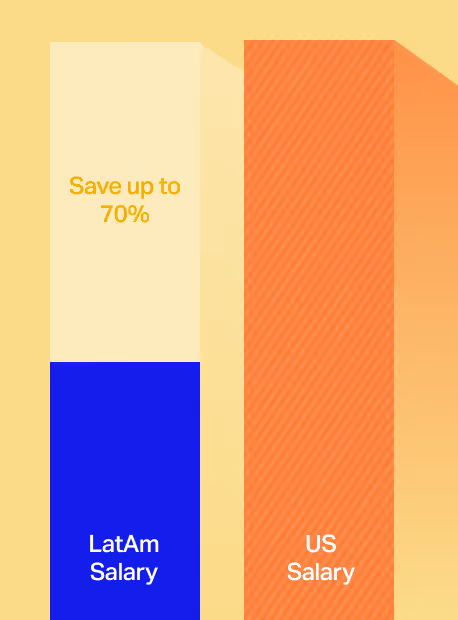
- Hiring developers in Jamaica gives US companies English-speaking engineers on a US East Coast schedule year-round, at salaries 30–70% below comparable US rates.
- Jamaica's developer pool is real and strongest at the mid-level, in software development, IT support, and cybersecurity, but smaller than Brazil, Colombia, or Argentina.
- US companies have four ways to hire a Jamaican developer: freelance platforms, direct hiring, nearshore staff augmentation, or a staffing and recruiting partner.
Hire developers in Jamaica and you skip a problem most nearshore markets don't solve: the language gap. English is the language of education, government, and business across the island, so Jamaican engineers communicate in fluent, native-level English as a starting point, not an exception you have to search for.
That fluency comes paired with working-hours alignment. Jamaica keeps one schedule year-round without daylight saving shifts, matching US Eastern time during the winter and sitting just one hour behind during the summer as US clocks move forward. Either way, a Jamaican developer is at their desk for the bulk of your workday, at 30–70% below domestic rates.
In this guide, I break down what you need to evaluate before bringing a developer onto your team from Jamaica: real developer salary benchmarks, where the island's technical talent concentrates, the four primary hiring models, and the local compliance essentials to keep in mind.
Why Should I Hire Developers in Jamaica?
Jamaica offers three things that rarely arrive together: English as the everyday working language, a US East Coast working day, and developer salaries well below US rates.
The tradeoff is pool size, covered next. Otherwise, it's the standard case for hiring remotely in Latin America.
Jamaican developers work in English
English is Jamaica's official language and the language of instruction in its schools and universities, so Jamaican professionals are educated and work in English every day.
That removes a trade-off US buyers manage everywhere else. In our conversations with hiring managers across the industry, this comes up constantly: when sourcing on their own, teams find someone strong on either the technical side or the English side, rarely both. A managing director at a US managed IT services company described the pattern:
We do have specific requirements in terms of the experience for these positions. And when we do find someone with the technical skills, they don't have the English level to communicate with the U.S.-based clients. They either focus on the technical skills or the language. Most of the times the technical skills, and they have challenges with communication. So I believe they're too focused on the technical part. And we haven't found the balance.
In Jamaica, that problem largely disappears. The incident write-up, the architecture review, and the client call all happen in English, as they do when you hire developers in Belize.
That's a country-level pattern, not a guarantee for any one candidate, so we still screen English on every hire the same way we would anywhere else.
Jamaican developers work in your time zone
Jamaica aligns with US Eastern time for half the year and US Central time for the other half, keeping a steady schedule with no daylight saving shifts. That stability means developers stay online during your core business day across every US time zone.
Eastern and Central teams get a fully shared workday, while West Coast teams secure five to six hours of daily overlap for immediate collaboration, as you can see in the table below:
Research from Harvard Business School and INFORMS, based on 12,038 employees, found that the larger the time zone gap between two colleagues, the more of their work gets pushed outside normal business hours for one side of the pair, and recommends distributing teams north to south rather than east to west.
That's the axis a US-to-Jamaica team sits on. Enterprise buyers increasingly require it. A US IT consulting and staffing firm placing engineers at Fortune 50 clients told us:
My client specifically said nearshore, not offshore. They want someone in the Americas, same time zone, and that's non-negotiable.
Jamaican developer salaries run well below US rates
Developer salaries across Latin America run 30–70% below US equivalents, according to our salary data, and that range includes Jamaica. A senior software engineer, for example, typically runs $72K to $108K a year in the region, against $140K to $238K for the same seniority in the US.
That gap changes what a given budget buys. Instead of stretching to afford a junior US hire, the same money often gets you a mid-level or senior engineer in Jamaica, someone who needs less ramp-up and can own more of the work from day one.
What you save doesn't have to just sit on the bottom line either: it can go toward tools, infrastructure, or the next hire, the difference between adding one person and actually building out an engineering team.
We cover the full salary breakdown by role and seniority later in this guide.

How Deep Is Jamaica's Developer Talent Pool?
Jamaica's technology ecosystem is anchored by a reliable university pipeline producing computer science, software engineering, and IT graduates, paired with a growing footprint of international employers operating out of Kingston.
While the country's largest outsourcing players focus primarily on customer experience and operations, pure engineering capacity is growing steadily.
Jamaica's developer market is high in quality, not focused on volume. The talent pool excels in full-stack software development, IT support infrastructure, database administration, and cybersecurity, though it’s smaller than high-volume Latin American engineering hubs like Brazil, Colombia, or Argentina.
According to Hire With Near’s 2026 State of LatAm Hiring Report, drawn from more than 2,000 placements across the region, Jamaica stands out as a leading destination for customer support and operational hiring, where specific roles often fill within a week.
While engineering placements skew heavily toward larger South American markets, developer hiring in Jamaica remains a strategic target of opportunity.
For small engineering pods, typically one to five developers, Jamaica fits exceptionally well; for large-scale engineering builds, it operates best alongside wider Latin American developer sourcing strategies.
Kingston as Jamaica's central engine
Unlike larger Latin American nations with multiple competing tech centers, Jamaica's technology market is concentrated almost entirely in its capital, Kingston.
Kingston concentrates the national infrastructure required for tech delivery:
- Corporate tech footprint: Kingston houses major regional IT integrators, digital agencies, and nearshore software operations. Companies like RealDecoy, a Canadian-headquartered digital commerce provider, maintain active software development centers in Kingston, drawing on local talent for North American clients.
- Tech parks and infrastructure: Modern business parks across the Kingston Metropolitan Area provide high-speed fiber redundancy, uninterrupted power systems, and specialized co-working facilities tailored to remote technology teams.
- Referral-based sourcing works well: Because corporate employers, technical incubators, and higher education facilities operate within the same geographic corridor, tech networks in Kingston are tightly connected, making referral-based sourcing and candidate vetting highly effective.
University developer pipelines: UTech and UWI Mona
Jamaica's developer supply is driven by two premier institutions in Kingston, each providing a distinct academic focus for software and technology candidates:
- University of Technology, Jamaica (UTech): UTech serves as the country’s primary polytechnic and main applied developer pipeline. Its School of Computing and Information Technology (SCIT) offers focused programs in Computer Science, Information Technology, Computer Engineering, and Cybersecurity. UTech’s curriculum emphasizes practical, project-based learning, making its graduates the most frequent target for US-facing software development, system administration, and IT support roles.
- The University of the West Indies at Mona (UWI Mona): UWI Mona is Jamaica’s flagship public research university and a premier academic institution across the Caribbean. Its Department of Computing offers specialized undergraduate and graduate degrees in Software Engineering, Computer Science, and Data Science. UWI Mona focuses heavily on computational theory, algorithmic complexity, and software architecture, producing senior-track engineers equipped for complex backend builds and analytical roles.
An introduction to UTech's computing curriculum is available in this School of Computing overview video. It provides context on the practical coursework and technical specializations that shape Jamaica's core developer pipeline.
For Jamaica's broader case, see Hire With Near's full guide to hiring in Jamaica.
What Technical Skills Do Jamaican Developers Have?
Jamaican developers bring a well-rounded mix of modern stack mastery, enterprise platform experience, and strong fundamental computer science practices. Driven by specialized coursework at leading institutions like UTech and UWI Mona alongside hands-on exposure to US-facing digital transformation initiatives, local engineers generally excel across four main core competencies:
1. Full-stack development
Full-stack JavaScript and TypeScript frameworks form the backbone of Jamaica's core software talent. Developers are typically proficient in building responsive frontend interfaces connected to scalable backend microservices.
- Frontend: React, Next.js, Vue.js, Angular, Tailwind CSS, HTML5/CSS3.
- Backend: Node.js (Express, NestJS), Python (Django, FastAPI), C# (.NET Core), and PHP (Laravel).
- Databases: PostgreSQL, MySQL, MongoDB, Redis, and Firebase.
2. Mobile application engineering
Given high regional mobile adoption and demand from nearshore client apps, mobile engineering is a key strength in Kingston’s talent market.
- Cross-platform: Flutter and React Native are widely used for rapid cross-platform builds across iOS and Android.
- Native development: Kotlin for Android and Swift for iOS development, particularly among engineers supporting legacy native applications.
3. Cloud architecture & DevOps infrastructure
Developers in Jamaica routinely work within modern cloud environments, maintaining deployment pipelines and managing cloud infrastructure for North American clients.
- Cloud platforms: Amazon Web Services (AWS) leads the local market, with a strong secondary presence in Microsoft Azure and Google Cloud Platform (GCP).
- DevOps tools: Docker, Kubernetes, CI/CD pipelines (GitHub Actions, GitLab CI, Jenkins), Terraform, and Serverless architectures.
4. Enterprise e-commerce & systems engineering
With major technology integrators operating in Kingston, such as RealDecoy, which specializes in enterprise commerce, there is a high concentration of engineers trained in complex B2B and B2C digital commerce systems.
- Commerce & CMS platforms: Shopify Plus, Salesforce Commerce Cloud, CommerceTools, Headless CMS architectures (Strapi, Contentful), and WordPress/WooCommerce.
- API development: RESTful APIs, GraphQL, gRPC, and third-party payment gateway integrations (Stripe, PayPal, regional gateways).
In dozens of conversations with Hire With Near's engineering recruiters this year, one point on stack matching comes up more than any other. The framework version matters less than buyers expect, because experienced developers move between frameworks once they know the principles underneath.
The real signal is whether a candidate can explain their own work. One of our Recruitment Consultants, Natasha Tarapow, describes the screen:
We always ask candidates to tell us about a project they've worked on, not just that they use this language and that one, but what their role was and what they actually did. It's important that they can explain their work to someone who isn't a developer. If they can do that, that tells me a lot.
— Natasha Tarapow, Recruitment Consultant, Hire With Near
The signals our recruiters trust: clean, testable code, curiosity about the business reason behind the work, and the ability to explain a technical decision to a non-technical audience. The clearest red flag is a candidate who can't describe their own role on past projects.
Long loops with three separate assessments also lose strong candidates, so you'll get further with one substantive technical conversation, which is how recruiters specializing in IT and engineering roles run it.
What Does It Cost to Hire Developers in Jamaica?
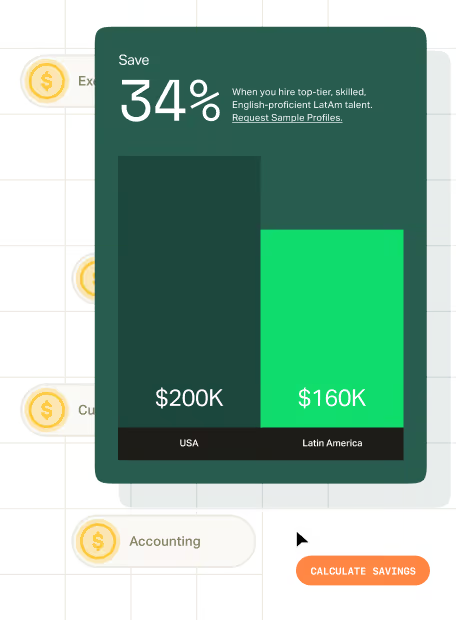
Hiring a developer in Jamaica typically costs 49 to 63% less than an equivalent US software engineer. No reliable Jamaica-only developer salary survey exists, so the honest basis for a budget is Hire With Near's Latin America and Caribbean benchmark data.
Here's what hiring a software engineer, full-stack developer, or specialist developer costs against equivalent US hires, according to Hire With Near's salary benchmarks:
For the most up-to-date figures, see Hire With Near's US vs Latin America Salary Guide.
For the role-by-role view, see the IT roles salary guide for US vs. Latin America.
Costa Rica and the Dominican Republic sit in similar territory, so you can also hire developers in Costa Rica, hire developers in the Dominican Republic, or hire developers in Venezuela.
Those salary levels track the cost of living, which is lower in Latin American and Caribbean countries, compared to US cities. You can see a comparison between Kingston and Tampa, Florida, in the table below:
Source: Numbeo.com, retrieved August 2026
One warning: most Jamaica developer pricing published online is hourly or monthly vendor pricing from offshore development shops, not comparable to an annual salary for a full-time team member. Our breakdown of offshore developer rates explains where the two models diverge.
How Can a US Company Hire Developers in Jamaica?
US companies have four ways to hire developers in Jamaica: freelance marketplaces, direct hiring, a nearshore staff augmentation company, or a staffing and recruiting firm. The best decision for your business hinges on one thing: is this work that ends, or a role that stays?
I'll cover all the routes from most to least complex.
Option 1: Freelance and contractor platforms
Platforms like Upwork and Toptal give you fast access to freelance developers in Jamaica, which suits short-term work. You carry quality control and retention, and the developer splits attention across clients.
For a permanent seat on your team, specialist staffing gives you fundamentally different results for full-time remote hires.
Option 2: Direct hiring
Hiring directly means you source and vet candidates yourself and take on the employment relationship. In Jamaica, that comes down to one of two mechanisms:
- Register a Jamaican subsidiary: This gives you full control and makes sense at real scale, but it takes several months, carries real upfront cost, and needs ongoing local legal support, the same calculus behind hiring remote foreign employees anywhere.
- Use an employer of record: An EOR handles contracts, payroll, tax withholding, benefits, and local compliance without you registering an entity. Jamaica makes that planning simpler than most of the region: with no mandatory 13th-month salary, 12 months of pay is the full annual cost. Worth knowing up front: an EOR handles employment logistics, not recruiting. You still source and screen every candidate yourself, through referrals or a job board for hiring in Latin America, which is why EOR companies work best once you've found the person you want.
Option 3: Nearshore staff augmentation
A nearshore staff augmentation firm places a pre-vetted engineer onto your team. You direct their day-to-day work exactly as you would an employee. They join your standups, use your tools, and follow your process, while the firm stays the legal employer and handles payroll, benefits, and compliance in the background. It fits a defined project or a team you expect to scale up and then back down, not a permanent seat.
A good staff augmentation partner vets for your actual stack, the frameworks and tools you use day to day, not just a job title that sounds close enough.
Our breakdown of how nearshore staff augmentation works covers what to check before you sign.
Option 4: Work with a staffing and recruiting firm
If you want a full-time developer on your own team, this is the simplest path: one relationship that both finds the person and employs them, instead of splitting the two across separate vendors.
Hire With Near works this way through our nearshore staffing and recruiting services: we source and vet the engineer, then handle payroll, benefits, compliance, and local employment requirements once you hire, so the developer joins your team as a permanent hire, not a rotating contractor.
Our roundups of specialist staffing firms for LatAm hiring and companies that help you hire developers in Latin America show how the field differs, if you want to compare options before choosing one.
{{prevetted-banner}}
What Do US Companies Need to Know Before Hiring in Jamaica?
Three things shape what a Jamaican hire costs and what you owe, and not all of them apply to you. Which ones do depends on how you structure the hire: they're mandatory if you employ the person directly, through your own entity or an employer of record, and they don't apply if you hire through a staffing partner that engages the developer as a contractor.
No mandatory 13th-month salary
For a direct employee, Jamaica doesn't require a 13th-month salary or year-end bonus. Any such payment is at the employer's discretion, which makes budgeting simpler than most of the region. It's the first line item that changes when you hire developers in Mexico instead, where it’s required by law.
Annual leave scales with tenure
For a direct employee, annual leave is set under the Holidays with Pay Act: two weeks (10 working days) for employees with fewer than 10 years of service, rising to three weeks (15 working days) after 10 years. It accrues at roughly one day per 22 days worked, and any unused leave must be paid out on termination.
Jamaica also has 10 public holidays a year, and pay for working one is generally settled by agreement between employer and employee rather than a fixed statutory rate.
Private health insurance isn't required, but candidates expect it
Private health insurance isn't a legal requirement for the arrangements most US companies use, but it's the benefit Jamaican candidates value most. Mid-level engineers typically expect full or co-paid coverage, and senior candidates often expect family coverage.
If you hire through a staffing partner, this is handled as part of the placement rather than something you administer yourself.
For common concerns among engineering leaders hiring in Jamaica and other countries in the region, see the questions tech leaders ask about hiring developers in Latin America.
How Does Hire With Near Help US Companies Hire Developers in Jamaica?
Hire With Near runs the search, the technical screening, and the employment logistics. Most clients see a shortlist within three to five business days of kickoff, and finish the hiring process in about three weeks.
Jamaica sits among our fastest-fill markets, though not for engineering roles specifically, so three weeks is the honest planning number.
Our vetting process is a filter, not a resume pass. Here's how it works:
- We source against your technical requirements rather than job titles.
- Every candidate goes through English screening.
- A project deep-dive interview covers what they built, what broke, and how they handled it.
If you want a hands-on evaluation on top of that, we can build in a small real-world task, usually debugging, refactoring for scale, or building a basic API with tests, reviewed live on a call at your request.
That live conversation is also the answer to AI-generated resumes: a fabricated CV doesn't survive twenty minutes of questions about a system the candidate claims to have built. If you're building a SaaS engineering team through nearshore SaaS recruiting, this is the step that matters most.
Across Latin America, the pattern for companies that start with one hire and keep going looks like ParkMobile. The mobility platform had used third-party agency developers for years, wanted its own senior engineers, and had never recruited in the market it chose to pilot.
Hire With Near ran sourcing, English screening, and candidate management inside ParkMobile's own applicant tracking system. Nine senior engineers later, across platform, backend, and iOS, that came to $1,066,085 in annual savings against US rates, a 73% reduction, at a 24-day average time-to-hire.
Their TA Lead put it this way:
The engineers we hired are performing exceptionally well. They show up, they take accountability, and they take a genuine interest in the team.
— Akshay Gokarnakar, TA Lead, ParkMobile
Leadership then expanded the program, began hiring team leads in the same market, and plans the same volume again. When a team adds a lead or director layer, executive search in Latin America covers the VP of Engineering and CTO hires. Companies building the whole function work with us to hire software engineers in Latin America.
Final Thoughts
In Jamaica, you can hire developers who work in English every day, keep direct real-time overlap with US business hours year-round, and earn 30–70% less than comparable US engineers.
The talent pool is real and strongest in the mid-level range rather than the deepest in the region, and that's the honest frame to hire against.
The best way to know if Jamaica is the right fit is to talk it through directly. Book a free consultation and we'll bring salary benchmarks for the role and walk you through how the search actually runs.
{{latam-hiring-cta-v2}}
Frequently Asked Questions
How much does it cost to hire a developer in Jamaica?
Hiring a developer in Jamaica typically costs $48,000 to $108,000 a year, 49–68% less than an equivalent US software engineer. Mid-level developers sit at the low end of that band and senior engineers at the top, per Hire With Near's salary benchmarks.
Is Jamaica in a compatible time zone with the US?
Yes, Jamaica keeps one consistent schedule year-round without daylight saving shifts, matching US Eastern time in the winter and sitting just one hour behind in the summer as US clocks move forward. That gives your engineers direct real-time overlap through your working day wherever you are based in the US.
Teams on Eastern, Central, and Mountain time get full or near-full shared hours, while West Coast teams get five to six hours of daily overlap for live stand-ups and code reviews.
Do Jamaican developers speak English fluently?
Yes, English is Jamaica's official language and the language of instruction in Jamaican schools and universities, so developers there are educated and work in English every day. That's a structural difference from Spanish-speaking markets, where proficiency varies by candidate. Documentation, architecture reviews, and client calls all happen in English.
Is 13th-month salary required in Jamaica?
No. Jamaica has no mandatory 13th-month salary or year-end bonus, unlike Mexico, Costa Rica, Honduras, and most of Latin America, and any bonus is at the employer's discretion. What does apply is tenure-scaled annual leave, 10 public holidays a year, and double pay when an employee works one by agreement.
How deep is Jamaica's software development talent pool?
Jamaica's developer talent pool is real and strongest at the mid-level. US companies that hire software developers in Jamaica find solid depth in software development, IT support, and cybersecurity, though the market is smaller than Brazil, Colombia, or Argentina for engineering scale.
Kingston is the single hub and the University of Technology, Jamaica the main pipeline. The country suits hiring one to five engineers.
How long does it take to hire a developer in Jamaica through Hire With Near?
Most clients see a shortlist within three to five business days of kickoff and reach an accepted offer in about three weeks. Jamaica appears among the fastest-fill markets in our placement data, where some roles close within a week, though that figure isn't developer-specific. It compares well against 60- to 90-day offshore notice periods.
What other engineering roles can I hire in Jamaica and Latin America?
US companies hire the full engineering stack across Latin America and the Caribbean. Nearshore back-end developers handle services and APIs, and remote front-end developers own the product interface. Cybersecurity analysts in Latin America come in as security work outgrows the team, and IT support specialists who work your hours cover internal systems. Each carries the same overlap and cost advantage.







.webp)


%203.svg)
.avif)





%20(1).avif)

%20(1).png)