


%203.svg)
Key Takeaways
- LatAm developers join your stand-ups, participate in code reviews, and integrate seamlessly into your team because time zone overlap means they work when you work—no 12-hour delays or async-only collaboration.
- Many LatAm developers have accents, but English fluency is what matters for team communication. The developers we place speak clear, fluent English.
- Working with a specialized LatAm hiring partner ensures you get developers with verified English proficiency, vetted technical skills, and long-term commitment without navigating unfamiliar markets yourself.
You need a new strategy for hiring developers. Maybe your budget can’t stretch to $150K+ salaries for US-based engineers. Maybe you’ve been working with a team 12 hours away, and you’re tired of the async-only collaboration.
So you start exploring hiring in Latin America. Then the questions start flooding in. Will they actually join our daily stand-ups? Can they communicate clearly with the rest of the team?
And behind these questions is a legitimate concern: making a hiring decision that slows down your team instead of speeding it up. You know what happens when technical hires don’t work out—delayed releases, mounting technical debt, and the morale drain that comes from carrying underperformers.
Here are the most common questions we hear from tech leaders about hiring developers in Latin America, with real insights from our recruiters who place this talent every day.
“Will they join our stand-ups?”
Yes, they’ll be in every stand-up, every sprint planning session, and every code review—because they work when you work.
This question usually comes from two different concerns.
First, if you’ve worked with development agencies before, you might be used to developers who report to the agency, not to you. You coordinate through project managers instead of having direct access to the developers themselves.
When you hire through Near, you’re hiring your own team members. They report directly to you. They join your stand-ups, your sprint planning, your code reviews—every meeting your US-based developers attend.
Second, you might be wondering about time zones. If you’ve worked with offshore teams 12 hours away, you know the frustration of async-only collaboration.
Latin America is different. Buenos Aires is just 1-2 hours ahead of New York, depending on the time of year. Mexico City is on Central Time. Bogotá is on Eastern Time. The majority of your workday will overlap.
One of our clients had been working with a QA engineer in Sri Lanka. The team rarely had her during their day and often released without proper testing because waiting for feedback meant missing deadlines.
After switching to a LatAm QA engineer, bug reports came during their workday. Questions got answered immediately. The feedback loop that used to take 24 hours now took 24 minutes.
When production breaks at 4 p.m., your LatAm developer is online to help fix it—not waking up to a Slack message 12 hours later.
“Do LatAm developers have accents that will make communication difficult?”
Many LatAm developers have accents, but what matters is whether you can have fluent conversations without things getting lost in translation—and that’s something we vet rigorously.
This is an understandable question. It often comes from not being aware of just how strong English proficiency is among many professionals in Latin America.
Here’s what our clients usually tell us matters most: They don’t need perfect, accent-free English. They need developers who can communicate effectively, understand what’s being said to them, and have conversations flow naturally without constant stopping or slowing down.
The key is fluency—the ability to have advanced conversations without much effort. Spoken English needs to be clear enough that team discussions don’t get derailed by comprehension issues. Strong written communication is also essential.
But this is exactly why we vet for English proficiency and send video introductions with every candidate shortlist. You hear them speak before you ever spend time on interviews. No surprises, no wasted time.
“What will my US-based team think if they know the LatAm developers are being paid less?”
Location-based compensation reflects global market realities and your US team already understands this concept from domestic hiring.
This concern comes up frequently, and it deserves a direct answer.
Compensation differences aren’t about valuing people differently. They’re about cost of living and local market rates.
A senior full-stack developer in Buenos Aires earning $70,000 has more purchasing power than a developer earning $140,000 in San Francisco. They’re not being paid “less” relative to their local market and cost of living.
Your US team already grasps this concept. They know a developer in Biloxi earns less than one in Manhattan—not because of skill differences, but because markets are different.
What matters to your existing team is performance and contribution. When your LatAm hires are shipping features on time, writing clean code, and helping the whole team hit sprint goals, location becomes irrelevant.
Our clients consistently report that teams stop questioning the model once they see results. LatAm developers earn respect through their work, and that’s what team dynamics are built on.
You might also worry that LatAm developers resent earning less than US counterparts. We haven’t found that to be true.
LatAm professionals working for US companies typically earn more compared to local opportunities. What’s critical is designing a fair compensation structure that reflects local market realities. Our recruiters understand what salary ranges attract and retain the best talent in each country, and we help you structure offers that are both competitive and sustainable.
“Will I understand what’s on their resume? How do I know if their previous companies are any good?”
This is exactly why working with a specialized LatAm recruiter matters—we know the regional tech ecosystem and can translate credentials that US hiring managers might not recognize.
When you’re reviewing a LatAm developer’s resume, the companies listed might not mean anything to you. Is that previous employer a scrappy startup or a well-established tech company?
Our recruiters live and work in Latin America. We know which companies are the regional equivalents of working at top US companies. We understand which universities have rigorous computer science programs.
As one of our recruiters explained,
We look at companies on the resume and recognize them. This is a FinTech, this is an e-commerce company. We know which companies are well-known and which are up-and-coming startups.
When you work with a partner who knows the region, you’re not flying blind. You’re getting candidates whose experience has already been validated against local market context.
“How do I handle payment logistics and equipment?”
Payment logistics and equipment procurement are simpler than you think—especially when you work with a partner who handles international hiring regularly.
One of the concerns that comes up frequently: “How do I actually pay someone in Argentina? What about labor laws? Do I need to set up a legal entity?”
The short answer is: you don’t have to figure this out on your own.
For payment and compliance, you have options. We can handle payroll, benefits administration, and local compliance if you want a full-service approach.
Or if you prefer to manage it yourself, many companies use Employer of Record (EoR) platforms like Deel or Remote. You hire the developer, the EoR manages the paperwork, and your developer gets paid compliantly.
If you’re already working with distributed teams, you likely have these systems in place. Adding a LatAm developer to your existing setup is straightforward.
Equipment logistics are similarly manageable. We work with local vendors who can source laptops and deliver them directly to your new hire. We work with local vendors specifically to avoid customs delays and complications.
“Are they just looking for contract work, or will they actually stay?”
Top LatAm developers want long-term careers with US companies, not short-term contracts.
When you hire developers directly (not through a dev shop), you’re building an actual team. These developers report to you, grow with your company, and stay for the long term.
Our recruiters actively filter out candidates who are job-hopping purely for salary bumps. As one recruiter put it:
We ask about their motivations. Why are you looking for a job? Why are you interested in this company? We try to rule out candidates who are just looking for more money.
LatAm professionals working for US companies see this as a significant career opportunity. They’re not looking for quick contractor gigs—they want to build something meaningful and advance their careers.
“What about culture fit?”
Cultural compatibility is one of LatAm’s strongest advantages for US companies—these developers understand US business culture because they’ve been working with American companies for years.
Major US corporations like Microsoft and Amazon have maintained operations in Latin America for decades. This created a deep pool of developers who already understand US business practices, communication styles, and agile methodologies.
One common problem our clients face when hiring in other offshore regions: developers who were technically strong but not very communicative. They took a long time to answer messages or didn’t notify managers about blockers.
LatAm developers tend to be more proactive about communication. They understand the expectations around responsiveness and ownership.
We screen specifically for culture fit, evaluating not just technical skills but also communication style, work ethic, and whether candidates will integrate smoothly with your existing team dynamics—just like you would when hiring local developers.
Here’s What We Think You Should Also Be Asking
Here are the questions that we feel actually predict developer success:
“Can they write clean, testable code and explain their technical decisions?”
The best LatAm developers write code that’s maintainable, scalable, and properly tested.
One of our recruiters’ favorite interview questions: “How do you test your code?” The answer reveals whether they understand that tested code is reliable code, and whether they’ve built proper engineering habits.
We also look for developers who can explain technical decisions clearly to both technical and non-technical stakeholders. If they can’t articulate why they chose a particular approach or how it solves a business problem, that’s a communication gap that will cause friction later.
“Have they worked on projects similar to ours, and can they adapt to our tech stack?”
Experience with your exact tech stack matters, but it’s not everything. Most experienced developers can adapt if they understand core engineering principles.
What matters more: Have they worked on similar types of problems? Do they understand the architectural challenges you’re facing? Can they learn new frameworks quickly?
A developer who’s built scalable APIs in Node.js can likely pick up Python or Go if needed. The underlying principles transfer.
“Will they take initiative or just wait for tickets?”
This separates good developers from great ones.
We look for candidates who take ownership of problems, suggest improvements, and don’t just wait to be told what to do. Developers who ask clarifying questions, think about edge cases, and care about the product—not just closing Jira tickets.
{{prevetted-banner}}
Final Thoughts
All the questions we get asked are valid—and exactly why most companies choose to work with a hiring partner rather than trying to navigate Latin American hiring on their own.
When you work with a partner who specializes in LatAm hiring, you don’t have to figure out which universities produce strong engineers, whether someone’s English is actually fluent enough for your team, or if that “senior” title on their resume matches their actual depth.
A good partner vets for the things that matter: strong English communication, solid technical skills, developers who are looking to stay long-term rather than job-hop, and cultural fit with US business practices and your team.
You get the cost advantages of hiring in Latin America (typically 30-60% less than US developers) with the time zone alignment that makes distributed teams actually work—without spending months learning the market yourself.
Your next senior developer might be in Buenos Aires, Mexico City, or Bogotá—and they’re ready to join your next sprint.
Ready to build a development team that works when you work?
Near helps companies hire top 1% developers in Latin America.
Schedule a free, no-commitment consultation call to discuss how we can help you build a high-performing development team.
Frequently Asked Questions
How can I pay LatAm developers?
Many companies worry about the logistics of paying international contractors or employees, but it’s actually straightforward with the right setup.
You have two main options: work with a recruitment and staffing partner like Hire With Near that handles all payroll and compliance for you, or use an Employer of Record (EOR) service like Deel that manages international payments and legal requirements.
If you’re hiring through Hire With Near, we can handle contracts, onboarding, invoicing, and monthly payroll with full transparency.
The key is choosing a solution that handles the complexities of international compliance, tax requirements, and currency conversion so you can focus on building your team rather than wrestling with payment logistics.
How long does it take to hire a software developer in Latin America?
The timeline is much faster than most companies expect.
With Hire With Near, after an initial kickoff call with your dedicated recruiter, so they can understand your needs, you’ll have a shortlist of pre-vetted candidates within 3–5 days. These aren’t random resumes. They’re professionals we’ve already screened for skill, experience, cultural fit, and English proficiency.
You can interview all candidates for free, with no upfront costs or commitment. Most of our clients make a hire within three weeks from start to finish.
Compare that to the typical 6+ months it takes to hire dedicated developers in the US market, and you can see why companies are making this switch. You’re saving money and you’re saving time.
How much does it cost to hire a developer in Latin America?
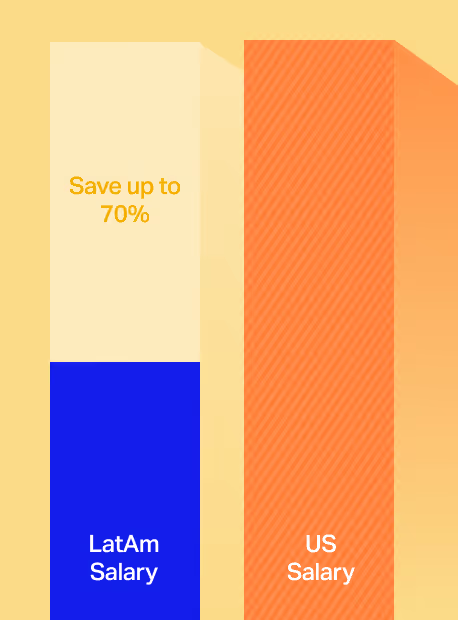
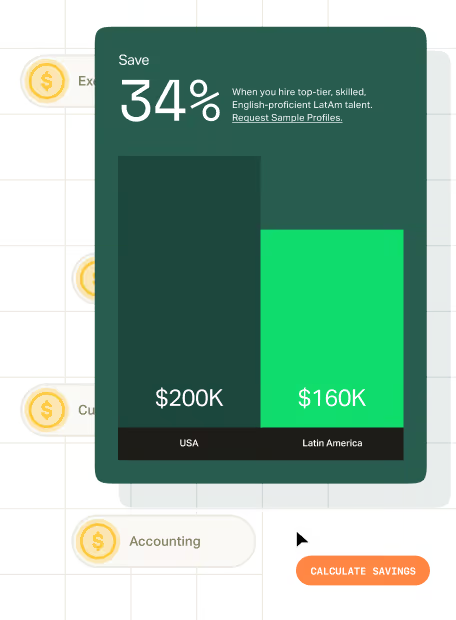
US companies save 30% to 70% compared to US salaries, depending on seniority and tech stack.
For example, here are the average annual salary ranges for a full-stack developer, according to Hire With Near's 2026 salary data:
- Junior: $36,000 to $46,000 in Latin America vs. $83,000 to $142,000 in the US
- Mid-level: $48,000 to $72,000 in Latin America vs. $90,000 to $154,000 in the US
- Senior: $72,000 to $108,000 in Latin America vs. $104,000 to $184,000 in the US
Across seniority levels, that lands inside the 30% to 70% range companies typically save by hiring in Latin America, while still paying competitively for the region.
For the most up-to-date figures, see Hire With Near's US vs Latin America Salary Guide.







.webp)


%203.svg)
.avif)





%20(1).avif)

%20(1).png)