%203.svg)
Key Takeaways
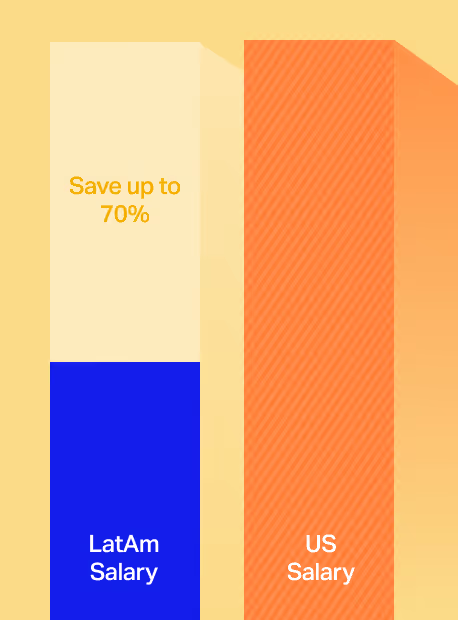
- Comparing local vs offshore developers, most US teams keep technical leadership and IP-critical work in the US. The rest of the development team goes to Latin America, where engineers work during the US business day at salaries 30 to 70% lower.
- Hiring a mid-level full-stack developer costs $90K to $154K a year in the US and $48K to $72K in Latin America. Across a three-person team that is roughly $126K to $246K a year, before benefits and overhead.
- You can hire under either model on your own, through a freelance platform, a development company, or a staffing and recruiting partner. This guide routes you to our vetted company lists for each.
Choosing between local vs. offshore developers is one of the biggest decisions an engineering leader makes when scaling a software team. Local talent means your team is in the room, sharing context and a time zone without a second thought. Offshore developers open up a much larger talent pool and cost significantly less to hire, but the tradeoffs depend heavily on which offshore market you pick.
That’s the part most comparisons skip. Offshore isn’t one thing: a team in Latin America overlaps your workday and communicates in real time, while a team eight time zones away often can’t. Plenty of growing companies don’t treat this as an either-or choice either. They keep architecture and product leadership close to home while building out delivery teams offshore, getting more speed without giving up quality.
This guide covers what it costs to hire local vs. offshore developers, what you give up or gain with each option, and how to hire developers in Latin America without lowering your engineering bar.
Local vs. Offshore Developers: Which Is Right for Your Business?
The choice between hiring local or hiring offshore developers comes down to budget, collaboration needs, and timeline pressure. Local hiring gives you the simplest legal story and the deepest US market context. Offshore hiring gets you senior engineers you can’t fund at US rates, in countries where the cost of living is lower.
Hiring locally means hiring inside the US, on your own payroll, whether or not anyone comes into an office. The in-person argument is thinner than it was: in Stack Overflow’s 2025 Developer Survey, 45% of US developers reported working fully remote and only 16.2% worked fully in-office.
Offshore hiring works best when you need to scale a team quickly without the US salary overhead, hire specialized skills that are hard to fund locally (from React developers to platform and data engineers), or cover work around the clock.
Here is how the three models compare on cost, overlap, speed, and fit:
Salary figures come from our own salary data; 21 days is our fastest software engineer fill in Latin America.
What many teams miss is that the local vs. offshore developer hiring decision doesn’t have to be an either-or choice. Most teams run a hybrid: US-based leads setting direction, development teams in Latin America doing the bulk of delivery, and far-offshore developers added only for overnight or narrowly scoped work.
One agency owner running that setup described what he wanted from it:
Why Latin America? I think that’s a leading factor... We want them to be active with us in Slack, essentially full-time hours. A dedicated resource that we can work with throughout the day.
What Are the Benefits of Local Development?
A US-based hire gives you four things no arrangement outside the country fully replicates: the simplest legal and compliance story, in-person access when your team co-locates, US market context for product decisions, and technical leadership sitting inside the company.
- Compliance and IP: If you handle protected health information, payment data, defense work, or a codebase that is the company’s core asset, one jurisdiction, one set of contracts, and one audit trail is the cleanest way to run it.
- In-person collaboration: When a team shares the same room, whiteboard sessions move architecture faster than any call. Be honest about whether that describes your team, because fewer than one in five US developers are now fully in-office.
- US market context: Developers who live in your market use what your customers use, and they catch product calls that land badly with US users.
- Technical leadership: The person who owns architecture, sets code standards, and mentors the team benefits from sitting closest to the business. That’s a choice rather than a constraint: Hire With Near also runs executive search in Latin America for CTO and VP of Engineering roles.
The catch is budget. According to our salary data, a mid-level full-stack developer in the US runs from $90K to $154K a year, and a senior one from $104K to $184K.
What Are the Benefits of Offshore Development?
Hiring developers outside the US gets you seniority you can’t fund at home, roles filled in weeks instead of months, and budget you can redirect into the roadmap.
You hire senior specialists you can’t find or fund locally
Hiring outside the US doesn’t mean hiring junior people. According to Hire With Near’s 2026 State of LatAm Hiring Report, 98% of the engineering roles we filled last year went to experienced professionals: 47% mid-level and 51% senior.
That’s not a coincidence. ManpowerGroup’s 2026 US Talent Shortage Survey found that 69% of US employers are struggling to find the skilled talent they need, with engineering among the roles they name as hardest to fill. Going offshore gets around that shortage by widening the pool of experienced people you’re searching in.
A US healthtech startup in hypergrowth shows what that looks like. Its two internal recruiters were running an eight-step interview process and couldn’t close the gaps fast enough. Hire With Near took over sourcing and screening, and the company hired seven senior engineers across backend, DevOps, QA, mobile, and frontend, saving $323,000 a year: a 33% reduction against US salaries.
ParkMobile set the same bar and got a named result. Its Head of Engineering was explicit about what she’d accept: “We don’t want to hire junior developers. We really need senior engineers who are able to think along with the product strategy.” Hire With Near placed 9 senior engineers across platform, backend, and iOS in 24 days, saving ParkMobile over $1 million a year against US rates, a 73% reduction.
You fill roles faster without lowering the bar
Speed and rigor aren’t a trade you have to make. That same company kept their eight interview steps, including deep technical screens and coding assessments, and still averaged 14 days to hire.
Bonfire, an e-commerce platform for custom merchandise, saw the same on a single hire: a UX Engineer search that normally ran two to three months closed in six weeks, saved $53,000 a year, and produced a hire who stayed over two years. Bonfire’s VP of Product Management put it plainly:
It was shocking to see the difference between the talent Hire With Near brought versus other firms I worked with. Our hires are extraordinary and a great cultural fit.
— Thomas Elliott, VP of Product Management, Bonfire
Retention matters here too, since engineering churn is the most expensive churn. Our placements stay an average of three years, and 80% stay two or more.
You redirect real money into the roadmap
The savings from hiring offshore aren’t just a lower number on an invoice. They’re budget that would’ve gone to salary, freed up to fund the next hire, the next feature, or the next quarter you didn’t think you could afford.
Delve, an Inc. 5000 digital consulting firm, made 10 hires in Latin America across data and marketing, including a Data Scientist it couldn’t source in the US, and saved $500,000 a year, roughly 50%. That funded 43% headcount growth rather than sitting on a spreadsheet as a cost cut.
You get back the collaboration a distant team costs you
The benefit US teams underestimate is workday overlap. Northstar Financial Consulting Group used contractors in India for finance and operations work, and its California team started the day as the contractors finished theirs.
After reaching out to Hire With Near, the company rebuilt its team in Latin America, made 12 hires, and saved more than $250,000 a year.
For the full set of advantages, check out our article about the benefits of offshore software development. And before deciding the answer is offshore, read about the tradeoffs in our guide to offshore development risks.
Local vs Offshore Developer Pay and Cost: What Each Model Really Costs
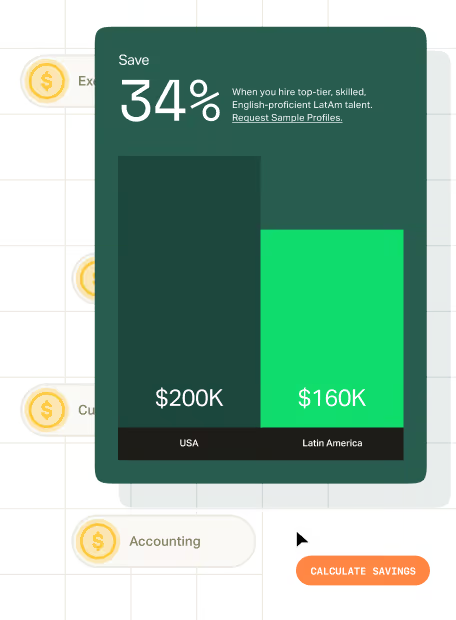
Hiring a developer in Latin America costs $30K to $108K per year depending on the role and level, compared to $66K to $238K for the US equivalent. Most companies budget 30–70% less per engineer without changing the seniority they hire.
Here’s what the same roles cost in each market, according to Hire With Near’s 2026 salary benchmarks:
For the most up-to-date figures, see Hire With Near’s US vs Latin America Salary Guide.
A senior engineer in Latin America fits inside a mid-level US salary band, so hiring at the seniority your roadmap needs costs less than hiring a level below it in the US.
Pay at the top of the local range and you compete for the strongest candidates there. Pay at the bottom and you’ll be rehiring within a year.
Visit our US vs. Latin America IT Roles Salary Guide for the role-by-role salary benchmarks.
It’s also important to note that US costs keep climbing. The US Bureau of Labor Statistics reported US wages and salaries up 3.2% over the 12 months ending June 2026, so a US-only plan gets more expensive every year you run it.
Why Should You Consider Hiring Nearshore Developers?
So far, we’ve used offshoring as an umbrella term covering any professional who isn’t in the same country as you, whether that’s Asia, Eastern Europe, or Latin America. But for US companies, Latin America is close enough, in distance and time zone, that it gets its own term: nearshoring.
Nearshore hiring gets you the cost profile of hiring outside the US without giving up real-time work, because your developers in Latin America are online during your business day. Stand-ups happen live, and a question asked at 2 p.m. gets answered at 2 p.m.
Here are some of its advantages:
- Overlapping working hours: Your Latin American hire works during your business day, whether your team runs on Pacific, Mountain, Central, or Eastern time. The gap shifts with the season, since most of Latin America doesn’t observe daylight saving time, but overlap is near-total for Central and Eastern teams and covers most of the day on the West Coast.
- Cultural compatibility: Latin American developers often have years of experience with US companies and know US business culture.
- English proficiency: Strong English is standard among the engineers we place, who run technical discussions, code reviews, and client calls in English.
- Geographic proximity: When you need people in a room, travel between the US and LatAm is quick and affordable.
That advantage isn’t only our observation. Research from Harvard Business School and INFORMS, covering 12,038 employees across 48 countries, found that each additional hour of time-zone distance cuts synchronous communication by about 11%. Their recommendation: organize distributed teams north to south rather than east to west.
Most of the engineering talent we place is based in Brazil, Colombia, Argentina, and Mexico. Our country guides break down salaries in detail: hire developers in Mexico, hiring developers in Argentina, hiring developers in Brazil, and hire developers in Colombia, and you can hire software engineers in Latin America across all of them through one process.
Start with our free guide to hiring remotely in Latin America.
The Verdict: Local vs. Offshore Developers
Most US teams shouldn’t pick a side. Keep technical leadership, architecture ownership, and IP-critical or regulated work in the US, put the bulk of delivery in Latin America, where the workday overlaps yours, and use far-offshore hiring only for work that has to happen while your office is closed.
Fully local is right when you can fill every seat at US salary levels. Fully offshore is right when overnight coverage is worth more than same-day collaboration.
The short version:
- Choose local if the role owns architecture or your core IP, works in a regulated environment, or genuinely needs to be in a room with your team.
- Choose offshore in a distant region if you need coverage outside your workday, or you are staffing well-defined work that doesn’t depend on daily back-and-forth.
- Choose hybrid if you’re scaling a product team on a fixed budget, which is where most of the companies we talk to land.
Buyer behavior points the same way. Hire With Near’s analysis of 2,000-plus hiring conversations found that 30% of the US companies weighing Latin America had already hired offshore somewhere further away. They were switching mainly to recover real-time overlap, one of the top reasons US companies hire in Latin America.
If your real question is whether to build a team at all, our comparison of whether to hire an in-house developer or outsource covers that axis.
What Are the Five Ways to Hire Developers Outside the US?
You have five realistic ways to hire developers outside the US, running from most work on your side to least: do it yourself, use a freelance platform, use a staff augmentation firm, use a development company, or work with a specialist staffing and recruiting partner.
When building an offshore development team, the route decides how much sourcing and vetting stays with you.
Source, screen, and hire on your own
You post the role, source on LinkedIn and country-specific job boards, run your own screens, and then need a legal way to employ the person. For a handful of hires, that means an employer of record, which handles contracts, payroll, local benefits, and compliance but doesn’t source or vet anyone.
Our comprehensive guide to hiring a top developer covers the process, and our breakdown of how to hire an offshore development team compares models and costs.
Freelance and contractor platforms
Platforms like Upwork and Toptal give you fast access to contractors, which works for a defined project or a short burst of capacity. They aren’t a path to a permanent team, though: you manage quality yourself, and the developer is splitting attention across other clients.
See our comparison of freelance developers versus offshore development companies.
Staff augmentation
A staff augmentation firm places a pre-vetted engineer on your team to work under your direction, while the firm stays the legal employer and handles payroll, benefits, and compliance. You manage the day-to-day work yourself: what they build, how they build it, and how it fits into your codebase.
This fits a defined project or a scaling period where you need capacity without adding permanent headcount.
Development companies and dev shops
A dev shop takes ownership of a piece of work rather than placing a person on your team. You hand off a feature, a project, or a defined scope, and the firm’s own project managers and engineers build it using their process, not yours.
This works when you need something built fast and don’t want to run either the hiring or the day-to-day management yourself.
The tradeoff is control: you’re not directing the work day-to-day, and the specific developers on your project can rotate based on the firm’s other client commitments, not yours.
Our CEO and Co-founder Hayden Cohen explains why this is often where strong candidates draw the line, in the video below:
A specialist staffing and recruiting partner
This is the simplest option for most US companies, because one relationship covers both jobs: finding the person and employing them. Staffing agencies handle sourcing plus payroll, compliance, and benefits administration; recruitment agencies focus on permanent placements and leave employment to you.
Hire With Near works as the first kind: we source the person and handle the employment side, so you’re not stitching two vendors together. Our process starts with a role intake call to pin down the stack, seniority, and comp band, then we source actively against those requirements.
You get a shortlist in three to five days, most companies hire in under three weeks through our nearshore staffing and recruiting services, and every placement carries a 180-day replacement guarantee.
Natasha Tarapow, one of Hire With Near’s Recruitment Consultants, describes what the screen looks for:
We always ask candidates to tell us about a project they’ve worked on — not just that they use this language and that one, but what their role was and what they actually did. It’s important that they can explain their work to someone who isn’t a developer.
— Natasha Tarapow, Recruitment Consultant, Hire With Near
Why is building your own remote development team often the better choice?
Hiring your own developers directly usually delivers the best long-term results. Your developers work on your product and your codebase rather than rotating between clients, so nobody is reassigned to another company’s project mid-sprint, which is the difference buyers ask about most.
The upfront effort is higher, but our placements stay an average of three years, so whoever learns your codebase is still on the team two roadmaps later. Either way, the employment side (contracts, payroll, local benefits, and compliance) is handled for you.
Here’s our CEO on why direct hiring often beats working with development agencies:
Whichever route you take, our offshore software development best practices cover the first 90 days.
Where to Find Developers: Our Vetted Company Lists
Four of our own lists cover every route in this comparison: developers in Latin America, offshore developers, offshore development companies, and nearshore staffing partners. Once you’ve picked a model, start there rather than building a shortlist from search results.
- Hiring in Latin America: Start with the best companies to hire developers in Latin America, updated for 2026.
- Hiring further afield: Our guide to how to hire offshore developers covers the process, and our roundup of the top offshore development companies covers the firms.
- Comparing staffing partners beyond engineering: See the best nearshore staffing companies.
Final Thoughts
Most US teams land on a hybrid approach. They keep technical leadership and sensitive projects local while hiring nearshore talent in Latin America for the bulk of their development work, which gives them real-time collaboration, salary costs 30–70% lower, and developers who understand US business practices.
At Hire With Near, we’ve helped 950+ companies build teams this way, and some of them save $300,000 to $1,200,000 annually while maintaining, and often improving, their output. A good share of that is IT and tech recruiting in Latin America for companies hiring their first engineers outside the US.
Schedule a free, no-commitment consultation call and our team will walk you through salary benchmarks for the roles you’re filling and how the process works. You can also see the developer roles we fill in Latin America first.
Frequently Asked Questions
What does offshore developers mean?
Offshore developers are software engineers you employ or contract in another country, working remotely for your company rather than from a local office.
Nearshore is the subset where the country sits close to yours, so the workdays overlap and collaboration happens live. Latin America is the nearshore region for US companies.
Our explainer on nearshoring vs. offshoring vs. onshoring breaks down all three.
What is the disadvantage of offshore outsourcing?
The two biggest disadvantages are lost real-time collaboration when the workdays barely overlap, and lost control when a vendor rotates people between clients.
Both are fixable: pick a region inside your working hours, and hire dedicated people rather than shared vendor capacity.
Why is offshoring controversial?
Offshoring is controversial mainly because it’s associated with moving existing US jobs abroad to cut labor costs, and because early offshore software projects built a reputation for poor quality.
In the hiring conversations our team logs, the realistic alternative to a role filled in Latin America is rarely a US hire at a higher salary. Most of these companies looked at the US price for the role, couldn’t fit it into budget, and shelved the req. So the real choice isn’t local vs. offshore. It’s hiring the person in Latin America, or leaving the seat empty and asking the rest of the team to cover the gap.
Our piece on misconceptions about offshore development covers the rest.
What’s the difference between nearshore and offshore development?
Nearshore development means hiring in a nearby country whose workday matches yours, which for US companies means Latin America. Offshore usually means a distant region where the workdays barely overlap.
The practical difference is when you get answers: nearshore engineers join your stand-ups and turn code review around the same day.
Our comparison of why Latin America stands out for software development has the tradeoffs.
How much can I save by hiring offshore developers?
Most companies save 30–70% against comparable US salaries. A full-stack developer in Latin America earns $36K to $108K a year compared to $83K to $184K in the US. A DevOps engineer runs from $30K to $100K, compared to $100K to $197K.
See our US vs. LatAm salary guide for every role and seniority level.
How do you vet offshore developers beyond their resume?
The filter is a small real-world task reviewed live, not a longer resume screen. Our recruiters use a short exercise that mirrors the job, such as debugging a snippet or building a basic API with tests, then walk through the solution on a call.
A project walkthrough follows, where the candidate explains a technical decision to someone who isn’t a developer. A candidate who can’t say what their own role was is the clearest red flag.
How do I know a senior developer in Latin America is senior by US standards?
You test scope and ownership, because that is what separates a senior engineer from a long resume. Ask what the candidate personally decided rather than what their team shipped, and how they handled a production failure they caused.
Our recruiters also treat a developer holding two or three parallel jobs as a red flag rather than a sign of demand.
See our questions tech leaders ask about hiring developers in Latin America.
What developer and engineering roles can I hire in Latin America?
US companies hire the full range of engineering roles in Latin America, not just application developers: software engineers in Latin America, remote back-end developers, nearshore front-end developers, nearshore QA engineers, remote DevOps engineers, and website developers based in LatAm.
Whichever role you fill, they work during your business day at salary levels 30–70% below comparable US rates.






.webp)
.webp)


%203.svg)
.avif)





%20(1).avif)

%20(1).png)