.webp)


%203.svg)
Key Takeaways
- A nearshore team is a group of full-time professionals based in neighboring countries (typically Latin America for US companies) who work overlapping US hours, speak excellent English, and cost 30–70% less than US-based equivalents. They are dedicated employees, not shared or outsourced resources.
- Knowing how to build a nearshore team starts with clarity on scope: define the roles, the seniority level, the English fluency standard, and the timeline before you engage a partner. The clearer the brief, the faster the search and the better the candidates.
- Hire With Near has helped 950+ US companies build LatAm teams across finance, sales, engineering, operations, and more, with most placements completed in under three weeks and no fee until you hire.
You've made the hire: one remote professional in Latin America, and it worked. The professional integrated into your team, the time zone held up, and the cost savings were real.
Now you're thinking bigger. A whole function, built in Latin America, working your hours, at 30–70% of what the same team would cost domestically.
That shift from one hire to a team is where most companies get stuck. They know nearshoring works for a single role, but they're not sure how to scope a multi-person build, which country to hire from, or how to onboard a distributed team without losing momentum in the first 90 days.
In this guide, I'll explain exactly how to build a nearshore team: from defining the roles you need to running a distributed team that performs at the same level as your US employees.
I've been through this process firsthand.
I built Hire With Near as a fully distributed company, with the core team assembled across Latin America. That experience, combined with helping 1000+ US companies do the same thing, is what this guide is based on.
What Is a Nearshore Team?
A nearshore team is a group of full-time professionals based in a neighboring country. For US companies, that typically means Latin America. They work during overlapping US business hours and function as dedicated members of your company rather than a shared external resource.
Unlike offshore teams in India or the Philippines, which operate 10–13 hours ahead of US time, nearshore teams in LatAm work within 0–3 hours of any US time zone.
Unlike outsourced arrangements, where a vendor owns the work and the workers, nearshore hires are your employees in every meaningful sense: they report to you, attend your standups, and build your products.
The US-to-Latin America axis has become the dominant nearshore model. Countries like Colombia, Argentina, Mexico, Brazil, and Chile offer deep talent pools across finance, engineering, sales, operations, marketing, and more, with a growing share of those professionals having direct experience working with US companies.
Why Are More US Companies Building Nearshore Teams?
More US companies are building nearshore teams because the model delivers on key aspects that matter: real-time collaboration with no time zone penalty, 30–70% cost savings compared to domestic hiring, and access to a talent pool deep enough to staff entire functions.
Here's what each of those looks like in practice.
Your team works US hours, in your time zone
Working the same hours as your team is the biggest practical difference between nearshore and offshore hiring. With nearshoring teams, daily standups happen live, urgent questions get answered the same day, and decisions don't wait until the next morning.
The consequences of time zone misalignment run deeper than most companies expect. Research from Harvard Business School and INFORMS found that each additional hour of time zone difference reduces synchronous communication by 11%.
The same study found that larger gaps force employees to shift their working hours to maintain communication, which creates measurable collaboration friction, increased work-life conflict, and a disproportionate burden on workers in collaborative roles.
The study's recommendation: organize distributed teams along a north-south axis, like US to Latin America, rather than east-west.
That finding tracks with what Hire With Near hears from companies switching from Asia-based teams. One operations leader at a growth-stage clean energy company put it plainly:
We learned very quickly that nearshoring is a much better option for us at this size... the last year, trying to manage someone in such a different time zone, and they don't work US hours, right? To us, moving to LatAm and staying kind of within the same reasonable time zone just makes so much more sense for us.
That's the practical difference.
The cost savings are real and substantial
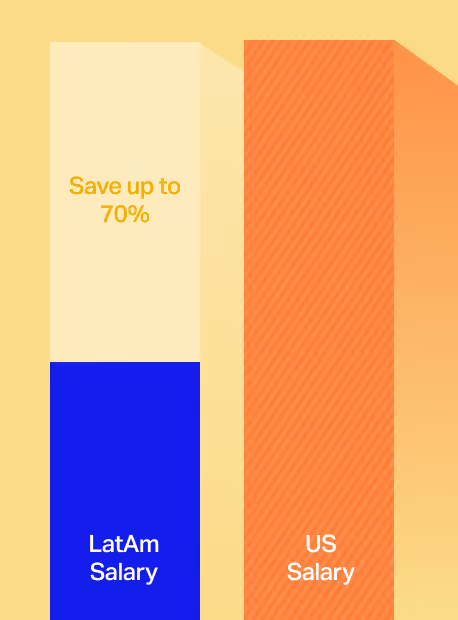
Hiring in Latin America typically reduces salary costs by 30–70% compared to US equivalents, depending on the role and seniority level. The cost advantage isn't about cheap labor. It reflects the lower cost of living in LatAm countries, which means you can pay competitive, fair salaries by local market standards while still saving significantly versus US market rates. We detail salary savings in the next section.
By betting on a nearshore team, you also avoid the overhead costs of building an on-site team: office space, equipment, software licenses, and US-standard benefits packages.
The talent pool supports entire functions
Most companies start with one nearshore hire. What they discover is that the talent pool in Latin America is deep enough to build entire departments around, and the supply problem that's making US hiring so difficult makes that discovery more urgent.
ManpowerGroup's 2026 Talent Shortage Survey found that 72% of US employers report difficulty finding people with the skills they need. That figure has held above 70% for several years running. The roles hardest to fill domestically, like controllers, software engineers, SDRs, operations leads, exist in depth in Colombia, Argentina, Mexico, and Brazil.
Finance and accounting professionals with Big Four experience, software engineers who have shipped production code for US SaaS companies for years, sales reps who know US business culture inside out. The depth is there across functions, not just in isolated pockets.
Shared business culture reduces friction in collaborative work
LatAm professionals generally share US communication styles, business norms, and professional expectations. That common ground reduces friction on collaborative work, and it's part of why companies that try nearshoring after an offshore arrangement consistently report a better experience.
My co-founder Michael Girdley explained that in his experience working across the region, Latin America and the US are basically in the same time zone and the cultures feel remarkably similar. Living in Texas and dealing regularly with people in Mexico, he says it feels like Texas, but a little further south, pretty much the same thing.
He goes deeper on this in the video below.
How Much Does It Cost to Build a Nearshore Team?
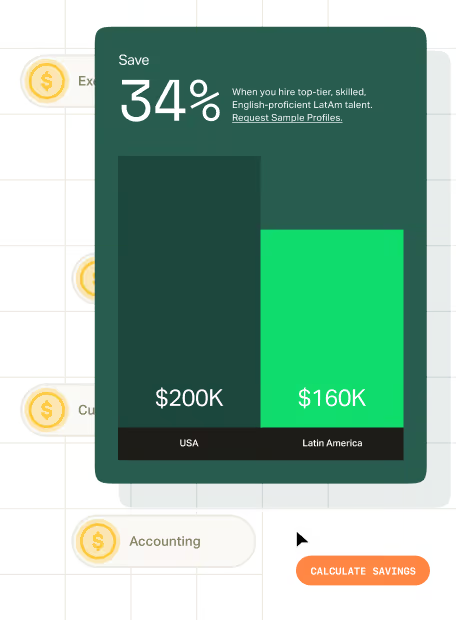
Nearshore hiring in Latin America typically reduces salary costs by 30–70% versus comparable US-based hires, and those savings apply across seniority levels, not just entry-level roles.
According to Hire With Near's 2026 State of LatAm Hiring Report, companies that build nearshore teams in LatAm save an average of $35,000–$64,000 per hire annually, and 84% of those hires are mid-level or senior professionals, not entry-level cost-cutting.
To illustrate the range, here are compensation benchmarks for some common roles:
Source: Hire With Near's 2026 State of LatAm Hiring Report
Savings vary by role and seniority level. Senior LatAm professionals command higher rates, but the gap versus their US equivalents remains meaningful. For a detailed comparison across roles, see the US vs. LatAm salary guide.
How to Build a Nearshore Team: Step by Step
Building a nearshore team follows the same logic as building any team, as my co-founder and COO Franco Pereyra explains:
Same pillars, but very important changes in the mechanics, not the principles. You still need the right people, the right roles, clear goals, strong management, and the right culture. What changes is how you make those things happen.
Here are the six steps:
Step 1: Define the roles and what you need them to deliver
Start by getting specific about what you actually need. Which functions are you staffing? What outcomes do those roles need to drive? “We need a finance team” isn't a scope. “We need a controller, two accountants, and a financial analyst to close the books faster and support our Series B prep” is a scope.
Define the roles, the experience level required, the English fluency standard you need for each position, and your timeline. The clearer the brief, the faster the search moves, and the better aligned the candidates will be.
Step 2: Choose your hiring model
When building your nearshoring team, you have three options:
- Hire directly: You manage compliance and payroll yourself if you have a local entity.
- Work with a staffing partner specializing in hiring in Latin America: They source, vet, and often handle payroll and compliance.
- Use an Employer of Record (EOR) service: A third party employs the worker legally on your behalf.
Most US companies building LatAm teams for the first time use a nearshore staffing partner. The compliance and payroll complexity of international hiring is real, and a partner handles it.
That's how Hire With Near works: We find and place the right candidates and handle the employment infrastructure, so you can focus on managing your team.
Related reading: A Comprehensive Guide to Hiring Remote Foreign Employees
Step 3: Identify the right country and talent pool
Latin America offers distinct talent pools across different functions:
- Argentina has a strong university system for finance, accounting, and technology professionals.
- Colombia and Mexico are strong for customer-facing roles, given their English proficiency and communication skills.
- Brazil has depth in software engineering and creative/marketing roles, but has some accent considerations for US-client-facing positions.
The right country depends on the roles you're filling, the English fluency required, and the time zone you're optimizing for. A good staffing partner will help you map the best talent pool to your needs. Don't assume one country covers everything.
Further reading: Top Destinations to Hire in Latin America in 2026
Step 4: Source and vet candidates with remote-work-fit criteria
Technical skills matter, but for a distributed team, they're not sufficient. Franco Pereyra describes the three traits critical for all remote hires:
Autonomy, judgment, and ownership. These folks won't have the proximity that comes with an on-site team. You need people who can think, who can decide, who can communicate clearly, who know when to ask versus when to act, and who take responsibility when they get it wrong.
When evaluating candidates, assess whether they can work independently without close supervision, whether they communicate clearly in writing and video calls, and whether they have experience with US business norms or US-based clients.
Those signals predict success better than a polished resume alone.
Step 5: Onboard intentionally
Only 12% of employees strongly agree their organization does a great job onboarding new hires, according to a foundational Gallup workplace study. For remote international hires, poor onboarding compounds quickly. They don't have an office hallway to pick things up informally.
A strong onboarding process for nearshore hires includes: a structured first-week schedule that introduces team members and processes, documented role expectations with clear 30/60/90-day milestones, a dedicated point of contact for questions, and regular check-ins in the first 90 days.
For detailed strategies, see the guide to onboarding remote international talent.
Step 6: Manage and measure ongoing performance
Set performance metrics from day one and review them consistently. Distributed teams need more structure around goals and feedback, not less. The informal course-correction that happens naturally in an office doesn't happen over Slack.
Invest in culture-building: regular team video calls, clear documentation, and deliberate inclusion of nearshore team members in company-wide communication. Think about benefits and perks you can offer remote talent to build retention from the start.
The guide on how to make remote hires feel like part of the team covers practical frameworks for this.
Related reading: How Nearshore Hiring Strategies Increase Company Valuation
How Hire With Near Helps Companies Build Entire Teams
Across the 950+ US companies we've helped build LatAm teams, the pattern I see in founders who scale this well is consistent: they stop thinking about nearshore hiring as filling individual gaps and start thinking about it as building entire functions.
That shift changes everything. The scope gets clearer, the onboarding gets more intentional, and the team you end up with actually runs the function, instead of simply filling a seat. A finance team in Argentina that owns the month-end close. A sales development team in Colombia that runs outbound without daily hand-holding. That's what the shift looks like in practice.
CyberFortress is the clearest example we have. The cybersecurity company was in hypergrowth mode, doubling headcount over 12 months, and their CFO, Seema Chacko, had exhausted traditional talent markets. The US labor market didn't have the finance and accounting professionals she needed at sustainable rates.
After reaching out to Hire With Near, she built a 20-person LatAm finance team, including a Director of Accounting with 15+ years of experience, an Accounting Team Lead from Accenture, and a Director of Global Tax with Ernst & Young background. Those aren't entry-level hires. Those are the people you build a finance function around.
The result: $1.2 million in annual salary savings versus US-based hiring, and the month-end closing reduced from 15 days to 10 days.
Seema described the experience:
We hired 20 team members who share our core values: great attitude and desire to learn, resourcefulness, and adaptability. Hire With Near's team was very responsive, and their easy-going communication fostered a hiring process we were happy with.
Hire With Near fills roles across the seniority spectrum, from individual contributors to director and VP-level positions through executive search in Latin America. For teams that want the option to work together in person, we can also help coordinate office space and equipment in LatAm markets.
{{state-latam-hiring}}
How to Choose the Right Nearshore Partner
The difference between nearshore hiring that works and nearshore hiring that disappoints usually comes down to the partner, not the talent pool.
In a conversation with a hiring leader who had switched from an outsourcing model, they explained that working with an agency never felt like the people were truly part of the team. What they wanted, they said, was people who were genuinely integrated into the company, just based somewhere else.
When evaluating a nearshore staffing partner, look for these things:
- Candidate vetting depth: How does the partner screen for English fluency, remote-work fit, and role-specific skills? A partner who delivers a shortlist without explaining how they got there isn't a partner. They're a resume forwarding service. Ask specifically what the vetting process involves.
- Time-to-hire benchmarks: How long does it typically take from kickoff to offer accepted? Hire With Near completes most placements in under three weeks. If a partner can't give you a benchmark, that's a signal.
- Deployment model flexibility: Do they support direct hire, EOR, and staff augmentation, or are you locked into one model? Your needs may change as the team grows, so flexibility matters.
- Compliance and payroll support: International employment compliance varies by country. A partner that handles contracts, payroll, and local labor law on your behalf removes significant operational risk.
- Dedicated vs. shared talent: Make sure you're hiring dedicated professionals who work exclusively for your company, not shared resources divided across multiple clients.
Challenges of Building a Nearshore Team (and How to Solve Them)
Building a nearshore team delivers real advantages, but managing a distributed team requires adjusting how you work. Here are the three most common challenges and how to handle them.
Onboarding remote hires without losing them in the first 90 days
Remote hires who don't feel integrated in their first three months are far more likely to leave. Without the informal onboarding that happens naturally in an office, new nearshore team members can feel disconnected before they’ve had a chance to contribute.
The fix: over-invest in structure during the first 90 days. Build a documented onboarding plan, assign a dedicated point of contact, and schedule regular check-ins.
See the guide to onboarding remote international talent for a detailed frameworks
Maintaining team culture when the team spans countries
Culture at a distance requires deliberate attention. The norms that sustain an in-office team (informal conversation, shared rituals, visible recognition) have to be actively replicated in a distributed setting.
From building Hire With Near as a fully distributed 60-person company, the lesson I learned is that culture doesn't happen by default. It happens when you build regular rhythms for connection.
Weekly all-hands calls, shared documentation practices, peer recognition in team channels, and occasional in-person offsites all contribute. None of it is complicated, but all of it requires consistency.
For a deeper look at how we approach this at Hire With Near, watch Franco Pereyra's breakdown of building company culture with a fully remote team in the video below.
Managing payroll and compliance for international hires
Paying employees in another country involves local labor law, tax compliance, and currency considerations that most US companies aren’t set up to handle alone. Setting this up incorrectly creates real legal and financial risk.
The practical solution: Use a staffing partner that includes payroll and compliance as part of their service, or use an Employer of Record. This isn't an area to DIY. The administrative cost of getting it wrong outweighs the cost of having a partner handle it correctly from the start.
Further reading: Hiring in Latin America: Answers to Your Questions About Hiring Remote Talent Offshore
Final Thoughts
The companies that get the most out of nearshore hiring approach how to build a nearshore team the same way they'd build any team: with clear scope, intentional onboarding, consistent management, and deliberate investment in culture across distance. The mechanics are different. The principles are not.
The cost savings are real, the talent is there. And because your LatAm team works the same hours you do, none of the collaboration advantages you have with your US team disappear.
We've helped 1000+ companies build this way across finance, engineering, sales, operations, customer support, and more. CyberFortress built a 20-person finance team and saved $1.2 million annually. AvantStay added $20 million in ARR with a LatAm SDR team. This is what happens when the model is applied well.
If you're ready to start, schedule a free consultation. You could have profiles of strong candidates in front of you in days. There’s no fee to interview, so you risk nothing by exploring what’s possible.
{{latam-hiring-cta-v2}}
Frequently Asked Questions
What is a nearshore team?
A nearshore team is a group of full-time professionals based in a neighboring country who work as dedicated members of your company. For US businesses, this most commonly means Latin America.
They work your business hours, communicate in English, and report directly to you, the same as any other employee, just based somewhere else.
The key distinction from offshore is time zone: LatAm professionals work within 0–3 hours of any US time zone, enabling real-time collaboration that offshore teams in Asia can't provide.
How long does it take to build a nearshore team?
Most companies complete individual placements in three weeks when working with Hire With Near.
Building a multi-person team depends on the number of roles and how clearly the scope is defined going in.
A 5-person team with clear role definitions can often be fully placed within weeks.
Delays typically come from unclear job specs or slow feedback loops during the interview process, not from candidate availability.
How much does it cost to nearshore?
Nearshore hiring in Latin America typically reduces salary costs by 30–70% versus US equivalents, with savings varying by role and seniority. Entry-level roles see the most substantial savings, but senior and director-level roles are still significantly less expensive than US equivalents.
Beyond salary, you save on overhead: office space, equipment, benefits packages, and US-market hiring fees.
For current salary ranges by role, see the US vs. LatAm salary guide.
What countries are best for building a nearshore team?
The right country to build a nearshore team depends on your roles and requirements. Argentina has deep talent pools in finance, accounting, and engineering, with a strong university system and a professional culture that maps well to US business norms.
Colombia and Mexico are strong for customer-facing roles, given their English fluency rates and communication styles. Brazil has significant engineering and creative talent, but has some accent considerations for US-client-facing positions.
Most staffing partners will recommend the optimal country based on your specific role mix. For a breakdown of options, see nearshore locations for US businesses.
What is an example of nearshore team building in practice?
CyberFortress, a cybersecurity and data recovery company based in San Antonio, is a clear example. During a hypergrowth phase, their CFO needed to build a full finance function quickly. Hire With Near placed 20 professionals, including three director-level hires with Big Four and Fortune 500 backgrounds, in a matter of weeks.
The team delivered $1.2 million in annual salary savings and reduced the month-end closing from 15 days to 10 days. The professionals hired are still with the company 2+ years later.
Should I use an EOR, a staffing partner, or hire contractors directly?
A staffing partner is usually the right choice when you need vetted full-time talent and want someone to handle sourcing, compliance, and payroll on your behalf.
An Employer of Record is a good fit when you want to hire an individual and formalize their employment without setting up a local legal entity.
Most companies building LatAm teams for the first time start with a staffing partner.
What types of nearshore teams can I form?
You can staff virtually any business function with a nearshore team. Common team types include software development, finance and accounting, sales, marketing, design, and operations and administrative support.
Many companies that start with one function expand to others once they see the results. The question isn't which functions can work in LatAm. It's which functions you want to build first.
What should I do if my nearshore team isn't meeting expectations?
Start with a direct performance conversation: share specific feedback, reset goals, and offer resources or training if there’s a skill gap. If the issue is structural, such as unclear expectations, poor onboarding, or misaligned role scope, address that first before drawing conclusions about the person.
If performance issues persist after a clear improvement plan, your nearshore staffing partner can help evaluate whether the role definition or candidate profile needs to change.
See How to Ensure Remote Employees Exceed Expectations for additional guidance.
What types of businesses build nearshore teams in Latin America?
Companies across many industries use LatAm nearshore teams.
For example, SaaS companies build engineering, customer success, and operations teams. Healthcare companies staff billing, admin, and care coordination roles. Finance firms hire analysts, accountants, and compliance professionals. Legal firms staff paralegals and legal operations roles.
The model works across sectors because the core advantages (time zone alignment, cost savings, and strong talent depth) aren’t industry-specific.







.webp)


%203.svg)
.avif)





%20(1).avif)

%20(1).png)