


%203.svg)
Key Takeaways
- Understanding why companies are nearshoring to Mexico starts with three advantages: full US time zone overlap, 30–70% cost savings versus equivalent US hires, and strong IP protections under USMCA that reduce trade secret and software risk.
- Mexico's appeal goes beyond cost. Its professionals share cultural and business norms with US companies, and the country produces a proportionally higher share of STEM graduates than the US, making it a strong source for technical and knowledge-worker roles.
- The Mexico nearshoring trend accelerated significantly after 2020, driven by the push to reduce dependence on Chinese supply chains, USMCA enforcement, and the post-pandemic normalization of remote work, all of which expanded Mexico's value beyond manufacturing to knowledge-worker hiring.
For years, US companies hiring offshore in India, the Philippines, and other countries accepted the tradeoffs these destinations brought: the cost savings were real, but so was the 10-hour time gap, the async communication, and the slow feedback cycles that quietly eroded the savings.
Mexico changed the equation. Same cost advantages, but with zero time zone penalty. A workforce that works when you do, communicates the way you do, and is close enough to visit when it matters.
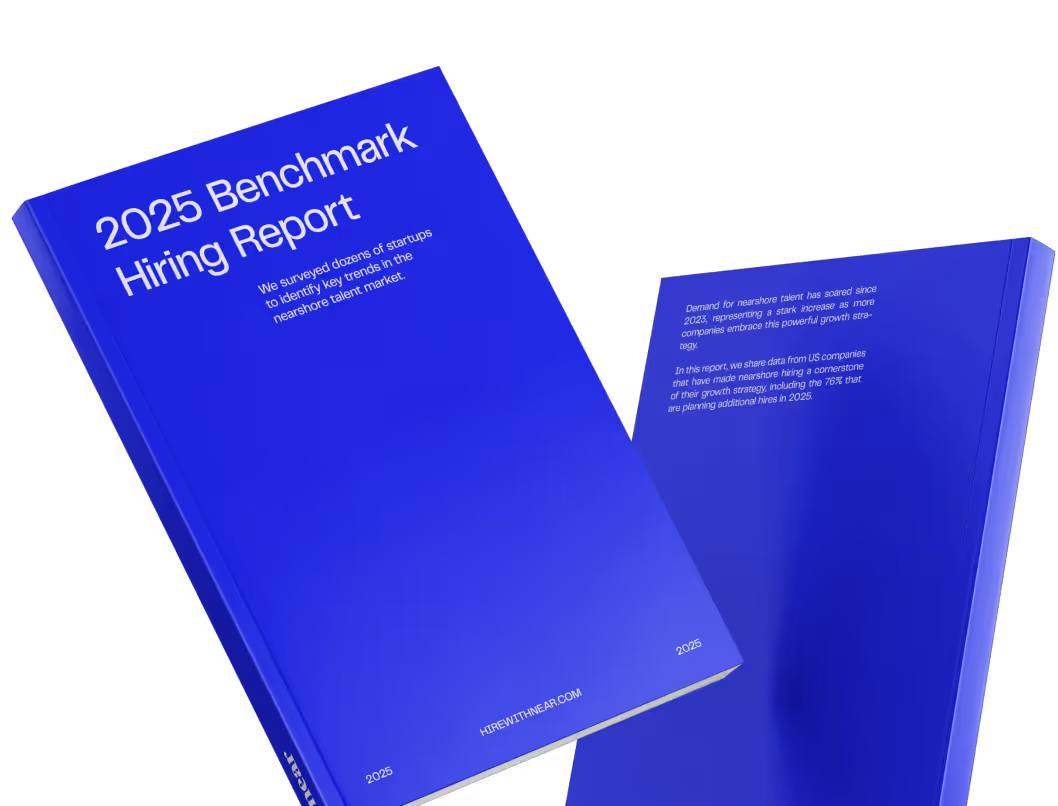
That’s why companies are nearshoring to Mexico at a rate that has accelerated significantly since 2020. And the trend shows no signs of slowing down. In this article, I cover what has changed in the past five years to make it a more compelling option than ever, how much you can realistically save, and which business functions and industries are leading the way.
Why Is Nearshoring to Mexico Growing?
Remote work became the norm for many industries during the COVID-19 pandemic, and US companies discovered that the real constraint on effective remote collaboration wasn't geography. It was time zones.
That mindset shift drove companies away from traditional nearshoring arrangements, in which a vendor managed delivery and the client had limited visibility into who was doing the work, toward direct remote hiring. Professionals who work your hours, communicate clearly, and share your business culture became the priority.
Mexico fits that profile better than most alternatives, because of the time zone alignment with the US and geographical proximity. But that’s not all: Strong government investment in infrastructure, tech corridors like Guadalajara's “Mexican Silicon Valley,” and Mexico's growing reputation in the global economy have reinforced that appeal.
Companies like Tesla, Unilever, and Hewlett-Packard have made significant investments in Mexico, signaling long-term confidence in the country's workforce.
The results are already showing: Mexico is ranked as the fourth-largest destination for IT hiring in Latin America with a market revenue projection of $7.9 billion by 2028, according to a Statista forecast.
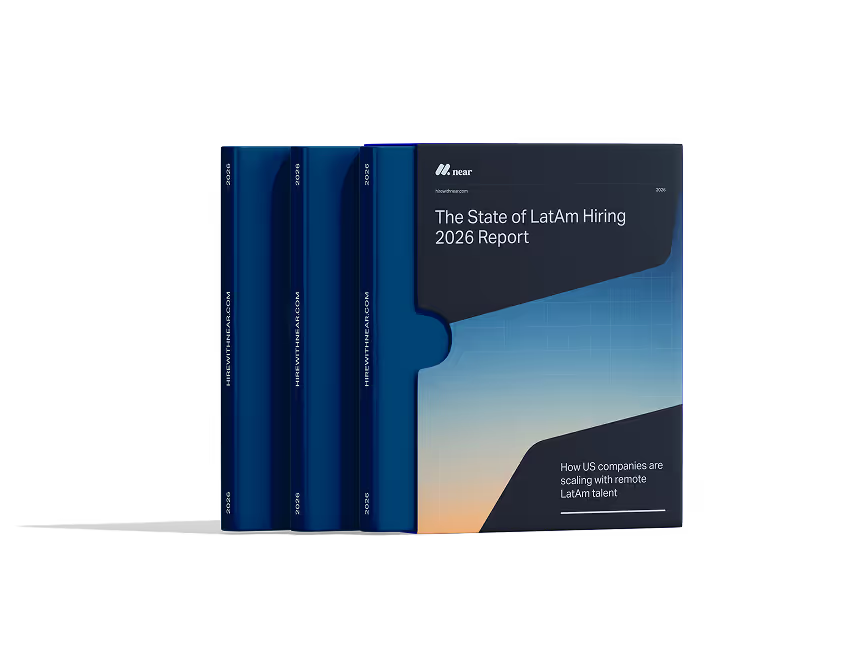
Within Hire With Near's own placement data, Mexico accounts for 9% of all LatAm placements, ranking fourth among all countries in the region, according to the 2026 State of LatAm Hiring Report.
That's a structural shift, not a blip, in where US companies are choosing to build their teams.
Why Now: What Changed Between 2020 and 2025?
Some of the benefits of nearshoring to Mexico have always existed. What changed after 2020 is that three separate forces converged to make it a much stronger argument, and US companies started acting on it.
- USMCA enforcement and the IP protection shift
The United States-Mexico-Canada Agreement took full effect in 2020 and added stronger intellectual property protections than the old NAFTA framework.
For US companies hesitant to hire in Mexico because of IP concerns, this changed the calculation. Mexico's obligations now include clearer protections for trade secrets, software, and proprietary processes.
- China decoupling and the “China+1” strategy
Supply-chain disruptions during 2020-2022 accelerated a broad movement by US companies to reduce their dependence on Chinese manufacturing and services. Mexico became the obvious beneficiary: geographic proximity, favorable tariff treatment under USMCA, and an established manufacturing base made it a natural choice.
This shift didn’t just affect factory work. It spilled into professional services, with companies looking to diversify their operational footprint away from Asia.
- Remote work normalized knowledge-worker hiring in Mexico
Before 2020, Mexico's appeal for US companies was largely concentrated in manufacturing and call centers. The COVID-19 pandemic proved that software engineers, accountants, marketing assistants, and operations professionals could work remotely just as effectively if they were in the right time zone.
Mexico's knowledge workers were already there. What changed was US companies' willingness to hire them directly, rather than going through large outsourcing contracts.
In the conversations our recruiting team has with US hiring managers, the pattern that emerges is consistent: the companies that made their first Mexico hire between 2020 and 2022 are now the ones building teams made of five, 10, and even 20 people. The proof of concept happened at scale, and the word spread.
Reasons More US Companies Are Nearshoring to Mexico
Understanding why companies are nearshoring to Mexico comes down to three factors that come up consistently: cost, time zone alignment, and trade protections. Here’s how each one plays out in practice, and a few extra reasons:
Cost savings
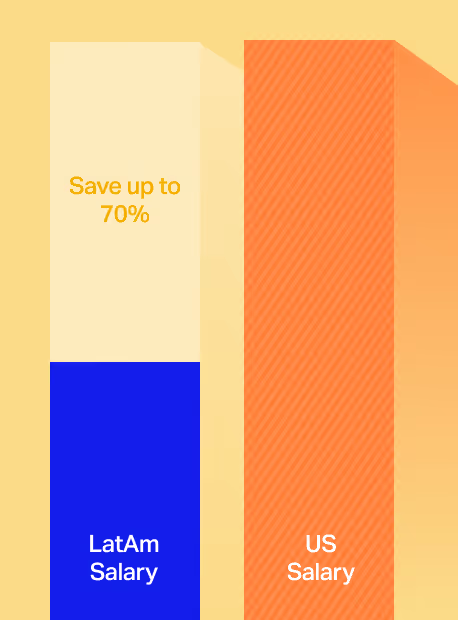
The most immediate driver is cost. Salary expectations in Mexico and across Latin America are considerably lower than in the United States, not because the talent is junior, but because the cost of living is lower. You're not compromising on experience. You're paying a rate that reflects the local market.
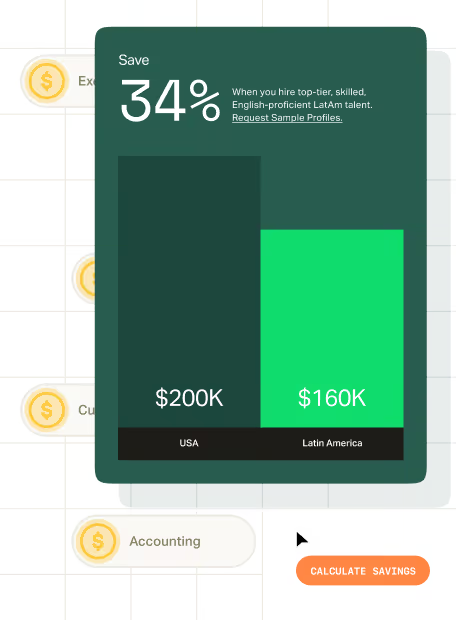
Hire With Near's 2026 State of LatAm Hiring Report, based on 2,000+ placements, found that companies save an average of $35,000-$64,000 per hire annually, and 84% of those hires were mid-level or senior professionals, not junior talent. This is an important distinction: the savings reflect a real market difference, not a quality trade-off.
{{state-latam-hiring}}
Favorable trade agreements
Mexico's participation in the USMCA, its bilateral agreements with the US, and its other global partnerships make it a highly favorable trade partner. These agreements protect US investors and benefit employers in Mexico, creating a more stable hiring and business environment than many other offshore or nearshore staffing alternatives.
USMCA's IP protections are particularly relevant for companies in tech, software, and professional services: industries where protecting proprietary information is non-negotiable. This is one area where Mexico has a concrete structural advantage over regions with weaker IP frameworks.
Time zone alignment
Mexico has full time zone overlap with the US for Central and Mountain time zones, and 1–2 hours of difference from the East Coast, enabling real-time collaboration, daily standups, and immediate response rather than scheduled twice-weekly calls or overnight turnaround on requests.
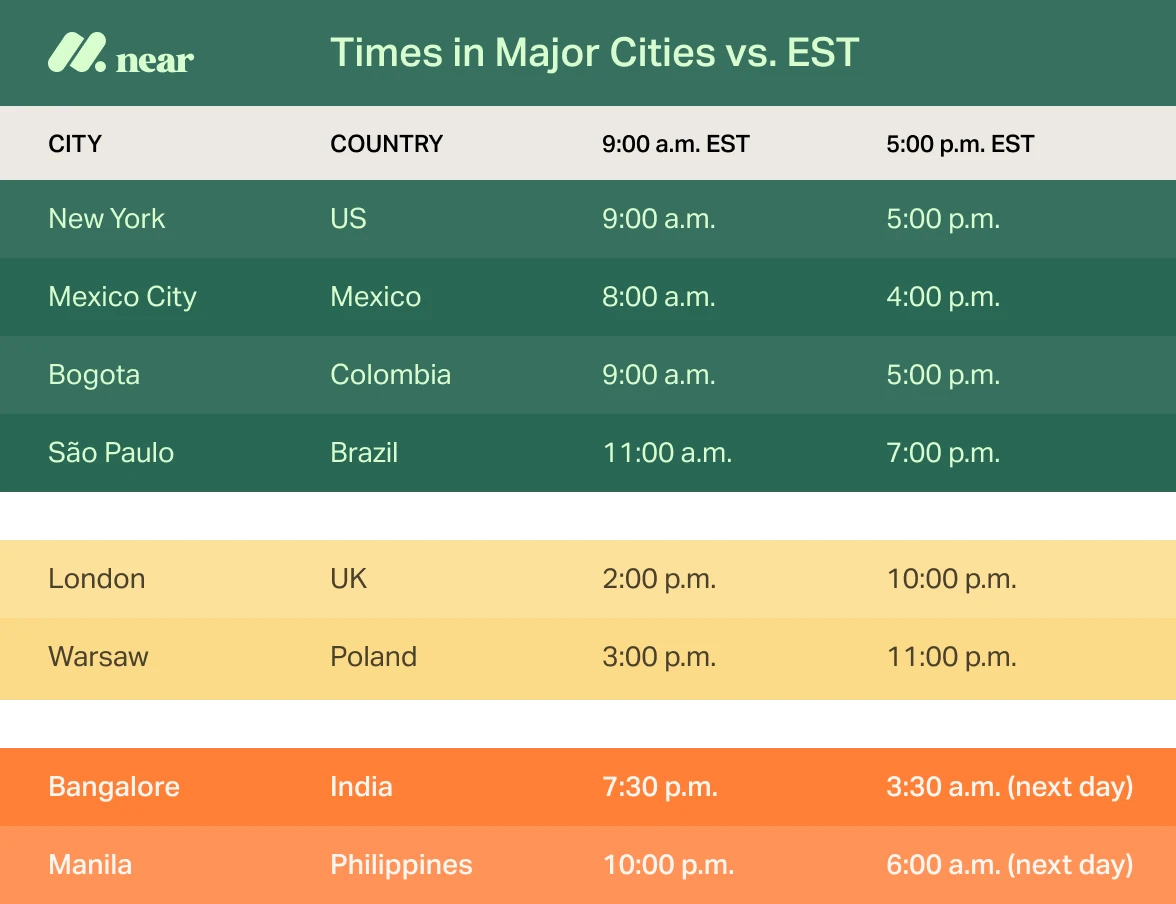
Research from Harvard Business School and INFORMS quantifies the impact: Each additional hour of time zone difference reduces synchronous communication (phone calls, video chats) by 11%. The researchers recommend organizing distributed teams along a north-south axis, like the US-Latin America corridor, rather than east-west, to maximize workday overlap.
In the conversations our recruiting team has with hiring managers, the time zone issue is almost always the first thing that comes up when they describe a previous offshore experience that didn't work. According to Hire With Near's research on why US companies hire in Latin America, 30% of companies choosing LatAm were explicitly switching from offshore regions like India and the Philippines, citing time zone gaps and the inability to collaborate in real time as the primary reason.
Northstar Financial Consulting Group, a Beverly Hills-based accounting and CFO firm, illustrates this problem well. They had tried Indian contractors first, but when their California team arrived at work each morning, the India-based team was already wrapping up for the night. Then, they switched to hiring in Latin America through Hire With Near, built a 12-person team across finance, accounting, operations, and admin, and the company doubled in size in 12 months while saving more than $250,000 annually.
Cultural proximity
Mexico and the US are distinct countries with their own histories, traditions, and professional cultures. But the overlap in business norms, communication styles, and work expectations is significant, showing up in how quickly Mexican professionals integrate into US teams.
Shared professional references, familiarity with US client expectations, and a workforce that has grown up alongside US business culture mean the adjustment period is shorter than with teams from more culturally distant regions. It's not identical, but it's close enough that it rarely becomes a friction point.
Michael Girdley, Co-Founder at Hire With Near, captures the cultural dimension this way:
The great thing about Latin America is it's basically the same time zone, and the cultures are very similar. Living in Texas, I deal with people in Mexico and I'm just like, this is just Texas but a little further south. Pretty much the same thing.
Skilled labor
Mexico's talent pool includes high-quality professionals across tech, engineering, finance, marketing, and operations. The country produces a proportionally higher share of STEM graduates than the US: Mexico's public higher education system awards approximately 37.5% of degrees in STEM disciplines, compared to roughly 20% in the US, according to Mexico's Secretariat of Economy.
Lorenzo Nourafchan, CEO of Northstar Financial Consulting Group, shared his opinion:
What stood out to us was Hire With Near's personal touch and candidate quality. They understood our problem and solved our hiring needs.
Bilingual professionals are common, particularly in client-facing and technical roles, which benefits US companies serving Spanish-speaking customers or operating in cross-border environments.
The founder of an edtech SaaS company put it well:
The time zone is good. At the same time, there would be Spanish speakers as well. We do have a lot of customers who are Spanish-speaking, and we can cater to that side of things as well.
Intellectual property protections
USMCA makes Mexico one of the safer destinations in the Americas for IP-sensitive work. The agreement strengthened protections for trade secrets, software, and digital commerce specifically, which makes it more viable to hire for roles involving access to proprietary systems, source code, or sensitive client data.
Support from the Mexican government
Mexico has invested meaningfully in infrastructure development, resulting in improvements to internet and telecommunications services across the country. Tech corridors in Guadalajara, Monterrey, and Mexico City have attracted global companies and produced a critical mass of experienced professionals.
This investment in connectivity and technical capability makes remote collaboration more reliable than it was even five years ago.
How Much Does Nearshoring to Mexico Cost?
The cost question comes up quickly for most hiring managers, and the numbers are more favorable than most expect, especially once you account for the experience level of the talent available.
Here's a comparison of representative roles across the most-hired departments for Mexico and Latin America broadly:
*Source: Compensation benchmarks based on industry data for Latin America.*
For a more detailed breakdown by role and seniority, see Hire With Near's salary comparison guide.
The savings range from 45% to 72% across every function. For a small company hiring two or three roles, the annual difference can easily exceed $100,000. For a company building a larger team, the math compounds quickly.
One point worth emphasizing: 84% of placements through Hire With Near were mid-level or senior professionals. The savings above aren’t driven by hiring junior talent. They reflect a genuine market rate difference between Latin American and US compensation for the same experience level.
{{latam-hiring-calculator}}
Which Functions Do US Companies Hire For in Mexico?
Mexico's talent pool includes professionals equipped to fill a wide range of roles. Here are the most common functions US companies hire in Mexico.
Virtual assistance
With its deep pool of professionals skilled in a wide range of tasks and roles, Mexico's virtual assistants are popular among US-based businesses, with expertise spanning data entry, marketing, e-commerce, and administrative operations.
Virtual assistants from Mexico bring a clear bilingual advantage for companies serving Spanish-speaking clients.
Information technology
Guadalajara's “Mexican Silicon Valley,” multiple tech-savvy hubs, and established tech operations across Mexico City and Monterrey reflect a large, experienced IT talent pool.
Nearshore IT roles include software engineers, IT support specialists, systems administrators, and project managers.
For a deeper look at the IT hiring opportunity, see nearshore software development in Mexico.
Related reading: How to Hire Developers in Mexico: Cost, Talent, and the Four Ways to Hire
Finance functions
Mexico's talent pool includes highly capable professionals in finance and accounting. This has led to more US businesses hiring accountants, bookkeepers, and finance professionals who can handle financial analysis, planning, and risk management in real time during US business hours.
Human resources
Hiring HR functions remotely is especially practical for companies that lack the headcount for a full in-house HR team. Popular roles include payroll processing, talent management, and recruitment coordination.
For companies with a significant Spanish-speaking workforce, common in industries like construction, manufacturing, hospitality, and logistics, Mexican HR professionals bring native Spanish fluency that makes employee communication and HR administration smoother across the board.
Customer support
Mexico's bilingual workforce is a strong fit for US companies with Spanish-speaking clients. Combining that bilingual advantage with 30-70% cost savings makes customer support one of the most common entry points for companies building a nearshore team.
Common roles include customer support representatives, customer success managers, and bilingual customer service representatives.
How to Start Nearshoring to Mexico
For companies that have decided that nearshoring to Mexico makes sense, the next step is executing the hire without creating compliance headaches or wasting months on the wrong candidate. The process is more straightforward than most hiring managers expect, but it has a few specific requirements worth understanding before you start.
Identify the right roles first
Not every role is equally suited to remote hiring, and not every role needs to be in Mexico specifically. Start by identifying the functions where time zone alignment matters most, where your US hiring costs are highest, or where you're struggling to find qualified candidates within your budget.
Finance, operations, customer support, and software development are typically strong starting points.
Understand local regulations
Mexico's labor laws and compliance requirements are different from those in the US. If you're hiring full-time employees directly, you'll need to navigate local employment contracts, social security contributions, and termination rules.
Working with a staffing agency in Mexico or a nearshore staffing partner can significantly reduce this burden. They handle compliance, contracts, and payroll so you don't have to build that expertise in-house.
Verify skills and cultural fit before hiring
Assessing remote candidates' skills requires a structured process. For technical roles, that means code assessments or case studies. For client-facing roles, it means evaluating English fluency and communication style directly in interviews. Don't rely on resumes alone.
If you're working with a recruiting partner, confirm they pre-screen for both technical competence and communication skills before presenting candidates.
Prepare your team for cross-cultural collaboration
Mexican professionals share cultural similarities with their US counterparts: similar business norms, comfort with direct communication, and familiarity with US professional culture.
Some differences do exist, particularly around feedback directness and hierarchy. A brief onboarding conversation that sets clear expectations for collaboration, communication tools, and meeting norms goes a long way.
Final Thoughts
Understanding why companies are nearshoring to Mexico has become easier as the evidence has accumulated. Mexico has moved from a manufacturing nearshoring story to a full-spectrum remote hiring opportunity, and the business case has only strengthened since 2020.
USMCA enforcement, the normalization of remote knowledge-worker hiring, and the growing shift away from distant offshore regions have all reinforced what the data already showed: Mexico delivers the cost advantages of offshore hiring without the time zone penalty that undermines it.
Franco Pereyra, Co-Founder and COO at Hire With Near, describes what US companies often find when they hire in Latin America:
What sets Latin American talent apart from other regions is that you'll find people who are proactive and creative, people who come up with ideas and new solutions. If you're looking for folks who can bring something to the table, who will push back if they think your idea doesn't make sense, that's what you find in Latin America.
If you're ready to build your first Mexico-based team or want to understand what the hiring process looks like, Hire With Near places full-time professionals across every function covered in this article. Explore nearshore candidates or book a free consultation to learn what it takes to make your first hire.
Frequently Asked Questions
Why are US companies moving to Mexico?
US companies are moving roles to Mexico primarily because of three advantages: time zone alignment with US business hours, 30-70% cost savings versus comparable US hires, and stronger trade protections under USMCA than most other offshore or nearshore alternatives.
The post-2020 normalization of remote work also expanded Mexico's appeal beyond manufacturing to knowledge-worker roles in finance, software, marketing, and operations.
What are the benefits of nearshoring to Mexico?
The core benefits are cost savings (typically 30-70% per hire versus US equivalents), real-time collaboration due to time zone overlap, bilingual professionals for US companies serving Spanish-speaking clients, and strong IP protections under USMCA.
Companies also cite cultural compatibility with US business norms as a practical advantage over offshore alternatives in Asia.
Why are foreign companies attracted to Mexico?
Mexico offers a combination of geographic proximity to the US, a large bilingual workforce, competitive labor costs relative to the US, and a favorable trade and regulatory environment under USMCA. For US companies specifically, the shared time zone means no coordination lag, and the cultural alignment with US business practices reduces the friction that often comes with offshore hiring.
What is the main reason for nearshoring?
For most US companies, the main driver is cost: hiring full-time professionals in Latin America at 30-70% lower cost than equivalent US talent, without sacrificing quality or collaboration. According to Hire With Near's research, 41% of companies that turn to LatAm hiring cite budget as the primary motivation. Time zone alignment runs a close second (30%), especially for companies that have tried offshore hiring in Asia and found the coordination overhead too high.
How much does nearshoring to Mexico cost compared to US hiring?
The savings vary by role, but typically range from 30% to 70% per hire annually. Hiring an accountant in the US costs approximately $84,000 per year, compared to approximately $37,800 in Latin America. Hiring a software engineer in the US costs approximately $126,000, compared to approximately $69,000. Hiring an executive assistant costs approximately $81,000, compared to approximately $22,200.
These are full-time professionals at market rates for their region, not junior talent. The savings reflect a genuine market rate difference, not a quality trade-off.
Which industries lead nearshoring to Mexico?
IT and tech companies are the most active, particularly for software development, DevOps, and IT support. Finance companies and manufacturing firms follow closely, along with SaaS companies scaling remote product and operations teams. Logistics companies also hire heavily in Mexico for supply chain coordination and operations roles.
Most US-based companies across industries find that LatAm hiring works for any function that requires real-time collaboration with a US team.
Can remote professionals in Latin America work US business hours?
Yes. Time zone overlap is one of the central reasons US companies choose Latin America over offshore alternatives. Mexico shares Central, Mountain, and Pacific time zones directly with US states. Professionals across Latin America broadly overlap with US Eastern hours by 3-5 hours minimum, and many professionals in Mexico work in the same time zone as US clients.
Research from Harvard Business School and INFORMS found that each additional hour of time zone difference reduces synchronous communication by 11%, which is exactly why nearshore delivers collaboration outcomes that offshore doesn't.
What roles can I hire in Mexico through Hire With Near?
Hire With Near places professionals across a broad range of functions, including:
- Accounting and finance: accountants, financial analysts, and bookkeepers
- Operations: virtual assistants and executive assistants
- Sales: SDRs and account managers
- Software: software engineers and full stack developers
Most placements happen within three weeks of starting the search.







.webp)


%203.svg)
.avif)





%20(1).avif)

%20(1).png)