


%203.svg)
Key Takeaways
- Outsourcing to Mexico is fully legal post-2021, but the Ley de Subcontratación changed how it works: US companies must hire through a direct employment relationship or a specialist services provider registered with REPSE, not through traditional third-party staffing of core business functions.
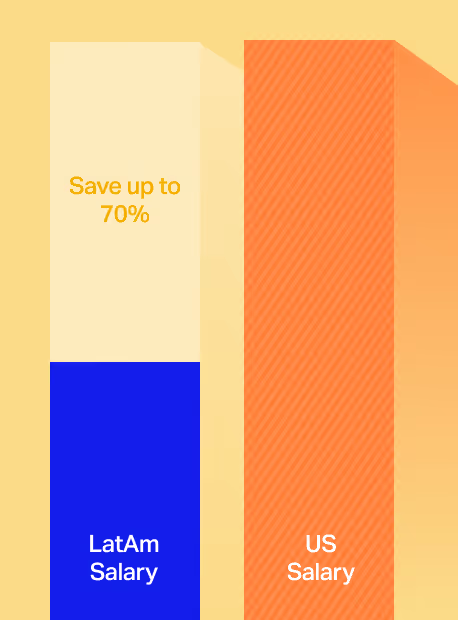
- Mexico-based professionals in customer service, software development, accounting, sales, and administrative roles typically cost 30–70% less than equivalent US hires, while working the same business hours as your team.
- Mexico offers structural advantages other outsourcing destinations can't match: Central and Mountain time zone alignment, USMCA intellectual property protections, and a STEM graduate pipeline that produces more than 130,000 engineers and technical professionals annually.
You're a US company that's been relying on the same team for years. Growth is picking up. You need to scale fast, but US salary expectations for the next five hires will push your payroll past what the business can sustain.
Mexico keeps coming up in conversations as a cost-effective alternative to domestic hiring, but so does a nagging question: Didn't Mexico change its outsourcing laws a few years back? Is this still even an option?
In dozens of conversations with Hire With Near's recruiting team, the same picture emerges: Yes, outsourcing to Mexico is absolutely still an option, and it's growing. The IT outsourcing market in Mexico alone is expected to reach $7.9 billion by 2028. The key is understanding how the rules changed and what that means for the way you hire.
This guide covers everything you need to know about outsourcing to Mexico from the US: what changed in 2021, the real pros and cons, which roles are the strongest fit, and what a nearshore outsourcing approach looks like in practice.
Why Are US Companies Outsourcing to Mexico?
Mexico has become one of the top destinations for US companies expanding their teams because of time zone alignment and strong English proficiency.
Time zone alignment
Many US companies have been outsourcing for years, but what a growing number of them discovered is that the time zone gap with India or the Philippines was quietly undermining the model. Latin American countries, including Mexico, emerged as the natural alternative: same or adjacent time zones, stronger cultural alignment, and a professional workforce available when your team works.
According to Hire With Near's research on why US companies turn to LatAm hiring, 30% are now switching from offshore solutions specifically because of time zone misalignment. One US CPA founder who had previously hired in the Philippines and Egypt described the tipping point:
I had to tell them: ‘Hey, you have to work North America times’. And it's just not a good quality of life for them... I would rather have somebody in Mexico who is in the same time zone, so their quality of life is going to be a lot better.
The time zone gap isn't just a quality-of-life issue for your team members. It's a structural drag on output. Every async cycle adds a day to decisions that should take an hour.
A Harvard Business School and INFORMS study published in Organization Science found that each additional hour of time zone difference reduces real-time communication by 11%. The same research recommends organizing distributed teams along a north-south axis, such as US to LatAm, rather than east-west to maintain communication overlap.
Michael Girdley, Co-Founder of Hire With Near, puts it plainly:
The great thing about Latin America is that it's basically the same time zone, and the cultures are very similar. Living in Texas, I deal with people in Mexico and I'm just like, this is just Texas but a little further south. Pretty much the same thing.
Cultural fit
Mexican professionals are familiar with US business communication norms, direct feedback styles, and the pace of North American companies. Many have studied or worked with US organizations, and the cultural overlap makes onboarding faster and collaboration more natural than with teams in more distant regions.
For some companies, the fit is even more direct. One US business owner with a largely Latino-majority workforce put it plainly:
Most of my workforce is obviously Latino, mostly from Mexico. So to me, it made a lot of sense to explore Latin America.
That kind of cultural continuity (shared language, shared professional references, familiarity with how US clients think and communicate) is harder to quantify than cost savings, but it shows up in the quality of the working relationship over time.
Presence of tech hubs
Mexico has responded to the digital revolution by cultivating several cities as tech-savvy hubs. These cities have developed strong digital infrastructure and attract global companies and startups looking for skilled IT professionals.

Here are some of the cities considered the country's leading tech hubs.
- Guadalajara: Also known as the Mexican Silicon Valley, Guadalajara is a hotspot for global tech companies and startups. It has a strong presence of highly skilled software engineers, and several tech giants such as IBM, Oracle, and Intel have development centers here.
- Monterrey: Known as the industrial capital of Mexico, Monterrey has a growing tech ecosystem with excellent technical universities and R&D centers contributing to its tech-savvy workforce.
- Mexico City: As the country's capital and largest city, Mexico City is a major player in the tech scene. The city boasts a vibrant startup culture and is home to large international tech companies.
- Tijuana: Tijuana is a fast-growing tech center, increasingly drawing attention from global tech companies for its tech talent, particularly in manufacturing and electronics. As it sits directly on the US-Mexico border, the proximity benefits of nearshoring are elevated even further for outsourcing to Tijuana.
- Yucatan: Ok, this one is a region rather than a city, but with government support for IT education and multiple tech parks, Yucatan is also emerging as a viable tech hub. The region's main focus is software development and IT services, making it an attractive destination for tech outsourcing.
Capacity to provide specialized services
US businesses outsource to Mexico due to its ability to provide specialized services. Mexico’s IT industry is mature and capable of delivering competitive services in areas such as software development and IT support. You can also find skilled support for services such as:
- Human resources
- Call center services
- Property management services
Mexico's talent pool is deep across these categories, with a STEM graduate base that accounts for roughly 37.5% of all public university degrees, making it straightforward to find individual professionals or specialist service providers for a wide range of needs.
How the 2021 Mexican Labor Reform Changed Outsourcing
Outsourcing to Mexico is legal. But the April 2021 reform brought a few changes that US companies hiring there should be aware of.
Before 2021, companies commonly routed workers through third-party staffing intermediaries to avoid direct employment obligations, a practice that kept labor costs low but left workers without full benefits or protections. The Ley de Subcontratación (Outsourcing Reform Law) closed that structure entirely.
Under the new rules, Mexican workers must be directly employed by the company using their services, or by a specialist services provider registered with the government's REPSE registry (Registro de Prestadoras de Servicios Especializados u Obras Especializadas). The reform also prohibited outsourcing core business activities to third-party staffing firms.
What's still permitted: Companies can contract out specialized services that fall outside their primary economic activity. A tech company can outsource accounting or facilities services. A law firm can outsource IT support. What's restricted is using a third-party firm to staff your core operations as a cost-avoidance mechanism, which is exactly what the reform was designed to stop.
For US companies, the practical implications come down to how you structure the hire:
- Direct employment: You hire the Mexican professional directly, which requires either setting up a local legal entity in Mexico or using an Employer of Record (EOR) service that employs the worker on your behalf and handles all local compliance.
- Specialist services: You contract with a REPSE-registered provider for services outside your core activity. The provider employs the workers and handles their payroll, benefits, and tax obligations.
- Nearshore staffing through a partner: Working with a nearshore staffing company that manages the EOR layer handles the compliance question automatically. You get the talent, while your partner handles the local employment infrastructure.
The key takeaway from the National Law Review's analysis of the reform: It isn’t a prohibition on hiring in Mexico. It's a structural requirement. US companies that hire through a direct employer relationship (or via an EOR or REPSE-registered partner) are fully compliant.
{{state-latam-hiring}}
What Are the Pros of Outsourcing to Mexico?
Mexico offers US companies a rare combination: full time zone overlap with the continental US, USMCA intellectual property protections, and salary benchmarks that are 32–80% below US equivalents across most professional roles.
Cost savings
When outsourcing to Mexico from the US, the salary difference holds across roles, not just entry-level positions. A mid-level customer support rep based in Latin America typically earns $22,000–$30,000 per year. In the US, the same role runs $60,000–$117,000 annually, a difference of 57–77%.
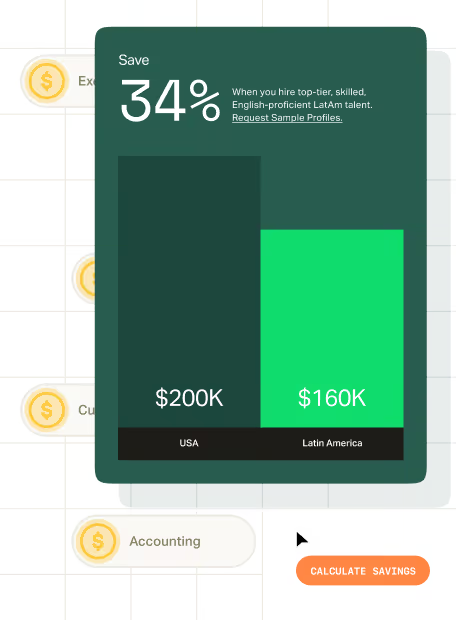
The savings extend to senior roles too. Hire With Near's 2026 State of LatAm Hiring Report, based on 2,000+ placements, found that companies consistently save $35,000–$64,000 per hire annually, and 84% of those hires are mid-level or senior professionals. This counters the common assumption that nearshore hiring only works for junior-level roles.
.webp)
Skilled workforce
Mexico's talent pool is large and educationally dense. According to the Mexican Secretariat of Economy's 2023 official talent report, Mexico's public higher education system produces more than 130,000 engineers and technical professionals annually, and approximately 37.5% of students in Mexico's public system study STEM disciplines.
That compares favorably to the US, where STEM degrees account for roughly 20% of all college graduates, according to the Georgetown Center for Security and Emerging Technology (CSET).
Franco Pereyra, Co-Founder and COO at Hire With Near, points to something the numbers don't capture:
What sets Latin American talent apart from other regions is that you'll find people who are proactive and creative. People who come up with ideas and new solutions, who won't just be a 'Yes, man’. If you're looking for folks who can bring something to the table, who will push back if they think your idea doesn't make sense, that's what you find in Latin America.
Free trade agreements
Mexico participates in more than 40 trade agreements, most notably the United States-Mexico-Canada Agreement (USMCA), which replaced NAFTA. These agreements facilitate business relations by reducing trade barriers and protecting intellectual property rights.
IP concerns can be serious when working with teams in countries without strong protections. Knowing that your IP is covered by a formal international treaty framework makes US companies far more comfortable outsourcing non-core operations to Mexico.
What Are the Cons of Outsourcing to Mexico?
The main challenges when outsourcing to Mexico are English proficiency variation, cultural communication differences, and post-2021 compliance requirements. The 2021 Mexican Labor Reform is the primary compliance concern: It changed how hiring in Mexico must be structured, and US companies that don't account for it can run into avoidable issues.
None of these is a dealbreaker, but each one is worth understanding before you hire.
English proficiency variation
Mexico's English proficiency has improved significantly, but it still varies across regions, seniority levels, and roles. For back-office and technical roles, this rarely creates problems. For client-facing or senior communication roles, it's worth screening specifically rather than assuming.
The most direct fix is working with a staffing partner that tests English proficiency as part of the vetting process, so you only see candidates who meet your communication requirements before the first interview.
Cultural communication style
Mexican business culture tends toward consensus-building and indirect communication, which can be misread by US counterparts as slow decision-making or ambiguity. It's not inaction; it's a different operating style.
The practical solution is setting clear communication expectations early. Define how decisions get made, what direct feedback looks like on your team, and how you want status updates delivered. Companies that establish this upfront rarely run into sustained friction.
Post-2021 compliance structure
The 2021 Mexican Labor Reform restricted the traditional practice of routing workers through third-party staffing intermediaries to avoid employment obligations. Today, hires need to be structured through direct employment, an Employer of Record, or a REPSE-registered specialist services provider.
Working with a staffing partner that understands REPSE and EOR compliance removes this burden from your team entirely. You don't need to become an expert in Mexican labor law. Simply let your partner handle it.

What Are the Best Roles to Outsource to Mexico?
The strongest roles to outsource to Mexico are customer service, software development, accounting and bookkeeping, sales, and virtual assistant functions. These are categories where Mexico's talent pool, English proficiency, and time zone alignment create the clearest advantages.
Customer service
Mexico's customer service sector is strong, thanks to the nation's moderate-to-high English proficiency and native Spanish fluency. Beyond frontline support, Mexican professionals are well-suited for more specialized customer-facing roles such as customer success management, account management, and technical support.
Responsibilities typically include:
- Answering and managing customer inquiries over the phone or email
- Providing product service information and resolving product or service problems
- Processing orders and handling customer complaints
- Providing technical support to customers
Example job titles: customer service representative, customer success manager, technical support specialist
Data entry
Outsourcing data entry to Mexico typically costs 40–60% less than equivalent US rates, and frees your internal team to focus on higher-value work. Mexican data entry workers are typically very accurate and efficient. This role could include:
- Entering customer and account data into databases
- Compiling, verifying accuracy, and sorting information to prepare source data
- Reviewing data for deficiencies or errors and correcting any incompatibilities
- Maintaining data entry requirements by following data program techniques and procedures
Example job titles: data entry clerk, data operator, data analyst
Software development
Mexico is known for its strong software development outsourcing industry. This includes responsibilities like:
- Designing, coding, and testing software programs and applications
- Fixing bugs and improving the functionality of existing software
- Collaborating with other team members to design and launch new features
- Conducting thorough QA testing to make sure software meets quality requirements
Example job titles: software developer, Webflow developer, Java developer, quality assurance engineer
Accounting and bookkeeping
Mexico's accounting industry is mature and known for its ability to handle bookkeeping duties while adhering to US GAAP or other international accounting standards.
Outsourcing accounting to Latin America can cut accounting costs by 49–71% compared to US hires, without compromising adherence to US GAAP.
Responsibilities typically include:
- Recording financial transactions and posting debits and credits
- Preparing financial reports and statements
- Completing payroll functions and preparing tax returns
- Making sure all financial reporting deadlines are met
Example job titles: accountant, bookkeeper, payroll specialist, tax accountant
Sales
Mexican sales professionals are highly adaptable and familiar with US business practices, with a significant share of candidates already having direct experience working with US clients.
Responsibilities typically include:
- Prospecting and qualifying leads through cold calling, email outreach, and social selling
- Conducting product demonstrations and managing the sales cycle from lead to close
- Building and maintaining strong client relationships for retention and expansion
- Managing CRM systems and tracking sales metrics and performance
- Collaborating with marketing teams on lead generation strategies
Example job titles: sales development representative, business development representative, account executive, sales representative, Salesforce manager
Administrative and operations support
Mexico has a strong pool of professionals who specialize in operational and administrative support: organized, proactive communicators who are comfortable working across multiple tools and time zones to keep business functions running smoothly.
Responsibilities typically include:
- Managing executive calendars, travel arrangements, and daily operations
- Conducting research and preparing reports, presentations, and documentation
- Handling administrative tasks like data entry, file management, and correspondence
- Coordinating meetings, events, and cross-functional projects
Example job titles: virtual assistant, executive assistant, legal analyst or assistant, administrative assistant
For a deeper look at why Mexico is such a strong choice for assistant roles, check out our guide on hiring virtual assistants in Mexico.
{{salary-guide-us-latam}}
Cost of Hiring in Mexico: A Salary Comparison
One of the most common questions US companies have before hiring in Mexico is what they'll actually pay. Here's a role-by-role breakdown based on compensation benchmarks across common outsourcing functions:
For the full picture across all roles, check the US vs. Latin America Salary Guide.
Why Working With a Recruiting and Staffing Partner Makes Hiring in Mexico Easier
The two biggest barriers US companies face when hiring in Mexico are compliance uncertainty and candidate quality. A recruiting and staffing partner solves both.
In conversations our recruiting team has with US hiring managers, the same pattern emerges: Companies spend weeks trying to figure out the legal structure, then either give up or proceed with significant uncertainty. Others skip the compliance question entirely and run into issues later. Neither outcome is necessary.
Here's what a good staffing partner handles on your behalf:
- Payroll and compliance: A nearshore staffing partner operating as an Employer of Record manages REPSE compliance, payroll processing, employment contracts, and benefits administration in Mexico. You don't need to understand the Ley de Subcontratación or set up a local entity. The Employer of Record structure makes post-2021 compliance automatic.
- Candidate quality: Hiring directly in Mexico without local market knowledge means sorting through candidates with no benchmark for what good looks like. Hire With Near's recruiters screen for English proficiency, US-client experience, technical skills, and cultural fit before a candidate ever reaches you. The difference between vetted and unvetted pools is substantial.
- Speed: Hire With Near's typical time-to-hire is 7–28 days. DIY hiring through job boards in an unfamiliar market routinely takes three to six months. If you're trying to fill a gap quickly, that difference matters.
- Risk reduction: Misclassification, tax withholding errors, and benefits non-compliance are issues that US companies regularly run into when hiring internationally without guidance. A partner with established processes in Mexico eliminates these risks before they become yours.
Conversion Logix, an Inc. 5000 digital advertising agency based in Austin, Texas, had tried Philippines-based offshore hiring before turning to Hire With Near. The offshore experiment created communication friction that hampered productivity and required extensive oversight.
Through Hire With Near, they placed 15 professionals across five departments, including machine learning engineering, finance, client services, and marketing, with a 22-day average time-to-hire. The result: $781,000 in annual savings, a 43% reduction compared to US-based hires.
Tawnya Morse, Client Services Manager at Conversion Logix, described the result:
I think the main benefit of LatAm talent is the ease of integration. It's been so easy to work together without really noticing any kind of difference from somebody that's in the States.
Hire With Near's nearshore staffing and recruiting services handle the full process: candidate sourcing, vetting, compliance, payroll, and onboarding, so your team can focus on the work, not the logistics.
{{prevetted-banner}}
Final Thoughts
Outsourcing to Mexico gives US companies a mature nearshoring destination with real structural advantages: full US time zone alignment, USMCA intellectual property protections, a strong technical talent pipeline, and cost savings that hold across roles from customer support to software development.
The 2021 Labor Reform changed how outsourcing in Mexico works, but it didn't close the door for US companies. Hiring through an EOR or a nearshore staffing partner handles the compliance question before it becomes a problem (and most companies find the process more straightforward than they expected).
When you're ready to move forward, book a free consultation with Hire With Near's team. With a pre-vetted pool of 45,000+ candidates and a 7–28-day time-to-hire, we can move quickly once you are.
Frequently Asked Questions
Is outsourcing to Mexico legal?
Outsourcing to Mexico is fully legal. The 2021 Labor Reform (Ley de Subcontratación) restricted the use of third-party staffing firms for core business activities, but US companies can still hire in Mexico through direct employment relationships, Employer of Record (EOR) arrangements, or REPSE-registered specialist services providers.
Working with a nearshore staffing partner that includes an EOR structure handles this compliance layer automatically, so the reform creates no barrier for most US companies following current practice.
How did the 2021 Mexican Labor Reform change outsourcing?
The Ley de Subcontratación, which took effect in April 2021, prohibits contracting out core business functions to third-party staffing firms, a practice that had been widely used to shift employment obligations away from the actual employer.
Specialist services that fall outside a company's primary economic activity are still permitted, provided the provider holds REPSE registration.
US companies hiring professionals directly or through an EOR aren’t affected by these restrictions, since the EOR employs the worker on the client's behalf under a compliant structure.
Why are more US companies outsourcing to Mexico?
US companies are increasingly choosing Mexico primarily because of time zone alignment, 30–70% cost savings versus US hiring, and the USMCA trade framework that protects intellectual property. Mexico offers full overlap with the US Central and Mountain time zones, making it easier to maintain the same working rhythms as a US-based team.
How much does it cost to outsource to Mexico vs. other LatAm countries?
Mexico is in the mid-range for LatAm talent costs. Some roles in Colombia or Argentina come in at slightly lower salary benchmarks, while Mexico offers the advantage of geographic proximity and Central time zone alignment for most US companies.
For a full comparison by role and country, the US vs. Latin America Salary Guide provides detailed benchmarks.
What roles are best to outsource to Mexico?
The strongest fits for outsourcing to Mexico are customer service, software development, accounting and bookkeeping, sales, and virtual assistant or administrative roles.
These categories align with Mexico's talent pipeline strengths: a large STEM graduate base, strong English proficiency, and a growing services sector with experience working with US clients.
The salary savings are most pronounced in customer support and sales development roles, where the cost differential between Latin America and the US runs 57–80%.
What time zones does Mexico cover for US business hours?
Mexico operates across three time zones: Central, Mountain, and Pacific, covering full overlap with the continental US regardless of where your team is based. Cities like Mexico City and Guadalajara operate on Central Time. Tijuana operates on Pacific Time, which is directly on the border with California. For US companies on the East Coast, a Central Time professional in Mexico is one hour behind, which creates more than enough overlap for a full collaborative workday.
Which types of US companies outsource to Mexico most often?
Technology and software companies, accounting and finance firms, marketing agencies, SaaS companies, and customer-service-intensive businesses are among the heaviest users of Mexico and LatAm hiring.
IT and tech companies in particular lean on Mexico for software development and technical support roles, given the country's strong engineering graduate pipeline. Accounting firms and marketing agencies also hire heavily from Latin America for the combination of cost savings and strong professional standards.
Most US companies across all sectors see 30–70% savings regardless of the specific function they're hiring for.
How does working with a staffing partner simplify outsourcing to Mexico?
A recruiting and staffing partner removes the two biggest friction points in Mexico outsourcing: compliance structure and candidate quality. The partner handles REPSE or EOR compliance, payroll, contracts, and benefits, so you don't need to build local HR infrastructure.
On the talent side, Hire With Near's recruiters pre-screen for English proficiency, US-client experience, and role-specific skills before you see a candidate. The typical result is a vetted shortlist within a week and a hire within 7–28 days.
For companies that have tried to source directly and run into compliance questions or unvetted candidate pools, a staffing partner changes the picture entirely.







.webp)


%203.svg)
.avif)





%20(1).avif)

%20(1).png)