%203.svg)
Key Takeaways
- Accounting outsourcing trades cost and flexibility for control and integration, while keeping it in-house gives you control at a higher cost. For most growing companies, hiring your own full-time remote accounting team in Latin America captures the cost savings of outsourcing without giving up control.
- The right model depends on your budget, how strategic the work is, your need for continuity, and your compliance and data-security requirements, not on price alone.
- A dedicated remote accountant in Latin America costs roughly what an outsourcing firm charges, but you get an employee you own and manage, working in your time zone with US GAAP fluency.
Your US accounting firm keeps raising its rates and an in-house hire costs more than your budget allows, leaving you spending time on books instead of running your business month after month. That’s the accounting problem most growing companies face, and most of them solve it the same way: they outsource.
Accounting outsourcing works. But it comes with tradeoffs most companies don’t fully account for upfront: rotating staff who don’t know your business, limited visibility into who’s touching your books, and service packages that rarely match exactly what you need.
There’s a third option that’s grown significantly among US companies in the past few years: hiring a dedicated, full-time accounting professional from Latin America. It delivers the cost savings of outsourcing with the control and continuity of an in-house hire.
This guide walks through what accounting outsourcing actually involves, the pros and cons of outsourcing versus keeping the work in-house, how to decide which model fits your business, and why building your own finance and accounting team in Latin America is increasingly the best of both worlds.
What Accounting Services Can You Outsource?
You can outsource almost any accounting function, from routine bookkeeping to high-level financial planning. The same functions can also be handled by a dedicated remote hire. The difference is who owns the relationship and how the work gets done.
Here are the core services companies most often hand off or hire for directly:
- Bookkeeping: The foundation of any accounting system. Bookkeeping involves recording and organizing day-to-day financial transactions so the rest of your reporting stays clean. Whether you outsource or hire a dedicated bookkeeper from Latin America, this is typically the first function companies take off their plate.
- Payroll management: More than issuing paychecks. It includes calculating wages, withholding taxes, complying with employment laws, and issuing year-end tax forms. A dedicated remote payroll specialist handles all of this within your existing systems.
- Accounts payable and receivable: Keep cash flow steady by managing what you owe and what you’re owed, handling invoices, ensuring timely payments, and managing collections. Some companies prefer to keep invoicing in-house; more on that in the tips below.
- Financial reporting: Accurate, timely reports drive good decisions. This function delivers income statements, balance sheets, and cash flow statements you can rely on. It’s one of the most common functions handled by an outsourced or remote staff accountant, or by a senior accountant.
- Tax services: Tax compliance and preparation give you access to specialists who can handle everything from filing to planning for tax efficiency. Outsourcing or hiring a LatAm tax accountant with US GAAP and IFRS exposure is a common approach here.
- Financial planning and analysis: Beyond crunching numbers, FP&A turns your data into forecasts and strategy. This is work an outsourced or nearshore financial analyst typically owns.
Most of these functions can either be outsourced to a firm or staffed with your own remote team member. Which path makes sense depends on the tradeoffs below.
Should You Outsource Your Accounting?
Outsourcing accounting makes sense when you need flexible support at a lower cost and the work isn’t tightly woven into your day-to-day operations.
It doesn’t work as much when you need control, continuity, and deep integration with your team.
Check the real benefits and drawbacks below:
Pros of outsourcing accounting services
Outsourcing your accounting services offers several clear benefits:
- Lower salary costs: You can often find accounting talent in regions where labor costs are lower than in the US. Latin America is a popular destination because of its pool of highly skilled remote professionals with salary expectations below their US counterparts, allowing you to hire a more experienced professional.
- Flexible hiring arrangements: Accounting outsourcing lets you scale support up or down. You can engage accounting services by the hour or by the project instead of carrying a full-time salary you don’t always need, which suits smaller businesses well.
- Industry expertise: A good outsourcing partner brings talent that has worked with companies in your sector and understands your specific accounting requirements. That helps when you operate in a niche market with complex needs.
- Knowledge of accounting tools: Outsourcing can connect you with professionals already fluent in QuickBooks, NetSuite, or SAP, saving you the time of training a team on those tools.
- A larger talent pool: Accounting outsourcing widens your search well beyond your local market, giving you access to a broader range of skills and experience.
Cons of outsourcing accounting services
Just as important as learning the advantages of outsourcing is understanding its drawbacks:
- Limited knowledge of US GAAP: Not every accounting professional outside the US understands US Generally Accepted Accounting Principles (GAAP). If GAAP compliance is essential, you have to screen for it carefully.
- Harder to build a real partnership: Depending on the provider, an outsourced team can feel more like a vendor than a part of your team. Without daily interaction, they may never fully learn your business, and the work can feel transactional.
That US GAAP concern is the one finance leaders raise first, and from the editorial work I do interviewing Hire With Near’s finance and accounting recruiters, it’s also the one that’s easiest to put to rest with the right hiring approach.
Lucas Stepanenko, Sourcing Manager at Hire With Near, explains:
LatAm finance professionals have strong academic training and a lot of exposure to Big Four firms. That gives them experience with international markets and makes them very well versed in key accounting standards like US GAAP and IFRS, which are among the most common requirements we see from our clients.
In other words, the compliance gap is a sourcing problem, not a geography problem.
The “feels like a vendor” concern is a different story: it’s harder to solve it by outsourcing, because it’s baked into the model. That’s where the in-house comparison comes in.
In-House vs. Outsourced Accounting: How the Two Models Compare
Several small businesses give up hiring in-house accounting professionals because US salaries are beyond their budget. Hiring in Latin America makes it possible without any compromise on quality.
In-house accounting gives you full control and tight integration at a high fixed cost, while traditional outsourcing gives you lower cost and flexibility at the expense of control, continuity, and tight integration.
The table below lays out where each model wins.
The most common frustration with outsourcing isn’t quality. It’s that the people doing your books never feel truly integrated into your company, as one client who switched from outsourcing to direct hiring put it:
It ends up not feeling like they’re part of the team. They’re an agency that works with us. We really want to bring in people who are part of the team but just based somewhere else.
That instinct is widespread. Hire With Near’s research into why US companies hire in Latin America found that 12% made the move specifically to switch from outsourcing to hiring their own dedicated team rather than relying on transactional agency resources.
There’s also a hidden cost to the outsourced model that doesn’t show up on the invoice.
A media entrepreneur running two small businesses described the experience of working with an external accounting firm: the firm did the work, but every time something needed context or a decision, it landed back on the company’s founders rather than being resolved by someone who actually knew the business.
If you want to see how specific firms compare before you decide, this list of LatAm outsourcing companies is a useful starting point.
How to Decide: Should You Outsource, Hire In-House, or Build a Remote Team?
If you’re wondering whether you should outsource your accounting function, hire a US in-house team or build a remote team, there are five questions you should ask yourself before making a decision:
- What’s your budget? A full in-house hire carries US salary, benefits, and overhead. Outsourcing trims that, but a dedicated remote hire in Latin America typically gives you a full-time employee and more capability for a similar or lower spend, so the budget you already have stretches into a real team member rather than a contract.
- How strategic or client-facing is the role? Routine, high-volume tasks (data entry, basic AP) are easy to outsource. Strategic work (FP&A, board reporting, anything that touches your customers) rewards control and continuity.
- How much do you need continuity and control? Outsourcing firms rotate staff and institutional knowledge walks out the door. If you need the same person to learn your business and stick around, that points toward hiring your own.
- What are your compliance and data-security needs? If the work involves SSNs, bank data, or US GAAP filings, you want direct oversight of who touches it and how it’s handled.
- What’s your volume, and will it grow? Seasonal spikes suit flexible outsourced support. Steady, growing workloads usually justify a dedicated hire.
For most growing companies, the answer isn’t binary.
The domestic context is worth knowing: the US is projected to have more than 124,000 new accounting and auditing job openings each year over the coming decade, according to the U.S. Bureau of Labor Statistics. The number might sound big, but many of them are replacement roles, as experienced professionals retire or leave the profession.
Against that backdrop, building your own remote accounting team in Latin America opens up a significantly deeper talent pool at compensation levels that don’t exist in the US market.
Why Is Hiring Accounting Talent in Latin America the Best of Both Worlds?
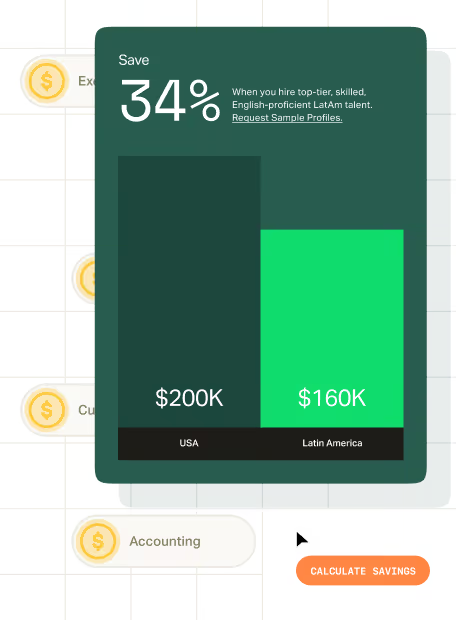
Hiring a full-time, dedicated remote accounting professional in Latin America costs roughly what you’d pay an outsourcing firm, but you get an embedded team member you own and manage.
Cost savings
That’s the part that surprises most finance leaders: the savings are real, and they don’t come at the expense of quality.
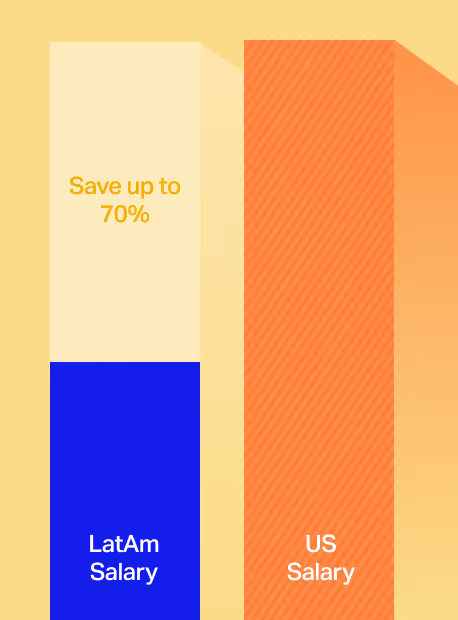
According to Hire With Near’s State of LatAm Hiring Report, companies save an average of 55% by hiring accountants in Latin America versus the US, and 30–70% on salaries across all roles, with most saving $35,000 to $64,000 per year per hire.
Our full breakdown of US vs. Latin America accounting salaries shows how that plays out by role, but here are a few examples:
For the most up-to-date figures, see Hire With Near’s US vs Latin America Salary Guide
Those numbers reflect compensation benchmarks for the region, which are lower than those in the US because of a lower cost of living, not because of a discount on capability. In fact, 84% of the placements made by Hire With Near are mid or senior-level positions.
Real-time collaboration
The advantages stack up beyond cost.
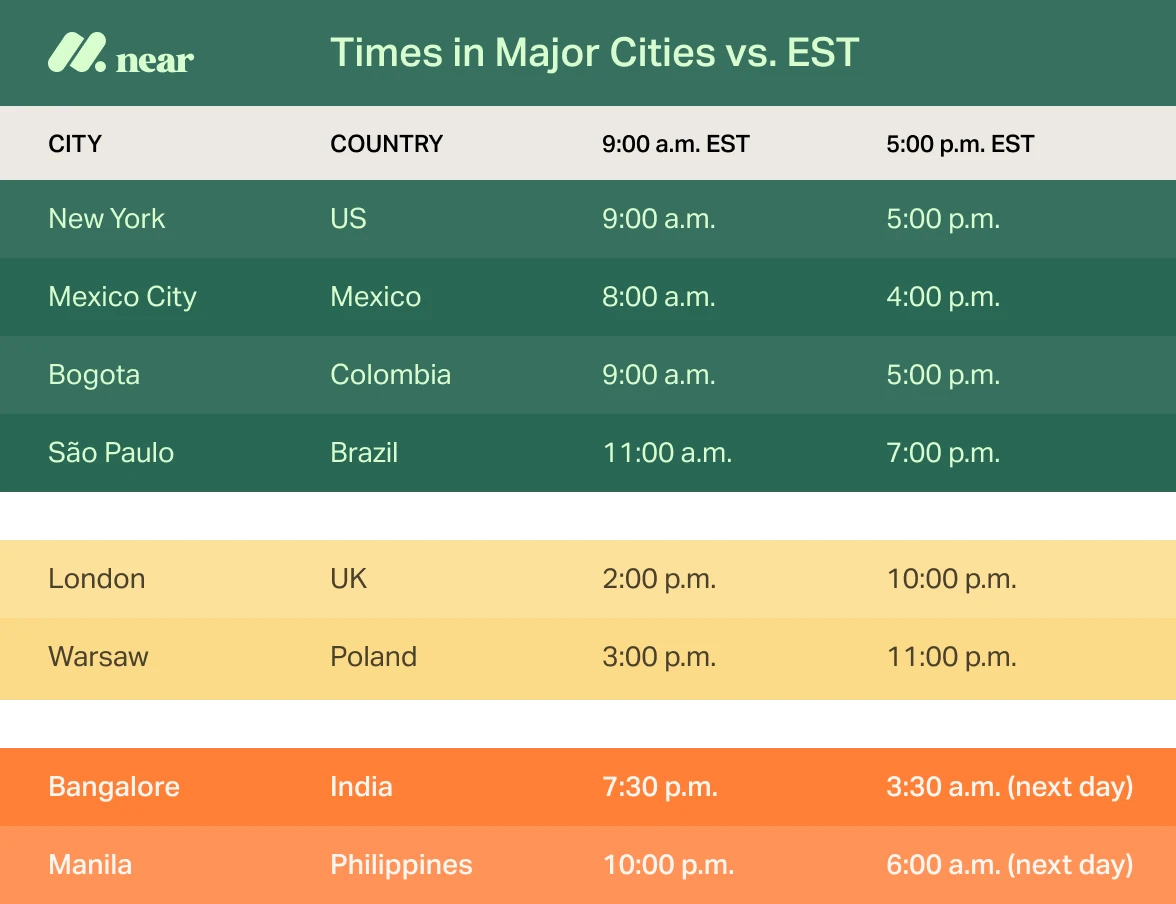
Accountants in Latin America work during overlapping US business hours: LatAm countries sit 0–3 hours from US Eastern Time.
That means your month-end close doesn’t wait on a 12-hour time lag, questions get answered the same day, and reconciliation issues get flagged before they become problems.
And unlike a Philippines or India offshore arrangement, your accounting hire is available for a quick call during your normal working day without anyone working outside their own reasonable hours.
Related reading: Should You Offshore Accounting to India or Latin America?
Seasoned professionals
Many LatAm accounting professionals bring Big Four training and genuine US GAAP and IFRS fluency, which directly addresses the compliance concern that outsourcing raises.
In Argentina alone, a university accounting degree takes five to six years, producing graduates with a depth of technical training that frequently surprises US hiring managers.
And because they’re your employees, not a vendor’s rotating staff, retention is stronger. Hire With Near’s data shows LatAm hires stay 66% longer than equivalent US hires on average, a meaningful advantage for a function where institutional knowledge adds up over time.
The CyberFortress example: 20 hires, $1.2M saved
CyberFortress, a fast-growing cybersecurity company based in San Antonio, Texas, is the clearest proof of the direct hiring advantages.
During a year when CyberFortress doubled headcount and hit acute US shortages for finance talent, the company chose to build its own team rather than outsource the function.
Working with Hire With Near, they built a full 20-person finance and accounting team in Latin America, including a director of accounting and financial reporting, an accounting team lead, and a director of global tax.
The result: an estimated $1.2 million in annual salary savings, and a month-end close cut from 15 days to 10.
Their CFO, Seema Chacko, put it this way:
We hired 20 team members who share our core values: great attitude and desire to learn, resourcefulness, and adaptability. Hire With Near’s team was very responsive, and their easy-going communication fostered a seamless hiring process.
Another great example is a real estate investment firm that hired a financial specialist based in Brazil. The role was initially scoped for fund accounting, but ended up running point on multi-million-dollar loan closings and company-wide reporting.
How to hire your own accounting talent
Once you decide to hire your own accounting professional, you have three real paths:
- Build it yourself: Source candidates on job boards or LinkedIn, then use an employer of record to handle contracts, payroll, and local compliance. The catch: an EOR manages the employment logistics but not the recruiting, so you still have to find and vet every candidate yourself.
- Freelance platforms: Upwork and Toptal are built for project-based contract work, not the full-time, embedded accountant most companies actually need. Useful for one-off engagements, but not the right fit for an ongoing finance function.
- Specialist staffing and recruiting partner: The simplest path for most. A specialist partner finds and vets the talent and handles employment, payroll, and compliance in one relationship. No need to manage two vendors.
If you want to compare your options, see our list of companies to hire LatAm finance talent. Hire With Near operates as exactly this kind of specialist partner: handling sourcing, vetting, payroll, and compliance for dedicated LatAm accounting hires.
For the mechanics end-to-end, our guide to hiring remotely in Latin America covers the full process.
{{state-latam-hiring}}
Which Industries Outsource Their Accounting?
Companies across virtually every industry can outsource or hire remote accounting help, with especially heavy adoption in sectors that operate across multiple entities, run on tight margins, or require complex compliance.
Hiring data points the same way: financial services industry, the accounting industry itself, construction, and real estate are consistently among the most active in sourcing remote accounting talent.
Real estate is a prime example. Investors and property managers juggle bookkeeping across many entities, and premium US firm pricing adds up fast. One US-based real estate investor with multiple property entities described the squeeze:
It’s costing us an arm and a leg to get it done by our current accountants here in the United States. They are a top regional accounting firm. So they’re charging top of market rates.
That pricing is exactly the kind of cost a dedicated nearshore real estate recruiting hire can absorb without scaling your bill linearly.
Energy companies face a similar story, which is why oil and gas recruiting in Latin America has grown for cost accounting and reporting roles.
The same is true for holding companies running several small businesses under one roof: one of our clients hired a remote bookkeeper to centralize accounting across every entity, a hire that went on to lead a system migration and a six-figure tax remediation project.
Manufacturing companies, healthcare organizations, SaaS businesses, insurance firms, and logistics companies all hire remote accounting talent too, typically for AP/AR, financial reporting, and FP&A functions that benefit from a steady, dedicated hand.
How Do You Outsource Accounting Successfully? 5 Tips That Also Apply to Building Your Own Team
Whether you outsource or build your own remote team, these tips help protect your data and get more value out of the partnership.
1. Secure your accounting information online
Use cloud storage or a cloud-based accounting system to keep records, reports, and sensitive financial data on a secure server that’s only accessible with a login. This makes backups easier and keeps your data safe and reachable if a system fails.
It also makes life simpler for a remote team member or outsourced provider who needs access from another location.
2. Use accounting management software
Good accounting software keeps your financial records organized, simplifies the work, and saves time and money. It delivers several benefits at once:
- Fewer manual steps: Software handles bookkeeping, billing, and reporting more consistently and reduces the chance of errors.
- Data security: Because most data breaches are motivated by financial gain, accounting work carries real exposure. Software adds protective layers like encryption and user authentication for sensitive financial information.
- Cost effectiveness: Automating manual work reduces the hours your team has to put in.
- Better communication: Real-time access to financial data supports faster, better-informed decisions.
- Scalability: Most accounting software scales up or down as your business changes, which helps fast-growing companies.
3. Build long-term relationships with your accounting team
Replacing your accounting team every time someone leaves is expensive and slow, so invest in continuity. A long-term relationship gives your accountants time to learn your business, tailor their work to your needs, and spot trends and issues earlier.
This is one of the strongest arguments for hiring your own dedicated remote team rather than relying on a revolving door of outsourced staff: when the person is yours, the institutional knowledge stays.
4. Separate treasury from accounting
Outsourcing treasury functions to a third party can expose your financial information to security risks. Keeping treasury in-house, accessible only to your most trusted team members, protects financial confidentiality and reduces the risk of breaches, mistakes, and fraud.
5. Don’t outsource invoicing
Outsourcing invoicing can cost more than it’s worth and add little value. Invoicing is related to accounting but isn’t strictly an accounting function. It’s a relatively simple process that most business owners or administrative staff can handle in-house.
Final Thoughts
After working with hundreds of US companies on their accounting hiring decisions, Hire With Near’s recruiting team has seen this pattern consistently: the choice between outsourcing and in-house was never really about cost alone. It’s about control.
Outsourcing trades control for savings, in-house trades savings for control, and hiring your own remote team in Latin America is the rare option that gives you both.
The companies seeing the biggest wins aren’t just cutting costs. They’re getting senior accountants with Big Four experience, controllers who streamline the month-end close, and financial analysts who bring fresh thinking, people who learn the business and stick around.
Companies retain remote LatAm hires far longer than US-based ones. CyberFortress didn’t just save $1.2 million a year. They cut their month-end close by five days and built accounting into a strength instead of a cost center.
Ready to see what’s possible? Browse pre-vetted sample candidate profiles to get a sense of the talent available. When you’re ready to move forward, book a free consultation with our team. You won’t pay anything until you make a hire.
{{latam-hiring-cta-v2}}
Frequently Asked Questions
What is accounting outsourcing?
Accounting outsourcing is the practice of hiring an external firm or provider to handle some or all of your accounting functions, such as bookkeeping, payroll, tax, financial reporting, and FP&A, instead of doing the work with in-house staff. Companies choose it mainly to lower costs and add flexibility without carrying full-time salaries.
The main tradeoff is less control and integration: an outsourced team often feels more like a vendor than part of your business, which is why many growing companies now hire their own dedicated remote accountants instead.
What accounting functions can you outsource?
You can outsource nearly any accounting function, including bookkeeping, payroll management, accounts payable and accounts receivable, financial reporting, tax compliance and preparation, and financial planning and analysis.
Routine, high-volume tasks like bookkeeping and AP/AR are the easiest to hand off. If you're outsourcing collections specifically, see our roundup of the top accounts receivable outsourcing companies. More strategic work, like FP&A and board reporting, can also be outsourced, but it benefits from the control and continuity you get with a dedicated hire who learns your business over time.
Is it cheaper to outsource or hire an in-house accountant?
Outsourcing is usually cheaper than a full-time US in-house accountant because you avoid salary, benefits, and overhead, but hiring your own remote accountant in Latin America can be cheaper still while giving you a dedicated employee.
Hire With Near’s compensation benchmarks show companies save an average of 55% on accounting salaries by hiring in Latin America versus the US.
The cost of a dedicated LatAm hire often lands close to what an outsourcing firm charges, so you don’t have to trade control for cost.
For more information on salaries, check our US vs. Latin America Salary Guide.
What is the difference between outsourcing accounting and hiring a remote accountant?
The difference between outsourcing accounting and hiring a remote accountant is ownership: an outsourced provider is an external vendor that works across many clients, while a remote accountant is your own full-time employee who happens to work from another location.
Outsourcing offers flexibility and low commitment but limited control and integration. A remote hire, especially in an overlapping US time zone, gives you direct management, cultural fit, continuity, and a person who learns your business, at a cost comparable to outsourcing.
Do accountants in Latin America understand US GAAP?
Yes, many accountants in Latin America are well versed in US GAAP and IFRS, particularly those with Big Four experience. Big Four exposure on a resume is one of the strongest signals of US GAAP and IFRS fluency, which is among the most common requirements US clients ask for.
Accountants in the region also work during overlapping US business hours, so reviews and month-end close happen in real time.
For more on what to ask, see these common questions finance leaders ask about hiring accountants in Latin America.
What other industries hire accountants in Latin America?
Companies across virtually every industry hire accountants in Latin America, not just finance and accounting firms.
Real estate companies are especially active, which is why nearshore real estate recruiting is common for multi-entity bookkeeping and reporting, and energy firms drive demand for oil and gas recruiting in Latin America in cost accounting roles.
Manufacturing, healthcare, SaaS, insurance, and logistics companies also hire remote accounting talent regularly.
The common thread is steady, detail-heavy financial work that rewards a dedicated, time-zone-aligned hire.
What finance and accounting roles can I hire in Latin America?
You can hire the full range of finance and accounting roles in Latin America, from entry-level to senior leadership. Common hires include accountants, bookkeepers, tax accountants, financial analysts, and nearshore controllers.
These roles typically offer the same depth as US-based professionals, with better time zone overlap than offshore alternatives and meaningful cost savings, so you can build a complete finance function rather than filling a single seat.
Where can I find a full list of accounting outsourcing firms?
If you want a curated list of providers, see this guide to the best finance and accounting outsourcing providers, which covers firms that specialize in outsourced accounting. It’s the right resource if you’ve decided outsourcing fits your needs.
If you’re leaning toward building your own dedicated team instead, a specialist staffing partner is usually the faster path to a great full-time hire. You can also compare the best nearshoring companies to hire accountants to find one that specializes in the region.
What are the benefits of offshore accounting
Offshore accounting can lower costs and open access to a large global talent pool, which is why many companies start there.
The main tradeoff is time zones—an offshore team in Asia often works while your US team sleeps, delaying reviews and month-end close. That's why many companies now choose nearshore hiring in Latin America, which keeps the cost savings while adding real-time overlap. For a full look at the upside, see the benefits of offshore accounting.






.webp)
.webp)


%203.svg)
.avif)





%20(1).avif)

%20(1).png)