


%203.svg)
Key Takeaways
- Accounts payable outsourcing means contracting a third-party provider to run your invoice processing, vendor management, and payment runs, and it fits companies whose AP work is high-volume, variable, and mostly routine.
- No credible industry body publishes a standard price for AP outsourcing, so benchmark every quote against what an invoice costs you in-house today: efficient AP functions process an invoice for around $1.42 while weak ones spend more than $6, according to American Productivity & Quality Center benchmarking.
- Hiring a dedicated accounts payable specialist in Latin America costs $18K–$42K a year against $47K–$72K for the US equivalent, which makes a full-time hire realistic for companies that need continuity, control, and someone who knows their vendors.
Invoices are stacking up, your controller or bookkeeper is coding them at 9 p.m., close slipped again last month, and vendors have started calling about payments they're still waiting on. Fixing this comes down to three options: accounts payable outsourcing, AP automation software, or hiring a dedicated accounts payable specialist of your own.
Outsourcing fits when your invoice volume is high, variable, and mostly routine. When AP involves judgment calls, vendor relationships, and a seat inside your approval chain, a hire usually serves you better.
But hiring locally comes with its own problem: supply. The US Bureau of Labor Statistics projects about 124,200 openings for accountants and auditors each year through 2034, many of them replacement roles as experienced professionals retire or leave the profession, so the people you want already have options.
That's why Latin America has become a common place for US companies to hire an accounts payable specialist. In this article, I'll explain why and help you decide when to outsource, when to hire, and when automation software is the right call for your business.
[VIDEO: "Why Are US Companies Hiring Accountants in LatAm?" https://youtu.be/TH3Qo-lXxEQ]
What Is Accounts Payable Outsourcing?
Accounts payable outsourcing is the practice of contracting a third-party provider to run some or all of your accounts payable process: receiving and coding invoices, matching them to purchase orders, maintaining vendor records, and executing payment runs. You keep approval authority and ownership of the books, while the provider supplies the people, the workflow, and usually the software.
That’s a different decision from hiring an accounts payable specialist of your own, and the distinction shapes everything else in this guide. Outsourcing moves a process to a firm. Hiring moves a person onto your team, inside your systems and your approval chain.
Both reduce the AP load on your finance team. They do it in ways that behave very differently once something goes wrong.
Companies usually arrive at AP outsourcing, and at accounting outsourcing more broadly, for one of two reasons: invoice volume has outgrown the people processing it, or the finance team's time is being spent on data entry instead of analysis. If you're weighing the process-versus-person question generally, our guide to what employee outsourcing is and how it works breaks down the same distinction across functions.
What Does an Accounts Payable Outsourcing Service Handle?
A provider typically takes over four things: invoice intake and coding, vendor record maintenance, payment execution, and the reporting around all three. What stays with you is approval authority, the general ledger, and every judgment call about whether an invoice is legitimate.
The transfer is rarely as clean as a services page suggests, so it's worth walking through what moves and where the handoff friction sits.
Invoice receipt and processing
The provider receives invoices, whether they arrive as PDFs, EDI files, or paper, captures the data, codes them to your chart of accounts, and matches them against purchase orders and receipts. Done well, this removes the highest-volume, lowest-judgment work from your team.
Two things stay yours:
- The chart of accounts and coding rules have to be documented well enough that someone outside your company can apply them, which most companies discover they have never written down.
- Non-PO invoices, the ones with no purchase order to match against, still need someone internally who knows which department ordered what.
Vendor management
Vendor management covers onboarding new suppliers, maintaining banking and tax details, and fielding the “where is my payment” calls. Handing this over reclaims real hours, because vendor inquiries are interrupt-driven work that breaks up a finance team's day.
The trade-off is that your vendors now talk to someone who doesn't know your business. When a key supplier calls about a disputed invoice, the person answering has your data but not your relationship history or your commercial context.
Vendor master file changes are also the single highest-risk task in AP. Any provider touching that file needs a verification step that doesn’t rely on email alone, because a fraudulent bank-detail change request is the most common way money leaves a company through accounts payable.
Payment processing
The provider prepares and executes payment runs, files remittance advice, and reconciles cleared payments. Timely payment protects your vendor terms and captures early-payment discounts that most companies leave on the table when AP runs behind.
Draw the line on payment authority. The healthy arrangement is that the provider prepares the run and someone on your side releases it. If a provider both enters invoices and releases payments, you've removed the control that catches errors and fraud.
Exception handling and approval routing
Every exception has to come back to a human at your company for a decision, then go back out again. For example, any invoice that doesn't match: wrong quantity, price variance, missing PO, a duplicate, an unapproved vendor. Depending on how your purchasing runs, exceptions can be anywhere from 5% to a quarter of your invoice volume.
Ask any provider three questions: what counts as an exception under their definition, how exceptions get routed to your approvers, and how long an exception sits before it escalates. A provider that quotes you a clean per-invoice price and then bills exceptions separately has a lot of room to move the number.
How Much Does Accounts Payable Outsourcing Cost?
There’s no published market rate for accounts payable outsourcing, and any provider who quotes a price before asking about your invoice volume, your PO mix, and your exception rate is guessing. Pricing arrives in one of four models, and the number moves on five variables. Your job in a provider conversation is to force both into the open.
The most useful figure you can bring to that conversation is your own. American Productivity & Quality Center (APQC) benchmarking data reported in late 2022 put the cost of processing a single invoice in-house at $1.42 for top performers and more than $6 for bottom performers. The same analysis found a company could save more than $450,000 for every 100,000 invoices by moving from bottom-performer to top-performer status.
That figure is a few years old now, so treat it as a reference point rather than a current-year number. It's also the cost of doing the work yourself, not what a provider charges.
The four pricing models you'll be quoted
- Per invoice: You pay a unit price for every invoice processed. Clean and easy to model, and the model where exceptions, non-PO invoices, and multi-line invoices most often carry surcharges that aren't in the headline rate.
- Per full-time equivalent: You pay for a dedicated team measured in FTEs. This behaves more like a salary, which makes it easier to compare against hiring, and it means you pay for capacity whether your volume shows up or not.
- Tiered monthly retainer: A flat monthly fee covering a volume band, with overage charges above it. Predictable while your volume is stable, expensive in a month when it spikes.
- Hybrid: A base retainer plus per-invoice charges above a threshold, sometimes with a separate line for exceptions. Most mid-market deals land here.
What drives the number
Five variables move an AP outsourcing quote more than anything else:
- Invoice volume: Unit prices fall as volume rises, which is why low-volume companies get the worst per-invoice economics.
- PO versus non-PO mix: PO-matched invoices are close to mechanical. Non-PO invoices need judgment and cost meaningfully more.
- Exception rate: The single biggest swing factor, and the one buyers most often fail to measure before going to market.
- Number of legal entities: Multi-entity consolidation, intercompany allocations, and multiple currencies add work per invoice.
- ERP integration lift: A provider connecting to a standard cloud accounting system is a very different project from one integrating with a customized on-premises ERP.
The costs buyers forget to ask about
Implementation and integration are usually billed separately, and the transition period is when your team does the most work, not the least. Documenting your coding rules, mapping approval workflows, and cleaning your vendor master file all land on your finance team before the provider processes a single invoice.
Then, check for minimum-volume commitments, exception surcharges, per-entity fees, charges for out-of-scope requests like audit support or year-end packages, and annual price escalators buried in the renewal terms.
Questions that expose the real all-in price
Take these into every provider call:
- What is billed separately from the per-invoice or monthly rate, itemized?
- What is your definition of an exception, and what does an exception cost?
- Is there a minimum volume commitment, and what happens in a month we fall below it?
- Who pays for the ERP integration, and what is the estimate?
- Is implementation billed separately, and how many hours of our team's time does it assume?
- What is the annual price escalator at renewal?
If you want to see how the same math plays out on the receivables side of the ledger, our breakdown of accounts receivable outsourcing costs walks through per-transaction fees against a salaried alternative.
What Are the Benefits of Outsourcing Accounts Payable?
Outsourcing AP buys back your finance team's time at month-end, lowers your cost per invoice once volume is high enough, and gives you a documented process where you previously had tribal knowledge. Those are real. They’re also narrower than most provider marketing suggests.
Time reclaimed at month-end close
The clearest benefit is calendar time. Invoice coding, PO matching, and vendor inquiries are the work that pushes close past the deadline, and they’re the work a provider absorbs. Finance teams that hand off AP intake typically get their close-week evenings back and can spend the reclaimed hours on variance analysis and cash forecasting instead.
Lower cost per invoice at high volume
Providers run AP at scale with purpose-built tooling, so at sufficient volume their unit cost is lower than yours. The volume qualifier matters. Below a few thousand invoices a year, the fixed cost of implementation and integration usually eats the unit-price advantage.
Better visibility and control over payment timing
A provider gives you dashboards and cycle-time reporting most companies don't build for themselves: days to process, exception rate, discounts captured against discounts offered. That reporting is often the first time a finance leader can see where AP runs slow.
The honest caveat: visibility into a process isn’t the same as control over it. You'll see the exception queue. Clearing it still depends on the provider's staffing and your approvers.
What Are the Risks of Outsourcing Accounts Payable?
The four risks worth planning for are payment fraud and data exposure, loss of day-to-day control, communication friction that slows same-day decisions, and the revolving door of a shared service pool. Each of these risks is manageable.
Data privacy and payment security
An AP provider sits inside your bank feeds, your vendor master file, and your payment approval chain, which makes this a higher-stakes handoff than most process outsourcing.
One fully remote accounting firm serving around 80 US business clients put the exposure plainly: they hold clients’ “bank account information,” plus “Social Security numbers, tax ID numbers.”
Controls, not comfort, are what resolve this. Require six things of any arrangement:
- Segregation of duties, so nobody who enters an invoice can release a payment.
- Dual approval on payment release above a threshold you set.
- Read-only access wherever the work doesn't need write access.
- Phone verification for vendor bank-detail changes, using a known number, never email alone.
- A current SOC 2 report with a clean exceptions section, not just a cover letter.
- Named individuals with background checks, not an unnamed pool.
A dedicated hire inside your own systems is often easier to control than a third-party queue, because the access, the approval limits, and the audit trail are all yours to configure.
Loss of direct control
Outsourcing AP means someone outside your company decides what gets worked on first when the queue is long. That's usually fine, until a payment your operations team promised a supplier sits behind 400 other invoices.
What surprises companies is how much administrative work boomerangs back. Answering the provider's coding questions, chasing your own approvers, and reconciling what the provider did against what you expected are all your team's work now.
Mitigate it with a service-level agreement that names cycle times, a documented escalation path with a person's name on it, and a monthly review of the exception queue rather than a quarterly one.
Our roundup of the questions finance leaders ask about hiring in Latin America covers the same tension from the hiring side.
Communication and time-zone friction
AP is same-day work. An invoice question, an approval, a payment release: none of these tolerate an overnight round trip. When your provider's team works while your office is closed, a question raised in your afternoon waits until tomorrow, and a payment run that needed one clarification slips a day.
A PE-backed wealth management firm with 150 employees across 15 offices ran AP and junior accounting work through an India-based staffing firm and hit exactly this wall. Their finance leader put it this way:
I have a real challenge with my team to get them in the office a bit earlier in the day. With India, you're getting pretty limited overlap. They were either working until 12 or 1. So that has the shift towards nearshoring options.
The issue is the working-hours mismatch, not the people doing the work. Any arrangement where the team is online during your business day, wherever in the US your office sits, removes most of this friction.
The revolving-door problem
With most providers, you get a pool, not a person. That's the point of the model, and it's also why nobody on the other end ever learns your vendors, your GL coding quirks, or which approver responds.
The cost shows up as repeated questions, coding errors on the same recurring invoices, and a permanent onboarding tax as staff rotate off your account.
Ask directly whether your account is a dedicated pod or a shared queue, what the team's turnover was last year, and whether you'll be told when the people on your account change.
How Do You Choose an Accounts Payable Outsourcing Provider?
Judge a provider on three things: whether they can handle your specific invoice profile, whether their quoted price survives contact with your exception rate, and whether their security controls hold up to an audit rather than a sales deck.
Turn each into questions you can take into a call, because a provider evaluation is only as good as the specificity of what you ask.
Assessing provider capabilities
Ask about your invoice profile, not their client list. What percentage of the invoices they process today are non-PO? What ERPs have they integrated with in the last year, and can you talk to one of those clients? What is their throughput at your volume, and what happens in your peak month?
Then ask for references from companies your size in your industry, and ask those references one question: what did the transition cost you in internal hours?
Evaluating cost and value
Model the total cost over three years, not the unit price. Include implementation, integration, exception surcharges, minimum-volume commitments, and the annual escalator. Then compare that number against your current in-house cost per invoice and against a full-time salary.
Don't choose on the lowest headline rate: the lowest per-invoice quote is often attached to the narrowest definition of an included invoice, which means the difference shows up on your exception bill three months in.
Verifying security and compliance
Ask for a current SOC 2 Type II report and read the exceptions. Ask how segregation of duties is enforced between invoice entry and payment release, what the process is for verifying vendor bank-detail changes, whether staff touching your data are background-checked, and how access is revoked when someone rotates off your account.
Ask what happens to your data at the end of the partnership, and get the answer in the contract.
Asking who does the work
This is the question a top-three-providers roundup never lets you ask. Is your account a dedicated pod or a shared queue? Who specifically will process your invoices, and what is their tenure? What was turnover on that team last year? Will you be told when the people on your account change, or will you find out from a coding error?
A provider who answers these directly is telling you something real about how the work will feel in month six.
If you want to compare accounts payable outsourcing companies side by side before you get to that stage, our roundup of the best finance and accounting outsourcing companies covers the broader finance and accounting field, which is where most AP providers also sit.
Accounts Payable Outsourcing vs. Accounts Payable Automation: Which Should You Choose?
Choose based on which constraint is binding: outsource when you don't have the people, and automate when you have people but too much manual work. Most companies discover the answer isn't one of the two but a combination, usually software plus a person to run it.
Automation software is worth understanding on its own terms. AP automation tools capture invoice data, match against POs, route approvals, and execute payments, which removes keystrokes rather than headcount.
Software is reshaping transactional accounting work. The Bureau of Labor Statistics projects employment of bookkeeping, accounting, and auditing clerks to decline 6% from 2024 to 2034, from about 1.6 million jobs. Its stated reason is plain: “the same amount of work can be done with fewer employees.”
Note what that does and doesn't say. It doesn't say the work disappears. Roughly 170,000 openings a year are still projected, driven by turnover and retirement.
Here's how the three options compare on what differs:
Two patterns hold up in practice:
- If your invoices are high-volume, PO-matched, and predictable, software plus a light internal owner is usually the lowest-cost answer that still works.
- If your AP is messy, exception-heavy, or spread across entities, a person who understands your business beats both a provider's queue and a rules engine.
When Should You Outsource Accounts Payable Instead of Hiring a Full-Time AP Specialist?
Outsource when your invoice volume is spiky, seasonal, or too low to keep one person busy, or when you're clearing a defined project like an invoice backlog or an ERP migration. Hire when AP is steady work that touches judgment, vendor relationships, and your approval chain.
The threshold sits at roughly one to two thousand invoices a month for a single AP specialist, adjusted down hard if your exception rate is high or you're consolidating multiple entities.
Across the editorial work I do turning our recruiters' expertise into guidance for hiring managers, one pattern comes up: companies rarely outsource AP because the work is complicated. They outsource it because nobody has time for it.
That's a capacity problem, and capacity problems have two solutions:
When outsourcing is the better call
Be honest about the cases where a provider or software wins:
- Your volume is spiky or seasonal: A tax-season or year-end surge you can't staff for year-round is exactly what a variable-cost provider is built for.
- Your volume is low: Under a few hundred invoices a month, you can't keep a full-time AP person busy and shouldn't pretend otherwise.
- You have a defined project: A 90-day backlog cleanup, a vendor master file remediation, or AP coverage during an ERP migration all have an end date. Hiring for them creates a headcount problem later.
- You're consolidating entities you can't staff for: Multi-entity AP across currencies and jurisdictions can need more specialized coverage than one hire provides.
There's also a middle path most small finance teams take: hire one person who carries AP alongside adjacent transactional work. An accounts receivable specialist, a bookkeeper, or a staff accountant who owns AP plus bank reconciliations and expense processing is how a company with 400 invoices a month justifies the seat.
If you're weighing the same question on the receivables side, our comparison of outsourcing versus in-house accounts receivable runs the identical argument.
If you'd rather compare providers than hire, the field of LatAm outsourcing companies is a reasonable place to start scoping that side.
When hiring a dedicated accounts payable specialist wins
Four conditions point to a dedicated hire:
- You need continuity: Someone who knows that this vendor always invoices short and that department head never approves anything before Thursday. That knowledge compounds, and it only compounds in a person who stays.
- AP involves judgment: Non-PO invoices, disputed amounts, and commercial conversations with suppliers need someone with context, not a queue with an SLA.
- You want them inside your approval chain: A team member you can give scoped system access, set approval limits for, and hold to your own controls.
- Your volume is steady enough to fill the seat: Steady, predictable work is the work that costs least to own outright.
Your options for making that hire come down to three:
- Source and employ the person yourself, using job boards, LinkedIn, and referrals, with an employer of record handling payroll, local benefits, and compliance for a cross-border hire. The gap to plan for: an employer of record handles employment logistics, not recruiting. Every candidate is still yours to find and vet.
- Use a freelance or contractor platform, which is built for project work rather than a permanent AP seat, so quality and retention stay your problem.
- Work with a specialist staffing and recruiting partner that does both jobs at once: finds and vets the candidates, then handles employment, payroll, and compliance in one relationship. For a full-time AP seat, that's the shortest route from decision to a person doing the work.
The migration from provider to direct hire is a measured pattern: in Hire With Near's analysis of 2,000+ conversations with US companies exploring Latin American hiring, 12% were moving off an outsourcing arrangement toward hiring directly, most often because they wanted people who were part of the team rather than a rotating pool managed by an agency.
What does a full-time accounts payable specialist cost in Latin America?
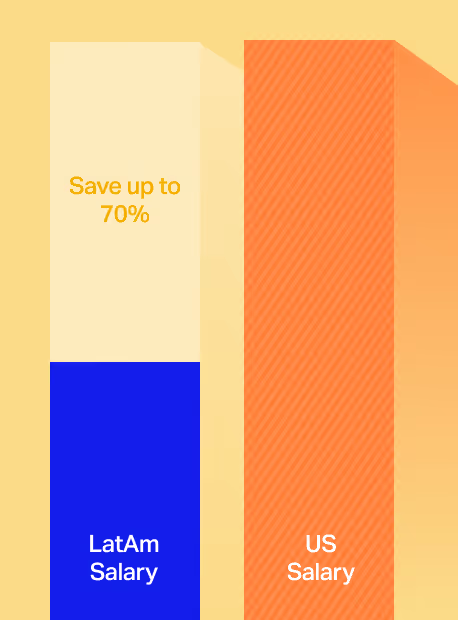
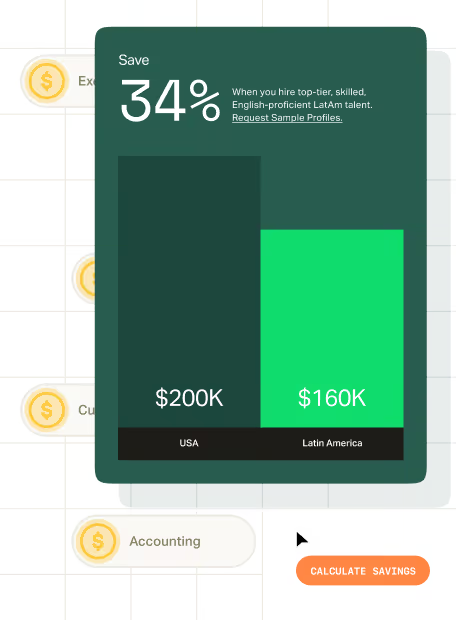
An accounts payable specialist in Latin America runs $18K to $42K a year depending on seniority, against $47K to $72K for the US equivalent. That range puts a dedicated hire back on the table for companies that had ruled it out on budget.
To put it in concrete terms, here's the full comparison, according to Hire With Near's salary benchmarks:
For the most up-to-date figures, see Hire With Near's US vs Latin America Salary Guide.
The gap is widest at the junior level and compresses as seniority rises: AP is one of the few finance roles where US and Latin American senior salaries move toward each other.
If you need a senior AP lead, the case is about access to the right person more than the salary difference. If you need solid mid-level transactional coverage, the salary difference is the case.
Our accounting roles salary guide for the US versus Latin America has the surrounding roles if you're sizing a whole transactional finance team.
Run the comparison against what you'd pay a provider. According to our salary data, a mid-level AP specialist at $24K to $34K a year is roughly $2,000 to $2,800 a month for a person whose entire attention is on your payables. Whether that beats a per-invoice fee depends on your volume, and now you have both numbers.
{{salary-guide-cta}}
A real case with $308,000 in savings per year
Stull CPA, an accounting firm in Fort Worth, Texas, ran that comparison the hard way. They had tried staffing peak tax season through offshore providers in Asia, where the working day barely overlapped theirs. A question raised in their afternoon waited until the next day, review cycles ran overnight, and nothing that needed correcting could be settled within the same business day, so senior managers absorbed the work themselves to hit client deadlines. They lost clients over it.
Working with Hire With Near, they hired three Senior Accountants and an Operations Manager directly in Latin America, all in place before tax season, at $308,000 less per year than US equivalents. Senior roles filled in under 30 days instead of up to three months. Their Operations Manager put the difference this way:
With other outsourcing companies, we lost clients because of mistakes and delays. With Hire With Near, we gained confidence.
— Gisela Piñeiro, Operations Manager, Stull CPA
Why Is Latin America a Strong Place to Hire Accounts Payable Specialists?
Latin America works well for AP hiring for four specific reasons: the working day overlaps yours, US GAAP fluency is common, English is strong enough for live vendor calls and payment disputes, and the finance talent pool is deep enough to hire from repeatedly. AP is same-day, communication-heavy work, which is exactly where those four things compound.
In more than a decade of writing and editing for B2B and finance audiences, I've learned to be skeptical of region-level claims, so here’s the specific version rather than the adjectives.
Same-business-day overlap for invoices, approvals, and payment runs
Your AP hire in Latin America is working while you are, wherever in the US your team sits. That matters more for accounts payable than for most roles: an invoice question, an approval nudge, and a payment release are all things that need an answer today, not tomorrow morning.
You can hire in Bogotá, Mexico City, Buenos Aires, or Medellín and get someone in your time zone or an hour or two off, depending on where you are in the US, as you can see in the table below:
Most of Latin America doesn't observe daylight saving time, so the gap shifts a little with the season. A hire in Mexico City shares nearly the whole working day with a team in Dallas or Denver. A hire in Buenos Aires starts a couple of hours ahead of an East Coast team and still shares most of the afternoon with Seattle.
Compare that to a provider team working while your office is closed, where a single clarification costs a full day of payment cycle time.
US GAAP fluency and Big Four exposure
Latin American finance professionals are qualified for US accounting work. Lucas Stepanenko, Sourcing Manager for Finance and Accounting at Hire With Near, explains what shows up on the resumes:
Finance professionals in Latin America have strong academic training and a lot of exposure to Big Four firms. That gives them experience with international markets and makes them very well versed in key accounting standards like US GAAP and IFRS, which are among the most common requirements we see from our clients.
— Lucas Stepanenko, Sourcing Manager for Finance and Accounting, Hire With Near
What to require on a resume: years of AP experience specifically at US companies, hands-on time in the AP platform you run, and multi-entity exposure if you consolidate.
Latin American accountants generally don't hold US CPA licenses, and for a transactional AP role, that isn't a requirement. Our guide to hiring finance and accounting talent in Latin America goes deeper on which credentials matter for which finance roles.
English strong enough for live vendor calls
This is the line between a nearshore hire and an offshore one for AP specifically. Invoice disputes get resolved on the phone. A supplier calling about a short payment, a controller pushing back on a coding decision, a vendor negotiating terms: all of it is live conversation, and written English alone doesn't cover it.
Screen for it directly. Put the candidate on a call and have them explain a payment discrepancy out loud. Our finance recruiters flag conversational fluency as the most common reason a technically strong AP candidate isn't the right fit for a client with heavy vendor contact.
Where does the finance talent concentrate?
The depth is real and measurable. According to Hire With Near's 2026 State of LatAm Hiring Report, accounting and finance is the largest department across our placements at 23.4%, and it's the top department in Colombia, Argentina, and Mexico alike.
Colombia and Argentina are where the concentration is heaviest, with Mexico strong and closest in working hours to Central Time teams. Argentina's accounting degrees run five to six years, which shows up in the depth of the mid-level and senior pool.
If you're mapping the region more broadly, our roundup of the best countries to hire remote finance talent compares them on cost, English, and pool size, and our complete guide to outsourcing to Latin America covers the models side by side.
If you'd rather see who can help you make the hire, we've compared the companies that help you hire LatAm finance talent, and our guide to hiring remotely in Latin America walks through the process end to end.
How Does Hire With Near Help You Build an Accounts Payable Team in Latin America?
Hire With Near sources, screens, and presents pre-vetted accounts payable candidates so you interview finalists instead of running a search, and most companies make a hire in under three weeks. You describe the role, we do the sourcing and screening, and you interview the shortlist.
We start with a role intake: your AP platform, your invoice volume and PO mix, your entity structure, and the seniority the work needs. Then, our recruiters source against that profile from a talent pool of 160,000+ pre-vetted candidates.
They screen for three things specifically:
- English strong enough for live vendor calls
- Hands-on proficiency in your AP stack rather than a resume mention
- Prior AP experience at US companies.
You get a shortlist of candidates in 3 to 5 days with video introductions.
That managed-shortlist approach is what clients tend to single out. In a verified G2 review from April 2026, one mid-market client who used Hire With Near to fill a full-time accountant role put it this way:
They took a managed approach to identifying all of the requirements we had for the role and then presenting us with a short list of candidates to review.
You can read more from the companies we've hired for on our client reviews page.
What that removes from your side is the sourcing and screening funnel. Stull CPA, the company mentioned earlier, measured it as a 75% reduction in their sourcing and screening burden, and their senior roles closed in under 30 days.
We've made 3,500+ placements for 950+ companies and we've filled 97% of the roles we took on. If it doesn't work, every placement is backed by a 180-day replacement guarantee, double the industry standard. Our placements stay an average of three years, which is the number that matters most for AP, where institutional knowledge is the whole point.
The commercial model, the interview logistics, and the specifics of how the role is set up are all things our team walks through on a call rather than in a guide. You can hire finance and accounting talent across the whole transactional stack, not just AP, and most companies who start with one AP seat come back for the next role.
We work with accounting recruiting in Latin America as one of our deepest specialisms, which matters if you're a CPA or accounting firm making this decision on behalf of your own clients rather than just for yourself. And when the AP problem turns out to be a finance-leadership gap, our executive search practice covers controller, VP of Finance, and CFO hires.
Final Thoughts
Three variables decide whether to outsource, hire, or automate:
- Volume: If your invoice count is spiky, seasonal, or under a few hundred a month, a provider or software is the honest answer.
- Complexity: If your invoices are exception-heavy, non-PO, or spread across entities, you need someone with context rather than a queue.
- Control: If AP touches judgment calls, vendor relationships, and your approval chain, that argues for a person inside your team.
Whichever way you land, benchmark it. Know your current cost per invoice, your exception rate, and what a full-time accounts payable specialist would cost you before you take a provider's quote at face value.
If you'd rather understand the model first, start with our guide on everything you need to know about nearshore outsourcing.
If hiring is the direction you're leaning, you can hire an accounts payable specialist in Latin America through Hire With Near, or book a free consultation call to talk through your requirements with our team. We'll give you salary benchmarks for the role and walk you through the process, so you can decide with real numbers instead of a guess.
{{latam-hiring-cta-v2}}
Frequently Asked Questions
What software will an accounts payable specialist know: QuickBooks, NetSuite, Xero, or Bill.com?
The tools that come up most in Latin American finance hiring are QuickBooks Online, NetSuite, Xero, Sage, Bill.com-style AP automation platforms, and Excel at an advanced level.
Make the AP platform an explicit screening requirement rather than something you hope for, and you'll get candidates who already know your stack. NetSuite depth is the hardest to find; QuickBooks is plentiful.
Test it live in the interview by having the candidate walk through a three-way match (invoice, PO, and receipt) or a batch payment run in the system, so proficiency is verified before you hire rather than discovered during training.
How quickly can an accounts payable specialist be in place?
Most companies working with Hire With Near see a shortlist in 3 to 5 days and make a hire in under three weeks, and Stull CPA filled senior finance roles in under 30 days.
Be fair to the alternative when you compare: a provider transition isn't instant either, since implementation, ERP integration, and documenting your coding rules typically take weeks to a few months before the first invoice is processed.
If a close deadline or an invoice backlog is bearing down on you, both paths need lead time, and the hiring path is often the shorter one.
What happens if the accounts payable hire doesn't work out?
Every Hire With Near placement is backed by a 180-day replacement guarantee, double the industry standard. If a placement isn't working inside that window, we run the search again.
That window exists because performance problems in AP work are rarely visible in the first month. Coding inconsistencies, missed discounts, and weak vendor communication tend to surface over a full quarter or two of cycles, by which point a 30-day guarantee has long closed.
How much does it cost to outsource accounts payable?
There’s no reliable published market rate for accounts payable outsourcing, so treat any figure you find online with suspicion, especially on a provider's own site.
Pricing comes in four shapes: per invoice, per full-time equivalent, a tiered monthly retainer, or a hybrid. What moves the number is your invoice volume, your PO versus non-PO mix, your exception rate, your number of legal entities, and the ERP integration lift.
Benchmark every quote against what an invoice costs you in-house today, and against a full-time salary.
What does the accounts payable process involve?
The accounts payable process runs from invoice receipt through payment and reconciliation: maintaining the vendor master file, receiving and coding invoices, matching them against purchase orders and receipts, routing them for approval, executing payment, and reconciling cleared payments back to the general ledger.
Exception handling sits inside every step, since any invoice that doesn't match needs a human decision. The process also produces the audit trail for every purchase your company makes, which is why controls on it matter as much as speed.
What other finance and accounting roles can I hire in Latin America?
Beyond accounts payable, US companies hire the full transactional finance stack in Latin America, including accounts receivable specialists, nearshore bookkeepers, staff accountants, and controllers.
AP is usually the first seat because the work is well defined and the impact is immediate, and it's common for companies to add AR or a staff accountant within a year once the first hire is working.
All of these roles come with the same working-hours overlap that makes same-day finance work possible.







.webp)


%203.svg)
.avif)





%20(1).avif)

%20(1).png)