


%203.svg)
Key Takeaways:
- Full-time virtual assistants based in Mexico typically cost $1,500–$2,800 per month, saving US companies 44–69% compared to domestic hires.
- Mexico operates primarily on Central Time, giving your VA full overlap with all US business hours for real-time collaboration without scheduling workarounds.
- Many VAs based in Mexico are fluent in both English and Spanish, making them a strong fit for companies serving US-Hispanic markets or coordinating with Spanish-speaking clients and vendors.
A virtual assistant in Mexico typically costs $1,500–$2,800 per month, works US business hours from a Central Time zone, and often speaks both English and Spanish fluently. For most US companies, that combination is hard to match anywhere else.
If you’re running on a VA from the Philippines who’s effectively working a graveyard shift to cover your EST hours, you already know what time zone misalignment costs in practice: slower responses, off-hours errors, and an employee burning out trying to sync with a calendar that’s never in their favor.
If you’re still handling admin yourself, the math is simpler. Every hour you spend on scheduling, inbox management, and data entry is an hour not spent on the work that actually grows your business.
In this guide, I’ll cover what hiring a virtual assistant in Mexico looks like, including costs, what tasks they can handle, and how to find the right fit.
Why Should US Companies Hire a Virtual Assistant in Mexico?
Hiring a virtual assistant based in Mexico delivers three concrete advantages over most remote hiring alternatives: cost savings of 44–69% versus US rates, overlapping working hours across all US time zones, and a talent pool that is genuinely bilingual in English and Spanish.
The sections below break down each one.
Time zone alignment with US business hours
Mexico is one of the few countries where your VA works the same hours you do, by default.
Mexico City, Monterrey, and Guadalajara run on Central Time. Tijuana is on Pacific Time. That means your VA is online when you are, whether you’re in New York, Chicago, or Los Angeles, with zero to two hours of difference at most.
The contrast with Asia-Pacific alternatives is significant. Hiring from the Philippines puts you 12–13 hours apart. One operations manager at a midmarket digital marketing agency described what that looks like in practice:
They’re working EST hours, but it’s the end of the day, like it’s overnight for them. I don’t know how they’ve managed it. I would like someone to be on more our working hours naturally, so that maybe that would help alleviate some of the performance issues we’re seeing too.
The performance link isn’t just anecdotal. A Harvard Business School and INFORMS study of 12,038 employees found that each additional hour of time zone difference reduces real-time communication by 11%. It also found that teams arranged on a north-south axis, like the US and Latin America, maintain near-complete business-hours overlap.
Mexico sits squarely on that axis. When something needs a fast turnaround, your VA is there.
Cost savings without the quality trade-off
A full-time virtual assistant in Mexico typically earns $1,500–$2,800 per month, depending on experience level, according to Hire With Near’s placement data. The same budget that covers a part-time US coordinator funds a full-time, senior-level hire in Mexico: someone with real industry experience and the judgment to take on increasing responsibility.
Here’s how the compensation benchmarks break down:
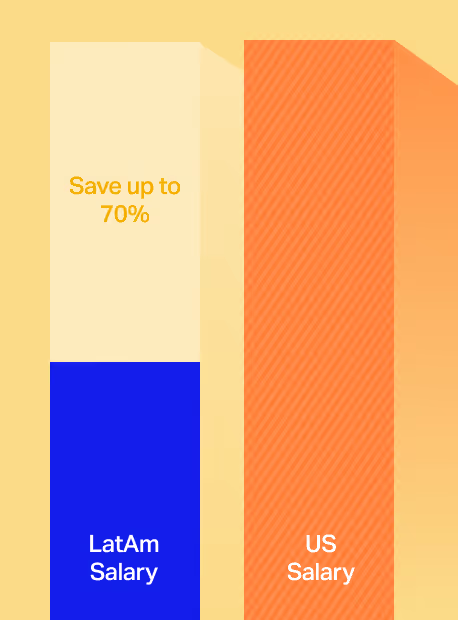
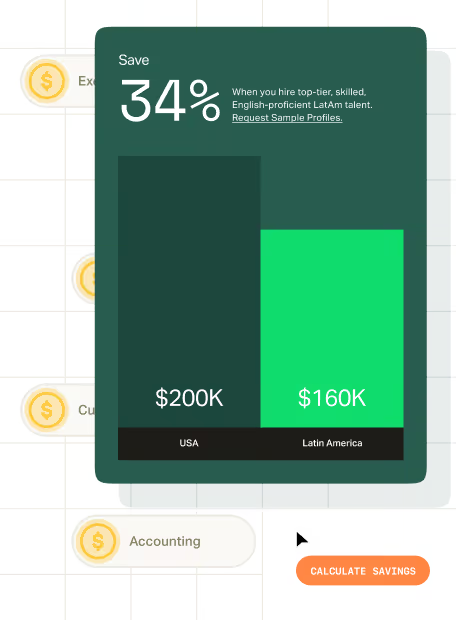
According to Hire With Near’s compensation benchmarks, hiring a full-time virtual assistant from Latin America saves US companies $13,000–$52,000 annually compared to domestic equivalents, depending on seniority level. That’s a 44–69% reduction without trading down on experience.
The lower cost reflects Mexico’s cost of living, not the caliber of the hire. Our placement data consistently shows that LatAm professionals working for US companies earn more than double what local employers pay, which means you’re attracting motivated, experienced people, not those who couldn’t find anything better.
That budget difference also has a second-order effect. The founders and managers we talk to most often describe the same problem: they’re doing work that shouldn’t require them. A VA handles that layer (calendar management, inbox triage, vendor follow-ups) so you’re not the bottleneck on tasks that don’t need your judgment. As one client put it: “If I did one more deal a year with this person, they’d pay for themselves.”
For a deeper look at what these savings mean across different admin roles, see our guide to hiring an assistant in Latin America.
{{latam-hiring-calculator}}
Spanish-English fluency for bilingual markets
Mexico’s bilingual talent pool is a genuine advantage for US companies with any Spanish-language dimension to their business, and it’s something a Philippines-based VA simply can’t replicate.
If your business handles any of the following, it’s worth factoring in:
- Customer-facing support for English and Spanish-speaking clients
- Vendor communication with Spanish-language suppliers or contractors
- Social media management for US-Hispanic audience segments
- Admin support for sales teams or executives operating in bilingual markets
The need comes up more than you’d expect outside of obvious markets. One healthcare services provider in California told us their county was roughly 95% Hispanic, making Spanish fluency a hard requirement for anyone handling client calls and scheduling.
They’d looked at the Philippines (where a colleague already hired) but ruled it out immediately. Spanish capability was the deciding factor that pointed them toward Mexico.
On the English side, it’s worth being clear-eyed. The 2025 EF English Proficiency Index ranks Mexico 103rd out of 123 countries globally. Strong English-speaking candidates exist in Mexico: Many have studied or worked in the US, or have years of experience serving American clients. But you will need a process that includes an English assessment to find them.
According to one of our recruiters, “a key skill often found in standout candidates is excellent communication — in a VA role, they engage with both internal team members and external clients, so it’s non-negotiable.”
The contrast with the Philippines is straightforward: strong English, no Spanish. If your business is entirely English-language, either market can work. If there’s any Spanish-language dimension, Mexico is the clearer fit.
Further reading: 8 Reasons Why Hiring a Virtual Assistant From Latin America (LatAm) Is a Smart Move
What Tasks Can a Virtual Assistant in Mexico Handle?
Mexican VAs handle the full range of remote administrative and operational work that US companies typically need. The right category depends on where your time is currently going.
Administrative support
This is the core of most VA roles: calendar management, inbox organization, document preparation, data entry, and project management support. If you’re losing hours to scheduling and follow-ups, this is where a VA pays for itself fastest.
Expect proficiency with Google Workspace or Microsoft 365, Slack or Teams, and project management tools like Trello, Asana, or Notion.
Customer support
Bilingual Mexican VAs are a strong fit here, particularly for businesses serving both English and Spanish-speaking customers. A VA can handle inbound inquiries via phone, email, or live chat, manage order tracking and onboarding, and escalate complex issues. All during your business hours.
Social media management
A social media VA keeps your presence active and consistent: scheduling and publishing content, monitoring engagement, responding to comments, and reporting on basic metrics. This works well for companies that need execution support rather than strategy. For campaign development or paid advertising, you’d want a dedicated specialist.
Further reading: What Does a Social Media Virtual Assistant Do and How Do I Hire One?
Sales support
A VA can handle the operational layer of your sales process, like updating CRM records, scheduling demos, sending follow-up sequences, and preparing materials. If you need someone actively prospecting and closing, that’s a different hire.
Data entry and research
VAs are well-suited to high-volume, accuracy-dependent work: lead list building, CRM updates, competitive research, and record maintenance. This is often the first category companies outsource, and the one that frees up the most time for everyone else on the team.
Executive assistant services
If your needs go beyond general admin, LatAm executive assistants operate at a different level: C-suite calendar management, board meeting preparation, confidential document handling, high-level correspondence, and strategic project coordination. The distinction between an EA and a VA matters more than most hiring managers expect: an EA is embedded in how an executive operates, not just handling tasks.
Further reading: 5 Top Executive Assistant Recruitment Agencies.
Specialized support
More experienced VAs can take on bookkeeping and basic accounting, market research, lead generation, project coordination, and basic web or design work using tools like Canva. These aren’t entry-level tasks. They require a more senior hire and a clear brief on scope and ownership.
{{state-latam-hiring}}
What to Look for When Hiring a Virtual Assistant in Mexico
The right VA candidate is out there, but the screening criteria matter more than most hiring managers expect.
Here’s what separates strong applicants from the ones who look good on paper.
1. Language proficiency
While VAs based in Mexico often demonstrate strong English skills, national proficiency is lower than in other LatAm countries.
Screening for English fluency is essential, especially for client-facing or written communication roles. Look for candidates who can:
- Express complex ideas clearly in writing
- Handle phone conversations confidently
- Understand nuanced instructions
- Ask clarifying questions when needed
In my work recruiting virtual assistants and executive assistants for US clients at Hire With Near, communication is always a non-negotiable. The role requires constant engagement with internal team members and external clients, so I treat it as a core requirement, not a nice-to-have.
Strong candidates come with real VA experience, proficiency in the tools that matter (Google Workspace, Notion, Slack, Trello, Zoom, CRMs), and a solid command of English. The ones who stand out can tell you exactly how they’ve handled competing priorities, in clear, structured sentences.
2. Technical proficiency
A VA’s tool stack matters, but the underlying question is whether they can learn new systems quickly and work independently within them. According to one of our recruiters, the screening question that reveals the most is simple: “What tools do you use to organize your work and communicate with clients or teams?” Candidates who can answer that specifically, with real examples, are typically the ones who hit the ground running.
- Google Workspace or Microsoft Office Suite
- Communication platforms (Slack, Microsoft Teams, Zoom)
- Project management tools (Trello, Asana, Notion)
- CRM systems (HubSpot, Salesforce)
- Time tracking software
That said, don’t disqualify a strong candidate for not knowing your specific tools. A VA who’s proficient in Asana but hasn’t used ClickUp will figure it out in a day. What you can’t teach is the organizational instinct behind the tool use. Focus your assessment there.
3. Industry experience and adaptability
A virtual assistant in Mexico who has supported a law firm but not a real estate company will adapt quickly if their core skills are solid. What you’re really evaluating is whether they’ve handled competing priorities, built systems that work under pressure, and developed habits that transfer across contexts.
Our recruiters use one question to cut through resume noise: Can you describe a time when you had to manage multiple urgent requests at once? How did you prioritize, and what was the outcome? Vague or generic answers are a red flag.
Look for candidates who demonstrate:
- Relevant VA experience with specific, describable examples, not just job titles
- Ability to learn new systems quickly, evidenced by the tool transitions they’ve already made
- Familiarity with US business practices: communication norms, response time expectations, meeting culture
- A track record of working with remote teams, ideally US-based ones
One thing that consistently surprises US clients: Many Latin American candidates have already worked with international companies and arrive familiar with US communication norms. The ramp-up is shorter than most expect.
4. Work schedule and availability
Time zone alignment is Mexico’s advantage, but availability goes beyond that. Confirm the practical details before you make an offer:
- Willingness to work your core business hours, not split shifts or adjusted schedules
- Reliable internet connection with documented backup options
- A dedicated workspace suitable for video calls, not a shared or noisy environment
- A contingency plan for outages or technical issues (this comes up more than people expect)
The hours question is usually straightforward. Most Mexican VAs actively seek US-hours roles. What matters more is verifying they’re not splitting their time across multiple clients. Full-time dedication is what creates the business familiarity that makes a VA genuinely useful over time.
5. Cultural fit and values alignment
When two candidates have similar experience and tool proficiency, cultural fit is usually what determines long-term success. The practical markers are harder to screen for, but not impossible to identify.
Look for candidates who:
- Communicate proactively rather than waiting to be asked (flag issues before they become problems)
- Demonstrate reliability through specifics: consistent delivery, follow-through on commitments, and how they’ve handled mistakes
- Show genuine interest in your industry or mission, not just the role itself
- Push back when something isn’t clear, rather than proceeding and hoping for the best
A short paid task or case study during the hiring process reveals more about working style than any interview question. Our recruiters use an assessment that tests how candidates prioritize tasks based on urgency and attention to detail: a better signal than years of experience on a resume.
For comprehensive guidance, read Hiring a Virtual Administrative Assistant: Cost, Tasks, and Where to Hire.
Major Mexican Cities for Virtual Assistant Talent
Virtual assistant talent is distributed across Mexico’s major urban centers, each with its own professional strengths. For US companies already outsourcing to Mexico in other functions, the administrative talent pool is often the next logical step.
The five cities below produce the largest share of candidates for remote roles with US companies.

- Mexico City: The largest talent pool in the country by volume. Mexico City draws professionals from across Mexico, which means a wider range of industry backgrounds, specializations, and experience levels than you’ll find anywhere else. If you need a VA with specific domain knowledge (legal, finance, marketing, healthcare administration), this is where you’re most likely to find them.
- Guadalajara: Mexico’s second-largest city and its main technology hub. Guadalajara has a high concentration of professionals with digital tool proficiency, familiarity with US tech companies, and experience supporting remote teams. Strong choice if your VA role involves CRM management, marketing automation, or any technical administrative work.
- Monterrey: Mexico’s most US-adjacent major city in terms of business culture. Monterrey is a major industrial and commercial hub with long-standing cross-border trade ties, which means many professionals here have direct experience working alongside US teams, understanding American business expectations, and operating in bilingual environments. English proficiency tends to be higher here than the national average.
- Puebla: A large, educated workforce with slightly lower salary expectations than Mexico City or Monterrey. Puebla has grown steadily as a source of remote talent for US companies, particularly in administrative and customer support roles.
- Tijuana: Geographically, the closest major Mexican city to the US, sitting directly on the San Diego border. Tijuana has a high concentration of bilingual professionals with cross-border work experience and strong cultural familiarity with American business norms. Worth prioritizing if bilingual customer-facing support is a core requirement.
{{prevetted-banner}}
Common Mistakes to Avoid When Hiring a VA in Mexico
Companies that run their own VA search for the first time tend to make the same errors, and the challenges of hiring virtual assistants in Latin America go beyond just the hiring process itself.
Here’s what to watch for:
Moving too slowly
Strong VA candidates are usually talking to multiple companies at once. A hiring process that drags past two to three weeks (extra rounds, delayed feedback, unclear next steps) loses top candidates to faster-moving employers.
In our experience, lengthy hiring processes are one of the most consistent reasons good VA candidates drop out before an offer is made. If you find someone you like, move.
Over-indexing on specific tools
Tool familiarity matters, but it’s not a hard filter. Eliminating strong candidates over a checkbox you can solve in a day’s onboarding is one of the most common and avoidable hiring mistakes we see.
Skipping the assessment
Resumes tell you what someone has done. A short task tells you how they work. At Hire With Near, we use a case study that tests how candidates prioritize competing urgent requests and how carefully they handle detail-oriented work, two of the most important predictors of VA performance.
Even a simple paid task will reveal more about working style, communication, and judgment than any interview question.
Accepting vague interview answers
Generic responses are a red flag, not a personality quirk. If a candidate can’t describe specifically how they’ve handled competing priorities, which tools they use day to day, or what went wrong in a past role and how they fixed it, that’s a signal they don’t have the depth the role requires.
Push for examples. The best candidates welcome the question.
Hiring part-time when you need full-time support
A part-time VA is, by definition, splitting their attention. They prioritize whichever client pays more or engages them most. If you need someone who genuinely understands your business, your preferences, and your rhythm, full-time dedication is what gets you there.
Final Thoughts
For US companies building remote administrative teams, Mexico is one of the most practical hiring destinations available. The combination of full time zone overlap, bilingual capability, and annual savings of $13,000–$52,000 compared to a domestic hire is difficult to match elsewhere.
The case for hiring a virtual assistant in Mexico isn’t complicated. It comes down to whether you want support that works your hours, communicates in your clients’ languages, and costs significantly less than a comparable US-based virtual assistant. For most US businesses, that’s a straightforward decision.
The harder part is finding the right person. Screening for English proficiency, running a real assessment, and moving quickly when you find a strong candidate are the steps that determine whether your hire works out. Get those right and the geography largely takes care of itself.
If you want to make hiring a virtual assistant in Latin America as easy as hiring in the US, Hire With Near sources and pre-vets candidates matched to your requirements, handles sourcing through payroll, and lets you interview candidates before making any commitment.
Schedule a free, no-commitment consultation call today to see how we can help you hire a top VA in Mexico (or anywhere else in LatAm).
Frequently Asked Questions
How much does it cost to hire a virtual assistant in Mexico?
A full-time virtual assistant in Mexico typically costs $1,500–$2,800 per month, depending on experience level. That’s 44–69% less than a comparable US hire.
A junior VA runs $1,500–$1,800/month; a mid-level VA $1,800–$2,200/month; a senior VA $2,200–$2,800/month.
These figures reflect current compensation benchmarks for Latin American administrative talent, not freelance platform rates.
What time zones do Mexican virtual assistants work in?
VAs based in Mexico work in Central Time (most major cities, including Mexico City, Guadalajara, and Monterrey), with Tijuana on Pacific Time. That puts them in real-time overlap with every US time zone during normal business hours: no lag, no asynchronous delays.
It’s the primary reason US companies choose Mexico over Asia-Pacific alternatives for administrative roles that require same-day responsiveness.
Are virtual assistants in Mexico bilingual in English and Spanish?
Many VAs based in Mexico are fluent in both English and Spanish, but English proficiency varies. Mexico ranks 103rd globally on the 2025 EF English Proficiency Index, so screening for it matters.
The Spanish capability is the real differentiator: If your business serves US-Hispanic customers, works with Spanish-speaking vendors, or operates in bilingual markets, a Mexican VA gives you something a Philippines-based VA can’t. The Philippines has strong English but no Spanish capability.
Which country offers the best value for hiring virtual assistants?
Mexico and LatAm aren’t the lowest-cost options on paper: the Philippines and parts of Eastern Europe can have lower floor rates. But the total cost of engagement typically favors Mexico when time zone strain and communication overhead are factored in.
On a pure monthly rate, a full-time VA based in Mexico runs $1,500–$2,800/month; the Philippines often runs slightly lower.
What those lower rates don’t account for: the productivity cost of asynchronous workflows, rework from communication gaps, and the churn that follows when VAs burning out on overnight schedules leave.
In our experience placing hundreds of US companies, the lowest-quoted rate often creates the highest real cost.
Is it better to hire a virtual assistant from Mexico or the Philippines?
Mexico offers significant advantages for US businesses: time zone alignment (Mexico aligns with US time zones vs. a 12-hour difference with the Philippines), cultural familiarity with American business practices, and easier travel for in-person meetings.
While both countries have skilled VAs, Mexico’s proximity makes collaboration more seamless.
However, the Philippines generally offers lower costs.
Choose based on whether real-time collaboration or maximum cost savings is your priority.
See our article on weighing up hiring a VA in Latin America vs. the Philippines for a full explanation.
How do I manage a virtual assistant in Mexico?
Successful management starts with clear communication protocols, regular check-ins, and using collaborative tools like Slack, Zoom, and project management platforms.
Set core collaboration hours that work for both time zones, provide comprehensive onboarding documentation, and establish performance metrics from day one.
For detailed strategies and best practices, read our complete guide on How to Manage Virtual Assistants: 11 Key Tips.
How do I find reliable virtual assistants in Mexico?
The most effective approach is working with specialized recruitment agencies that have established networks in Mexico. These agencies pre-vet candidates for skills, English proficiency, and cultural fit.
Alternatively, you can post on Mexican job boards like LinkedIn Mexico, Indeed Mexico, or OCCMundial, though this requires more time for screening.
Avoid relying solely on freelance platforms for long-term hires, as quality can be inconsistent.
Our article on the best companies to hire virtual assistants in LatAm includes companies that source from Mexico.
What other administrative roles can I hire from Latin America?
Beyond virtual assistants, US companies regularly hire a wide range of operations and administrative roles in Latin America, including executive assistants, administrative assistants, project managers, operations analysts, and event coordinators.
LatAm professionals in these roles offer the same organizational depth as US-based equivalents, with better time zone alignment than offshore alternatives and meaningful cost savings.
What industries hire virtual assistants in Latin America?
Virtual assistants from Latin America work across a wide range of US industries. Real estate companies use them for CRM management, listing coordination, and client follow-ups. SaaS companies hire them for customer onboarding support and admin ops.
Legal firms rely on them for document management and scheduling.
Healthcare organizations use them for patient scheduling and records admin. Finance and accounting firms hire them for data entry, reporting support, and client coordination.






.webp)
.webp)


%203.svg)
.avif)





%20(1).avif)

%20(1).png)