


%203.svg)
Key Takeaways
- Hiring a great JavaScript developer requires evaluating both technical skills and their ability to understand business context—not just code syntax proficiency.
- Top JavaScript developers command $59,000–$154,000 in the US, but you can hire Latin American talent with equivalent skills for 45–60% less without sacrificing quality.
- The best candidates can explain complex technical decisions clearly to both technical and non-technical stakeholders, deliver clean and tested code, and adapt to your specific business needs.
You’re losing velocity. Your team is stretched thin, your roadmap keeps slipping, and you know the missing piece is clear: you need another JavaScript developer.
Maybe it’s your first hire. Maybe you’re building out your front-end team. Or maybe it’s time to bring development in-house after relying on a dev shop. Whatever stage you’re in, hiring the right JavaScript developer can make the difference between staying stuck and finally shipping what matters.
This guide will walk you through everything you need to know to hire confidently: what JavaScript developers actually do, what skills to look for, how much to expect to pay, where to find talent (including cost-effective international options), and how to avoid common mistakes that slow hiring down or lead to the wrong fit.
What Does a JavaScript Developer Do?
JavaScript developers build the interactive experiences users actually engage with, from dynamic web applications to mobile apps and server-side systems.
According to Stack Overflow, JavaScript has been the most-used programming language every year they’ve done their annual Developer Survey except in 2013 and 2014. For 2024, 62.3% of developers reported using JavaScript. That kind of dominance isn’t accidental—it reflects just how essential JavaScript is across modern development stacks, from web to mobile to back-end.
While many people think of JavaScript as just “front-end code,” modern JavaScript developers often work across the entire tech stack. They might build responsive user interfaces with React or Vue.js, create APIs with Node.js, manage databases, or develop mobile applications using React Native.
The best JavaScript developers understand how their technical decisions impact user experience, performance, and business goals. They collaborate with designers to implement intuitive interfaces, work with product managers to translate requirements into technical solutions, and coordinate with back-end teams to ensure seamless data flow.
In most teams, JavaScript developers work closely with UX/UI designers, product managers, QA engineers, and back-end developers.
They’re often responsible for translating design mockups into functional interfaces, optimizing application performance, debugging cross-browser compatibility issues, and ensuring applications work smoothly across different devices and platforms.
How Much Does It Cost to Hire a JavaScript Developer?
In the US, you can expect to pay $59,000 to $154,000+ to hire a full-time JavaScript developer. However, outside the US, the annual salary of equally skilled developers can be up to 60% less.
JavaScript developer salaries in the US vary significantly based on experience level and specialization, ranging from entry-level positions to senior architects who can command premium compensation.
If budget constraints are limiting your ability to hire the experience level you need, expanding your search internationally can provide access to equivalent talent at more sustainable rates.
For example, based on our experience placing JavaScript developers, skilled professionals in Latin America typically earn:
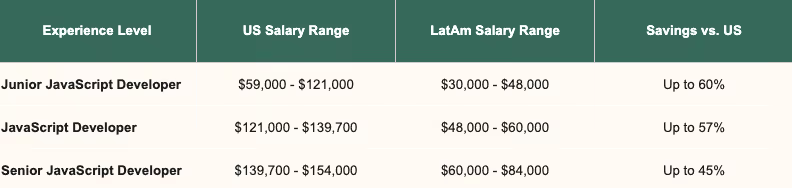
These differences aren’t about compromising on quality—they reflect different economic conditions and cost of living. Latin American developers with equivalent skills, education, and experience can provide substantial cost savings while maintaining the same professional standards you’d expect from US-based talent.
For many companies, this means hiring senior-level JavaScript developers on a junior-level budget, or building out complete development teams for what one US hire might cost. The key is focusing on value and skill alignment rather than geography.
What Skills Should You Look For When Hiring a JavaScript Developer?
Finding a strong JavaScript developer means looking beyond surface-level coding ability to understand how they think, collaborate, and execute in real-world scenarios. However, skill evaluation depends heavily on the seniority level you’re targeting.
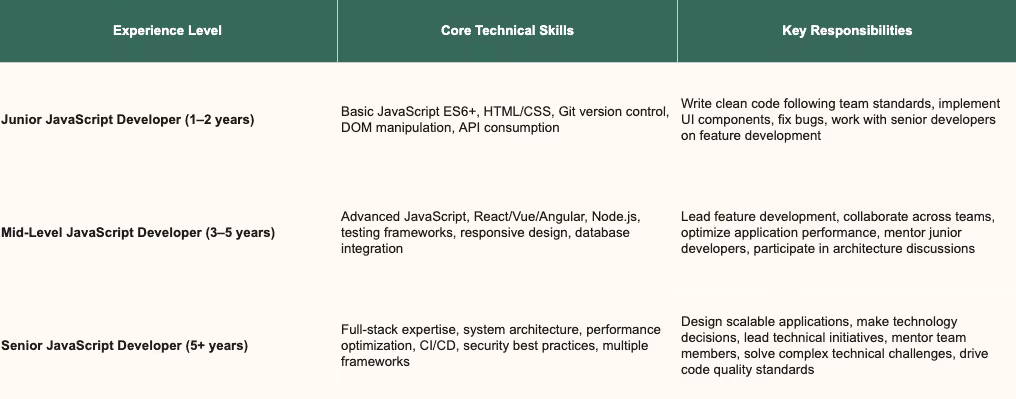
A junior JavaScript developer might excel at implementing basic features using established patterns but need guidance on architecture decisions and performance optimization. In contrast, a senior JavaScript developer should be able to design scalable applications, mentor other developers, and make strategic technical decisions that impact the entire product.
Understanding these distinctions helps you evaluate candidates fairly and set realistic expectations for what each experience level can contribute to your team from day one.
Here’s how JavaScript developer skills typically progress across experience levels:
Regardless of seniority level, all JavaScript developers should demonstrate certain fundamental capabilities.
Here are the core skills to evaluate:
Hard skills (the must-haves)
- Core JavaScript proficiency: Look for developers who understand ES6+ features, asynchronous programming (promises, async/await), and can work with modern JavaScript frameworks. They should be comfortable with concepts like closures, prototypes, and event handling.
- Framework expertise: Whether it’s React, Vue.js, Angular, or Node.js, strong candidates should have deep experience with at least one major framework and understand when to use different tools for different problems.
- Version control and collaboration: Solid Git knowledge is non-negotiable. They should understand branching strategies, code reviews, and how to collaborate effectively in team environments.
- Testing and debugging: Look for familiarity with testing frameworks (Jest, Mocha, Cypress) and debugging tools. The best developers write testable code and know how to identify and fix issues efficiently.
- API integration and data management: They should understand RESTful APIs, GraphQL, and how to manage application state effectively. Experience with databases (both SQL and NoSQL) is often valuable.
- Build tools and deployment: Familiarity with tools like Webpack, Vite, npm/yarn, and CI/CD pipelines shows they understand the full development lifecycle.
Soft skills (equally important)
- Clear communication across technical levels: According to our recruiters who specialize in this role, the ability to explain technical decisions clearly to both developers and non-technical stakeholders separates excellent developers from average ones. If they can’t explain their work to someone who might not understand the technical details, it often indicates they don’t truly understand the broader impact of their decisions.
- Problem-solving methodology: Great JavaScript developers approach challenges systematically. They break down complex problems, research solutions effectively, and know when to ask for help versus when to push through independently.
- Ownership and accountability: Look for developers who take responsibility for their code’s performance, maintainability, and impact on the user experience. They should be proactive about understanding business requirements and suggesting improvements.
- Adaptability and learning mindset: JavaScript evolves rapidly. Strong candidates should demonstrate curiosity about new tools and willingness to adapt their approach based on project needs.
- Collaboration and feedback receptiveness: Based on our experience placing hundreds of developers, the most successful candidates handle feedback well and contribute positively to team dynamics.
Nice-to-have skills (the differentiators)
- TypeScript proficiency: While not always required, TypeScript knowledge indicates advanced thinking about code maintainability and team collaboration.
- Performance optimization experience: Understanding of web performance metrics, bundle optimization, and user experience considerations adds significant value.
- DevOps familiarity: Knowledge of containerization (Docker), cloud platforms (AWS, GCP), or infrastructure as code can be valuable for full-stack roles.
- Mobile development experience: React Native or other mobile JavaScript frameworks expand their potential contributions.
- Design system understanding: Ability to work with design tokens, component libraries, and maintain consistent user interfaces across applications.
Where Can You Find and Hire Great JavaScript Developers?
You’ll find the strongest JavaScript developers when you cast a wide net—beyond your local market—and choose the sourcing method that matches your hiring goals, budget, and timeline.
Demand for top JavaScript talent is high, and the best candidates don’t stay on the market long.
That means where and how you search matters. Whether you’re hiring locally, expanding across the US, or looking internationally, aligning your sourcing strategy with your needs can make or break your hiring process.
Deciding between local, national, or global talent
Because JavaScript development is a role that can be done fully remotely, your first decision is where it makes the most sense to hire based on your budget, collaboration needs, and timeline.
Choosing between local, national, or international talent will shape everything from the size of your candidate pool to how competitive your offers need to be.
Each option comes with trade-offs—especially when you’re trying to move quickly or scale efficiently.
- Local/in-office hiring offers the advantage of direct collaboration and simplified onboarding processes. You’ll have face-to-face interaction and no timezone complications, but you’re limited to your immediate geographic area and will typically pay premium rates.
- Remote US-based talent expands your pool significantly while maintaining familiar business practices and legal frameworks. However, you’re still competing in a highly competitive market where top JavaScript developers often command premium salaries.
- Offshore hiring opens access to excellent developers worldwide, often with significant cost advantages and diverse perspectives. Latin America offers particularly strong advantages for US companies—substantial timezone overlap, strong English proficiency, and excellent technical education systems.
You’ll also find skilled offshore developers in Eastern Europe and Southeast Asia, though with different time zone and cultural considerations.
Many companies find Latin American JavaScript developers provide an optimal balance of technical skill, communication ability, cost efficiency, and working hour compatibility.
Choosing the right sourcing channel
Different sourcing methods work better for different hiring situations and company needs:

Job boards and developer communities work well when you have time to screen candidates personally and want direct control over the sourcing process. This approach makes sense if you have clear hiring criteria, understand current market rates, and have bandwidth for thorough candidate evaluation.
Developer communities like GitHub and Stack Overflow are particularly valuable for finding passionate developers who contribute to open source projects and stay current with industry trends.
Professional networks and referrals often yield the highest-quality candidates since they come pre-vetted through trusted connections.
Your existing team members can provide insights into both technical skills and cultural fit. However, this limits your reach and may result in less diverse candidate pools.
Freelance platforms serve a specific purpose when you need to test a developer’s capabilities before making a full-time commitment, or when you have project-based work that doesn’t require long-term employment.
Just be aware that freelance developers may be juggling multiple clients and may not be available for the collaborative, team-focused work that many full-time roles require.
Why working with a recruiting partner makes a difference
A specialist recruitment partner can help ensure you make the right hire, access more qualified candidates faster, and avoid delays.
You can absolutely hire great JavaScript developers independently—many companies successfully build strong teams through in-house recruiting. If you have dedicated internal resources, a clear hiring process, and aren’t facing tight deadlines, a DIY approach can work well.
However, working with a recruiting or staffing company that specializes in tech talent often makes sense when you’re scaling quickly, hiring internationally, or need expertise in vetting technical talent.
A recruiting partner experienced in JavaScript hiring can help accelerate your process in several ways. They understand the technical nuances that separate strong developers from those who simply know the syntax. They can screen for both hard skills and remote-readiness and surface candidates who match your specific needs.
The most significant advantage comes when hiring internationally. Navigating global sourcing, understanding local market conditions, and structuring competitive offers requires expertise that most companies don’t have internally. A specialized recruiting firm can help you access top-tier international talent while avoiding common pitfalls that lead to failed hires and handle the complexities of international hiring, including compliance and payroll.
For companies looking to explore options for how to hire the best developers offshore, working with experts can significantly reduce the learning curve and time to successful hire.
How to Hire the Best JavaScript Developer: Best Practices
Hiring exceptional JavaScript developers requires a systematic approach that evaluates both technical capability and how candidates work within your specific environment.
Here’s what experienced hiring managers focus on:
Stage 1: Before and during sourcing
Define your specific technical needs clearly
Avoid the “full-stack unicorn” trap by identifying what you actually need.
Are you building interactive user interfaces, server-side APIs, or full-stack applications? Do you need React expertise, Node.js specialization, or broad JavaScript knowledge?
Be clear about your JavaScript version requirements (ES6+), whether you're working with existing codebases or greenfield projects, and what frameworks are central to your current stack versus planned for future features. Are you maintaining legacy systems, building new features, or migrating from another technology?
Create job descriptions that attract the right candidates
Great JavaScript developers want to understand the business impact of their work. Include information about your team structure, development practices, and growth opportunities.
According to our recruiters, being specific about your tech stack’s role in your roadmap—whether it’s your current stack or planned for future features—helps candidates understand the role better and prevents mismatched expectations.
For more guidance on writing job descriptions that attract the right talent, check out our article on how to write a developer job description.
Stage 2: Screening and evaluation
Look beyond portfolio projects
While GitHub contributions and project demos are important, dig deeper into their thought process. Our top recruiters recommend asking candidates to complete a small, real-world task like debugging code, refactoring for scalability, or implementing a basic API with tests.
This reveals not just coding ability but their approach to problem-solving and understanding of clean code principles.
Assess communication and collaboration style
Since JavaScript developers often work across teams, evaluate how they explain technical concepts to different audiences. Pay attention to how they communicate during the interview process—their email responses and question-asking approach often predict how they’ll perform in a remote or collaborative environment.
Test for business context understanding
Exceptional JavaScript developers don’t just write functional code—they understand how their technical decisions impact user experience and business goals. Ask about times they’ve had to balance technical debt, performance requirements, and feature delivery deadlines.
Stage 3: Making the offer and closing the deal
Emphasize growth and ownership opportunities
Based on our years placing talent, top developers in this role particularly value work-life balance, learning opportunities, and ownership of their work. Highlight how they’ll contribute to technical decisions, what they’ll learn, and how the role connects to your product roadmap.
Consider international compensation strategies
If hiring from Latin America or other international markets, ensure your offer is competitive locally while providing clear value.
This might include USD payment, professional development budgets, or flexible PTO policies that respect local holidays.
For more detailed guidance, read our article on making a good job offer to hire and retain top talent.
Top Interview Questions for Hiring JavaScript Developers That Reveal the Right Fit
Effective JavaScript developer interviews go beyond syntax quizzes to uncover how candidates think, solve problems, and collaborate in real-world scenarios.
“Can you describe a recent project where you had to design and implement a full-stack solution? What tech stack did you use and what challenges did you overcome?”
This question reveals practical experience, problem-solving approach, and how deeply involved they were in architecture and delivery.
Look for candidates who can explain their technology choices, describe specific challenges they faced, and articulate how they measured success. Strong answers demonstrate ownership and strategic thinking beyond just coding.
“Tell me about a time when you had to explain a complex technical decision to a non-technical stakeholder. How did you approach it?”
According to our recruiters, this is a crucial skill that separates truly excellent developers from average ones.
You want someone who can bridge technical and business perspectives. Listen for examples where they used analogies, focused on business impact rather than technical details, and successfully gained buy-in for their recommendations.
“How do you typically handle feedback, both positive and negative, from peers or managers? Can you share an example where feedback led to significant improvement?”
Our recruiters find this question particularly revealing about a candidate’s professional maturity and growth mindset.
Strong candidates will discuss specific feedback they’ve received, how they processed it, and concrete changes they made as a result. Watch for defensive responses or inability to provide specific examples.
“Describe a situation where you had to debug a complex issue that wasn’t immediately obvious. What was your process?”
This tests systematic thinking and persistence. Look for candidates who describe methodical approaches: reproducing the issue, isolating variables, checking logs, and documenting their findings.
“Tell me about a time when you disagreed with a technical approach your team was taking. How did you handle it?”
This reveals collaboration style, technical judgment, and professional communication. You want developers who can present alternative viewpoints respectfully, support their recommendations with solid reasoning, and accept team decisions even when they disagree.
Common Mistakes to Avoid When Hiring JavaScript Developers
Even with strong processes, certain pitfalls can derail your search for the right JavaScript developer. Here are the most costly mistakes we see companies make:
1. Underestimating the importance of communication skills
JavaScript developers frequently work across teams—with designers, product managers, QA engineers, and back-end developers.
A technically skilled developer who can’t communicate clearly will slow down your entire team, especially in remote environments. During interviews, pay attention to how they explain concepts, ask questions, and follow up on next steps.
2. Creating unrealistic technical assessments
Overengineered take-home projects and rigid online coding tests are one of the fastest ways to lose great candidates—especially senior ones. Top developers are in high demand, and most won’t jump through unnecessary hoops unless they’re genuinely excited about the role.
That doesn’t mean you should skip evaluations altogether. But it does mean you need to focus on real-world assessments that reflect how the role actually works. Instead of generic algorithm tests, try a task pulled from your backlog or a collaborative session that mirrors the type of problem-solving the developer would do on the job.
A great example comes from Slack. In an effort to improve their engineering hiring process, they moved away from abstract problem-solving and instead designed exercises based on real production scenarios. The result? A significantly faster and more effective hiring process, with better signal on how candidates would perform on the job.
3. Rushing the cultural fit evaluation
It’s easy to focus entirely on technical ability, especially when you're hiring for a high-impact role like a JavaScript developer. But if you overlook cultural fit—how a candidate collaborates, communicates, and aligns with your way of working—you risk bringing on someone who may technically be great, but still slow your team down.
Cultural fit isn’t about whether you’d grab a beer together. It’s about how well someone fits into your team’s rhythm, ownership mindset, and communication style.
Does this person take initiative or wait for instructions? Can they give and receive feedback constructively? Do they write code in isolation, or do they collaborate with product and design to solve real problems?
These soft skills are often what separate a developer who checks tasks off a list from one who drives real progress.
In our experience, the best developers don’t just ship code—they think in terms of business impact, team dynamics, and long-term maintainability. That’s the kind of fit that fuels growth, not just velocity.
One way to evaluate this early: Ask how they’ve worked with cross-functional teams in the past. Great developers will have clear, thoughtful examples of how they communicated trade-offs, resolved disagreements, or helped unblock a teammate.
Don’t treat this as an afterthought. A technically strong hire who doesn’t align with how your team operates can be harder to manage—and more disruptive—than having the seat open a little longer.
Final Thoughts
The right JavaScript developer becomes a cornerstone of your product development team. They’ll translate business requirements into functional applications, collaborate effectively across departments, and write maintainable code that scales with your growth.
Finding that developer requires looking beyond technical assessments to evaluate how they think, communicate, and execute in real-world environments. Whether you need someone for front-end interfaces, full-stack applications, or specialized JavaScript projects, investing in the right talent pays dividends across your entire development process.
At Near, we understand that hiring JavaScript developers isn’t just about finding someone who can write code—it’s about finding someone who can contribute strategically to your team’s success.
We connect you with pre-vetted Latin American JavaScript developers who combine strong technical skills with excellent communication abilities and business understanding.
Our candidates work during your hours, integrate smoothly with your existing team, and deliver exceptional value at rates 45–60% lower than equivalent US-based developers.
We’ve helped over 700 companies build strong remote teams through our comprehensive vetting process and deep understanding of both technical requirements and cultural fit.
Book a free consultation call with our team today, and we’ll help you find the right developer within 21 days. You can interview for free and only pay once you make a hire.
Frequently Asked Questions About Hiring a JavaScript Developer
1. What should I look for when hiring a JavaScript developer?
Look for strong technical fundamentals (like JavaScript, HTML/CSS, and relevant frameworks such as React or Node.js) alongside soft skills like ownership, clear communication, and real-world problem solving. The best JavaScript developers think in terms of product outcomes—not just code quality.
2. How much does it cost to hire a JavaScript developer?
In the US, salaries typically range from $59,000 to $154,000 depending on experience and specialization. Hiring in Latin America can reduce that cost by 40–60%, with equally skilled developers earning between $30,000 and $84,000 annually.
3. Where can I find qualified JavaScript developers?
You can find great candidates through job boards, referrals, developer communities, and specialist recruiting partners like Near. For companies open to international hiring, Latin America offers a strong talent pool, real-time collaboration, and better cost efficiency than hiring exclusively in the US.
4. What’s the difference between a front-end, back-end, and full-stack JavaScript developer?
Front-end JavaScript developers focus on user-facing features—what people see and interact with. Back-end developers handle server logic, databases, and APIs. Full-stack developers do both. Your needs will depend on your product’s complexity and existing team structure.
5. Should I use a coding test to hire a JavaScript developer?
Only if it reflects real work. Standardized tests can turn off top candidates. Instead, assess candidates with real-world tasks—like debugging a simplified version of your codebase or building a feature they’d actually work on.
6. Should I work with a development agency or hire a full-time JavaScript developer?
Outsouring to development agencies can be a good fit for short-term builds or MVPs, especially if you need to move quickly without managing a team.
But if you want long-term ownership, faster iteration, or deeper integration with your product team, hiring a dedicated JavaScript developer is usually the better move. You’ll get someone invested in your roadmap—not just delivering what’s scoped.
7. Can I hire JavaScript developers in Latin America?
Yes—and many US companies already do. Developers across Latin America offer strong technical skills, excellent English, and overlapping working hours that support real-time collaboration.
“Nearshore hiring” in Latin America is one of the best options if you want high-quality talent without the US price tag.
8. I’ve tried hiring offshore developers before and it didn’t work—what should I do differently?
You’re not alone. Many teams have struggled with offshore hires that looked good on paper but failed in practice—because of time zone mismatches, poor communication, or dev shops that prioritized margin over team fit.
But those failures often come down to how the hiring was done.
Here’s a breakdown of the seven most common offshore hiring mistakes—and how to avoid them.







.webp)



%203.svg)

.avif)





%20(1).avif)

%20(1).png)