%203.svg)
Key Takeaways
- The most reliable way to hire offshore developers is to work with a partner that runs real technical vetting, hires where the working day overlaps yours, and backs the placement with a replacement guarantee.
- Offshore developer salaries vary widely by region. In Latin America, where the working day overlaps yours, they run $30K–$108K vs. $66K–$238K in the US.
- The strongest options for a US company hiring offshore developers include Hire With Near for full-time Latin American engineers, Toptal for senior freelance specialists, and Andela for enterprise AI and data programs.
Bringing an offshore developer on board can sound intimidating if you haven’t done it before: a different country, a different legal system, a search you don’t know how to run. It doesn’t have to be. The companies that get this right almost always have the same thing in common: a partner who’s done the search before and knows where the friction really is.
This guide covers what those obstacles look like and how to avoid them. I’ll go through the real costs by country and seniority, the actual routes to hire an offshore developer, what to check before you sign with any platform or company, the mistakes that cost people the most time and money, and the 11 companies worth comparing once you know what you’re looking for.
What Qualities Do the Best Offshore Developers Have?
The best offshore developers succeed on how they operate without anyone standing over their shoulder, not on how deep their stack runs: they flag blockers before a day is lost to one, write decisions down so nothing lives only in their head, and hold themselves to a deadline whether or not someone is chasing it.
- Proactive about blockers, not just responsive to them: A developer who’s stuck sends a message with what they tried and what they need the same hour it happens. One who goes quiet until the next stand-up is showing you how the whole engagement will run.
- Comfortable owning ambiguity: A distributed team can’t clarify a vague ticket over a five-minute hallway conversation. Developers who do well fill the gap with a reasonable assumption, write it down, and keep moving instead of waiting on an answer that might not land until tomorrow. Our guide to hiring remotely in Latin America covers what that looks like across a full remote hiring process, not just the interview.
- Relevant domain exposure, not just relevant tech: A developer who’s already built inside your industry’s constraints, healthcare’s data privacy rules, fintech’s audit trails, logistics’ real-time inventory, ramps faster than one learning your industry from scratch. This is also where a generalist recruiter struggles, and recruiters specializing in IT and tech roles earn their fee.
- Documentation as a habit, not an afterthought: Decisions and trade-offs that would get talked through in person on a co-located team need to live somewhere a teammate eight time zones away can find them the next morning.
- A track record of hitting dates without being chased: Ask about a project where a deadline slipped, what they did about it, and who they told first. The answer tells you more than the resume does.
- Cultural fit that shows up as response time, not small talk: Nearshore software development outsourcing works best when a developer already operates on US business norms: they answer a message inside the hour instead of the next morning, and they escalate a risk before it costs you a sprint.
How Much Does It Cost To Hire Offshore Developers?
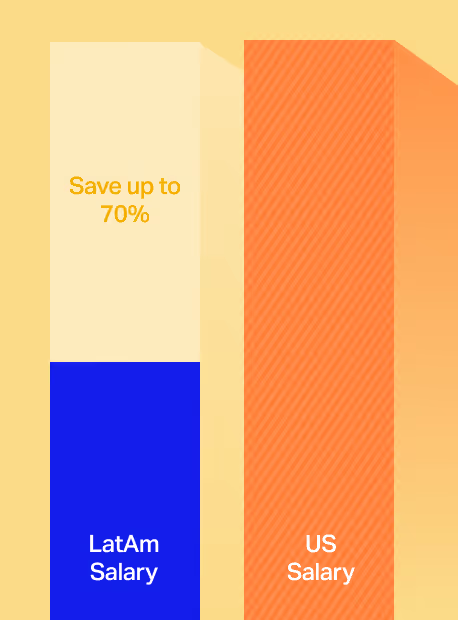
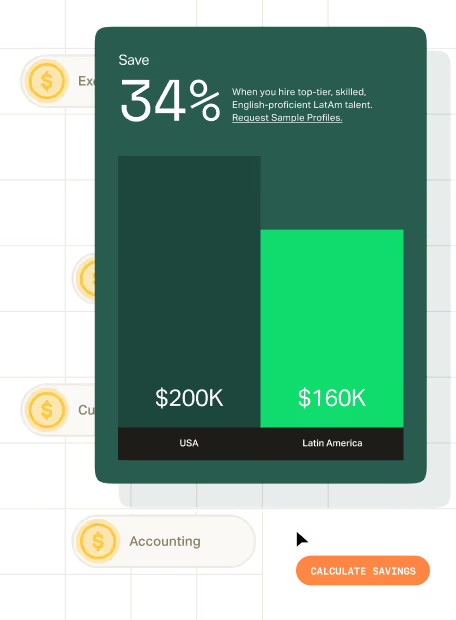
Hiring an offshore developer costs $30K to $108K per year if you hire in Latin America, against $66K to $238K for the equivalent US hire, plus a partner fee if you use one.
For an independent baseline on the US side, the US Bureau of Labor Statistics (BLS) puts the median annual wage for software developers at $133,080 as of May 2024. It projects 15% employment growth from 2024 to 2034, with roughly 129,200 openings a year across developer, QA, and testing roles.
Here’s what hiring each of the main developer roles costs in Latin America compared with an equivalent US hire, according to Hire With Near’s salary benchmarks:
For the most up-to-date figures, see Hire With Near’s US vs Latin America Salary Guide.
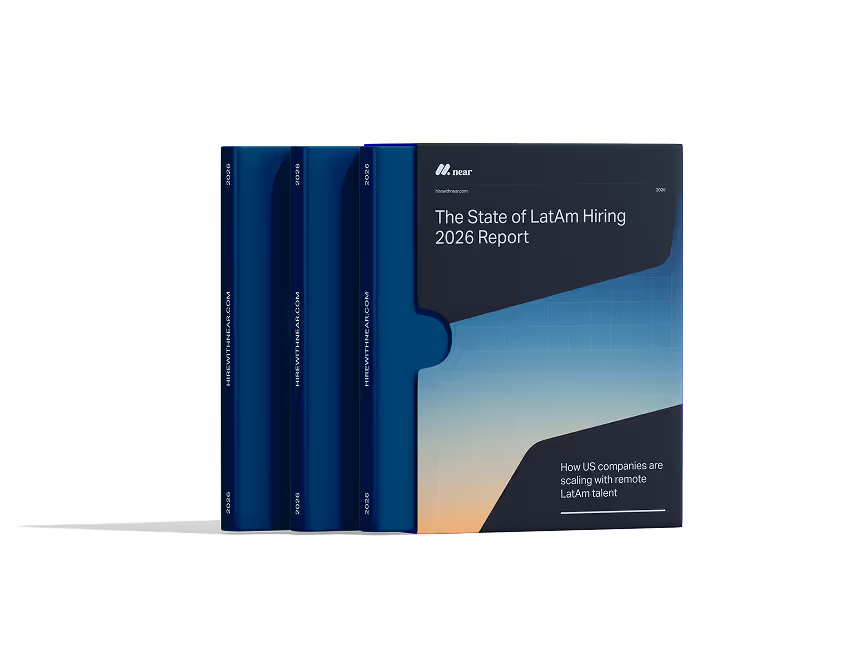
Across the 2,000+ placements in Hire With Near’s 2026 State of LatAm Hiring Report, companies hiring software engineers in Latin America saved between $23,000 and $85,000 per year compared to an equivalent US hire, a 28% to 59% reduction.
The same report found that 98% of engineering placements were mid-level or senior. At the top of the Latin American range, you’re paying roughly what hiring a mid-level US engineer costs, for someone several years further along.
Our data on developer salaries in the US vs. Latin America breaks the same comparison down role by role.
What else you’re paying for
Salary is the biggest line, not the only one. Budget for the partner’s fee, local benefits and equipment, and the cost of the hire not working out.
Partner fees come in one of two shapes, and knowing which one you’re being quoted tells you most of what you need:
- A direct-hire recruiting fee is a one-time percentage of first-year salary: you pay it once, the person is on your payroll, and nothing recurs.
- A staffing or staff augmentation fee is a monthly amount for as long as the person is engaged through the partner, and it normally includes payroll, benefits administration, and local compliance inside it.
Marketplaces are a third category. The rate you see is the developer’s rate plus a platform fee, and the platform does the least work of the three.
Three questions to price any vendor on this list.
- Is the fee one-time or recurring?
- What is included in it?
- And what happens to it if the hire leaves in month two?
If a company won’t answer the first two on a call, that’s your answer.
Our breakdown of how much offshore developers cost runs the comparison region by region.
Software companies tend to budget for this most carefully, and for good reason: a single US hire often costs as much as building out a small team in Latin America instead. That price gap is a big part of why nearshore SaaS recruiting is one of the busiest categories we see.
For the region-specific numbers, our guide on how to hire Latin American developers covers salaries and hiring models country by country.
{{latam-hiring-calculator}}
How Do You Hire Offshore Developers Step by Step?
Hiring offshore developers isn’t complicated, but to help you understand the process, we created a 7-step guide: define the role precisely, pick your sourcing channel, test the skills instead of reading about them, check communication, run a paid trial, protect your IP, and build the person into your team rather than around it.
1. Define your project requirements
Define the role before you talk to anybody. A front-end developer, a back-end developer, a website developer, and a specialist like a Google Cloud developer are four different searches with four different candidate pools, and vendors will happily let you find that out late.
Write down the stack, the seniority, how much of the working day you need covered, and the three things this person has to ship in their first quarter.
Our guide to hiring the right web developer shows the level of detail that changes the shortlist for a single role.
2. Compare your four sourcing channels
You have four realistic ways to bring an offshore developer on, and they differ in who does the finding and who does the employing.
- Source and hire on your own: Use job boards, LinkedIn, and referrals to find candidates, then use an employer of record to handle contracts, payroll, local benefits, and compliance in the developer’s country. It’s the lowest-cost route on paper. The gap worth naming: an employer of record handles the employment side and none of the recruiting, so every candidate is still yours to find, screen, and interview.
- Freelance and contractor marketplaces: The fastest way to a working developer, and built for project work. Rates are visible and you can find someone fast, but quality control is entirely yours and most of the talent carries several clients at once. That’s fine for a scoped build and a problem for a permanent seat, which is why specialist staffing gives fundamentally different results for full-time remote hires.
- A specialist staffing and recruiting partner: The one option that does both jobs in a single relationship: it sources and vets the engineer, and it handles the employment side once you hire. That’s where most companies hiring a full-time offshore developer end up.
- Staff augmentation: An agency employs a pre-vetted engineer who works on your team under your direction, which suits a defined project or a team you expect to scale up and down. Outsourcing firms and dev shops go further and deliver whole builds with their own team, a different purchase from hiring a person, and several of the LatAm outsourcing companies that work this way appear on the list below.
Ask the developers themselves and most will tell you they’d rather be hired directly onto a team than rotated through a dev shop. Hayden Cohen, our CEO and Co-founder, explains why in the video below:
3. Evaluate skills and experience
Test the work instead of reading about it. Hire With Near’s software engineering recruiters consistently flag the same three signals in a strong developer screen, and none of them show up on a resume:
- Code that is clean, scalable, and testable rather than merely working.
- Curiosity about the business purpose behind a ticket rather than just closing it.
- Ability to explain a technical decision to a non-developer without being asked to.
The assessment that separates candidates is simple. Ask them to debug a piece of code, refactor something for scale, or build a basic API with tests, then review it together on a call.
Take-home or live both work. What doesn’t work is stacking three technical assessments on top of each other. Strong developers drop out of processes like that, and the candidates you most wanted are the first to go.
One question does more work than any test. Federico Bilello, Recruiter for Software Engineering at Hire With Near, screens for something narrower than skill:
The main thing I look for is ownership. I always look for developers who have worked in startups or smaller companies, because those are the people who probably have ownership. If you bring them a problem, they won’t ask how to solve it, they’ll try their own ideas, they’ll be creative.
— Federico Bilello, Software Engineering Recruiter, Hire With Near
Ask candidates to describe a recent project where they designed and implemented a full-stack solution: what stack they used, what went wrong, and how they got around it. If they can’t say what their own part was, you have your answer.
Our five-question test for spotting a fake senior engineer covers the rest of that conversation.
Be careful what you screen for, too. A specific framework version is usually the wrong filter. A developer who understands the principles underneath it adapts inside a week.
4. Prioritize communication
Communication is the single most in-demand skill employers hire for, ranking first on LinkedIn’s most in-demand skills list ahead of leadership and project management.
A 2022 peer-reviewed study of 530 technology job adverts found the same pattern inside software specifically: communication tops the list of soft skills employers screen for, regardless of the type of position.
Test it the way you’d test code. On your own screening call, ask the candidate to walk you through a past project as if you were a non-technical colleague. Then, ask what they’d do differently now. What you’re listening for is whether they can explain a decision they made and own the part they got wrong, not whether their accent is easy on you.
5. Set up a paid trial
Run a two-week paid trial before you commit to a full-time seat. Give the candidate one real ticket from your backlog, at the seniority you’re hiring for, and have the engineer who will own their code review look at the output with them.
Make sure to pay for the work. You’re buying evidence, and unpaid trials filter out the people who already have other options.
What you learn isn’t just whether the code works. You see how they ask questions, how they handle an ambiguous ticket, and how they respond when you push back on an approach.
6. Protect your intellectual property
Get the paperwork done before anyone touches your repository. Four instruments cover most of it:
- An NDA signed before code access.
- An IP assignment clause naming your company as the owner of work produced.
- Repository access scoped to what the role needs rather than the whole codebase.
- Offboarding checklist that revokes credentials the day an engagement ends.
Then, ask who is accountable for the IP paperwork in the developer’s own country. Whoever handles employment there, whether that’s you, the staffing partner, or an employer of record company, should also be the one confirming the assignment clause holds up under local law. If a vendor can’t say who that is, that’s worth knowing before you sign.
7. Build the developer into your team
Collaboration isn’t a soft benefit. Distributed teams that hold ongoing discussions about how they work together report 84% better team collaboration and 50% higher employee engagement, according to Gallup, and simply having a plan for distributed work makes employees 66% more likely to be engaged.
So put that conversation on the calendar. Ask the team every few weeks what’s slowing handoffs down, then change one thing. Your offshore developer should be in your stand-ups, your code reviews, and your retros on the same terms as everyone else. That is what turns a 24-hour question loop into a same-day answer.
11 Best Companies and Platforms to Hire Offshore Developers in 2026
Eleven companies clear the bar for hiring offshore developers in 2026: Hire With Near, Toptal, Andela, Revelo, CloudDevs, Lemon.io, BEON.tech, Upwork, Uplers, Radixweb, and Bacancy Technology.
They split into four models: a staffing and recruiting partner, nearshore staff augmentation firms, vetted developer marketplaces, and outsourcing shops that deliver whole projects.
How I built this list: every company holds a rating of 4.5 or above with at least 50 client reviews on at least one established review platform (G2, Clutch, Trustpilot, GoodFirms, or ClearlyRated).
From the companies that cleared that bar, I compared how they source and vet developers, which regions they hire from, the engagement models they offer, and the pricing information published on their own websites.
The companies below are in no particular order, and no ranking is implied.
There’s no single best option for everyone; the right fit depends on the roles you’re filling, your budget, your timeline, and how you like to work. My goal is to help you build a shortlist worth making calls about.
If your search is nearshore rather than offshore, our list of the best companies to hire developers in Latin America is the closer comparison.
Here’s how the eleven compare on model, best fit, and client rating:
Note: Ratings shown are as of August 2026. To keep this list current with our selection criteria, we re-check third-party review-site ratings on a regular basis and update them as needed.
Hire With Near

Website: hirewithnear.com
Headquarters: United States
Rating: 4.9/5 on G2 (150+ reviews) as of August 2026
Services: Full-service nearshore staffing and recruiting, RPO, staff augmentation, executive search
Focus Regions: Latin America only
Hire With Near is a full-service staffing and recruiting agency that helps US companies hire top-performing remote talent in Latin America across all departments and industries, including software engineering. Companies come to us to hire developers in Latin America, and we run the hire end to end: sourcing, technical and cultural screening, candidate presentation, then payroll, compliance, and onboarding.
We’re the only firm on this list that recruits exclusively in Latin America for US companies. We’ve hired for 950+ companies, including Expensify and Deel, source from a pre-vetted pool of 160,000+ Latin American professionals, and were ranked No. 118 on the 2026 Inc. 5000 list of the fastest-growing private companies in America.
Key features:
• Senior engineering roles, every week: We place senior back-end, front-end, mobile, QA, DevOps, and data and ML engineers, with tech recruiters who screen for real-world impact rather than keywords.
• Quality-first approach: A 97% placement rate, a 9.1 client satisfaction score, and 80% of our hires still in the role two years on.
• One partner, one process: Scale across functions with one dedicated team. First candidates in 3 to 5 days with video introductions, most hires in under three weeks, and each round gets easier as we adapt to your feedback.
• Transparent pricing: Benchmarks and fees up front; you set the salaries, and you pay nothing until you make a hire.
Best for: US companies that want a dedicated, full-time developer working their hours, hired the first time properly.
Limitations: We recruit in Latin America only, so we’re the wrong call if you want engineers in Asia or Eastern Europe, and we don’t take project work.
Pricing: Direct hire is a one-time recruiting fee; the staffing model is a monthly fee with payroll and compliance included. Every placement carries a 180-day replacement guarantee, double the industry standard.
Toptal

Website: toptal.com
Headquarters: Wilmington, Delaware, US
Rating: 4.7/5 on G2 (270+ reviews) as of August 2026
Services: Freelance developers, designers, finance experts, and project managers
Focus Regions: Global
Toptal earned a spot here on the strength of its screening funnel and the client roster that follows from it. The company states that fewer than 3% of the more than 200,000 people who apply each year make the cut, and it publishes an average time to match of under 24 hours.
Named clients include Bridgestone, Zoetis, the Cleveland Cavaliers, and the University of Southern California, which tells you the model holds up under enterprise scrutiny.
Key features:
• Two-week no-risk trial: Engagements start with a trial of up to two weeks, and you pay nothing if you stop there.
• Beyond developers: The same network covers designers, finance experts, and project managers across 54+ specializations.
• Flexible engagement shapes: Hourly, part-time, and full-time arrangements all work, which suits a project that starts small and grows.
Best for: Companies that need a proven senior specialist on a defined project and want them this week.
Limitations: The model is freelance and contract-first, so it isn’t the route to a full-time employee with payroll and compliance handled for you.
Pricing: Not publicly listed; Toptal states rates vary by talent location, project complexity, seniority, and engagement type.
If you’re interested in Toptal, check our Hire With Near vs. Toptal comparison page.
Andela
Website: andela.com
Headquarters: New York, New York, US
Rating: 4.7/5 on G2 (1,535+ reviews) as of August 2026
Services: AI system development, managed engineering teams, engineer augmentation, and technical training
Focus Regions: Global, with talent across Africa, Latin America, Europe, and Asia
I included Andela because it’s the clearest fit on this list for a company staffing an AI program rather than filling a single seat.
Andela reports 17,000 certified AI-native engineers and more than 200,000 technologists trained since 2014.
Its named client list includes GitHub, Goldman Sachs, Capital One, Johnson & Johnson, and Coursera, which is also a signal that Andela is built for programs with a budget and a roadmap behind them.
Key features:
• AI-specialized roles: AI application engineers, AI systems and infrastructure engineers, ML and MLOps specialists, data engineers, and data scientists.
• Three delivery shapes: Augment with individual engineers, deploy a fully managed team, or buy training for the engineers you already have.
• Notable clients: The enterprise roster is worth knowing about if you’re a 20-person startup weighing whether you’d be a priority account.
Best for: Enterprises and funded scale-ups staffing AI, data, and platform engineering programs.
Limitations: The positioning is heavily AI-first, so a straightforward web application hire is not where its strength shows.
Pricing: Not publicly listed, though individual engineer profiles show example monthly ranges of $6,500 to $8,500.
Revelo

Website: revelo.com
Headquarters: Not publicly listed
Rating: 4.8/5 on G2 (160+ reviews) as of August 2026
Services: Engineer placement, pre-assembled teams, software development, and AI training data
Focus Regions: Latin America, across 18 countries
What stood out about Revelo is how directly it answers the complaint that sends most people off an offshore setup. Its engineers are based in Latin America and, per its own site, work within two hours of US Eastern time.
Revelo reports a network of 400,000+ vetted software engineers, delivers three to five matched candidates within 72 hours, and cites a 14-day average from requirements to an engineer shipping code.
It counts 2,500+ companies as clients, including Amazon, Meta, and Anthropic.
Key features:
• Employment handled across 18 countries: Revelo runs payroll, benefits, taxes, and compliance in every country it hires from, so you don’t set up an entity.
• Month-to-month engagements: There’s no long-term lock-in, which lowers the cost of being wrong about a role.
• Layered vetting: Candidates are identity-confirmed, skills-tested, and human-screened before they reach you.
Best for: US teams that want Latin American engineers working their hours without taking on the employment side.
Limitations: Engineers are engaged through Revelo rather than hired onto your payroll, and the scope is software engineering roles only.
Pricing: Not publicly listed; Revelo claims 30–50% cost savings versus a US hire and offers month-to-month terms.
If you’re interested in Revelo, check our Hire With Near vs. Revelo comparison page.
CloudDevs

Website: clouddevs.com
Headquarters: Wilmington, Delaware, US
Rating: 4.9/5 on G2 (160+ reviews) as of August 2026
Services: Full-time hires, freelance and contract developers, and team placements
Focus Regions: Latin America, with hubs in Mexico, Brazil, Argentina, Colombia, and Peru
What sets CloudDevs apart is speed: it says vetted talent is ready to start within 24 hours of a request, faster than most of the other platforms on this list.
It reports a network of 8,000+ pre-screened developers and designers, and its client base runs from pre-seed startups to Fortune 500 companies, a wide enough range that it works whether you’re hiring your first engineer or your fiftieth.
Key features:
• Seven-day risk-free guarantee: If the match doesn’t work, CloudDevs offers a replacement or a refund within the first week.
• Pay only after you hire: There’s no upfront cost and no minimum commitment period.
• Live coding in the screening: Vetting runs in three stages, and the last one is a coding challenge rather than a resume review, which is the part most marketplaces skip.
Best for: Teams that need a Latin American developer quickly and are working to an hourly budget.
Limitations: Engagements are hourly contracts, so this isn’t the path to a developer on your own payroll with benefits handled.
Pricing: All-inclusive rates averaging $45 to $75 an hour, from roughly $28 at the junior end to $58 for senior engineers.
Lemon.io

Website: lemon.io
Headquarters: Not publicly listed
Rating: 4.8/5 on Trustpilot (355+ reviews) as of August 2026
Services: Vetted contract and in-house engineering hires across 50+ technologies
Focus Regions: 40+ countries across four continents
The reason Lemon.io made the list is a decade of narrow focus on one thing: predicting whether an engineer will work out before you meet them. The company started in 2015, maintains a pool of 1,500+ vetted developers, and states a matching time of roughly 24 hours.
Its vetting runs in three layers: AI agents trained on engineering assessments, then technical interviews conducted by senior engineers, then hand-matching to your stack.
Key features:
• Broad role coverage: Full-stack, front-end, back-end, mobile, game, DevOps, cloud, AI, data, blockchain, and automation QA engineers are all in scope.
• No upfront fees: You pay for work delivered, and there’s no stated minimum project duration.
• Senior-engineer interviews: Candidates are interviewed by senior engineers before they ever reach a client call.
Best for: Startups that need a vetted contract engineer working inside the week.
Limitations: The model is contract-first rather than permanent placement, and there’s no published rate card, only a calculator on the site.
Pricing: Not publicly listed; you pay for work delivered, with no upfront fees.
BEON.tech
Website: beon.tech
Headquarters: Not publicly listed
Rating: 4.9/5 on Clutch (70+ reviews) as of August 2026
Services: Nearshore staff augmentation across 100+ technical positions
Focus Regions: Latin America, across 23 countries
BEON.tech caught my attention for how it vets and, unusually, for what happens after the hire: tech leads personally review every candidate and produce a written report.
The company cites a 3:1 submit-to-hire ratio, which means you’re reading three profiles rather than thirty.
Its network holds 73,900 vetted candidates and it claims developers are ready to ship in under two weeks, and named clients include npm, Evisort, Acoustic, AutoFi, and SimplePractice.
Key features:
• Retention support built in: Every engineer gets a Talent Experience Manager who handles growth planning, aimed squarely at the churn problem in augmentation.
• Logistics and equipment handled: BEON.tech runs hiring logistics, onboarding, and equipment provisioning.
• You’re charged only on onboarding: There’s no fee unless an engineer starts.
Best for: US software teams adding Latin American engineers they intend to keep for years.
Limitations: The scope is developer and technical roles only, so it won’t help you hire across other departments.
Pricing: Not publicly listed.
Upwork
Website: upwork.com
Headquarters: Not publicly listed
Rating: 4.5/5 on G2 (3,220+ reviews) as of August 2026
Services: Open freelance marketplace with hourly and fixed-price contracts, plus an Enterprise tier
Focus Regions: Global
Upwork is here for one specific reason: no other company on this list gives you the sheer breadth of an open marketplace, and its more than 3,220 G2 reviews are the largest evidence base of any company on the page.
It suits work you can define tightly, and it’s a poor fit for building a permanent engineering team. Hourly contracts bill weekly with a review window before funds are released. Fixed-price contracts run on milestones funded into escrow first.
Key features:
• Escrow and review protections: Fixed-price milestones are pre-funded, and hourly contracts give you a window to review and dispute work before payment releases.
• Enterprise tier: Configurable contracts, IP protection, Upwork Payroll, sourcing help, and program managers.
• Speed of access: You can post a role and be reviewing proposals the same day, with no vendor onboarding in between.
Best for: Scoped, short-term development work you’re willing to screen yourself.
Limitations: Screening is your job rather than the platform’s, and most freelancers carry several clients at once, so attention is split.
Pricing: Freelancers set their own rates, with Upwork’s platform fees on top. No fixed rate card.
Uplers

Website: uplers.com
Headquarters: India
Rating: 4.8/5 on Clutch (125+ reviews) as of August 2026
Services: Curated sourcing, full-service hiring, and contract talent across engineering and go-to-market roles
Focus Regions: India
I chose Uplers based on the depth of its single-country focus. It draws from a network of 3.5 million+ professionals in India, positions on the top 1% of that pool, and commits to three to five relevant candidates within 48 hours.
Verified profiles include work history, major projects, and an intro video, so you’re evaluating a person rather than a formatted resume.
Key features:
• Lifetime free replacement: Uplers offers replacement cover with no stated expiry, which is unusual in this category.
• Three engagement models: Curated sourcing, full-service hiring, or contract talent, so the level of involvement is yours to pick.
• Notable clients: GitLab, Tripadvisor, Airbnb, HackerRank, and Darwinbox appear on its own client list.
Best for: Companies that specifically want India-based engineers and a full-service hiring process around them.
Limitations: Talent comes exclusively from India, so overlap with your working day is limited compared with the nearshore options here.
Pricing: Not publicly listed; the site’s budget questionnaire spans monthly ranges from $1,500 to $9,000+.
Radixweb
Website: radixweb.com
Headquarters: Frisco, Texas, US, with delivery centers in Ahmedabad, India
Rating: 4.8/5 on Clutch (50+ reviews) as of August 2026
Services: Custom software development, AI enablement, data engineering, and system modernization
Focus Regions: Global delivery, India-based engineering
Radixweb qualified on certifications, which is the criterion that decides vendor choice in regulated industries. The firm has 26+ years behind it, 650+ engineers, and 3,000+ businesses served across 30+ industries.
It holds ISO 9001:2015 certification for quality management, and its client roster spans healthcare, fintech, and logistics, industries where a vendor’s process discipline gets checked before a single line of code does.
Key features:
• Compliance credentials: ISO 27001:2022, ISO 9001:2015, and SOC 2, plus HIPAA and GDPR capability.
• Three engagement models: Dedicated development teams, project-based delivery, or a long-term engineering partnership.
• Long client tenure: Radixweb reports 40+ clients with relationships running five years or longer.
Best for: Regulated-industry builds where security certifications are a gating requirement.
Limitations: This is a project and dedicated-team model rather than a route to a developer on your payroll, and the orientation is mid-market to enterprise.
Pricing: Not publicly listed; custom quoting per engagement.
Bacancy Technology
Website: bacancytechnology.com
Headquarters: United States, with international delivery
Rating: 4.7/5 on Clutch (60+ reviews) as of August 2026
Services: Software development outsourcing, staff augmentation, and dedicated teams
Focus Regions: Global delivery
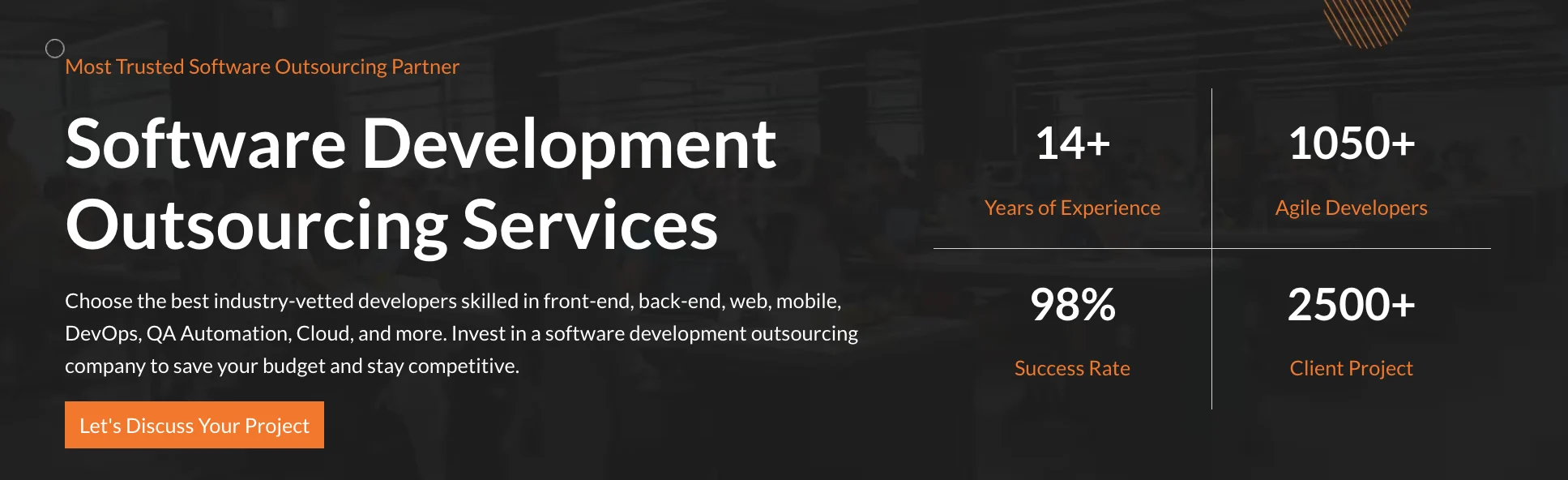
Bacancy Technology stayed on this list because the enterprise names it works with are the kind that audit their vendors. Founded in 2011 and now 1,050+ vetted engineers, it reports 500+ enterprise clients and 98% client retention, and it commits to onboarding in 48 hours, which is fast for a firm operating at that scale.
Key features:
• Platform depth beyond app development: Coverage includes Salesforce, SAP, ServiceNow, Snowflake, and Databricks alongside standard web and mobile stacks.
• AI and data engineering practice: LLM development, RAG systems, AI agents, computer vision, plus data warehousing and governance.
• Notable clients: Verizon, Shell, NatWest, Edward Jones, and Academy Sports + Outdoors are on its own client list, worth weighing if you’re a small team wondering where you’d sit in the queue.
Best for: Enterprise platform, data, and AI programs that need a delivery partner rather than a hire.
Limitations: The outsourcing and augmentation model means the engineers stay Bacancy’s employees, and processes are built for larger programs than a five-person team may want.
Pricing: Not publicly listed.
How Do You Evaluate an Offshore Developer Hiring Company?
Judge an offshore developer hiring company on what happens before a resume reaches you, never on what its website homepage claims. Offshore developer hiring company sites read almost identically from the outside, and the differences only surface when you ask about process.
From the editorial work I do interviewing the recruiters who place these roles, six questions separate the vendors that save you a search from the ones that cost you one. Ask all six on the first call, and listen for specifics instead of adjectives.
What happens between your job description and the first resume you see?
Ask for the steps by name, with owners and a stated time to shortlist. A good answer sounds like this: a recruiter who specializes in engineering roles writes the search brief with you, sources against it, then runs a screening call that doubles as an English check. They send three to five profiles inside a week, with video introductions.
A bad answer sounds like “we have a large network and we’ll send you some options.” The second answer is where 50 unvetted resumes come from.
Is the technical vetting real, or resume screening with a nicer interface?
Make them describe the assessment, not the funnel. This is the most common complaint we hear about other vendors, and it shows up months into a relationship rather than on the first call.
One talent acquisition leader at a mid-market compliance SaaS company, already running a five-engineer team in Latin America, described it this way:
Right now, [our current vendor] is sending us candidates, and their resumes do look good, but when they do make it to our technical assessment and our interview rounds, our hiring team is finding that they’re maybe not as senior as we’re hoping for. So we’re just looking for candidates that are more senior than from what we’ve seen over the last several months with [them].
A good answer names a form of assessment: a small real-world task reviewed together on a call, or a technical interview run by a senior engineer.
Treat an AI-scored screen with no human step as a red flag. And credit the vendors that are honest about the limit, because no one’s vetting replaces your own technical interview. The good ones say so unprompted.
Is the pricing legible, or is there a spread you can’t see?
Ask what the developer receives and what the vendor keeps. You’re entitled to know, and how they handle the question tells you how the rest of the relationship will go.
One US e-commerce holding company running several D2C brands, after using a freelance marketplace and an AI-staffing agency for development work, put it plainly:
Our issue with the other company was they wouldn’t tell us how much we were paying them. And one of the people that I interviewed said that the job was listed at like 50% less than what they told us we’d be paying. So that means that their fee was super high. That’s something that didn’t sit right with me.
A good answer states the model and the number: a one-time percentage of first-year salary, or a monthly amount with payroll and compliance inside it, and you set the salary. A single blended hourly rate with no breakdown isn’t an answer.
Who handles payroll and compliance, and who manages the developer day to day?
These are two separate questions and you want both answered before you sign.
The developer should work as part of your team, join your stand-ups, and report to your engineering lead, the same as anyone else on the org chart.
On the employment side, either you employ them directly or the partner (or an employer of record) handles contracts, payroll, local benefits, and compliance in their country.
What matters is that somebody is clearly accountable for compliance where the developer lives, and that it isn’t you by accident.
What’s the replacement guarantee, and how long does it run?
Most credible vendors have one, and the length varies more than anything else on this list.
Pin down three things: how long the window runs, whether it covers a replacement search or a refund, and whether a second fee applies. Replacing someone in a technical role costs around 80% of their salary according to Gallup, on top of the ramp time you already spent, so don’t forget to ask.
For reference, every Hire With Near placement carries a 180-day replacement guarantee, double the industry standard.
Have they filled this exact role, in this region, recently?
Ask for the last three searches they ran that look like yours and what happened in each one. Category experience isn’t role experience: a firm that places support agents at volume isn’t the firm to hand a staff-level platform engineer to.
A good answer includes a role, a region, a timeline, and a client willing to take your call.
What Mistakes Should You Avoid When Hiring Offshore Developers?
Offshore developer hires usually fail for one of eight reasons, and they split evenly between the company you hired through and the person you hired.
In the conversations I have with Hire With Near’s software engineering recruiters, the same eight keep coming up, and so do the stories US engineering leaders tell them after a first offshore attempt.
Mistakes to avoid with the hiring company
- Judging a vendor by its marketing site instead of its process: Every company in this category has a good website; that’s the least expensive thing they own. The failure it causes is a three-month relationship built on a landing page. The fix is the six questions in the section above, asked on a call, with notes.
- Assuming a large talent database means good candidates: A big pool is a real advantage for speed and a real risk for fit, and the two are separate questions. If the profiles you’re shown were already sitting in a pool, you may be reading what other clients passed on. Ask directly whether these candidates were sourced for your role or pulled from a bench, and how many other companies have seen the same profiles.
- Comparing hourly rates without comparing what’s inside them: A $60 hourly rate that includes payroll, benefits, and compliance is a different number from a $60 rate that includes none of them, and vendors rarely volunteer the difference. Put every quote into the same annual, all-in shape before you compare, or you’ll pick the wrong one confidently.
- Treating a marketplace built for project work as a source of full-time hires: Marketplaces are excellent at what they’re for: a scoped build, a specialist for six weeks, a gap you need covered now. They’re not built to produce someone who learns your codebase and is still there in two years.
Our roundup of common nearshore outsourcing mistakes covers the variations.
Mistakes to avoid with the developer
- Trusting resume seniority without a live technical check: Resumes have never been easier to generate, and titles aren’t standardized across markets, so the same title can mean different things in two countries. Run one small real-world task and review it together on a call.
- Making a degree a hard requirement: Our Recruitment Consultant Natasha Tarapow tells clients not to make a degree a must-have. Many of the strongest engineers in Latin America started working before they graduated, took a good job, and never went back to finish. A degree filter removes those people from your pipeline and keeps out anyone that a technical assessment wouldn’t catch anyway.
- Ignoring how much of your working day the developer shares: This mistake ends more offshore experiments than any other. Research from Harvard Business School and INFORMS found that the bigger the time zone gap, the more work gets pushed outside normal business hours for one side of the pair, and recommends organizing distributed teams north to south rather than east to west. In practice, that’s the difference between same-day code review and a 24-hour question loop. Ask how many hours of your own working day the developer will actually be online for, in your hours, not theirs. If your shortlist leans toward Asia, check our comparison of hiring remote talent in LatAm vs. India.
- Hiring someone who’s juggling several clients: Split attention shows up as slow reviews, missed context, and a person who is never quite in your sprint. Our recruiters flag two or three parallel jobs as one of the clearest predictors that an engagement won’t last. Ask what else the developer is committed to, in writing, and ask the vendor what their own retention looks like a year in.
For more details, we keep a running account of the top offshore development risks and how to manage them.
Final Thoughts
When hiring offshore developers, start by picking the model before choosing the company, because the model decides most of what your experience will be.
A marketplace is the efficient answer for a scoped piece of work. An outsourcing firm makes sense when you want a team to deliver something end to end. A recruiting partner is the right call when you want an engineer who joins your stand-ups, learns your codebase, and is still there in two years.
At Hire With Near, we help US companies hire software engineers in Latin America as full-time members of their own teams, working their hours. Once a team grows past its first few developers, we run executive search in Latin America for engineering leadership.
Talk to a few companies on this list, including us. Twenty minutes is enough for us to understand the roles you’re filling, walk you through how our process works, and give you real salary benchmarks for the seniority you need. No pitch and no commitment.
Book a free consultation call today.
{{consultation}}
Frequently Asked Questions
What are the best companies for a US company to hire offshore developers?
For a US company hiring offshore developers, the strongest options are Hire With Near for full-time Latin American engineers hired onto your own team, Toptal for senior freelance specialists, Andela for enterprise AI and data engineering programs, Revelo and BEON.tech for Latin American staff augmentation, and Upwork for scoped short-term work you screen yourself.
If you want a permanent team member who joins your stand-ups, use a staffing and recruiting partner. If you need flexible capacity for a defined project, use a marketplace or an augmentation firm. If you want a team to deliver a whole build, use an outsourcing firm like Radixweb or Bacancy Technology.
Will offshore developers work in my time zone and join our stand-ups?
Yes, if you hire in Latin America, and usually not if you hire in South or Southeast Asia. That’s why what offshore means for you is the first thing to settle. Latin America spans roughly the same band of hours as the continental US, so a developer in Mexico City, Bogotá, or São Paulo is online through your business day. Live stand-ups and same-day code review are normal.
How good is offshore developers’ English for technical communication?
Strong enough for architecture reviews in most senior hires, but the thing to test is technical articulation, not accent. Conversational and written fluency is common among experienced engineers across Latin America; what varies is whether someone can explain a decision they made to a person who isn’t a developer.
Run one test on your own screening process: ask them to walk you through a past project as if you were a non-technical colleague. If they reach for terminology instead of describing work they owned, you usually have your answer.
What happens if an offshore developer doesn’t work out?
You fall back on the vendor’s replacement guarantee, which is exactly why its terms are worth reading before you sign anything. Ask how long the window runs, whether it covers a replacement search or a refund, and whether a second fee applies.
Guarantees in this category range from a single week to six months. Every Hire With Near placement carries a 180-day replacement guarantee, double the industry standard, and we run the replacement search ourselves rather than handing you a credit.
What engineering roles can I hire offshore or nearshore through Hire With Near?
US companies hire the full engineering stack from Latin America: remote software engineers, nearshore full-stack developers, mobile developers, remote QA engineers, and nearshore DevOps engineers.
One healthtech client hired across all of those categories in a single scaling push.
These roles cluster well in the region because the senior pool runs deep in the same stacks US teams already use, and because the working-hours overlap makes pairing and code review possible in real time.
Which countries are best for hiring offshore developers?
Brazil, Mexico, Colombia, and Argentina are the strongest starting points for a US company, because they combine real overlap with your working day and the deepest senior engineering pools in the hemisphere. Judge any country in this order: how much of your working day it shares, English depth for technical conversation, then the size of the senior pool.
GitHub’s Octoverse 2025 report counted 3.2 million net new developers across Latin America in a single year, naming Brazil, Mexico, and Colombia as the standouts.
Our ranking of the best countries to hire remote software engineers covers the rest.






.webp)
.webp)


%203.svg)
.avif)





%20(1).avif)

%20(1).png)