


%203.svg)
Key Takeaways
- The reliable way to hire Laravel developers is to screen object-oriented PHP before framework knowledge, verify professional years with Laravel specifically rather than total years in tech, and test candidates on a small real-world task instead of algorithm puzzles.
- Hiring a Laravel developer in the US runs $80K to $189K a year depending on seniority; in Latin America the same seniority levels run $30K to $108K, saving up to 68%.
- Hiring in Latin America isn't a seniority trade-down: 98% of Hire With Near's engineering placements are mid-level or senior. We share a shortlist of candidates in 3–5 days versus the 3–6 months a typical US search takes.
If your roadmap is stuck behind a Laravel hire, PHP’s dominant framework, that doesn’t pencil out at US rates, the fix most teams land on is Latin America: you can hire Laravel developers in Latin America working during your business day for $30K to $108K per year, while a US equivalent hire would charge $80K to $189K.
Cost is the most common reason US companies start looking to the region. In our analysis of more than 2,000 hiring conversations, 41% of US companies told us budget was what pushed them to look at Latin America. For most of them, the alternative was never a US hire at a US salary: with tight budgets, the solution was leaving the role open and watching the release date slip another quarter.
This guide covers how to hire Laravel developers in 2026: what they cost, what to screen for, where to find them, whether you need a consultant or a full-time hire, and how to run a process that closes a good one in weeks.
What Does a Laravel Developer Do?
Laravel developers build and maintain web applications using the Laravel PHP framework, creating everything from APIs and e-commerce platforms to content management systems and enterprise software.
They write clean, maintainable PHP code using Laravel’s built-in features like Eloquent ORM, routing, middleware, and Blade templating. Their daily work includes building database structures, creating RESTful APIs, implementing authentication systems, optimizing application performance, and integrating third-party services.
Laravel developers typically work as back-end developers, but many also handle frontend tasks using technologies like Vue.js, React, or traditional HTML/CSS/JavaScript.
What they don’t do is handle server management or infrastructure setup (unless they’re in a full-stack role). Their focus is on application logic, data flow, and keeping the codebase scalable and maintainable as your product grows.
According to JetBrains’ State of PHP 2025 survey, 64% of PHP developers use Laravel, against 25% for WordPress and 23% for Symfony. That concentration shows up in our nearshore IT and tech recruiting work too: when a company runs PHP, it usually runs Laravel.
How Much Does It Cost to Hire Laravel Developers?
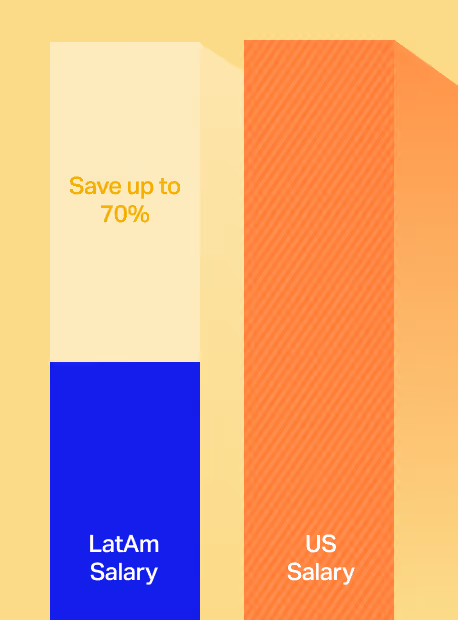
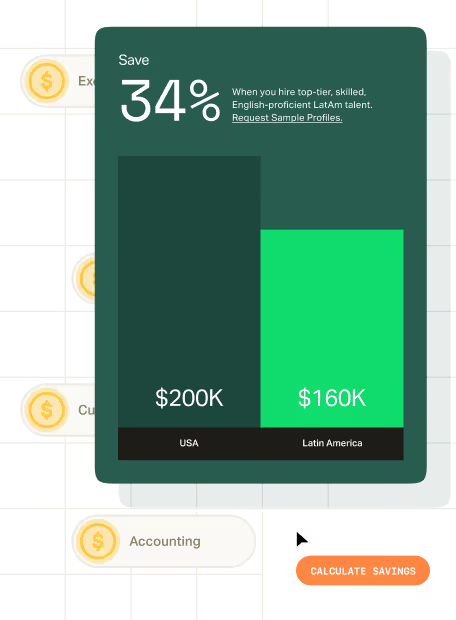
Hiring Laravel developers in Latin America costs $30K to $108K a year from junior to senior, compared to $80K to $189K for equivalent US hires, a saving of up to 68%, depending on seniority.
PHP and Laravel salaries have stayed competitive because demand is steady while the developer pool shifts underneath it. JetBrains’ State of the Developer Ecosystem 2025 puts PHP among the languages in long-term decline in share, alongside Ruby and Objective-C. PHP itself isn’t going anywhere, though: the same survey shows a mature, professional community around it. But a smaller share of new developers choosing PHP means experienced Laravel people are harder to replace.
To put those numbers in concrete terms, here’s what hiring a Laravel developer costs by seniority compared to an equivalent US hire, according to Hire With Near’s salary benchmarks:
For the most up-to-date figures, see Hire With Near’s US vs Latin America Salary Guide.
The bigger point is what the gap between salaries in Latin America and the US makes possible: a senior Laravel hire in Latin America often lands under what a mid-level US hire costs, so the architecture work you shelved becomes something you can staff this quarter.
These salary differences reflect local economic conditions and cost of living, not differences in skill: across roles and departments, US companies see savings of 30 to 70% by hiring in Latin America.
Similar salary gaps exist in Eastern Europe, South and Southeast Asia, where offshore developer rates can run lower still, but the time zone misalignment needs to be considered.
What Skills Should You Look For in Laravel Developers?
When hiring a Laravel developer, look for three skills: solid object-oriented PHP underneath the framework, real Laravel depth across Eloquent, queues, testing, and conventions, and the communication skills to explain a technical decision to someone who doesn’t write code.
Hard skills (the must-haves)
- Object-oriented PHP: Modern PHP features, PSR standards, interfaces, and namespaces underneath the framework, because Laravel is PHP first.
- Laravel fundamentals: Eloquent ORM, routing, controllers, middleware, and Blade, plus the judgment to say when a framework feature is the wrong tool for the job.
- Databases through Eloquent: Relational modelling, migrations, and enough SQL to spot the query Eloquent is generating badly.
- Systematic debugging: Can read a stack trace and a Laravel log and tell you where the request broke, then check the docs instead of guessing.
Soft skills (equally important)
- Problem-solving approach: Asks what the feature is for before building it, and says so when the ticket describes the wrong fix.
- Communication: Explains a technical decision to your product manager and your founder, not only to other engineers.
- Ownership and accountability: Thinks about edge cases, handles errors gracefully, and follows up on issues after deployment rather than passing them off.
- Team collaboration: Works well in Agile teams, gives useful code reviews, and picks up slack when the sprint slips.
Ownership is the one our recruiters weight most heavily, as Federico Bilello, a Recruiter for Software Engineering at Hire With Near, explains:
The main thing I look for is ownership. I always look for developers who have worked in startups or smaller companies, because those are the people who probably have ownership. If you bring them a problem, they won’t ask how to solve it, they’ll try their own ideas, they’ll be creative.
Federico Bilello, Recruiter for Software Engineering, Hire With Near
Nice-to-have skills (the differentiators)
- Frontend knowledge: Vue.js, React, or Alpine.js, which makes a Laravel developer easier to pair with your frontend team.
- DevOps awareness: Docker, CI/CD pipelines, and deployment, so they write code that ships and can troubleshoot a production issue.
- Performance optimization: caching strategies (Redis, Memcached), database tuning, query optimization, and eager loading.
- Package development: creating or maintaining Laravel packages shows they understand the framework well enough to extend it.
- Modern Laravel features: Livewire, Octane, or Nova, which can shorten development time for specific use cases.
Matching seniority to the work in front of you
Your expectations should match the level you’re paying for. A junior builds basic CRUD applications and follows established patterns. A mid-level developer handles most Laravel work independently and contributes to technical planning. A senior designs scalable applications, mentors others, and makes technical decisions that hold up against business goals.
Expecting a junior to architect microservices from scratch leads to frustration, and hiring a senior for simple feature work is overkill.
Here’s how Laravel developer skills typically progress across experience levels:
Where Can You Find and Hire Laravel Developers?
You can find strong Laravel developers through job boards, referrals, freelance platforms, staff augmentation firms, and recruiting partners.
But first, you should decide whether to hire locally, nationally, or internationally. Location sets both the size of your pool and what the hire costs.
Deciding between local, national, or global talent
Laravel development is remote-friendly work. There’s no requirement for your developer to be in the same office as you, or even the same city, to deliver high-quality results.
So decide upfront how far you’re willing to look. Your three options are:
- Local/in-office hiring offers the simplest collaboration and legal structure, but limits your talent pool and raises costs. This works best when in-person collaboration is critical or when you have specific compliance requirements.
- Remote US-based hiring expands your options while keeping familiar legal and cultural frameworks. You’ll still pay US market rates, but you’ll have access to developers across US time zones and different cost-of-living areas.
- Offshore/nearshore hiring gives you the largest talent pool and the biggest salary gap. In this case, Latin America stands out for development: developers there are used to following US business practices, working during your business day, and earning 30–70% less than a US hire. Eastern Europe and Southeast Asia are also options, but with a shorter time zone overlap.
The Latin American pool is bigger than most US teams assume. GitHub’s Octoverse 2025 counted 3.2 million net new developers in Latin America in a single year, with Brazil, Mexico, and Colombia leading and much of the growth attributed to remote hiring by US and EU firms. Brazil alone now has 6.89 million developers, the fourth-largest developer population in the world.
Across the 950+ companies we’ve helped hire, Latin American developers come out as the best combination of technical skill, communication, overlapping hours, and salary for US businesses. The practical questions that come next about contracts, payroll, and onboarding are covered in our free guide to hiring remotely in Latin America.
Choosing the right sourcing channel
Once you know where you’re looking, you’re choosing between four ways to hire a Laravel engineer, ordered here from the most work on your side to the least:
- Source and hire on your own: Post on a job board, work LinkedIn, lean on referrals. Referrals give the strongest culture fit and the shortest cycles but the smallest pool, while job boards give you candidates who are actively looking, plus the entire screening burden. For a hire outside the US, you’ll also need an employer of record company as the legal employer, and it’s worth being clear about the limit: an EOR handles contracts, payroll, and local compliance, and does no recruiting at all. You still find and vet every candidate yourself.
- Freelance platforms and marketplaces: Useful for a short-term project, an urgent gap, or testing someone before a full-time offer. Quality varies, the strongest people split attention across several clients, and platform fees stack on top, so it’s a weak fit for a developer you want owning your codebase.
- Staff augmentation: A firm places a temporary, pre-vetted developer onto your team and stays the legal employer, handling payroll, benefits, and compliance. It fits a defined project or a team you need to scale up and down.
- A specialist staffing and recruiting partner: A recruitment partner to hire full-time, permanent developers sources and vets candidates against your requirements, then handles the employment side once you hire. You get a pre-vetted pipeline and only best-fit candidates, usually in a fraction of the time sourcing yourself would take.
The table below helps you visualize the pros and cons of each sourcing model:
Why working with a recruiting partner makes a difference
Hiring the right person is hard enough when you’re sourcing locally. Add offshore hiring and the complexity multiplies: unfamiliar talent markets, compliance and payroll rules, and the challenge of figuring out what makes a competitive offer in a different country.
A recruitment firm that specializes in international hiring handles most of that for you. It sources and vets candidates against your requirements in a market where you have no network, and it knows what a competitive Laravel offer looks like there.
Once you hire, it handles payroll, benefits, and local compliance, so you stay on the right side of labor and tax rules.
For instance, a US healthtech startup reached out to Hire With Near with two internal recruiters and an 8-step technical hiring process it refused to shorten. We took over sourcing, screening, and candidate coordination while its team focused purely on evaluation decisions.
The company kept every step of its process, averaged 14 days to hire, filled 7 senior roles across backend, DevOps, QA, mobile, and frontend, and saved $323,000 a year against US salaries.
With the right partner, you hire faster and get the full range of benefits of hiring offshore Laravel developers. And if the plan is to hire software engineering talent beyond this one role, that pipeline adds up instead of restarting every time.
{{prevetted-banner}}
Should You Hire a Laravel Consultant or a Full-Time Laravel Developer?
Hire a Laravel consultant for scoped, time-boxed work: a performance audit, a version upgrade, an architecture review, a push to get a launch out the door. Hire a full-time Laravel developer when Laravel is core to your product and someone needs to own the codebase.
Consultants bill hourly, daily, or by project, so the rate is high but you can start and stop it. A full-time developer is a salary line: predictable and lower per hour of work, which is why the annual figures above are the right comparison once the work is continuous.
The real trade-off isn’t price, though. It’s context. A consultant who spends six weeks inside your application learns your data model, your integrations, and your quirks, then leaves with all of it. Make the handover part of the deal: documentation, tests, and a walkthrough with whoever maintains the code next.
If your budget today is project-shaped, start there. Plenty of teams hire a Laravel programmer for a defined piece of work, see how they operate, and then hire Laravel developers full-time once the roadmap justifies it. Starting scoped and converting later is a legitimate path.
How to Hire Laravel Developers: Process and Best Practices
Hire Laravel developers in three stages: define the work before you write the job post, screen with one small real-world Laravel task reviewed on a call, then move fast with an offer that spells out what success looks like.
Stage 1: Before and during sourcing
Before writing a job description, get specific about what your Laravel developer will build. Are you developing a new e-commerce platform, maintaining an existing API, integrating with third-party services, or building internal tools?
Most of the Laravel work we recruit for through nearshore SaaS recruiting sits in one of those buckets, and the bucket sets the profile: rapid feature development, legacy system maintenance, or architectural planning.
Consider the broader context too: Will they work independently or as part of a larger team? Do you need someone who can mentor junior developers or someone who thrives under guidance?
Across 3,500+ placements, clarifying the type of work they’ll do most and matching that to their strongest area is usually the difference between a shortlist you can act on and one you argue about. It also keeps you out of the “unicorn developer” trap.
Write job descriptions that attract serious Laravel developers
Your job posting should reflect both the technical requirements and the collaborative environment your developer will join. Include specific details about:
- The Laravel version and key packages you’re using (Livewire, Nova, Horizon), as context rather than a hard requirement
- Whether the work involves greenfield development, feature expansion, or legacy maintenance
- Database systems and third-party integrations they’ll work with
- Team structure and collaboration expectations
Textio’s analysis of over a billion job postings found that the best-performing job posts land between 300 and 660 words, and that a post containing at least one growth-mindset phrase fills an average of eight days faster.
Skills-based hiring expands candidate pools by 6.1x globally, so focus on capabilities rather than rigid degree requirements.
Avoid generic phrases like “Laravel expert” or “fast-paced environment.” Instead, focus on concrete skills and realistic project context that help qualified developers self-select.
Stage 2: Screening and evaluation
Skip the algorithm puzzles and give candidates a small piece of real Laravel work: an API endpoint with tests, a feature built to Laravel conventions, or a bug to find in existing code. Then review it together on a call.
The review call is the part most companies skip, and it’s where the signal is. Reading the code tells you how they structure work and handle edge cases. Walking through it together tells you why they made each decision and whether they can defend it.
Pair the task with the other filter our recruiters use. Federico Bilello puts it plainly:
I always ask for years of professional experience with a specific tool, not total experience. Some candidates count their university thesis work or barely-touched freelance projects. A client doesn’t care about that. They want to know how many years of real, professional, on-the-job experience you have with this tool.
— Federico Bilello, Recruiter for Software Engineering, Hire With Near
Society for Human Resource Management (SHRM) research reveals that 54% of organizations now use pre-employment assessments, and 78% of those that do report an improvement in hire quality. The same research found 36% say assessments lengthen time-to-fill, which argues for one focused task rather than three rounds of them.
When interviewing, ask candidates to describe a time they identified and solved a problem that wasn’t explicitly assigned to them, or how they approached a project with ambiguous requirements. Look for examples of taking responsibility for outcomes, not just completing tasks.
Stage 3: Making the offer and closing the deal
Strong Laravel developers, especially experienced ones, often receive multiple opportunities. Once you’ve identified the right candidate, move fast with a competitive offer that reflects both their skills and their local market.
For Laravel developers, competitive offers should include not just salary but also considerations like:
- Professional development opportunities and conference attendance
- Flexible working arrangements
- Quality equipment and development tools
- Clear career progression paths
Based on my years of placing developers, I’ve found that work-life balance (flexible hours & PTO), learning and growth opportunities, and having ownership of their work matter most to candidates beyond just salary.
During the offer process, clarify what success looks like in the first 90 days, 6 months, and beyond. Discuss the specific projects they’ll work on, the team members they’ll collaborate with most closely, and how their performance will be evaluated.
For additional guidance on structuring compelling offers, see our article on making a good job offer to hire and retain top talent.
What Are the Top Interview Questions for Hiring Laravel Developers?
Five questions do the most work in a Laravel interview: how they’d architect an application for your scenario, how they fixed a slow app, how they handle Eloquent relationships, how they integrated a third-party service, and how they test. Together, they cover technical knowledge, problem-solving, and how a candidate works with a team.
“Walk me through how you would architect a Laravel application for [specific business scenario relevant to your company].”
This question reveals architectural thinking and understanding of Laravel’s ecosystem. Listen for how they break down the problem, which Laravel features they’d use, and whether they consider scalability, security, and maintainability from the start.
Strong answers will mention specific Laravel components (middleware, service providers, jobs), discuss database design decisions, and show awareness of potential challenges. Weak responses focus only on basic CRUD operations without considering the broader system.
“Describe a time when you had to optimize a slow Laravel application. What was your approach?”
Performance optimization is a common real-world challenge that separates experienced developers from beginners. This question tests practical knowledge of Laravel-specific performance techniques and systematic problem-solving.
Look for candidates who mention profiling tools, database query optimization, caching strategies (Redis, query caching), and Laravel-specific techniques like eager loading. Great answers will also include how they measured improvement and reported it back to the people waiting on the fix.
“How do you handle database relationships in Laravel, and when would you use different types?”
This tests fundamental Laravel and database knowledge that impacts application performance and maintainability. It also reveals whether they understand the business implications of their technical decisions.
Strong candidates will explain Eloquent relationships clearly, discuss when to use eager loading vs. lazy loading, and demonstrate understanding of when complex relationships might indicate a need for refactoring. They should also mention potential performance implications.
“Tell me about a recent project where you had to integrate a third-party service with Laravel. What challenges did you face?”
API integration is common in Laravel development, and this question reveals practical experience with external systems, error handling, and maintaining code reliability when dealing with dependencies outside your control.
Look for answers that cover authentication methods, error handling strategies, testing approaches for external integrations, and how they handled rate limits or service outages. Strong candidates will also mention documentation and monitoring.
“How do you approach testing in Laravel, and can you give me an example of a test you’re proud of?”
Testing practices separate professional developers from those who rely on manual testing. This question reveals their approach to code quality and long-term maintainability.
Good answers will discuss different types of testing (unit, feature, integration), Laravel’s testing tools, and provide specific examples. Great candidates will explain how testing influences their development process and helps them refactor with confidence.
{{state-latam-hiring}}
What Are the Common Mistakes to Avoid When Hiring Laravel Developers?
The five most common Laravel hiring mistakes are screening for Laravel before PHP fundamentals, expecting one developer to cover DevOps and design too, running a hiring process that’s too long, underrating communication skills, and getting seniority and screening filters wrong. Each one costs you time, money, and the right candidate, and they’re all avoidable.
1. Focusing only on Laravel experience without evaluating PHP fundamentals
Laravel is built on PHP, and weak PHP knowledge creates long-term problems even if someone can follow tutorials. Developers who don’t understand object-oriented programming, dependency injection, or PHP best practices will struggle with complex applications and write code that’s hard to maintain.
Instead, evaluate PHP fundamentals first, then assess Laravel-specific knowledge. A strong PHP developer can learn Laravel quickly, but the reverse isn’t always true. Test their understanding of PHP concepts like namespaces, interfaces, and error handling alongside Laravel features.
2. Expecting one developer to handle everything
Laravel developers aren’t automatically DevOps engineers, UI/UX designers, or database administrators. Trying to find someone who can do it all often leads to hiring someone mediocre at multiple things rather than excellent at the core skills you need.
Be clear about what your Laravel developer will do day-to-day. If you need someone focused on API development, prioritize that skill over frontend knowledge. If you need full-stack capabilities, be explicit about that and adjust your expectations and budget accordingly.
3. Making the hiring process too long or complex
One mistake I see companies make constantly is having too long of a process. Candidates don’t want to go through multiple technical assessments or extended evaluation periods, especially strong developers who have other options.
Cut your process to two or three meaningful interactions: an initial conversation, one practical assessment, and a final interview. Respect candidates’ time by being organized, responsive, and clear about next steps.
4. Underestimating the importance of communication skills
Technical brilliance doesn’t matter if your Laravel developer can’t explain their decisions, collaborate with designers, or participate in planning meetings. Poor communication leads to misunderstood requirements, missed deadlines, and team friction.
During interviews, pay attention to how clearly candidates explain technical concepts, whether they ask clarifying questions, and how they describe past collaborative experiences. Technical skills can be taught more easily than communication skills.
5. Getting seniority and screening filters wrong
In my nearly four years recruiting technical talent at Hire With Near, the two filters I see more frequently getting wrong are the degree requirement and the parallel-jobs blind spot.
A lot of the strongest PHP engineers in the region started working before they graduated and never finished, and they aren’t weaker candidates for it. But if someone tells me they’re currently holding three jobs in parallel, that’s a red flag: either they’re not performing at any of them, or none of the workloads are real.
Senior is also the most inflated title in engineering. Three markers separate a real senior Laravel developer from a titled one: architecture decisions they personally owned and can defend, verified years of professional experience with Laravel specifically rather than total years in tech, and evidence they stayed responsible for something after it shipped.
One talent acquisition leader at a mid-market SaaS and compliance company described the pattern that shows up when this filter gets skipped:
Right now, [our current vendor] is sending us candidates, and their resumes do look good, but when they do make it to our technical assessment and our interview rounds, our hiring team is finding that they’re maybe not as senior as we’re hoping for.
Hiring in Latin America is not a trade-down on seniority. According to Hire With Near’s 2026 State of LatAm Hiring Report, 98% of our engineering placements last year were mid-level or senior, with 51% at senior level.
Final Thoughts
Judge Laravel candidates on how they think, collaborate, and execute, not on the framework line in their resume. Screen PHP fundamentals before Laravel depth, verify professional years with Laravel specifically, and put one small real task in front of them.
Great Laravel developers exist everywhere: in your city, across the US, and internationally. Match your sourcing strategy to your timeline and your budget.
For most US teams, that path leads to Latin America. At Hire With Near, we take the time to understand your product goals, team dynamics, and growth plans, then find you skilled Laravel developers in LatAm who work during your business hours and communicate clearly in English.
Book a free consultation to talk through your requirements with our team. We’ll give you salary benchmarks, walk you through the process, and answer all your questions.
Frequently Asked Questions
What’s the difference between a PHP developer and a Laravel developer?
All Laravel developers are PHP developers, since Laravel is a framework built entirely on PHP, but not all PHP developers are Laravel developers. A PHP developer might work with Symfony, CodeIgniter, or pure (“vanilla”) PHP instead.
Laravel developers have specialized experience in the framework’s structure, features, and conventions, which lets them build modern, maintainable, scalable applications more efficiently than a general PHP developer. For the wider skill set, see our guide to hiring PHP developers.
Should I outsource my Laravel development or hire a dedicated Laravel developer?
Outsource when the work is a defined project with an end date and hire your own developer when Laravel is core to your product and someone needs to own it long term.
Outsourcing gets you capacity fast without a permanent commitment, which is why Laravel developer outsourcing companies suit one-off builds. The trade-off is less control over prioritization and less continuity as people rotate off your account.
Our breakdown of whether to hire an in-house developer or outsource covers the decision in more depth.
If you’re building a core product, handling sensitive data, or need someone embedded in your processes, a dedicated developer is the better call. Many CTOs get both by building their own team in Latin America, as the case made in why forward-thinking CTOs are turning to LatAm to build better engineering teams.
Will a Laravel developer in Latin America work my hours and join our stand-ups?
Yes. Latin American developers work during your business day, so stand-ups, pairing sessions, and same-day code review all happen live, whether your team runs on Pacific, Mountain, Central, or Eastern time.
The region spans roughly the same band of hours as the continental US: overlap is near-total for most pairings and still substantial for a West Coast team working with someone in Brazil or Argentina. Most Latin American countries don’t observe daylight saving, so the gap shifts by an hour twice a year.
This and other common concerns are answered in the questions tech leaders ask about hiring developers in Latin America.
How good is their English, and can they explain technical decisions to my team?
English is assessed directly in a live conversation, never assumed from a line on a resume. The test we use and recommend is simple: ask the candidate to walk through a past project in plain language and see whether someone non-technical on your side can follow it.
That one exercise shows spoken fluency under mild pressure and whether the developer can explain a decision to a product manager or a founder. A candidate who can only describe their work in framework jargon will struggle in your architecture reviews no matter how strong the code is.
How long does it take to hire a Laravel developer?
You’ll get a shortlist of candidates in 3 to 5 days, and most of our clients make a hire in under three weeks, compared to the 3 to 6 months a US-based engineering search commonly takes.
Three things move that timeline and you control all of them: how clearly the role is specified before sourcing starts, how many interview rounds you run, and the notice period your candidate has to serve. Trimming the loop to an initial conversation, one practical assessment, and a final interview is usually the biggest accelerator.
Can a Laravel developer in Latin America work my specific stack (Livewire, Vue, Nova, legacy PHP)?
Yes, and the stack details worth specifying are narrower than most job descriptions assume. Developers who understand core Laravel and PHP principles pick up Livewire, Nova, or Octane quickly, so making a niche package or an exact Laravel version a hard requirement shrinks your pool for little practical gain.
What is worth spelling out: the kind of work (greenfield build, feature expansion, or legacy maintenance), your database and hosting setup, and the third-party integrations they’ll touch. Those decide whether someone is productive in week one. Packages they can learn.
What other engineering roles can I hire in Latin America?
US companies hire the full range of engineering roles in Latin America, and most teams that start with one Laravel hire keep going. Closest to a Laravel developer are nearshore back-end developers and remote full-stack developers, who can pick up the same codebase.
For the interface layer, front-end developers in Latin America working in Vue or React pair naturally with a Laravel back end, and DevOps engineers plus nearshore QA engineers round out a small product team. All of them come with the same overlapping working hours and the same salary gap against US rates.







.webp)


%203.svg)
.avif)





%20(1).avif)

%20(1).png)