.avif)


%203.svg)
Key Takeaways
- The strongest Laravel development outsourcing companies in 2026 are Redberry, The Software House, Hire With Near, Aalpha Information Systems, Saritasa, Orases, Space-O Technologies, Tecla, Scopic, and CSSChopper. Each is either a specialist agency that ships a Laravel build end to end or a staffing partner that places a dedicated Laravel developer on your own team.
- Judge any Laravel partner on four things: provable Laravel depth (Eloquent ORM, Blade, queues, API design), a technical screen you can inspect, overlap with your working day, and written replacement and IP terms.
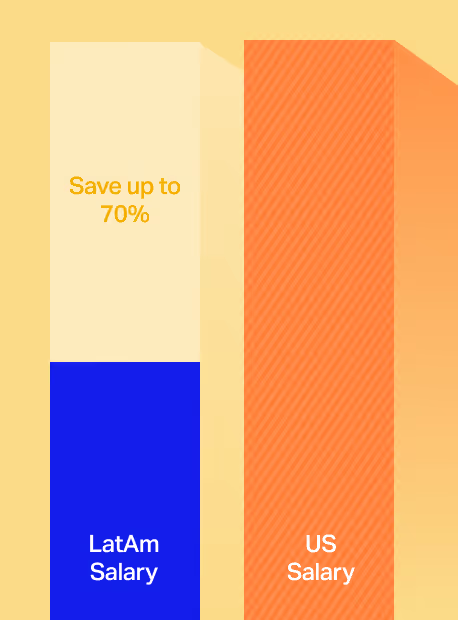
- Agency rates for Laravel work run from under $25 to $199 per hour, while hiring your own mid-level Laravel developer in Latin America costs $48K–$72K a year, up to 54% less than the US equivalent.
Most Laravel work falls into one of two categories: a project with a clear start and end, like a new build or a platform migration, or ongoing work that never really stops, like maintaining an app’s business logic as it grows.
The first kind is exactly what Laravel developer outsourcing companies are built for: a team that already knows Eloquent, queues, and Laravel’s ecosystem well enough to skip the ramp-up time an in-house hire would need. You hand off the project, they deliver it, and the relationship can end when the work does.
The second kind is when hiring a dedicated Laravel developer makes more sense: someone who joins your own team, learns your codebase once, and stays with it instead of moving on to the next client.
This guide covers both routes. The main focus is the ten outsourcing companies below, what each does well and who each one fits, but it also lays out the path to hiring your own dedicated Laravel developer, for the cases where that’s the better call.
Why Do Businesses Hire Laravel Developer Outsourcing Companies?
Businesses outsource Laravel development for three practical reasons:
- They need experienced Laravel engineers to build sooner than they could hire them
- They want a vendor to carry the recruiting and day-to-day management
- Hiring the same level of experience costs less outside the US
Laravel, a popular PHP framework, is the default choice in its ecosystem. According to JetBrains’ 2025 State of PHP survey, 64% of PHP developers report using Laravel, well ahead of WordPress at 25% and Symfony at 23%.
It powers some of the web’s most well-known platforms, including the website of fashion magazine Vogue, which uses it for the flexibility and scalability to handle massive traffic.
That adoption is why demand for experienced Laravel developers keeps climbing. Laravel developer outsourcing companies let you tap teams that already have those engineers on staff. Here’s what you get out of it:
- Access to global talent: Local hiring caps your options at whoever is commutable and available. The developer population outside the US is now enormous: GitHub’s 2025 Octoverse report counts 6.89 million developers in Brazil alone, now the fourth-largest developer community in the world, with Brazil, Mexico, and Colombia adding 3.2 million net new developers in a single year.
- Cost efficiency: Senior Laravel developers in the US earn $106K–$189K a year, against $72K–$108K in Latin America, according to our IT Roles Salary Guide. The same gap holds for full-stack developers who often sit beside a Laravel back end, at $104K–$184K in the US. Outsourcing to Latin America or other popular regions cuts salary costs by up to 68% at the junior level and up to 43% at the senior level, a consequence of lower living costs in those markets.
- Scalability without a long-term commitment: Workloads change. Outsourcing makes it easy to scale up or down without the logistics of permanent hires, which is ideal for startups and for projects with an uneven shape.
- Faster development cycles: Teams in distant time zones keep work moving after your office logs off, which can compress a delivery schedule. Nearshoring in LatAm accelerates timelines in a different way, by keeping review cycles inside a shared working day instead of overnight.
With the right partner, you get experienced Laravel development without building a recruiting function first.
What you give up is control. The engineers working on your codebase report to their agency, not to you, so priorities, pace, and who’s assigned to your project are the agency’s calls to make, not yours. We’ll discuss it in a later section.
How Much Does It Cost to Outsource Laravel Development?
The ten companies on this list have hourly rates between $25 and $199, most with a project minimum between $10,000 and $75,000.
An agency rate is a bundle. Inside an hourly or monthly retainer sits the engineer’s pay, the agency’s margin, and the overhead of whoever manages the account, plus any QA, DevOps, or design time the contract includes.
The problem with the agency rates is the opacity. One US e-commerce holding company that had used both Upwork and an agency for development work described what tipped the decision:
Our issue with the other company was they wouldn’t tell us how much we were paying them. And one of the people that I interviewed said that the job was listed at 50% less than what they told us we’d be paying. That means that their fee was super high. That’s something that didn’t sit right with me.
What to ask any vendor about pricing before you sign
You can make almost any provider’s pricing legible with five questions. Ask them before you compare quotes, not after:
- What portion of this rate reaches the developer? A vendor that won’t answer is telling you something.
- Who else is billed inside this rate: a project manager, QA, DevOps, a solution architect? At what percentage of their time?
- How are scope changes and overruns billed, and who signs off before the clock starts?
- What is the minimum commitment, the notice period, and the penalty for ending early?
- If we hire the developer directly later, what does that cost? A conversion fee that nobody mentions upfront is a common surprise.
For a broader view of what the market charges, our breakdown of offshore developer rates shows how the same seniority is priced across regions and delivery models.
How Do You Evaluate and Select the Best Laravel Developer Outsourcing Company?
Judge a Laravel partner on four things: provable Laravel depth, a technical screen you can inspect, real overlap with your working day, and what the contract says when it doesn’t work out. Here’s how to work through them:
Key traits of a strong Laravel outsourcing company
Look for these traits when you shortlist:
- Deep Laravel expertise: Proven track record with Eloquent ORM, Blade templating, API integrations, and database management.
- Scalability and flexibility: Can add or drop an engineer inside a sprint or two, with the notice period and the cost of doing it written into the contract.
- Strong project management: Runs agile development with a named point of contact, a visible backlog, and a written status cadence you agreed to.
- Commitment to security: Follows secure coding practices, can name the data-protection rules it works under, and puts IP ownership in writing.
- Post-launch support and maintenance: Keeps the application patched, monitored, and fast enough as traffic grows, with a named person to call when something breaks.
Steps to find the right Laravel partner
Work through five steps to shortlist a Laravel partner: define the project, review Laravel-specific work, assess technical and soft skills, check references, and ask the uncomfortable questions.
- Define your project requirements: Outline must-have features, budget, and timeline to prevent misalignment.
- Review portfolio and case studies: Look for Laravel-specific projects, and confirm they have expertise in Vue.js or React if front-end integration is needed.
- Assess technical and soft skills: Development ability should be matched with problem-solving and strong communication for smooth collaboration.
- Check client testimonials: Look for feedback on project execution, code quality, and post-launch support, and ask for one reference whose project shipped late.
- Ask about the uncomfortable things: Pricing structure, security practices, who owns the code, and what happened on the last project that went wrong. A partner that answers the last one candidly is usually the one worth hiring.
How can you tell whether a partner’s technical vetting is real?
Ask who runs the technical screen, what the assessment is, and to walk you through one real example, start to finish. Every vendor claims rigorous vetting; the ones with a real filter can describe it in specifics without preparation.
In dozens of conversations with Hire With Near’s engineering recruiters this year, the same assessment format comes up as the one that works: a small real-world task rather than a generic take-home.
Debug a piece of code, refactor something for scalability, or implement a basic API with tests, then review it together on a call so the candidate has to explain their reasoning out loud. Resumes and AI-assisted CVs survive keyword matching easily, but not that type of conversation.
Two red flags apply just as well to an agency’s engineers as to a direct hire, and our recruiting team treats both as disqualifying: a developer who can’t explain what their actual role was on a past project, and one who won’t talk about a mistake.
How do you test real Laravel depth beyond a full-stack claim?
Probe five things in a portfolio review: Eloquent relationships and query performance, Blade and front-end integration, queues and background jobs, API design and versioning, and migrations plus test coverage. A team with genuine Laravel depth can walk you through decisions in each area on a specific project, but a team selling a generic full-stack service will answer in service-page language.
Our recruiters flag one nuance worth carrying into these conversations: specific framework versions get overemphasized. An experienced developer who understands core principles adapts to a version bump in days, so screening on a Laravel version number filters out good engineers while letting weak ones through.
Test architectural judgment instead. Ask how they’d structure a queue-heavy notification system, when they’d break an Eloquent relationship into a separate service, or how they’d handle a migration on a table too large to lock.
Ask for the repository walkthrough, not the case study. Fifteen minutes in real code disqualifies faster than any proposal.
What should the contract say if the developer doesn’t work out?
Get four things in writing before you sign: the replacement window and what triggers it, whether the remedy is a replacement or a refund, who owns the IP and the repository if the engagement ends, and how handover is documented. Engineering hires are expensive to onboard, so the safety net has to exist on paper rather than in a sales conversation.
Push on the specifics. A replacement window that only covers a developer who quits, and not one who underperforms, isn’t a guarantee. Ask how quickly a replacement is presented, whether you pay twice for onboarding, and whether the clock starts at contract signature or at the developer’s start date.
On IP, confirm that code, repository access, credentials, and documentation transfer to you by default, that NDAs cover subcontractors as well as employees, and that a departing engineer’s environment access is revoked on a defined schedule. If a vendor answers that this is all standard, ask them to point to the clause.
Agency, marketplace, or staff augmentation: which model fits best?
When outsourcing Laravel development work, three models compete. A full-service agency sells you delivery; a marketplace sells you access; and a staff augmentation firm sells you a person who works on your team under your direction while the firm remains their employer.
Get the model right and the vendor choice gets much easier. Get it wrong and even a strong agency will feel like a bad fit.
What Is the Alternative to Outsourcing Laravel Development? Hiring a Dedicated Laravel Developer
If you’d rather have a Laravel developer embedded on your own team than route the work through an agency, hiring your own dedicated developer is the better fit.
Building your own development team means the person stays through every future release, not just the one they were staffed for, which is the trade-off an agency can’t offer no matter how good the delivery is.
The key differences between outsourcing and building your own team
Four things change when the developer works for you instead of for an agency:
- Direct relationship: Your Laravel developer works for you, not a third-party agency. They attend your standups, follow your processes, and become integrated team members.
- Knowledge retention: When developers stay with your project long-term, they build deep product knowledge that accelerates development over time. Across our own placements, 80% of hires stay two years or more, and average tenure runs about three years. That’s what a direct relationship, ownership of real work, and a visible growth path produce. An engineer who reports to you and sees the roadmap has reasons to stay that no account assignment can replicate.
- Communication control: No account managers or project coordinators between you and your developer. Direct communication means faster decision-making and clearer requirements.
- Cost transparency: You pay the developer’s salary directly rather than agency markups.
While outsourcing Laravel development can get experienced developers on board quickly and launch projects faster, it comes with trade-offs that become more apparent as your product matures.
You’ll likely notice engineers rotating out just as they master your codebase, project managers creating barriers to direct communication, and developers with divided loyalties between your priorities and their employer’s.
In the video below, our CEO and Co-founder Hayden Cohen explains why top developers prefer to be hired rather than working through a dev shop:
How much does it cost to hire a Laravel developer?
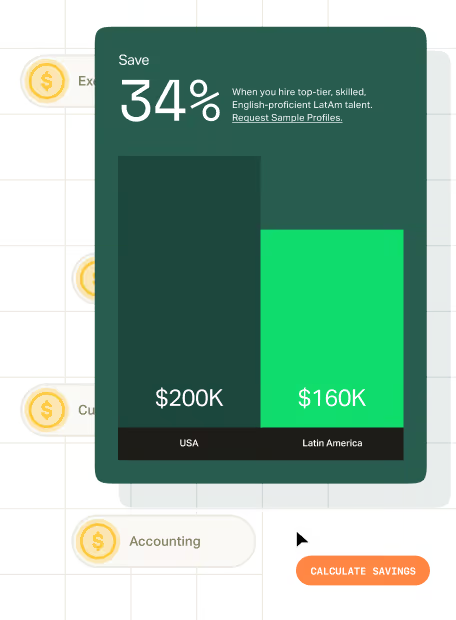
Hiring a mid-level Laravel developer in Latin America costs $48K–$72K a year and a senior one $72K–$108K, against $87K–$157K and $106K–$189K for the same seniority levels in the US, according to our 2026 salary data.
Hiring your own developer has two visible components instead: the salary you set, and a recruiting fee, either one-time for a direct hire or monthly if a staffing partner also handles payroll and compliance. You know exactly what the developer earns because you decide it.
To put the direct-hire route in concrete terms, here’s what hiring a Laravel developer costs compared to equivalent US hires, according to Hire With Near’s salary benchmarks:
For the most up-to-date figures, see Hire With Near’s US vs Latin America Salary Guide.
Hiring a senior Laravel developer in Latin America often costs less than hiring a mid-level engineer in the US. According to Hire With Near’s 2026 State of LatAm Hiring Report, 98% of the engineering roles we placed last year went to mid-level or senior engineers: 47% mid-level and 51% senior.
Our own client data on how much US companies save by hiring in Latin America tracks the same pattern and the Bonfire case, an e-commerce platform for custom merchandise, is a useful example of what changes when the hiring route changes.
Their VP of Product Management had been running engineering searches himself, with each US hire taking two to four months of his own time. Hire With Near took over sourcing and initial vetting, closing the search in just 19 days while saving over 60% compared to US rates. The engineer stayed for more than two years. Having worked with other recruiting agencies before, the VP put the difference clearly:
It was shocking to see the difference between the talent Hire With Near brought versus other firms I worked with. Our hires are extraordinary and a great cultural fit.
— Thomas Elliott, VP of Product Management, Bonfire
Why hire Laravel developers based in Latin America specifically?
Overlap with your working day is the reason, and it changes how the work feels day to day. You can hire Latin American developers who are online while your team is online, whether your office runs on Pacific, Mountain, Central, or Eastern time, which isn’t true of a team whose day ends as yours begins.
The talent depth surprises people more than the time zones do. Julia Guillen, Senior Tech Recruiter at Hire With Near, tells us clients consistently underestimate the caliber of engineer available in the region. Senior candidates there often have “more hands-on experience with specific frameworks than candidates they’d find locally.”
That overlap is also why so many companies who start with an agency end up here instead. Hire With Near’s research into why US companies are hiring in Latin America, drawn from 2,000+ hiring conversations, found that 12% came to the region specifically to move off outsourcing agencies and hire directly, with engineering roles making up 16% of the hires in that group.
An engineering leader at a US manufacturing and technology company described the pattern:
We quickly focused on Latin America because of the overlap of time zones. Because of this high bar of expectations, there’s a lot of hands-on interaction expected. And we’ve had experience with contracted labor where we go to an agency. They provide us with talent, but they are the supervisors, they run everything. And it’s been a bad experience. They haven’t met our expectations on quality.
When you hire software engineers in Latin America with a recruiting partner, first candidates typically arrive in 3 to 5 days and a hire lands in under three weeks, against a 3 to 6 month US cycle.
And because you can hire skilled Laravel developers as permanent team members rather than booked hours, you’re building a team instead of managing a vendor, at up to 54% less than the US equivalent at mid-level and up to 43% less at senior level, per the table above.
If you’re weighing Latin America against Eastern Europe specifically, our guide to hiring remote talent in LatAm vs. Eastern Europe covers where each one lands.
{{prevetted-banner}}
Will a Latin American Laravel developer work in my time zone and join our standups?
A Laravel developer based in Latin America works during your business hours, so standups happen live and you get answers within the same day rather than the next one. Exact overlap depends on where your team sits in the US and where the developer sits in the region.
Sprint planning, pairing sessions, and architecture reviews all get scheduled inside one shared workday instead of a two-hour window at the edges.
Set core collaboration hours anyway, the way you would with a US hire, and keep the rest of the schedule flexible. The overlap is wide enough that you don’t need to claim identical hours to get the benefit.
Can they communicate technically with my team and clients?
Judge communication by the specific tasks the job requires, not by an adjective in a vendor’s pitch. For a Laravel developer, that’s four things: explaining a technical trade-off to your CEO or a non-technical product owner, writing a PR description and documentation another engineer can follow, holding their own in an architecture review, and saying clearly when an estimate is wrong.
Each one is testable in an interview. Ask the candidate to explain a past technical decision to you as if you were the CEO. Ask them to describe a bug they caused and how they communicated it. Send a short written prompt, a paragraph explaining a migration plan, and read it the way you’d read their documentation.
Do that with any developer, anywhere. The point is that a vendor calling someone a strong English speaker isn’t a hiring signal, and a 30-minute conversation about their own past work is.
When does outsourcing make sense?
Outsourcing is the better answer in four situations:
- A defined, finite project you want delivered end to end with minimal management from your side.
- Validating a concept before you commit to permanent headcount.
- A short-term capacity spike alongside an existing in-house team that stays the owner of the codebase.
- A specialized one-off, like a legacy Laravel migration or a security audit, that you won’t need again.
Our breakdown of the top reasons to outsource Laravel application development covers those cases in more detail, and if you’re leaning toward building the team yourself, our guide to hiring remotely in Latin America walks through how that works in practice.
The key is knowing what you’re optimizing for: speed to market, or sustainable team building.
What Are the Top 10 Laravel Developer Outsourcing Companies in 2026?
The ten Laravel developer outsourcing companies below fall into three groups.
- Laravel-first specialist agencies: Redberry, The Software House.
- Full-service software firms that run a Laravel practice inside a wider stack: Aalpha, Saritasa, Orases, Space-O Technologies, Scopic, CSSChopper.
- Staffing partners that place a dedicated Laravel developer on your team instead of delivering a project: Hire With Near and Tecla.
Which group fits your business needs matters more than which company you pick first. If your real need is engineering capacity rather than a Laravel build specifically, the wider list of the best companies to hire developers in Latin America is the better starting point.
Every company on this list cleared three tests: real Laravel or PHP work for US clients (verified on their site and review profiles, not just a logo among forty), a rating of 4.5 or above on G2, Clutch, or Trustpilot, and a minimum of 35 reviews.
From the companies that cleared those three tests, I compared Laravel and PHP depth, delivery model, published pricing, and how much of a US working day each team overlaps, using their own websites and review profiles.
My goal is to help you build a shortlist, not to declare a winner. That only becomes clear on calls. And yes, Hire With Near is one of the ten, so read that entry with my bias in mind. There is no objectively best option here; your budget, timeline, and the way you like to work decide it.
The companies below are in no particular order, and the list implies no ranking.
Here’s what sets each apart:
Note: To keep the list up to date with our selection criteria, we regularly check ratings on third-party review sites and update as required.
1. Redberry
Website: https://redberry.international/
Headquarters: Tbilisi, Georgia
Rating: 4.9/5 on Clutch (35+ reviews) as of August 2026
Services: Laravel and Vue.js development, custom web applications, product design, technical consulting
Focus Regions: Europe and North America
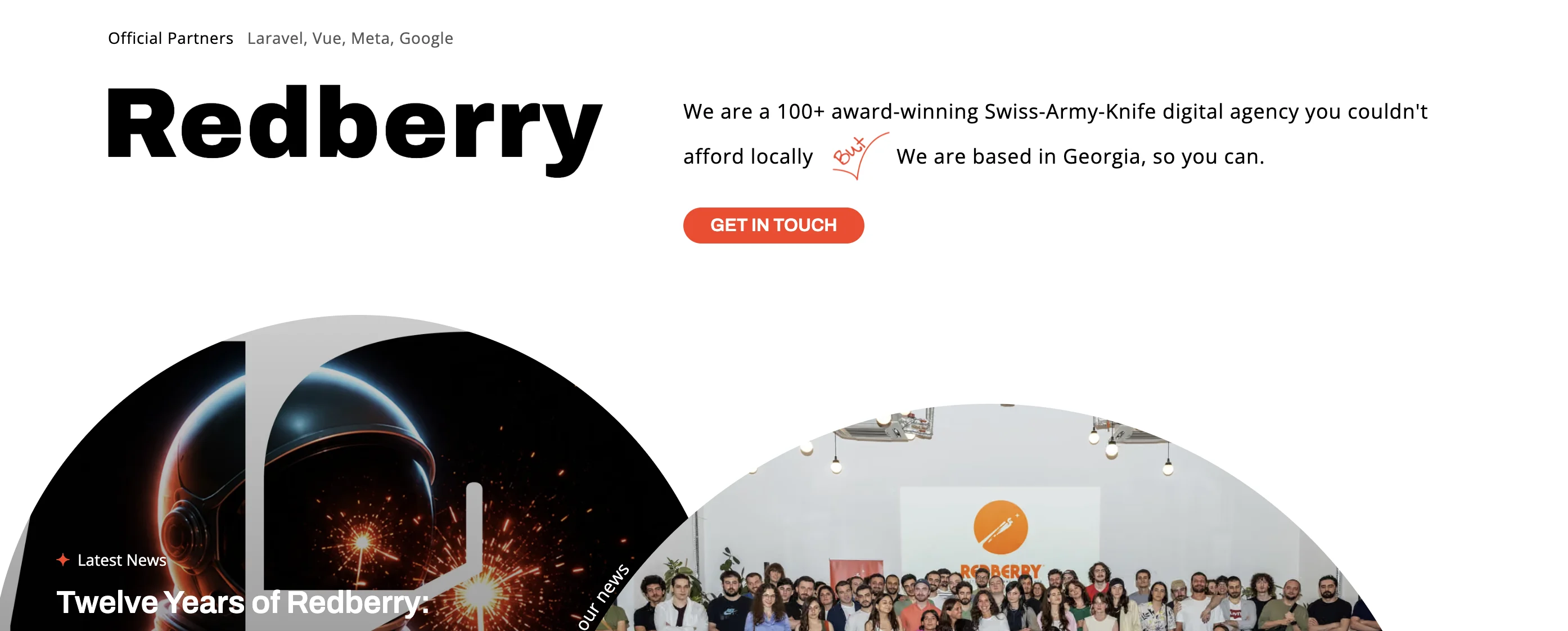
Redberry earned a spot on this list because Laravel is the practice the company is built on and not just one service line among many. They’re an official Laravel and Vue.js partner, listed on Clutch as a Premier tier Laravel and Vue partner, and Clutch has named them a top Laravel development company for five consecutive years.
The company has grown from four people to a team of roughly 200, and reviewers keep returning to the same themes: deep framework knowledge, clear communication, and collaborations that run for years rather than sprints.
Key features:
• Official partner status: One of a small group of agencies formally recognized by both the Laravel and Vue.js teams, which is as close to a credential as this framework has.
• 200+ Laravel projects delivered: A portfolio built almost entirely on Laravel, with more than 100 developers on staff to draw from.
• Full product team in one place: Laravel back ends paired with Vue.js front ends, product design, and QA, so a build doesn’t need a second vendor.
Best for: Companies that want a Laravel-first agency to own a build end to end, particularly with a Vue.js front end.
Client perspective: “The Redberry team is exceptionally talented. They really wanted to understand what we were trying to achieve. They had a very humanistic approach and came up with excellent suggestions.” — Customer review on Clutch
Limitations: Georgia is eight to nine hours ahead of the US East Coast, so live overlap lands in your early morning. The published $25,000 minimum project size also puts small fixes and short engagements out of scope.
Pricing: $25 to $49 per hour, with a $25,000 minimum project size (Clutch).
2. The Software House (TSH)
.webp)
Website: tsh.io
Headquarters: Gliwice, Poland
Rating: 4.8/5 on Clutch (75+ reviews) as of August 2026
Services: Laravel and PHP development, cloud architecture, web development, team augmentation
Focus Regions: Europe and North America
What stood out about The Software House is how selective they are about who ends up on your project: the company accepts roughly 5% of developer applicants. Clutch reviewers credit their engineers with pushing back on requirements instead of building them as written, and with holding schedules on long engagements.
Clutch has ranked them among the highest-rated development firms in Poland, and most of their work is for product companies that need a team to own an application rather than a contractor to fill a gap.
Key features:
• Cloud-native Laravel: REST APIs, AWS, Docker, and Horizon for queue-heavy applications, handled by the same team that writes the application code.
• Two engagement shapes: Full project delivery or team augmentation, so an in-house team can borrow Laravel engineers without handing over the whole build.
• Enterprise-scale experience: Clutch shows project budgets running from $10,000 to more than $2 million.
Best for: Product companies that want a senior European team to own a Laravel application, cloud architecture included.
Client perspective: "Their team members and engineers have a keen passion for engineering and learning." — Customer review on Clutch
Limitations: Poland-based delivery means your overlap ends in the early afternoon. Rates of $50 to $99 per hour and a $25,000 minimum sit well above the India-based firms on this list.
Pricing: $50 to $99 per hour, with a $25,000 minimum project size.
3. Hire With Near

Website: hirewithnear.com
Headquarters: San Antonio, Texas
Rating: 4.9/5 on G2 (150+ reviews) as of August 2026
Services: Full-service nearshore staffing and recruiting, direct hire, staff augmentation, and executive search
Focus Regions: Latin America only
Hire With Near is a full-service staffing and recruiting agency that helps US companies of all sizes hire top-performing remote talent in Latin America across all industries and departments, including the software engineering function.
We handle sourcing, technical screening, candidate presentation, payroll, and compliance, so a Laravel hire lands on your team without you building a recruiting function first.
We’re on this list as the alternative to the agency model. Our nearshore IT and tech recruiters find you top-tier Laravel developers in LatAm who become your employees, drawn from a pre-vetted pool of 160,000+ LatAm professionals.
We’ve hired for 950+ companies, including Expensify and Deel, hold a 4.9/5 rating on G2 across 150+ verified reviews, and rank No. 118 on the 2026 Inc. 5000 list of the fastest-growing US private companies.
When you compare outsourcing companies, notice what you’re buying: an agency’s engineers work on your project while employed by someone else, and they rotate when the agency needs them elsewhere. A developer you hire through us works only for you, in your standups, in your codebase, for years.
Key features:
• Elite talent for Laravel and back-end positions: We place senior back-end developers, front-end developers, nearshore mobile engineers, remote QA developers, and data/ML engineers every week, with specialist tech recruiters screening beyond keywords for real-world impact. Whether you need deep PHP and Laravel experience, a Vue.js or React front-end alongside it, or someone who has scaled a queue-heavy application, our recruiters know the difference and why it matters for your build.
• Quality-first approach: Our 97% placement rate and 9.1 client satisfaction score come from obsessing over fit: not just skills, but the drive, readiness, and cultural match to contribute from day one and help your company grow over the long term.
• One partner, one process: Scale across functions, not just engineering, with one dedicated team and a repeatable hiring cadence. First candidates in 3 to 5 days with video introductions, and most hires in under three weeks. We remember what worked last time, and we adapt based on your feedback so hiring gets easier and more effective over time.
• 180-day replacement guarantee: Double the industry standard. If a hire doesn’t work out in the first six months, we find a replacement at no additional cost to you.
Best for: US companies that want a dedicated Laravel or PHP developer on their own team, working their hours, rather than a project delivered and handed back.
Client perspective: “They’re thorough and timely in their recruiting, they send over written summaries, video interviews, and everything you’d need for an initial assessment, and they project-manage further interviews, referrals, etc. Everyone on their team is engaged and extremely professional.” — Customer review on G2
Limitations: We’re not a project-delivery shop. We don’t take fixed-scope Laravel builds, we don’t manage the developer for you, and we only source in Latin America. If you need an agency to own a build end to end, one of the specialist firms on this list is the better call.
Pricing: Two models: direct hire (a one-time recruiting fee) or a staffing model (a monthly fee with payroll and compliance included). You set the salary, interviewing is free, and there is no upfront cost.
4. Aalpha Information Systems

Website: aalpha.net
Headquarters: Bengaluru, India
Rating: 4.9/5 on Clutch (215+ reviews) as of August 2026
Services: Laravel and PHP development, dedicated development teams, API development, CMS and e-commerce builds
Focus Regions: Global, with clients across the US, UK, and Middle East
Aalpha earns its place on the sheer weight of client feedback behind its score: more than 215 Clutch reviews at 4.9/5, more than any other company here.
They’ve been shipping Laravel and PHP applications for over 15 years, and reviewers return to the same points: competitive rates, organized project management, and delivery on the date they promised.
For a company weighing a full build against a long-term dedicated team, Aalpha is one of the few firms on this list that quotes both at entry-level budgets.
Key features:
• Dedicated team model: Hire an assigned Laravel team you can scale up or down, rather than buying a single fixed-scope project.
• Breadth beyond the framework: Mobile, QA, DevOps, and AI work in-house, useful when a Laravel back end is one piece of a larger system.
• Documented delivery controls: Agile sprints with NDAs and clear IP assignment on client work.
Best for: Cost-sensitive companies that need a full Laravel build or an ongoing dedicated team and can work asynchronously.
Client perspective: “Their significant data sources and thoughts made this venture a gigantic achievement.” — Customer review on Clutch
Limitations: India-based delivery means live overlap with your working day is limited to your early morning. Reviewers also rate their design and UI work below their engineering delivery, so a design-heavy build may need a second partner.
Pricing: Under $25 per hour, with projects starting at $1,000.
5. Saritasa

Website: saritasa.com
Headquarters: Newport Beach, California
Rating: 4.8/5 on Clutch (105+ reviews) as of August 2026
Services: Custom Laravel and PHP development, web and mobile apps, legacy modernization, AR/VR, DevOps
Focus Regions: United States, with additional offices in Tampa and New York
Saritasa is here because of their track record on complicated, long-lived applications rather than quick builds. Clutch placed them at No. 22 in its Clutch 1000 list of leading service providers globally, on the back of 106 reviews averaging 4.8/5.
Laravel sits inside a stack that also covers Django, mobile, systems architecture, and DevOps, which matters when an application has to talk to hardware, legacy systems, or analytics pipelines. Reviewers consistently mention how much scoping happens before anyone writes code.
Key features:
• Legacy modernization: Rebuilding aging PHP applications on Laravel while the existing system keeps running.
• Full-cycle in-house delivery: Architecture, API integrations, and analytics under one roof, with US-based project management.
• Wide industry coverage: Healthcare, education, automotive, finance, and real estate builds, so compliance-heavy contexts are familiar ground.
Best for: US companies that want a domestic partner for a large or heavily integrated Laravel application.
Client perspective: “Saritasa put the time and effort into understanding the scope of the project before they began working.” — Customer review on Clutch
Limitations: US rates of $100 to $149 per hour and a $50,000 minimum project size rule out smaller engagements. Laravel is a portion of their work rather than the whole practice.
6. Orases
Website: orases.com
Headquarters: Frederick, Maryland
Rating: 5.0/5 on Clutch (70+ reviews) as of August 2026
Services: Custom software development, PHP and Laravel builds, APIs and integrations, UI/UX design, AI consulting
Focus Regions: United States
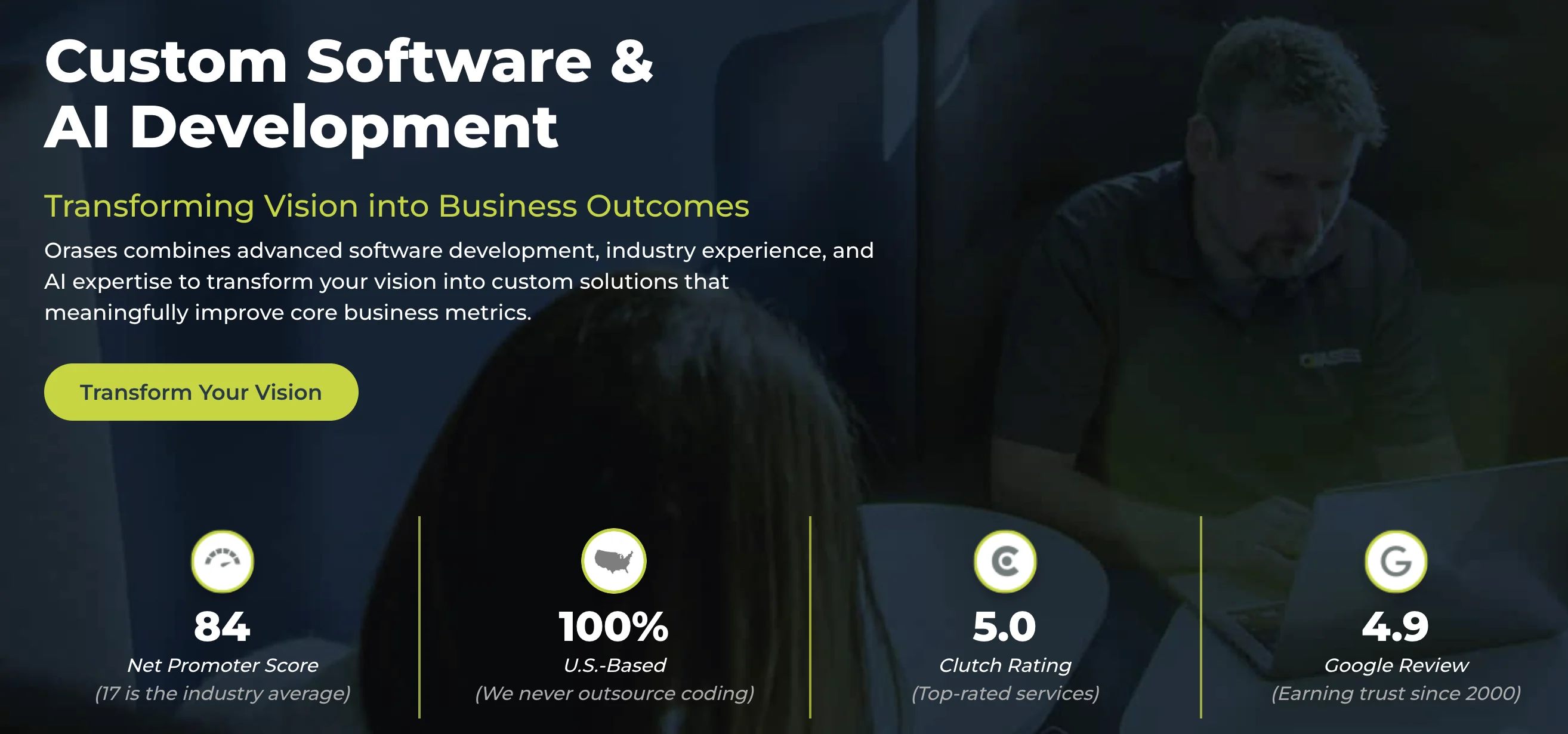
The reason Orases made this list is a perfect 5.0/5 across 74 Clutch reviews, which is rare at that volume. Founded in 2000, the firm keeps every engineer in the United States and states plainly that it never outsources code.
PHP accounts for most of its programming work and Laravel for a large share of its framework work, and it sells strategy alongside execution rather than taking a spec and disappearing.
Clutch also lists Orases at its Premier Verified tier, which covers financial and legal vetting.
Key features:
• Notable clients: The NFL Foundation, MLB, and the American Kidney Fund, which signals comfort with high-traffic, public-facing systems.
• All-US engineering: No subcontracted development, which matters when a contract or data rule requires it.
• Published retention metrics: A 96% client retention rate and a Net Promoter Score of 84.
Best for: US organizations with real budget that want a consultative domestic partner for a business-critical Laravel or PHP application.
Client perspective: “They are so good at what they do I hope to work with them for years and years into the future. As long as I have software needs, I am 100% going to be working with the team at Orases.” — Customer review on Clutch
Limitations: There’s no nearshore or offshore staffing model, so scaling a team at a lower rate isn’t available.
Pricing: $150 to $199 per hour, with a $75,000 minimum project size (Clutch).
7. Space-O Technologies

Website: spaceotechnologies.com
Headquarters: Ahmedabad, India
Rating: 4.8/5 on Clutch (75+ reviews) as of August 2026
Services: Laravel and PHP development, custom CMS, e-commerce platforms, mobile apps, AI development
Focus Regions: North America, Europe, and Asia
Space-O Technologies stands out for how product-shaped its Laravel work is: custom CMS platforms, e-commerce builds, and internal enterprise tools rather than brochure sites.
The company has been delivering Laravel projects for over 15 years, holds 4.8/5 across 75 Clutch reviews, and works with clients across North America, Europe, and Asia.
Their reviewers highlight budget alignment and responsiveness when requirements move, which is the situation most mid-build projects find themselves in.
Key features:
• Arranged overlap hours: Support windows are scheduled per client rather than fixed to one shift, so review cycles can land inside your working day.
• One team for web and mobile: Laravel backends, native apps, and AI work in-house, so a platform and its companion app come from the same place.
• Security built into the sprint: Secure coding practices, code review, and NDA coverage as part of the standard process.
Best for: Companies that want an experienced offshore team for a custom Laravel platform at mid-market rates.
Client perspective: “Their commitment to understanding our vision truly set them apart. Space-O Technologies didn’t just develop an app. They’re creating a platform that genuinely supports and enhances our mission.” — Customer review on Clutch
Limitations: Laravel is a small share of a mix that leans toward mobile and AI. India-based delivery limits live overlap with a US working day.
Pricing: $25 to $49 per hour, with a $25,000 minimum project size.
8. Tecla

Website: tecla.io
Headquarters: Dallas, Texas
Rating: 4.8/5 on Trustpilot (70+ reviews) as of August 2026
Services: Nearshore recruiting and staff augmentation for Laravel and full-stack engineers
Focus Regions: Latin America
Tecla is on this list for its staffing model, the closest company here to what Hire With Near does. Instead of delivering a project, they place Latin American engineers who work your hours as part of your team, drawing on a network they describe as 2,000+ Laravel developers inside a wider pool of 50,000 tech professionals across 18 countries.
Their screening includes live coding assessments on Laravel patterns alongside English and communication checks, and they publish a 96% candidate success rate.
Key features:
• Published speed: A seven-day average time to hire, with interviews starting within the first week.
• Embedded in your team: The developer works inside your process and joins your standups rather than reporting to a delivery manager.
• Public cost benchmarks: Senior Laravel developers in Latin America at roughly $5,500 to $7,500 per month, against $12,000 to $15,000 for US equivalents.
Best for: Teams that want a Latin American Laravel developer working inside their own process on a monthly engagement rather than a permanent hire.
Client perspective: Tecla’s Trustpilot profile carries a 4.8/5 rating across 70+ reviews, with reviewers citing hiring speed and clear communication through the process.
Limitations: Staffing only, so there’s no project delivery or technical management on their side. Engagements run on a rolling monthly basis rather than a permanent hire, and no replacement guarantee is published.
Pricing: A monthly rate per developer; Tecla publishes LatAm senior Laravel ranges of $5,500 to $7,500 per month. Their fee structure isn’t publicly listed.
9. Scopic

Website: scopicsoftware.com
Headquarters: Marlborough, Massachusetts, with a fully distributed team
Rating: 4.8/5 on Clutch (65+ reviews) as of August 2026
Services: Laravel and PHP development, custom software, web and mobile apps, design, ongoing maintenance
Focus Regions: Global, with engineers across six continents
Scopic makes the list on the strength of a distributed model that predates the remote-work wave. Founded in 2006, the company runs a team of 250+ engineers spread across six continents and reports more than 1,000 delivered projects. Its Laravel work concentrates on back-end depth: API design, job automation, and data modeling.
Across 69 Clutch reviews at 4.8/5, the theme reviewers raise most often is what happens after launch, when issues get answered quickly instead of entering a support queue.
Key features:
• Maintenance as a core service: Long-term support is a standing offering, which suits an application you plan to run for years.
• Specialists on demand: A remote-first bench means a niche skill can join a project without a local hiring constraint.
• Design and marketing in-house: Available through Scopic Studios for teams that need more than engineering.
Best for: Companies that want a long-running Laravel backend built and then maintained by the same team.
Client perspective: “They were accommodating of the changes in the scope and flexible in meeting our vision for the final product.” — Customer review on Clutch
Limitations: Some Clutch reviewers report budget overruns and ask for clearer estimates up front. Because the team spans many time zones, your overlap depends on who is assigned to the project.
Pricing: $50 to $99 per hour, with a $10,000 minimum project size.
10. CSSChopper

Website: csschopper.com
Headquarters: New York, New York
Rating: 4.9/5 on Clutch (60+ reviews) as of August 2026
Services: Laravel and PHP development, custom CMS, e-commerce, API integrations, front-end development
Focus Regions: Global
What put CSSChopper on this list is more than a decade of Laravel and front-end work at a price point that fits smaller budgets, backed by 4.9/5 across 61 Clutch reviews.
The team works in MVC architecture, Eloquent ORM, and Laravel’s built-in security features, and much of the portfolio is CMS and store builds.
Reviewers mention deadline discipline, thorough testing before handover, and a habit of suggesting features the brief didn’t ask for.
Key features:
• Laravel commerce and CMS: Store and content builds, including migrations off older PHP stacks.
• Front-end depth: The company started in markup and UI work, so Laravel backends arrive with production-ready interfaces.
• Large delivery bench: Clutch lists 250 to 999 employees, so parallel workstreams are realistic.
Best for: Small and mid-sized companies that need a Laravel CMS or e-commerce build on a tight budget.
Client perspective: “They are quick to respond and organized. Communicating back and forth with them was also very convenient. Their team managed the project well and fulfilled our requirements precisely” — Customer review on Clutch
Limitations: Clutch lists the headquarters as New York, but delivery teams are international, so confirm overlap hours for your own working day before you sign. Product strategy and consulting are not part of the offering.
Pricing: $25 to $49 per hour, with a $10,000 minimum project size.
Final Thoughts
Pick your model before you pick your company: a Laravel-first agency for a defined build, or a recruiting partner if you want the developer to stay on your team afterward.
If you’re still weighing the wider category, the best LatAm outsourcing companies guide covers the same decision beyond Laravel.
Not every Laravel outsourcing company brings the same depth. Vetting a shortlist properly means you end up with a team that understands Laravel’s architecture, its security model, and where its elegant syntax stops covering for a weak data design.
At Hire With Near, we screen for more than Laravel syntax. We’re looking for the engineer who works during your hours, holds their own in an architecture review, and is still the right hire in year two rather than week one.
We help companies hire remote developers across Latin America, and when the role is a VP or head of engineering rather than an individual contributor, our executive search for engineering leadership covers that too.
Book a free consultation, and we’ll help you hire your next Laravel developer within 21 days. Interviewing is free, and you won’t pay until you find the right person for your team.
{{consultation}}
Frequently Asked Questions
Is Laravel still relevant in 2026?
Yes. Laravel is the most widely used PHP framework and remains a mainstream choice for new production applications, with 8.9% of all developers and 9.3% of professional developers reporting they work with it in the Stack Overflow Developer Survey 2025.
Among PHP developers specifically, JetBrains’ 2025 State of PHP survey puts usage at 64%. Its ecosystem, hosting tooling, and hiring pool are all deep enough that a Laravel application started today is unlikely to become a maintenance risk on hiring or ecosystem grounds.
Are Laravel developers in demand?
Yes, and the wider market explains why. The US Bureau of Labor Statistics projects employment of software developers to grow 15% from 2024 to 2034, much faster than the average occupation, with a median wage of $133,080 as of May 2024. Laravel roles sit inside that demand: PHP powers a large share of existing web applications, and the engineers who can modernize them are competing for fewer than they’d like.
Which big companies use Laravel?
Laravel runs production applications for consumer brands, SaaS products, and marketplaces, including the website of fashion magazine Vogue.
Most Laravel deployments are internal platforms, admin tools, and customer portals that never get announced, so a public logo list is a weak signal anyway.
The more useful question when you compare vendors is which Laravel applications a partner has shipped at your scale, and whether they will put you on a call with that client.
Will AI replace Laravel developers?
No. AI tools have changed what a Laravel developer spends time on, not whether you need one. Scaffolding, boilerplate, test stubs, and first-draft migrations are faster now, which raises the value of the judgment AI doesn’t supply: data modeling, queue and job design, API versioning, security review, and knowing when a generated solution will not survive production traffic.
Screen for architectural reasoning rather than syntax recall, because that is the part of the job that has become more valuable, not less.
How long does it take to hire a Laravel developer?
Working with a recruiting partner in Latin America, most companies see first candidates in 3 to 5 days and make a hire in under three weeks, against a 3 to 6 month cycle for a comparable US search. What moves that timeline is on your side: a clear scope, a short interview loop, and one decision-maker who can say yes.
Our roundup of the questions tech leaders ask about hiring developers in Latin America covers what to prepare before you start the hiring process.
What engineering roles can I hire in Latin America?
You can hire the full engineering org in Latin America, not just framework specialists. Beyond Laravel developers, that commonly means remote software engineers, nearshore front-end engineers, remote back-end developers, and nearshore PHP developers, plus QA engineers in Latin America and remote DevOps engineers as a team matures.
Our nearshore IT and tech recruiting work covers all of them, and the same time-zone overlap and cost ranges apply across the group.




.webp)



%203.svg)
.avif)





%20(1).avif)

%20(1).png)