%203.svg)
Key Takeaways
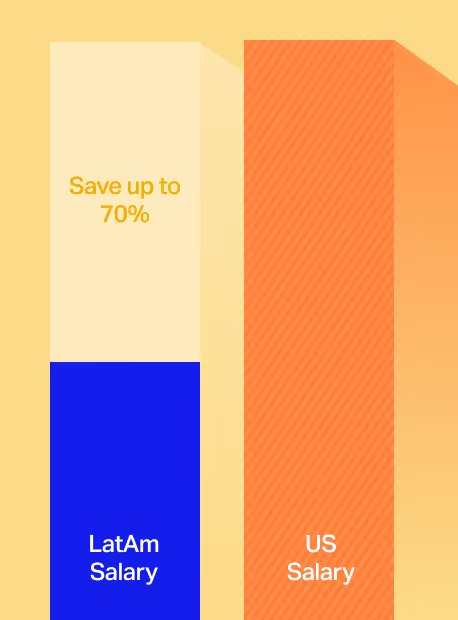
- To hire offshore developers for a startup, most founders recruit full-time developers in Latin America through a specialized staffing partner, where salaries run 30–70% below US rates and working hours overlap the US business day.
- When you evaluate candidates, weight real-world technical assessments over coding puzzles, look for developers who take ownership in a fast-moving startup, and confirm they can explain their work clearly in English.
- Managing an offshore development team well comes down to three habits: proactive communication systems, real overlap in working hours, and treating remote developers as full members of the team.
Hiring offshore developers for a startup may feel impossible when you're on a tight budget. Your roadmap is moving faster than your team can keep up, your best engineer is stretched across three priorities at once, and every week without the right hire is a week of slipping deadlines.
Add to that the reality of bidding against tech giants paying six-figure salaries, and even finding available developers can take months.
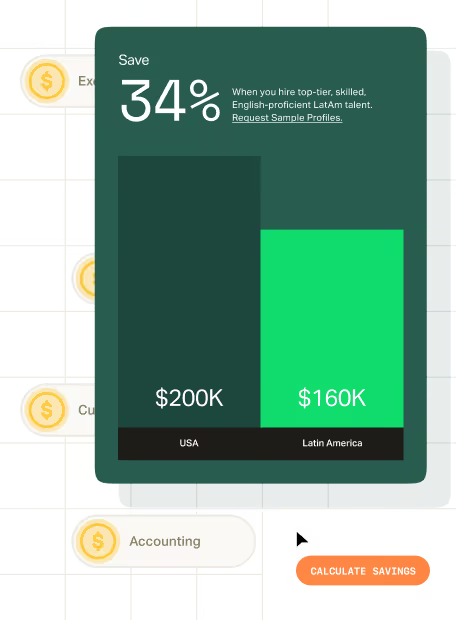
For most founders, the fastest path through that squeeze is to hire full-time offshore developers in Latin America through a specialized staffing partner. You get senior engineers who work during your business hours and cost 30 to 70% less than US hires, and you skip the months-long US hiring cycle.
Many startups, and plenty of larger companies too, are already seeing the benefits. If you want your company to be one of them, this guide has everything you need to know: what offshore developers cost, how and where to hire them, and how to keep a distributed team in sync.
What Is Offshore Hiring?
Offshore hiring means bringing on talent from outside the US to work as a full remote member of your team. These developers become your employees, working alongside your existing team. They aren't freelancers juggling multiple clients or a third-party agency you hand a project to.
“Offshore” is actually an umbrella term. It covers hiring anyone outside the US, whether that's a developer in India, Poland, or Brazil. Within that broader category sits nearshore hiring, which for US companies specifically means hiring in Latin America.
The most important distinction is working hours: a nearshore developer's day overlaps the US business day, which makes real-time collaboration far easier than it is with hiring offshore developers in Asia or Eastern Europe, where the workday barely lines up.
That overlap compounds over time. A blocked pull request that waits eight to twelve hours for a reviewer slows down every sprint that follows it, while a nearshore developer working your hours can unblock a teammate the same afternoon.
Related reading: Nearshore vs. Offshore vs. Onshore: Compare Outsourcing Types
Why Hiring Offshore Developers Works for Startups
For startups, hiring offshore developers solves the two problems that stall early teams at once: cost and access to talent. Here's what we see after working with 950+ companies:
You get more runway for your funding
In Latin America, senior developer salaries typically land in the $72K to $108K range, according to Hire With Near's salary data. A comparable senior professional in the US commonly starts at $106K per year.
Hiring offshore developers for your startup in Latin America gives you that same experience while keeping more of your funding on building the product rather than payroll. That's a deliberate use of your startup's capital at a stage when every month of runway counts.
You can build a complete team faster
The lower salaries in Latin America mean startups can hire a whole offshore software development team for what hiring two mid-level US developers alone would cost. These are skilled professionals who have worked with US companies and know the stack you use.
And since the pool is deep, the hiring process runs fast. According to GitHub's 2025 Octoverse report, Brazil alone now has 6.9 million developer accounts. Country-level figures for the rest of Latin America weren't released in the 2025 edition, but the 2024 report counted Mexico at more than 1.9 million, with Argentina and Colombia each over a million. All four are growing at double-digit rates year over year.
You can scale based on your funding rounds
Startup growth isn't linear, and hiring in Latin America has become a common way for US companies to fuel their growth. Sometimes you need to scale up quickly after a funding round, and other times you need to extend your runway by trimming costs without losing development capacity.
Most companies hire offshore developers through specialized staffing and recruitment partners rather than sourcing talent directly, because it's faster. These partners keep a pipeline of pre-vetted talent, so you can hire quality developers when you need them.
You can compete with the big players
Big tech figured this out years ago. Companies like Microsoft, Google, and Amazon have been building engineering teams in Latin America and other regions for decades, not as a stopgap, but as a core part of how they scale.
Now, smaller companies can use the same playbook, without needing an internal recruiting team or years of institutional knowledge about how to hire across borders. A specialized staffing partner gives a five-person startup the same access to vetted, senior talent that a Fortune 500 company gets, at a fraction of the internal overhead.
You get comparable experience at a salary that fits a startup budget, because the salary gap reflects the local cost of living, not a skill gap.
How Much Does It Cost to Hire Offshore Developers?
Hiring an offshore developer for a startup typically costs 30–70% less than hiring the equivalent in the US, with most of the range set by seniority, country, and tech stack. In Latin America, that usually means a mid-level developer in the $48K to $72K range and a senior developer in the $72K to $108K range. Comparable US hires run $87K to $189K a year.
These are Hire With Near's own benchmarks, the salaries we place developers at, not anonymous market averages. Offshore rates in Asia and Eastern Europe vary widely by location, so the Latin America figures here are the ones we stand behind.
To put it in concrete terms, here’s what hiring a developer costs compared with equivalent US hires, according to our salary data:
For the most up-to-date figures, see Hire With Near's US vs Latin America Salary Guide.
It's important to note that lower salaries don't necessarily mean your startup is hiring junior talent. They reflect the lower cost of living in Latin American countries, not a discount on experience. According to Hire With Near's 2026 State of LatAm Hiring Report, 98% of our engineering placements are mid-level or senior developers, not junior hires.
Franco Pereyra, Hire With Near's COO, offers a quick way to benchmark what to pay:
Take whatever you'd spend on a US salary and divide by two. 50% of a US salary tends to be very competitive across the board. For more niche software engineers, you might need to go to 60%. For more commoditized roles, 40% of a US salary still gets you top talent.
—Franco Pereyra, COO and Co-founder, Hire With Near
ParkMobile put that math into practice at scale. Its back-end and platform engineering had been handled by outside development agencies for years, so every time those developers rolled off, they took hard-won knowledge of ParkMobile's systems with them.
Working with Hire With Near, the company hired nine senior engineers at an average time to hire of 24 days, with most roles closing in under a month, building the team in-house for about 73% less than equivalent US hires would have cost, saving over $1 million a year.
For a startup, that difference matters: you keep more capital in the business, and you can bring on experienced engineers sooner than you could if you hired only in the US.
How to Hire Offshore Developers for Your Startup
Hiring offshore developers for your startup comes down to four steps: define your requirements, choose whether to hire on your own or through a partner, evaluate candidates on real work, and set the hire up to succeed.
Finding great developers is hard locally, and doing it internationally adds a layer of complexity, but Hire With Near has helped more than 950 companies build their offshore teams, so we've learned what works.
1. Define your requirements clearly
Start by defining exactly what you need, because rushing the hire is what creates headaches later. Beyond the obvious technical requirements like languages and frameworks, think about the demands specific to a startup.
Your ideal candidate needs more than technical skill. They have to thrive in a fast-moving environment where priorities shift week to week. Look for developers who have worked independently and can show real problem-solving ability. Communication matters too, especially English proficiency and the ability to explain technical decisions clearly.
One factor founders overlook is working-hours overlap. You don't need a perfect match, but having a few hours of shared working time makes collaboration much smoother. This is why US startups often prefer hiring Latin American developers: their workday lines up with US business hours, so real-time collaboration is simple.
2. Choose your hiring strategy
There's no single right way to hire offshore developers: your choice depends on your resources, timeline, and internal capabilities. The three main paths are handling it yourself, using staff augmentation, or working with a recruiting partner:
Going it alone
Handling offshore hiring internally gives you full control, but takes real time and resources. You'll source candidates yourself through job boards, LinkedIn, or referrals, then run interviews and manage the hiring process end to end.
The employment side is where it gets more complex. You either need to set up a legal entity in the country you're hiring from, which takes months and carries real legal and accounting costs, or use an employer of record (EOR) to handle contracts, payroll, tax, and compliance without setting up an entity yourself. Either way, you still have to source and vet every candidate on your own, since an EOR only manages the employment logistics, not the hiring.
This works better for larger startups with dedicated HR resources and international hiring experience, though it's possible with a small team. We have a detailed guide you can follow if you want to go this route.
Staff augmentation
Staff augmentation sits between the two. A firm places a pre-vetted developer on your team to work under your direction, while the firm stays the legal employer and handles payroll, benefits, and compliance. It's a good fit when you need to scale up quickly for a defined project or a few months of extra capacity, rather than committing to a permanent hire.
The trade-off is that the developer isn't fully yours. They may be split across other clients, and when the engagement ends, they typically roll off rather than staying with your team long-term. For a startup building a core product, that's a real limitation if the role is meant to be permanent from day one.
Related reading: 10 of the Best IT Staff Augmentation Companies
Partnering with a recruitment or staffing firm
This is how most startups hire offshore developers, and for good reason. You brief the partner on the role, they source and vet candidates against your requirements, and you interview a shortlist of people who've already cleared the technical and communication bar.
Once you hire, the partner typically handles payroll, benefits, and local compliance in the background, so the developer becomes a full member of your team without you needing to set up an entity or manage an EOR relationship yourself.
Take Bonfire, an e-commerce platform for custom merchandise and fundraising. Dan Strogiy, their Director of Design and UX, had hired remotely before, but his do-it-yourself process of posting on LinkedIn and combing job boards ate up two to three months per role.
When Hire With Near took over sourcing and screening, he only ran the final interviews, and the UX engineer was hired in six weeks, about twice as fast. That hire saved roughly $53,000 a year compared with a US-based equivalent and stayed on the team for more than two years.
Thomas Elliott, VP of Product Management at Bonfire, praised the partnership:
It was shocking to see the difference between the talent Hire With Near brought versus other firms I worked with. Our hires are extraordinary and a great cultural fit.
— Thomas Elliott, VP of Product Management, Bonfire
After that, Bonfire stopped treating each search as a solo project and came back for later product and design roles. A good software developer recruitment agency also supports you after the hire, so your new developer integrates well. For most startups, this is the clear win: you focus on the product while the firm handles the complexity of international hiring.
If you want to compare options, there are offshore development companies built specifically for this work, ranging from firms that place full-time direct hires to those that offer staff augmentation for shorter-term needs.
If you're looking beyond engineering roles, our roundup of nearshoring companies for startups covers options across other departments too.
3. Evaluate candidates effectively
Vet developers on real work, not abstract puzzles. Start with a technical assessment built around problems close to what they'll face at your startup, then run a project deep-dive where the candidate walks you through something they built and the role they played in it.
Hire With Near's engineering recruiters consistently find the strongest signal isn't the stack on a resume, it's whether a developer can explain their work clearly. Recruitment Consultant Natasha Tarapow explains the test she runs:
We always ask candidates to tell us about a project they've worked on — not just that they use this language and that one, but what their role was and what they actually did. It's important that they can explain their work to someone who isn't a developer. If they can do that, that tells me a lot.
— Natasha Tarapow, Recruitment Consultant, Hire With Near
A specific, clear answer tells you more than a whiteboard quiz.
Because resumes can be inflated and AI-written CVs are now common, a paid trial project on your top candidates removes the guesswork. Set clear deliverables and a timeline, and watch both code quality and how the candidate communicates and collaborates remotely.
That combination, a real-world assessment plus a short paid trial, is a filter you can see into.
4. Finalize the hire and set up for success
Once you've found the right developer, a little setup protects the hire. If you're working with a staffing partner or an employer of record, they handle contracts, payroll, benefits, and local compliance, so the developer remains a full member of your team and reports to you day-to-day.
If you're hiring on your own, you'll need to set up compliant contracts for each country, establish international payments, and understand local labor laws and tax rules, or use an employer of record company to manage that for you.
Whichever route you take, you need a solid onboarding plan. Start with the basics: accounts and access, introductions to key teammates, and a walk-through of your development process. Have documentation ready for your stack, coding standards, and common procedures.
Don't rush this part. A thorough onboarding process matters even more for remote developers, who can't tap a colleague on the shoulder with a quick question. The time you put into onboarding pays off in faster ramp-up and better team integration.
Overcoming Challenges with Offshore Development Teams
Offshore hiring comes with a few main challenges: communication, time zone gaps, team cohesion, and having the right tools in place from day one. None of them are dealbreakers, but each needs a deliberate fix rather than hoping it works itself out. Here's how to handle each one:
Make remote communication work
Communication is the first thing to get right with a distributed team. When your team isn't in one office, you lose the quick desk-side chats and whiteboard sessions that solve problems in minutes, and written messages can be misread without in-person context.
Companies solve this consistently with a few basics:
- Daily async updates through tools like Slack or Loom
- Weekly video calls for deeper discussions
- A shared knowledge base for documentation
- Clear response-time expectations for different types of messages
Set these expectations at the start. Agree on a block of hours when the whole team should be online together, and let developers arrange the rest of their day around it. That flexibility is part of what makes remote work hold up, since people do their sharpest work at different times. Once everyone knows what has to happen live and what can wait, collaboration gets much smoother.
Hire from nearshore countries
Developers in Latin America work during your business hours, so they join your standups, weigh in on product decisions, and respond to urgent issues in real time, whether your team runs on Pacific, Mountain, Central, or Eastern time.
For a startup making quick decisions and fast iterations, that overlap matters more than many founders expect. If your developer is asleep while you're deciding what to build, you hit bottlenecks fast.
The effect is measurable. Research from Harvard Business School and INFORMS found that larger time zone gaps force employees to work outside their normal business hours just to stay in sync with distant teammates, a pattern that creates measurable collaboration friction and, over time, contributes to retention problems, with the burden falling disproportionately on whoever ends up absorbing the off-hours work.
The researchers recommended organizing distributed teams along a north-south axis, like the US and Latin America, rather than east to west. Our guide to hiring remotely in Latin America walks through how to structure a team around that overlap from day one.
Founders who hired far offshore describe the gap in the same terms. One founder of a small startup with engineering talent in Asia-Pacific told us:
We currently have a senior QA that is focused on both manual testing and automation. She's based in Sri Lanka, and I don't get her enough during my day to actually allow to keep on that high quality and high throughput for my team. So we often release without her. So it's not good, right?
Others keep their offshore team and add Latin America for coverage. A technical co-founder with an existing engineering team in Eastern Europe put it this way:
My goal is to continue to keep my team in Romania. No challenges with that at all. They're doing an awesome job. They're really good engineers. It's just that in order to have good coverage for our U.S. customers, I'm looking for options in the same time zone. So with that thought in mind, I thought maybe I should look at Latin America.
Two of the region's largest developer markets are worth a close look: you can hire developers in Brazil or hire developers in Argentina, and either option shares most of your workday wherever you sit in the US, with only an hour or two of difference at the edges depending on your location and the time of year.
If Central or Eastern time matters most to your team, you can also hire developers in Mexico or in Colombia, both of which line up especially closely with those hours. That overlap keeps your team in sync with your product decisions and lets everyone adapt quickly as priorities change.
Make remote developers feel like part of your team
The biggest challenge here isn't technical. It's human. Building a cohesive team culture across borders takes intentional effort, and it's what separates a team that ships from a group of people who clock out and disengage.
Here's what works:
- Include offshore team members in all company meetings
- Create virtual spaces for casual chat, like a dedicated Slack channel
- Schedule regular one-on-ones for feedback
- Recognize and celebrate wins together
- Account for local holidays and customs
Get tools in place before day one
The right processes before the first day are what make everything else work. You don't need dozens of tools, just a few that fit how your team operates.
A basic setup might include:
- A project management tool like ClickUp or Asana
- A communication platform like Slack
- A video conferencing tool like Zoom
- A documentation system like Notion
The time you spend setting these up pays off many times over. The startup teams we've seen succeed treat their offshore developers as full team members rather than extra hands. They invest in onboarding, keep documentation current, and build an environment where everyone feels connected to the mission.
The goal is bigger than hiring skilled developers: it's building a team that helps your startup grow. Setting up solid processes and facing these challenges directly is what separates successful offshore hiring from expensive mistakes.
If you want to go deeper on any of these concerns before you start hiring, our roundup of the questions tech leaders ask most when hiring in Latin America covers what comes up most often.
Final Thoughts
Building a startup is about growth, and your software engineering team has to grow with you.
Plenty of recruitment and staffing companies can find you capable developers, run the assessments, and hand you a shortlist. Screening for technical skill is the easy part.
Where Hire With Near goes further is fit. Our recruiters are based in Latin America with real relationships in the tech community there, and they take time to learn how your startup runs, what you're building, and the kind of engineer who will thrive on a small, fast-moving team. We look for people who want to help build something early and stay as it grows.
Most clients start with one or two developers and come back to build full teams as they scale, including executive-level engineering hires when they need senior leadership.
Want to see how this could work for your startup? Book a free consultation to talk through your requirements with our team. You'll get salary benchmarks and a clear picture of the process, so you have what you need to decide if it's right for you.
Frequently Asked Questions
What types of developers should startups prioritize when hiring offshore?
Startups typically need to build their core product first, which usually requires offshore web developers to create the user-facing website or application. Beyond web developers, you might also need mobile developers if you're building iOS or Android apps, full-stack developers who can handle both front-end and back-end work, and eventually DevOps engineers to manage your infrastructure as you scale.
What other IT and engineering roles can startups hire from Latin America?
Beyond developers, Hire With Near helps startups build complete technical teams from Latin America. This includes software engineers for architecture and system design, front-end developers for user interface work, back-end developers for server-side logic, QA engineers for testing, MERN stack developers for full JavaScript builds, and data engineers for building data pipelines as your startup grows.
Should startups hire specialized developers or generalists when building offshore teams?
Early-stage startups often benefit from hiring full-stack developers who can work across your entire technology stack, reducing coordination overhead and keeping your team lean. As you grow and your product becomes more complex, you can bring in specialists like React developers for front-end work, Python developers for back-end services, or AI developers if you're building machine learning features.
Can I hire AI and automation specialists from Latin America for my startup?
Yes, and this is increasingly where startups are finding the biggest advantage. Latin America has a strong and growing bench of AI developers and machine learning engineers who can build and fine-tune models, work with LLM APIs, and integrate AI capabilities into your product.
You'll also find RPA developers for automating repetitive operational workflows, and systems engineers who handle the infrastructure that keeps automation running reliably as you scale.
For early-stage startups especially, hiring these roles from Latin America makes the build-out financially viable at a stage when US market rates for AI talent would be prohibitive.
Can I hire Unity and virtual reality developers from Latin America?
Yes, if your startup is building games, simulations, or immersive experiences, Latin America has solid talent for it. You can hire Unity developers experienced in building 2D and 3D applications, as well as virtual reality developers who specialize in VR/AR environments.
These roles are harder to source locally, which makes the LatAm talent pool especially valuable for startups building in this space.
Which types of startups hire offshore developers from Latin America most often?
The model works across industries, but it's especially common among SaaS startups that need to ship product fast without a Bay Area engineering budget, FinTech startups that require backend and security-conscious development work, and companies building in the AI and machine learning space where experienced engineers are both scarce and expensive in the US.
IT and tech companies more broadly have been nearshoring development to LatAm for years and tend to have the most established playbooks for onboarding and managing distributed teams effectively.
How good is the English of offshore developers in Latin America?
English is strong among Latin American developers, especially those who already work with US companies. The signal that matters isn't accent, it's whether a developer can clearly explain a technical decision to a non-technical teammate, write a readable pull request, and hold their own in an architecture review. Screen for that directly by asking a candidate to walk you through a past project in plain language.
Latin America's large pool of US-experienced engineers means you can be selective about communication without sacrificing technical depth.
How quickly can an offshore developer start?
Hiring in Latin America moves fast, often much faster than the 60 to 90 day notice periods common in some offshore markets. With a specialized partner, most companies get a shortlist of candidates in three to five days and make a hire in under three weeks. Then, the start date depends mainly on the developer's current commitments.
If you have a product shipping next quarter, that speed is often the difference between hitting the date and slipping it.
How long do offshore developers stay? Should I worry about churn?
Retention among Latin American hires is strong: about 80% of Hire With Near's placements stay two or more years, and the average tenure is around three years.
Part of that is the market, and part is screening. Treat several parallel jobs on a resume as a red flag, and look for a track record of two- to three-year stints.
Hiring developers who want to grow with an early-stage company, rather than chase the next contract, is how you protect the months of context you invest in a hire.






.webp)
.webp)


%203.svg)
.avif)




%20(1).avif)

%20(1).png)