


%203.svg)
Key Takeaways
- Hiring a mid-level Laravel developer in Latin America costs $48K to $72K a year, compared to $87K to $157K for the same hire in the US, and works during your business hours instead of handing work back overnight.
- Offshoring widens your candidate pool for hard-to-find Laravel/Eloquent expertise, but only a nearshore hire gives you live overlap. An offshore hire in Asia works while your office is closed.
- Hire With Near delivers a shortlist in 3 to 5 days, and most clients make a hire in under three weeks.
If you want to hire offshore Laravel developer talent who can start in weeks instead of months, Latin America is the strongest place to look. Hiring a mid-level Laravel developer in the region costs $48K to $72K a year compared to $87K to $157K in the US, according to our salary data, and the professional works during your business hours.
If you're reading this, local hiring probably hasn't gone to plan: the role stays open, the shortlist is thin, and the candidates with the Laravel depth you need price themselves out.
Meanwhile, the roadmap slips and your senior developers lose hours to basic CRUD work a dedicated Laravel hire should own.
Offshore is the right search, but where your hire is based matters more than anything else: in our research into why US companies hire in Latin America, 30% got there after an offshore team stopped working out, and time zone overlap was the reason.
This guide covers what an offshore Laravel developer costs, which countries to source from, what to screen for, and how to run the hire, on your own or with offshore software engineering hiring support.
What Are the Top Reasons to Hire Offshore Laravel Developers?
Offshore Laravel developers offer specialized PHP framework expertise at 43–68% lower cost, while providing the same technical depth and collaboration capabilities as US-based developers.
That's why offshore Laravel development has become a standard move for IT and tech teams that need to ship faster than their local hiring market allows.
Here are the key reasons why you might want to hire offshore Laravel developers:
Access to the exact Laravel skills you need
When you're struggling to find developers with specific Laravel expertise locally, expanding your search offshore widens the pool enough that finding that expertise stops being the constraint.
Instead of settling for generalist PHP developers or junior Laravel developers, you can find candidates with deep experience in your specific use case, whether that's Laravel API development, complex Eloquent relationships, or Laravel package development.
Many offshore Laravel developers have spent years on nothing but PHP work, often across e-commerce and fintech builds where Eloquent relationships and API design get genuinely complex.
Cost-effective hiring
Offshore hiring puts skilled Laravel developers within reach, including senior candidates whose US salary expectations would rule them out.
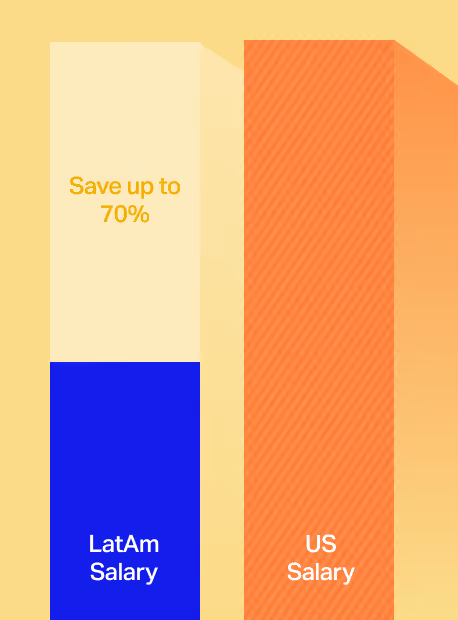
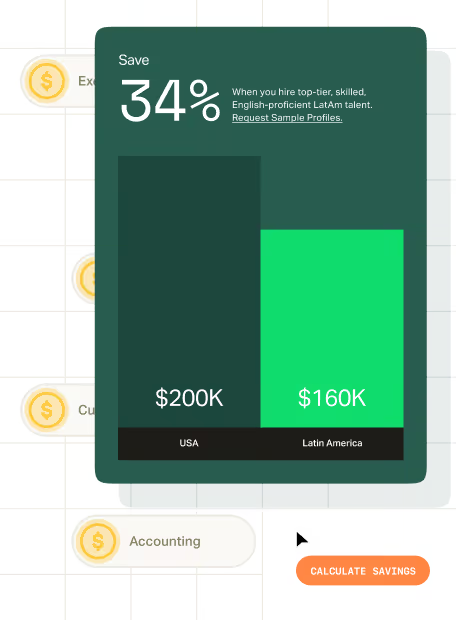
Depending on seniority, a Laravel developer in Latin America costs roughly a third to two-thirds less than the equivalent US hire, according to our salary data. The savings are widest at junior level and narrowest at senior, which is worth knowing before you set a band.
Fast hiring timelines with specialist recruiting support
Most companies hire offshore Laravel developers through specialist recruiting firms that can deliver qualified candidates in 2-3 weeks instead of the 3-6 months typical for US hiring. These firms keep pre-screened talent pools, which is why a shortlist arrives in days rather than weeks.
In my nearly four years recruiting technical talent at Hire With Near, the part that surprises clients most is how fast candidates move. On a Laravel search, a shortlist lands in 3 to 5 days. If there's a take-home assessment with a seven-day deadline, plenty of candidates hand it back in four or five, because they're eager to move forward.
From there, most of our clients make a hire in under three weeks.
Will an offshore Laravel developer work in your time zone?
Yes, if you hire in a region that shares your workday. A developer in the Philippines or Vietnam works while your US office is closed, which gives you a follow-the-sun cycle rather than live overlap.
A Laravel developer in Latin America, on the other hand, is online during your business hours, wherever your team sits, so standups, code review, and unblocking happen live.
Both models work, but which is best depends on whether you value live collaboration or continuous progress more for your projects. Choose deliberately, based on how you want to collaborate:
- Real-time collaboration: Hire from countries with workday overlap (such as much of Latin America if you're US-based). You'll have instant communication for stand-ups, sprint planning, and resolving blockers during your normal business hours.
- Around-the-clock development: Hire from regions farther from your own time zone (such as Eastern Europe or Asia) to create a 24/7 development cycle where work continues after your in-house team signs off.
One founder running a distributed engineering team described what happened with a team split between the US and Sri Lanka, a distant offshore country:
We currently have a senior QA that is focused on both manual testing and automation. She's based in Sri Lanka, and I don't get her enough during my day to actually allow to keep on that high quality and high throughput for my team. So we often release without her. So it's not good, right?
There's independent research behind that. A large study of distributed teams by Harvard Business School and Georgetown researchers, published in Organization Science, found that as shared working hours shrink, people start time-shifting, logging on outside normal hours to stay in sync, which is where the retention and burnout cost of a wide gap shows up.
Its recommendation for teams that need to collaborate closely: align north-south, in nearby time zones, rather than east-west.
Easy cultural and workflow integration
Many offshore developers, particularly those in regions with strong ties to the US and US business culture, have prior experience with US-based companies, communicate well in English, and work within Agile/Scrum frameworks.
This makes onboarding smoother, reduces miscommunication, and helps them operate as an extension of your in-house team from day one.
How Much Does It Cost to Hire an Offshore Laravel Developer?
Expect to pay $30K to $108K a year to hire offshore Laravel developer talent in Latin America, depending on seniority, compared to $80K to $189K for the equivalent hire in the US.
Here is the breakdown by seniority against equivalent US hires, according to Hire With Near's 2026 salary benchmarks:
For the most up-to-date figures, see Hire With Near's US vs Latin America Salary Guide.
What matters more than the band is where inside it you hire. Hire at the bottom of a range and you get junior-level work. Most of the Laravel and PHP placements we make land mid to senior, so treat the mid-level row as the realistic planning figure for production work. Set the band from the seniority you need, not from the lowest number in the table.
Hire With Near's 2026 State of LatAm Hiring Report puts the annual savings on a software engineering hire in Latin America at $23,000 to $85,000, a 28% to 59% reduction against US salaries. That's a strategic decision rather than cost-cutting. Hiring a senior Laravel developer in Latin America often costs less than hiring a mid-level developer in the US, so the seniority you can hire goes up rather than the spend going down.
If you're benchmarking more than one engineering role, we break down what IT roles cost in the US versus Latin America, and how offshore developer rates are built covers what sits behind the number.
ParkMobile, the parking app used in more than 4,200 cities, shows what this looks like at team scale. Its back-end and platform work had run through third-party agency developers for years, which its head of engineering saw as a business-viability risk, and US rates of $148K to $214K per role put an in-house team out of reach.
Working with Hire With Near, ParkMobile replaced those agency developers with nine directly employed senior platform, backend, and iOS engineers in Colombia. It saved over $1M a year, a 73% reduction against US rates, at a 24-day average time to hire.
That's the distinction worth holding on to: offshoring is not outsourcing. ParkMobile didn't hire an offshore agency; it replaced one with engineers it employs itself.
The TA Lead put it this way:
Collaboration with Hire With Near is solving the problem of entering a completely new market for us. They have been an invaluable partner in this expansion, helping to successfully close roles quickly. Their deep understanding of the local talent landscape is what allows them to source and vet top-tier candidates efficiently.
— Akshay Gokarnakar, TA Lead, ParkMobile
How to Hire a Laravel Developer: A Step-by-Step Process
Hiring a Laravel developer takes five steps: define the requirements, source candidates, review their Laravel and PHP experience, test them on a real task, and choose for skill and team fit. Most Laravel searches fail on process rather than on candidate supply, and a skilled Laravel developer who also fits your team's working style is what carries a project, so here is how each step runs:
- Define your project requirements: Name the Laravel version, the framework depth (API-only backend vs. full Blade/Eloquent build), and whether the role is greenfield or maintaining someone else's codebase.
- Search for qualified candidates: Use reliable sources like LinkedIn, GitHub, developer platforms, or a software developer recruitment agency to find experienced Laravel developers with proven portfolios and client testimonials that indicate a strong track record.
- Evaluate skills and experience: Review resumes and past programming projects, conduct interviews, and assess candidates' expertise in Laravel and PHP.
- Test practical skills: Give candidates a trial project or coding challenge to gauge their technical skills and problem-solving abilities in a real-world scenario.
- Choose the right fit: Select ideal candidates who have technical skills and align with your team's culture and communication style.
Working with the top developer staffing and recruiting agencies can speed this process up, helping you find the talent you need without running the sourcing and screening yourself.
Your four realistic routes differ mostly in how much of the work lands on you. You can source and screen on your own and employ the person through an employer of record, which handles payroll, compliance, and local benefits while the developer works as part of your team under your day-to-day management. The gap is recruiting: an employer of record vets nobody, so every candidate is still your search.
Freelance and contractor platforms move faster, but they're built for project work and the talent splits attention across clients, which is a poor fit for a full-time Laravel role.
Nearshore staff augmentation sits in between: the firm employs a pre-vetted developer who works on your team, which suits a defined project or a team you want to scale up and down.
The fourth route, a specialist staffing and recruiting partner, is the only one that does both jobs in a single relationship: it sources and vets candidates, then handles employment, payroll, benefits, and compliance once you hire.
The distinction that matters when choosing a Laravel outsourcing partner is who the developer works for. An offshore Laravel development company sells you capacity on its own delivery team; a staffing partner builds yours. Whichever way you go, ask what happens if the hire doesn't work out. Every placement we make is backed by a 180-day replacement guarantee, double the industry standard.
For more tips on the hiring process for Laravel developers, including interview questions, hiring best practices, and mistakes to avoid, see our complete guide on how to hire a Laravel developer.
What Are the Skills to Look for When You Hire Laravel Developers?
The six skills that decide a Laravel hire are PHP and Laravel proficiency, front-end familiarity, MVC architecture, database management, API development, and testing and debugging.
Across the back-end and full-stack developers I've placed for US clients, the resume is the least reliable part of the file. When I'm screening a Laravel developer, I ask them to walk me through a project: what their role was, what they built, what broke. If they can explain it to someone who isn't a developer, that tells me a lot.
Two red flags come up again and again: a candidate who can't articulate what they personally owned on a past project, and one who won't talk about a mistake.
Proficiency in PHP and the Laravel framework
Since Laravel is a PHP framework, Laravel developers should be proficient in PHP (as well as Laravel itself). This includes understanding Laravel's tools and functionalities, like Eloquent ORM, Blade templating, and built-in authentication, which is what lets a developer ship features without rebuilding the plumbing first.
Working familiarity with front-end technologies
While Laravel is a back-end framework, and most Laravel hires are effectively back-end developers, familiarity with front-end technologies saves handoffs. That means HTML, CSS, JavaScript, and frameworks like Vue.js or React. This knowledge enables Laravel developers to create cohesive applications that integrate cleanly with front-end components.
Understanding of MVC architecture
Laravel is based on the model-view-controller (MVC) architecture, which separates business logic from user interface code. A developer should understand how to use MVC principles to structure code cleanly, making it easier to debug, test, and maintain over time.
Database management skills
A solid understanding of database management, including MySQL and PostgreSQL, is a must for Laravel developers. They should be able to design, optimize, and manage database systems efficiently so the application keeps performing as your data grows.
For a back-end-heavy role like Laravel, it's worth asking directly whether the candidate also owns data modeling and database design, and whether they've worked with both SQL and NoSQL. Docker and CI/CD experience is the other question that separates people who ship from people who hand off.
API development and integration knowledge
Laravel developers should be skilled at API development, as many applications require communication between different services. Knowing how to build, integrate, and secure APIs helps an application exchange data reliably and connect to third-party services without custom glue code every time.
Familiarity with testing and debugging
To deliver a high-quality product, offshore Laravel developers should be proficient at both testing and debugging. Having a deep understanding of Laravel's testing tools and PHPUnit helps them write code that is reliable, easy to maintain, and cheap to fix when something breaks.
On paper, all of this is easy to claim, and AI-written resumes have made the claims cheaper than ever. The filter that works is a small real-world task: debug a piece of code, refactor something for scalability, or implement a basic API with tests, then review it together on a call so you can hear the reasoning.
Keep it short. Strong candidates drop out of long multi-round processes, and a 45-minute review tells you more than a take-home marathon does.
Our Software Engineering Recruiter adds a second filter:
I always look for overqualified candidates. If a client asks for a senior back-end developer with five years of experience, I'll look for someone with seven, eight, or nine, so I can be sure the person I'm talking to is actually proficient. Years of experience don't necessarily mean proficiency, but having more than required gives me more confidence.
— Federico Bilello, Recruiter, Software Engineering, Hire With Near
One more thing I tell clients: don't over-index on a specific Laravel version or a niche package. An experienced developer who understands the core principles adapts within a week.
Holding firm on data modeling, database design, SQL and NoSQL experience, Docker, and CI/CD will do far more for your shortlist than a version number, and I'd say the same about making a computer science degree a must-have. Plenty of the strongest engineers I place started working before they graduated and never finished.
Where to Hire Offshore Laravel Developers
The five countries that come up most often for an offshore Laravel hire are Brazil, Mexico, Argentina, the Philippines, and Vietnam. Each stands out for its technical talent, costs, and experience working with US teams, and the table below compares them on the things that decide a Laravel hire: workday overlap, English, rate, and how deep the local developer pool runs.
If your shortlist of regions is still open, we compare the best countries to hire remote software engineers more broadly, and the nearshore staffing companies that recruit in them.
The pattern I see when a client moves a Laravel role out of a distant time zone is that the engineering was rarely the problem. What broke was the loop: a question asked at 3 p.m. costs a day, and the developer never gets to sit in the conversation where the decision is made.
English is the column companies underrate most, and it's rarely conversational English they end up short on. A managing director at a US managed IT services company described the pattern:
We do have specific requirements in terms of the experience for these positions. And when we do find someone with the technical skills, they don't have the English level to communicate with the U.S.-based clients. They either focus on the technical skills or the language. Most of the time, the technical skills, and they have challenges with communication. So I believe they're too focused on the technical part. And we haven't found the balance.
Two things are worth knowing before you read the English column. Country-average proficiency indexes measure the general adult population, not developers who have spent five years on calls with US product teams, so they understate the candidates you would interview. And they're no substitute for screening: we test technical English directly on a live call rather than inferring it from a country score.
On talent depth, Brazil alone has more than 6.89 million developer accounts, according to GitHub's Octoverse 2025 report. Per GitHub's Octoverse 2024 report, Mexico counts more than 1.9 million developer accounts, and Argentina 1.1 million, both growing double digits year over year. PHP is one of the deepest stacks in Latin America, which is why, in my experience, a Laravel search there fills faster than clients expect.
Overlap figures are approximate and shift with daylight saving. Most Latin American countries do not observe it, while most of the US does. Scores and bands come from the EF English Proficiency Index 2025, which measures general adult proficiency rather than the English of screened senior developers.
The Latin America rate ranges are Hire With Near's own Laravel developer benchmarks for mid-level to senior talent; no equivalent measured benchmark exists for the Philippines or Vietnam, which is why those cells carry no number rather than an estimate. See our US vs Latin America Salary Guide.*
If you're weighing Asia against Latin America specifically, we've compared Latin America and the Philippines side by side for remote teams.
Brazil
Brazil has the largest developer community in Latin America, with more than 6.89 million GitHub accounts, and PHP is one of the region's deepest stacks. It has a strong STEM education system and a fast-growing IT workforce.
Mexico
Mexico is a key nearshore destination, offering proximity to the US and a workday that overlaps most of yours, wherever your team sits. Developers based in Mexico work across modern PHP and JavaScript stacks, and the country has a deep bilingual talent pool (1.9M+ GitHub accounts, Octoverse 2024).
Argentina
A high-quality educational system and government initiatives have bolstered Argentina's technology sector. Familiarity with US business practices, competitive rates, and an active developer community make it an attractive option for companies hiring nearshore talent.
Philippines
The Philippines offers a large pool of proficient developers with expertise in Laravel and PHP development. Developers based in the Philippines are known for their strong English proficiency and adaptability, and they work comfortably with distributed international teams.
Vietnam
Vietnam's software sector has grown fast, and it counts more than a million developer accounts on GitHub (Octoverse 2022). The country is known for competitive rates and a growing pool of experienced developers. The tradeoff is hours: a Vietnam-based developer hands work back overnight rather than working alongside you.
Offshore versus nearshore: hiring Laravel developers in LatAm
Offshore means hiring outside your own country. Nearshore is the subset of offshore close enough to share your working day. Neither is outsourcing: in both models, the developer joins your team and reports to you, rather than a vendor delivering work at arm's length.
For a Laravel hire, the practical difference is hours. A developer in Latin America overlaps most of your workday, so review and unblocking happen live. One in Asia hands work back overnight instead.
How much of your workday you need the developer to be online is the question that decides it, and it's a bigger part of why US companies hire in Latin America than cost is. If Latin America is where you've landed, you can hire Laravel developers in Latin America directly.
Final Thoughts
Hiring a Laravel developer offshore comes down to two numbers: what the role costs and how much of your workday you need the developer inside. In Latin America, that's $48K to $72K for a mid-level hire and most of your business day.
Although the best offshore location for hiring Laravel experts ultimately depends on your situation, LatAm countries stand out as a strong choice because their workday overlaps yours and their business practices are close to US ones.
With Hire With Near, you can hire remote LatAm Laravel developers, giving you access to these benefits. You start working with senior Laravel developers who are online during your business hours and screened on technical English before you meet them. If your search is broader than one framework, we also cover hiring Latin American developers across the region, and our guide to hiring remotely in Latin America walks through the setup.
Snap Diagnostics, a fast-growing medical equipment company, saved $587,000 annually with Hire With Near, 67% less than hiring in the US. It also cut its time to hire to 19 days.
If you want to work out what a Laravel hire would look like for your team, the best next step is to book a free consultation to talk through your requirements with our team. They'll give you salary benchmarks for the role and explain how the process runs, so you can decide with real numbers instead of a guess.
{{latam-hiring-cta-v2}}
Frequently Asked Questions
How much does it cost to hire a Laravel developer?
A mid-level Laravel developer in Latin America costs $48K to $72K a year, compared to $87K to $157K for the same hire in the US, according to Hire With Near's salary data. Junior roles start around $30K and senior Laravel developers run $72K to $108K, so seniority moves the number more than country does.
Is Laravel still relevant in 2026?
Yes. Laravel is still one of the most widely used PHP frameworks, and PHP is among the most requested stacks in our engineering placements. Supply isn't the constraint either: Brazil alone has more than 6.89 million developer accounts on GitHub, and PHP is one of the deepest stacks in Latin America.
Is Laravel developer in demand?
Yes, and demand concentrates at the experienced end. Most companies hiring Laravel talent want someone who can own architecture rather than tickets, which is why senior candidates are the scarce part of the market. Senior rates reflect that: $106K to $189K a year in the US against $72K to $108K in Latin America.
How can I hire a dedicated Laravel developer?
Define the role, then work with a specialist recruiting partner rather than a marketplace: you'll see a shortlist in 3 to 5 days and most companies make a hire in under three weeks. Dedicated means the developer works full-time as part of your team rather than splitting hours across several clients the way platform contractors do.
What is the difference between hiring offshore and nearshore Laravel developers?
Offshore means hiring outside your own country; nearshore is the subset close enough to share your working day. A nearshore Laravel developer in Latin America overlaps roughly 6 to 8 hours of your workday; one in Asia overlaps almost none.
That gap drives most of the questions engineering leaders ask before they commit.
Which countries have the best-paid remote Laravel developers?
Rates track the client's market more than the developer's country: a senior Laravel developer working for a US company from Latin America earns $72K to $108K a year, compared to $106K to $189K for the same role based in the US. So the country matters less than the client, and remote roles with US companies are what developers compete for.







.webp)


%203.svg)
.avif)





%20(1).avif)

%20(1).png)