%203.svg)
Key Takeaways
- Hiring offshore PHP developers costs $30K–$46K a year at junior level and $72K–$108K at senior level in Latin America, against $80K–$144K and $106K–$189K in the US.
- Offshore and nearshore are not the same thing: Argentina and Mexico are nearshore for a US company and share most of your working day, while the Philippines and India are offshore and barely overlap it.
- Evaluate an offshore PHP developer on modern PHP 8 fundamentals, depth in one framework such as Laravel or Symfony, and a practical task you review together on a call.
PHP still runs a huge share of the web, and most offshore PHP developers I placed were hired to keep a real application alive: fixing what's breaking, adding what the business needs next, and doing it on a codebase someone else wrote years ago.
That's not entry-level work, and the engineers who can truly do it well don't come cheap in the US. Most companies I talk to hit the same wall: the developer who can own their PHP app costs more than the budget allows.
When I see that gap, offshore is almost always the next question a client asks, and Latin America is usually where the search ends up. It's not the only option, but it's the one that closes the gap without asking a client to compromise on experience.
This guide covers what an offshore PHP developer earns, which countries are worth looking at, and how I'd screen one myself before you commit. If you'd rather skip ahead to talking about a specific role, our nearshore staffing and recruiting service is a good place to start.
What Is an Offshore PHP Developer?
An offshore PHP developer builds and maintains the server-side logic behind your website or web application, usually in a framework like Laravel or Symfony, the same core job any PHP developer does. What makes them “offshore” is where they're based: they work remotely from another country, employed directly by you as part of your team, not delivering a finished project as a vendor. They report to you the way a local hire would.
Three words get used interchangeably here, and they mean different things:
- Offshore describes distance: a developer in a country far from yours, often on the other side of the world.
- Nearshore describes a country close to yours, in or near your own band of time zones, which for a US company means Latin America.
- Remote describes how someone works, not where they live, so a remote PHP developer might sit in Manila, Mexico City, or Milwaukee.
That distinction drives the decision. Every offshore hire is remote, but not every remote hire is offshore, and only some offshore hires are online while you are.
One note on how this guide uses the word: most US buyers say offshore for any hire outside the country, so that's the sense used below, and every Latin American figure in this guide is the nearshore end of that market.
Our guide to hiring remotely in Latin America covers how each model works.
What Are the Types of Services Offshore PHP Developers Can Provide?
An offshore PHP developer builds and maintains the parts of your product customers never see: databases, business logic, integrations, admin tools, and the content system your marketing team lives in.
Here's what one commonly covers:
- Full-stack PHP development: Handle the front-end and the back-end of the same feature, so one full-stack developer can ship it end to end.
- PHP application development: Build internal tools, customer portals, and booking or billing systems from scratch.
- PHP e-commerce development: Build online stores with shopping carts and payment options.
- Custom PHP CMS development: Develop content management systems, commonly WordPress, tailored to your website.
- PHP application modernization: Update old PHP apps for better performance and security.
- PHP migration: Move your site or app from other technologies to PHP.
- PHP support and maintenance: Patch security releases, keep dependencies current, and clear the bug backlog.
- API integration: Connect your site to third-party services through APIs.
- PHP frameworks: Use frameworks like Laravel or Symfony to speed up development.
Most offshore PHP development roles mix two or three of these, so be specific before you look. Six years inside WordPress is a different hire from six years building Laravel APIs.
What Are the Benefits of Hiring an Offshore PHP Developer?
Hiring an offshore PHP developer means you can bring on an experienced software engineer at salaries well below US market rates, without the multi-month search a local hire takes.
Lower cost to hire
The true cost of an in-house employee is usually 1.25 to 1.4 times their salary, a rule of thumb the US Small Business Administration has published for years. An in-house PHP developer on $95,000 therefore costs you well over $118,000.
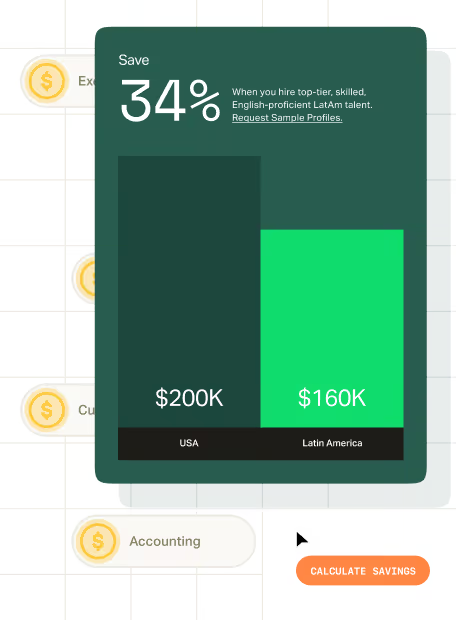
That multiplier doesn't disappear when you hire offshore, it's the base salary underneath it that changes. According to Hire With Near's salary data, a mid-level PHP developer in Latin America earns $48,000 to $72,000 a year against $87,000 to $157,000 in the US, so the same loaded-cost math lands on a much smaller number.
A deeper talent pool
Hiring offshore widens the pool from your metro area to an entire region. That matters: 69% of US employers report difficulty finding the skilled talent they need, according to ManpowerGroup's 2026 Global Talent Shortage Survey.
Latin America is where most of our clients look. The LatAm software industry has grown quickly on local and foreign investment, and companies that hire Latin American developers get access to PHP talent they wouldn't find locally.
Flexibility and scalability
You can add developers for a build and hold a smaller team for maintenance. Companies that start with one PHP developer and later need three often build an offshore development team in one country.
Specialist framework expertise
Good PHP developers bring their tooling with them: Laravel or Symfony, Composer packages, testing frameworks, and deployment patterns they've run in production. That's why a modernization job that looks like a rebuild often turns out to be an upgrade.
Less hiring and admin load
Sourcing, screening, contracts, payroll, and local compliance take time your engineering leads don't have. A partner moves most of that off your plate.
How Much Does It Cost To Hire an Offshore PHP Developer?
Hiring an offshore PHP developer in Latin America costs $30,000 to $108,000 per year depending on seniority, against $80,000 to $189,000 for the same hire in the US.
Across a full-time month of roughly 160 hours, that works out to about $16 to $24 an hour at junior level, $25 to $38 at mid-level, and $38 to $56 at senior level. The US Bureau of Labor Statistics puts the 2024 median pay for web developers at $45.85 an hour.
Here is the full annual picture, according to Hire With Near's 2026 salary benchmarks:
For the most up-to-date figures, see Hire With Near's US vs Latin America Salary Guide.
Our breakdown of US vs. Latin America developer salaries covers other roles, and this guide to offshore developer rates sets PHP against other stacks.
Seniority is what moves those numbers. According to Hire With Near's 2026 State of LatAm Hiring Report, 98% of our engineering placements were experienced professionals: 47% mid-level and 51% senior.
Hiring a senior PHP developer in Latin America often costs less than hiring a mid-level developer in the US. That's why companies going offshore usually aren't chasing junior talent to save money, they're finally able to afford the senior engineer they couldn't fund at home.
{{salary-guide-cta}}
What drives the total beyond salary
Four things move the number:
- Seniority: The gap between mid-level and senior is the largest single line in the budget, and the one worth paying.
- Framework specialization: Laravel and WordPress price close to the ranges above. Rarer combinations, such as legacy Symfony plus a specific payment platform, price higher.
- Engagement model: A full-time hire, a staff-augmented developer, and a freelancer carry different rate structures and different levels of commitment.
- Employment costs: Someone carries payroll, statutory benefits, and local compliance in the developer's country. Either you budget for it, or a partner or employer of record prices it into what you pay.
Ask any provider to split their number into salary and fee before you sign. A quote you can't break down is one you can't compare.
Offshore vs. In-House PHP Developers: What You Save, What You Take On
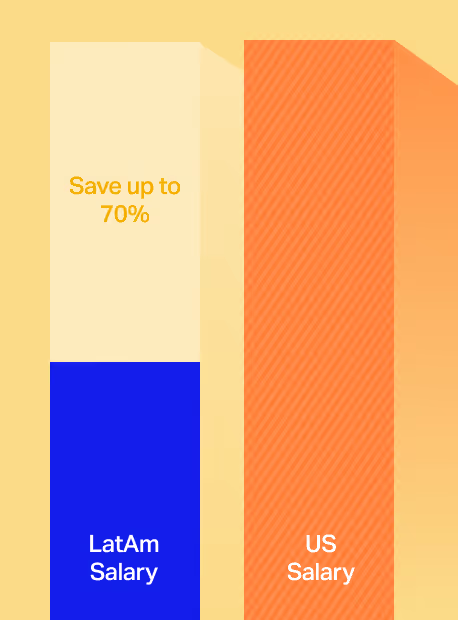
Against the salary ranges above, hiring an offshore PHP developer costs roughly 43% to 68% less than an in-house US hire depending on seniority, and can start in weeks rather than months.
What you take on instead is coordination, onboarding, and cross-border contract work a local hire doesn't carry. Here's how the two compare:
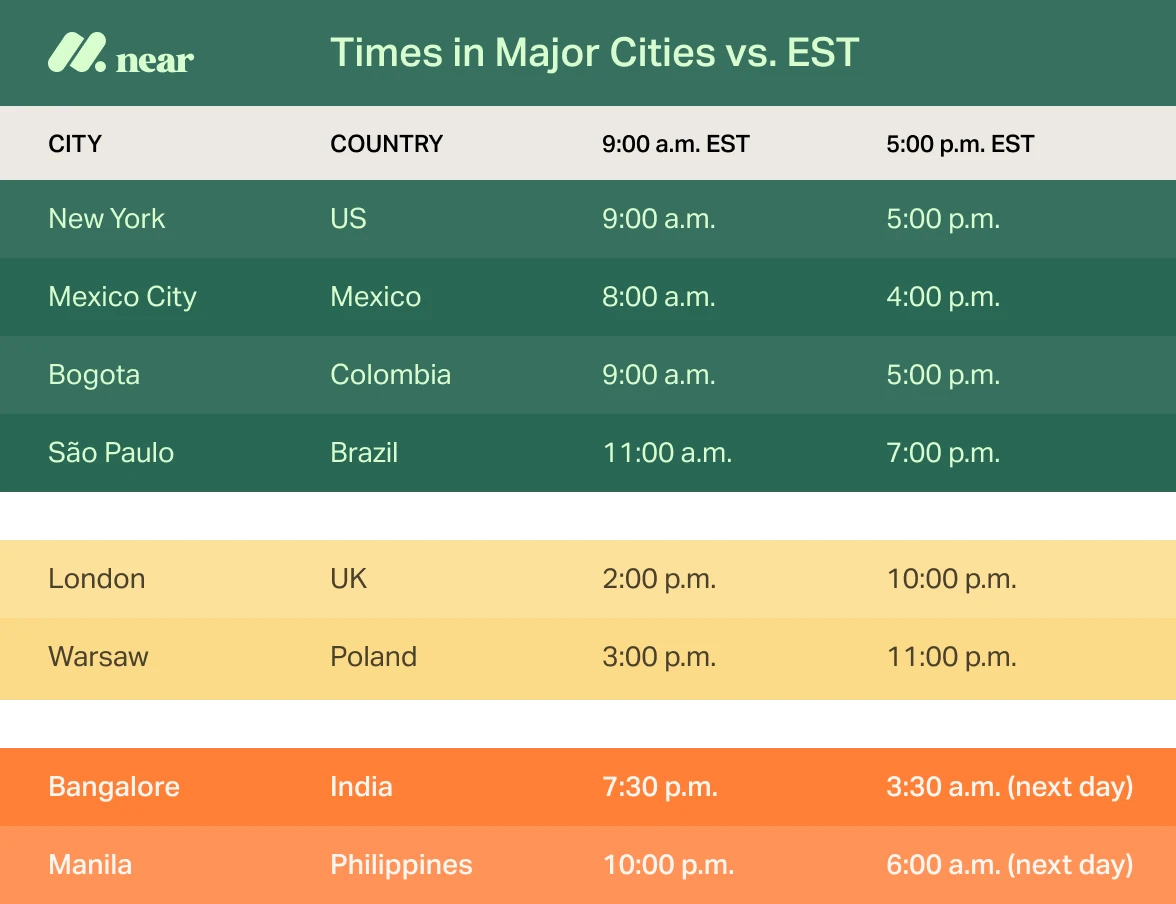
The working-day gap can be tricky
The cost of an offshore hire is rarely the salary. It's the day you lose whenever a question waits for the other side of the world to wake up, and how often that happens depends entirely on where you hire. A developer in Latin America is online during your business day; one in Asia or Eastern Europe usually isn't, and that gap is what costs you, not the country on the contract.
Research published in Organization Science by researchers at Harvard, Georgetown, and Rice found that the larger the time zone gap between two colleagues, the more of their work gets pushed outside normal business hours for one side of the pair, based on data from more than 12,000 employees at one multinational.
Our clients say the same. When we looked at why US companies came to us for Latin American talent, 30% were switching away from offshore hiring, almost always over the time zone gap.
One founder of an early-stage startup, whose engineering team was based in India, described what that felt like day to day:
They did a pretty decent job refactoring a lot of code, to be honest. It's just, you lose a day. You lose a day every single time just from a message.
Note what he said about the work: the refactoring was good. The problem was the clock, which is the part you can fix by choosing a different geography. A developer in Latin America works during your business hours, wherever your team sits in the US, so a blocked ticket doesn't cost a night.
Onboarding, ramp, and management overhead
A hire in another country ramps more slowly than someone sitting next to your lead developer, unless you plan for it. Repository access, staging environments, credentials, and a written explanation of how your application fits together all have to exist before day one.
Someone on your side also owns priorities and reviews. We compare both paths in our guide to hiring local or offshore developers.
IP, source code access, and confidentiality
Cross-border IP and confidentiality terms are harder to enforce than a domestic agreement, and any provider who says the risk is zero is overselling. What reduces it: signed IP assignment and NDA terms as standard, a partner that carries contractual liability rather than leaving you with an agreement thousands of miles away, and repository access scoped to the work.
What's the Best Approach for Hiring an Offshore PHP Developer?
You have four realistic options for hiring an offshore PHP developer: source and employ them yourself, use a freelance platform, use staff augmentation, or work with a specialist staffing and recruiting partner. They run from the most work on your side to the least:
Dedicated, freelance, or agency: choosing an engagement model
Decide what you're buying before you decide where to buy it. A dedicated PHP developer works only on your product and learns your codebase, which is what ongoing development needs.
A freelancer splits the week across clients. An agency team delivers a scope of work and leaves, taking the context with them. Our guide to hiring PHP developers covers that choice when offshore isn't the deciding factor.
Whichever you pick, ask what you pay and what the provider keeps. One owner of a small US e-commerce holding company told us why:
Our issue with the other company was they wouldn't tell us how much we were paying them. And one of the people that I interviewed said that the job was listed at like 50% less than what they told us we'd be paying.
Option 1: Source and hire on your own
You post the role, source on LinkedIn and job boards, and screen candidates yourself. Then, you solve the employment side: either a legal entity in the developer's country, which takes months and only pays off at real scale, or an employer of record that becomes the legal employer on paper while you manage the work.
The trap is assuming the EOR solves hiring. It handles contracts, payroll, tax withholding, benefits, and compliance, not sourcing and vetting, so you still need to find, screen, and assess every candidate yourself.
Option 2: Freelance and contractor platforms
Platforms like Upwork, Toptal, and Fiverr give fast access to contractors, which works for a bounded project: a plugin, a bug backlog, a two-week integration. For a full-time PHP role, they fit less well, because you carry quality and retention risk alone and the developer splits attention across clients.
For ongoing work, a full-time hire through a staffing partner gives you someone who stays on your codebase; here are the alternatives to freelance platforms in LatAm.
Option 3: Staff augmentation
Staff augmentation means renting a developer, not hiring one. A firm keeps the person as its employee, on its payroll, under its benefits and compliance, and lends them to you to work on your team, taking direction from you, sitting in your standups, following your priorities, just like an employee would.
The difference from a direct hire is who they technically work for. You get the day-to-day relationship without becoming their legal employer, which matters if the need isn't permanent, a defined project, a launch, or clearing a backlog, but it also means the developer stays on the firm's books, not yours, so this isn't a path to a long-term hire the way a direct hire is.
This fits teams staffing a defined project or adding capacity they don't need permanently.
Option 4: Work with a specialist staffing and recruiting partner
This is the simplest path for most companies, because it does both jobs at once: finding the developer and employing them. You describe the role, the partner sources and screens against your technical bar, and once you hire, payroll, benefits, and local compliance run through our nearshore staffing and recruiting services.
Two questions separate good partners from the rest:
- Ask what happens if the hire doesn't work out, and whether the answer is a replacement or a refund. Every Hire With Near placement is backed by a 180-day replacement guarantee.
- Then, ask how they screen technically. If you're comparing firms, we keep a list of the best companies to hire developers in Latin America.
Specialization matters here: IT and tech recruiting in Latin America is its own discipline, and a recruiter who has placed PHP developers knows which resume signals hold up.
If the role is a VP of Engineering or a CTO rather than an individual contributor, that is executive search for engineering leadership.
How To Hire an Offshore PHP Developer: Step-by-Step Process
A full offshore PHP hire usually takes roughly three weeks with a partner: three to five days to a shortlist, then one to two weeks of interviews and assessment before the offer. Sourcing alone takes longer, because most of the work happens before a resume reaches you.
- Define the role, down to the framework: Write down the framework (Laravel, Symfony, or none) and the PHP version your codebase runs on. Then, decide whether the work is greenfield or legacy maintenance, and whether this is a CMS job (WordPress, Drupal, Magento) or an application build.
- Choose your hiring route: Sourcing yourself, a platform, staff augmentation, or a partner. Decide before you look, because switching halfway restarts the pipeline.
- Search and vet candidates: Filter on real professional experience with your stack, a portfolio you can look at, and English strong enough for a technical conversation. With a partner, that’s already covered for you. Expect a shortlist in three to five days, screened on technical fit, communication, and salary expectations.
- Run a technical evaluation: Interview for how they think, then confirm with a small practical task. The next section covers what to test.
- Negotiate terms and set expectations: Agree on salary, start date, hours of overlap, and how performance will be measured. Write the first 90 days down: what ships, what they own, what outputs should look like.
- Onboard deliberately: Access, environments, credentials, and an architecture walkthrough on day one, plus a named person for their questions in week one.
- Monitor progress and give feedback: Weekly one-on-ones for the first two months, then your normal cadence. Most problems with a remote hire show up as silence, so make it easy to raise them early.
How To Evaluate an Offshore PHP Developer
Evaluate an offshore PHP developer on four things: modern PHP fundamentals, depth in the framework your codebase runs on, evidence they can handle a database and an API under load, and a short practical task you review together.
In my nearly four years recruiting technical talent at Hire With Near, most rejections come down to communication in the interview or the technical assessment. The take-home is where candidates get filtered out, so I'd rather run one good task than three rounds of trivia.
Modern PHP and object-oriented fundamentals
Confirm the candidate works in PHP 8 rather than carrying PHP 5 habits forward. Ask what changed for them between PHP 7 and PHP 8 and listen for typed properties, enums, or match expressions rather than a version number. Then, ask them to explain dependency injection as if you weren't a developer.
Framework expertise: Laravel and Symfony
Screen for depth in one framework plus evidence of having worked across others. Someone who knows Laravel well and has shipped something in Symfony adapts faster than someone listing five frameworks with surface knowledge of each.
PHP and WordPress are two of the stacks I have the least trouble filling in Latin America.
Database and API skills
PHP is a server-side language, so a strong PHP developer is a back-end developer who happens to write PHP. Ask how they model data, how they fix a slow query, and what they do when a third-party API fails mid-request.
Testing and code quality
Ask what test coverage looked like on their last project and what they chose not to test. A candidate who names what they skipped and why understands the tradeoff; one who claims full coverage usually hasn't shipped much.
Application security
PHP applications get probed constantly, so security is part of the job. Ask how they handle input validation, SQL injection, cross-site scripting, and secrets in configuration.
A practical assessment, reviewed together
Give candidates a small, real task: debug a broken piece of code, refactor a function for scalability, or implement a basic API endpoint with tests. Keep it to two or three hours, then review it together on a call, which is what shows how they made decisions.
Federico Bilello, Software Engineering Recruiter at Hire With Near, is direct about why that step can’t be skipped:
Even though I do everything I can to verify a candidate's skill set before they get to the client, there's always a small percentage who make it through to the technical interview. The only way to truly find out if someone is proficient is that technical interview. That's where the truth comes out.
— Federico Bilello, Software Engineering Recruiter, Hire With Near
If you're not technical yourself, these are the questions I'd take into an interview:
- Walk me through a project you worked on. What was your role, and what did you personally build?
- What is something in that codebase you would do differently now?
- Tell me about a bug that took a long time to find. How did you find it?
- How do you decide whether to fix something properly or ship a workaround?
Our list of tech interview questions goes deeper on the engineering side.
What are the red flags to watch for when hiring offshore PHP developers?
The strongest signal for me is whether someone can explain a project without getting lost in technical details. If a candidate can't describe what their role was or avoids talking about mistakes, that's a problem, whatever the resume says.
If a candidate tells me they're holding three jobs in parallel, that's another red flag: either they're not performing at any of them or none of them is real work.
To check whether a senior is genuinely senior, ask for years of professional, on-the-job experience with the specific tool, not total years in tech, because candidates count university projects and freelance dabbling in the same number.
Our guide on how to spot a fake senior developer is a five-question version of that and in the video below, our CEO and Co-founder Hayden Cohen explains how to tell if a so-called senior engineer is cheating on coding exams:
One requirement I usually tell clients to drop: the degree. Plenty of strong engineers in Latin America started working before they graduated and never finished college, and they're not weaker candidates for it.
None of this has to slow you down. A US healthtech startup proved that with two internal recruiters and an eight-step interview process it refused to shorten. It kept every step, and it still hired seven senior engineers at an average of 14 days each and saved $323,000 a year against US salaries.
The bar didn't move. The waiting did.
Top 4 Countries Where You Can Hire Offshore PHP Developers in 2026
Argentina, Mexico, the Philippines, and India are the four countries US companies hire PHP developers from most often, and they split into two groups. Argentina and Mexico are nearshore for a US buyer. The Philippines and India are offshore. That difference between nearshoring, offshoring, and onshoring decides how much of your working day you share with your developer.
Here's how the four countries compare:
If you'd also like to compare providers, we keep a list of LatAm outsourcing companies for US teams, and if you want to look past these four, our roundup of the best countries to hire remote software engineers and developers covers 22 of them.
Argentina
Argentina is where I send most US clients hiring senior PHP talent while watching salary spend, because it pairs strong English with senior salaries at the lower end of the region.
It has more than 1.1 million developers on GitHub, growing 22% year over year, and ranks 26th globally on the 2025 EF English Proficiency Index, first in Latin America.
The tradeoff is that Argentina sits at the eastern edge of the region, ahead of US Eastern teams by an hour or two depending on the season. A West Coast team shares the morning and early afternoon rather than the whole day.
Related reading: Hire Developers in Argentina: Costs, Skills, and How to Hire Fast
Mexico
Mexico is the closest of the four to a US working day, which makes it the default for teams that want live collaboration without anyone changing hours.
It has more than 1.9 million developers on GitHub, up 21% year over year, and a services sector that has built for US clients for years. Argentina is the pick when salary spend is the binding constraint; Mexico when maximum overlap is.
Mexico also runs deep on the CMS and e-commerce side of PHP, which matters if your work is WordPress, WooCommerce, or Magento.
Working English is common across the Mexican tech sector, though it's a per-candidate question rather than a country-level guarantee: the test that settles it is the explain-a-project question in the evaluation section above.
Salaries run higher than Argentina at the same seniority, which is the price of the closer overlap.
Related reading: How to Hire Developers in Mexico: Cost, Talent, and the Four Ways to Hire
Philippines
The Philippines has a mature IT services sector and one of the largest English-speaking professional workforces in Asia, with more than 1.7 million developers on GitHub and 29% growth year over year. PHP work is well established there, particularly web development and maintenance for US clients.
The trade-off is hours, not people. Sitting 12 to 13 hours ahead of US Eastern time depending on US daylight saving shifts, a developer based in the Philippines works almost entirely outside your day, so a question asked in your afternoon gets answered while you sleep. Teams that make it work invest heavily in documentation and async handoffs.
Related reading: LatAm vs. the Philippines: Which Region Is Right for Your Remote Team?
India
India has by far the deepest engineering market of the four, with more than 17 million developers on GitHub and 28% year-over-year growth. For large-scale PHP projects and long-running maintenance work, no other market on this list has that depth of experience, and junior and mid-level rates are the lowest of the four.
English is used professionally across Indian engineering teams, and the same rule applies as everywhere else on this list: judge it in the interview, not from the country.
Two tradeoffs remain. The overlap with a US working day is minimal, with the same overnight feedback loop the Philippines carries, and notice periods are commonly far longer than US practice, so a hire you accept in March may not start for months.
Related reading: Hiring Remote Talent in LatAm vs. India: A 2026 In-Depth Comparison
Final Thoughts
The decision that matters most with an offshore PHP developer isn't the country on the contract. It's whether their working day overlaps yours enough to keep the project moving, and whether you evaluate them properly first.
Hire With Near helps US companies hire remote PHP developers in Latin America, along with the rest of the engineering team around them, at 43–68% less than a comparable US salary for the same seniority. We source, screen, and coordinate the search and handle payroll, benefits, and compliance once you hire, so your team spends its time evaluating developers rather than chasing them.
ParkMobile is a good example of what that looks like in practice. It had run its platform and backend work through third-party agency developers for years and wanted its own senior engineers instead, in a market it had never recruited in before. We placed 9 senior engineers in Colombia at a 24-day average time to hire, and ParkMobile now saves $1,066,085 a year against US rates, a 73% reduction.
You've seen the numbers in this guide. The next step is seeing them applied to your actual role, not a general range. Book a free consultation and we'll bring you real salary benchmarks for the seniority you need, walk you through exactly how the search runs, and give you a straight answer on whether Latin America is the right call for this hire.
{{latam-hiring-cta-v2}}
Frequently Asked Questions
How much does an offshore PHP developer charge per hour?
Offshore PHP developers in Latin America work out to roughly $16 to $24 an hour at junior level, $25 to $38 mid-level, and $38 to $56 senior, based on our monthly salary data and a full-time month of about 160 hours. The US Bureau of Labor Statistics puts the 2024 median for web developers at $45.85 an hour.
Is PHP outdated in 2026?
No. PHP 8.5 shipped in November 2025, and the language releases a major version every year with four years of support per branch. As of August 2026, PHP runs 70.3% of websites whose server-side language is known, according to W3Techs.
It isn't the right choice for real-time systems, but for web applications it's current and maintained.
Is a PHP developer still in demand?
Yes. PHP is one of the most requested programming languages across the placements we made in 2026, alongside Python, JavaScript, and SQL.
WordPress alone, built in PHP, runs 40.7% of all websites as of August 2026, so modernization and maintenance work keeps coming even where new builds use something else.
How do you hire an offshore PHP developer?
Define the role by framework, codebase, and PHP version, then choose your hiring route. Screen for real professional experience with your stack and confirm it with a short practical task you review together.
Your routes are sourcing on your own with an employer of record, a freelance platform, staff augmentation, or a specialist staffing partner that handles both.
What is the difference between offshore and nearshore PHP developers?
An offshore PHP developer works in a distant country, such as India or the Philippines. A nearshore developer works close by, which for a US company means Latin America.
The practical difference is overlap: a nearshore developer is online during your business hours, so questions get answered the same day. A developer in Asia works while you sleep.
Can an offshore PHP developer work US business hours?
Yes, if you hire in Latin America, and rarely if you hire in Asia. A developer in Latin America works during your business hours whether your team is on Pacific, Mountain, Central, or Eastern time, so live standups are normal. In Asia, matching your hours means working through the night.
See the questions tech leaders ask about hiring developers in Latin America.






.webp)


%203.svg)
.avif)





%20(1).avif)

%20(1).png)