


%203.svg)
Key Takeaways
- The challenges of hiring virtual assistants in Latin America are real but solvable: language and accent concerns, time zone coordination, trust, reliability, and legal and tax questions are the most common. Each has a clear fix.
- Most of these challenges trace back to how a VA was sourced, so the single biggest factor in avoiding them is strong vetting before anyone reaches your shortlist.
- Working with an experienced hiring partner that pre-screens for English, judgment, and reliability neutralizes most of the challenges in this article before a candidate ever reaches your shortlist.
You hired a virtual assistant in Latin America to get time back. Instead, you’re reviewing every email before it goes out, second-guessing whether the communication style will land with clients, and then your assistant went quiet for two days last week with no explanation.
That’s the exact failure mode one insurance agency owner described after trying a VA agency, and it’s the fear most US founders carry into their next hire.
When a VA hire doesn’t stick around, the work doesn’t disappear with them. It piles back onto you. The role stays open, the tasks you tried to offload are right back on your plate, and you’re stuck doing work that keeps you away from the parts of the business only you can run.
The good news: according to Hire With Near’s salary data, hiring a virtual assistant in Latin America typically costs $1,500 to $2,800 a month, depending on seniority, and the challenges that worry you are well understood and very fixable.
This article walks through the 15 most common challenges of hiring virtual assistants in Latin America and how to solve each one. A hint: strong sourcing and vetting are what make the difference.
Why Do Companies Hire Virtual Assistants From Latin America?
Companies hire virtual assistants in Latin America for four reasons that consistently outweigh the challenges: cost, a deep talent pool, overlapping working hours, and cultural alignment with US teams.
Before getting into the challenges of hiring LatAm VAs, it helps to understand why so many companies are turning to the region for hiring remote administrative talent in the first place.
Cost effectiveness
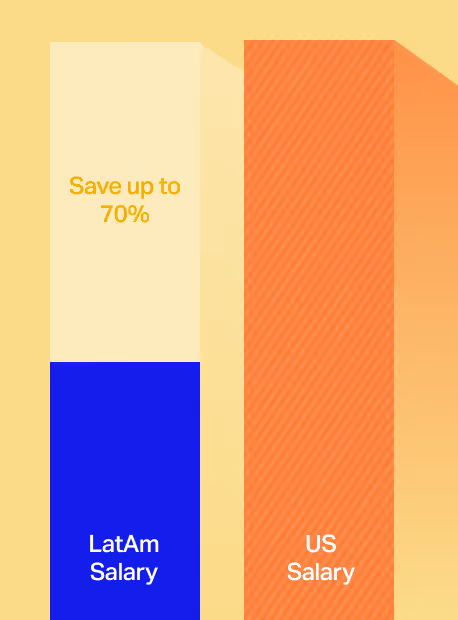
Hiring a VA in Latin America stretches your budget further than a comparable US hire. The same spend buys you more capable support, because the region’s lower cost of living means competitive local salaries still land 30% to 70% below US rates.
You can dig into the numbers in our breakdown of the cost-effectiveness of hiring VAs, and you can read more about the wider picture in our guide to hiring remotely in Latin America.
Large talent pool
Latin America has a large pool of experienced administrative professionals, many of whom are fluent in English and have spent years working with international clients.
That depth makes it realistic to find a VA who can run a calendar, manage inboxes, handle client communication, and take real ownership, rather than someone who only executes narrow tasks.
Overlapping working hours
Time zone overlap is one of the strongest reasons companies pick Latin America over offshore regions. Many countries in the region share working hours with the US, so your VA is online when you are, and real-time coordination on calls, calendars, and urgent requests is straightforward.
Take a look at the table below to see how some of the Latin American countries align with the US time zones:
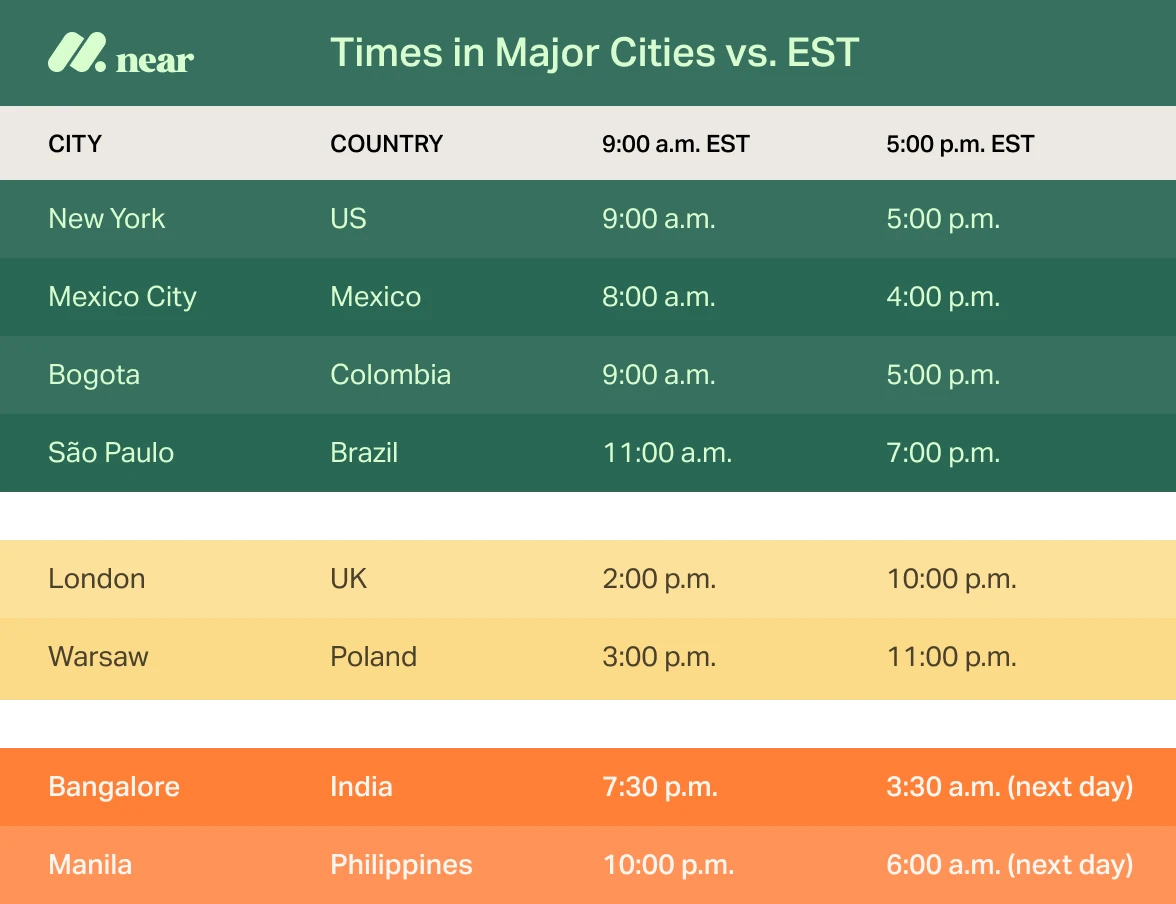
This is a major draw for companies that have used nearshore administrative recruiting after a frustrating offshore experience.
Cultural similarities
Cultural alignment is the fourth factor that makes Latin America an appealing place to hire a VA. Latin America and the US share many of the same business norms, so a Latin American VA tends to understand US client expectations, communication styles, and pace without a long ramp.
Hire With Near’s co-founder, Michael Girdley, shares his perspective:
The great thing about Latin America is it’s basically the same time zone — and the cultures are very similar. Living in Texas, I deal with people in Mexico, and I’m just like, this is just Texas, but a little further south. Pretty much the same thing.
Further reading: From Cost Savings to Better Retention: 8 Benefits of Hiring a Virtual Assistant From Latin America
15 Challenges of Hiring Latin American VAs and How To Solve Them
Here are 15 of the challenges you might face when hiring VAs in Latin America, along with strategies to overcome each one effectively.
The pattern you’ll notice throughout: most of these challenges are downstream of sourcing, so the way a candidate is found and vetted decides whether the challenge ever reaches you.
1. Language barrier
The most common worry about hiring a VA in Latin America is whether the English will hold up on client-facing work. It’s a fair concern since accent and fluency vary widely, and a VA who reads well on a resume can still struggle in a live conversation with customers.
The data here is more reassuring than most founders expect. According to the EF English Proficiency Index 2025, three Latin American countries rank in the global top 40, with Argentina and Honduras sitting in the High proficiency band and Uruguay close behind.
That’s a country-wide average, not a cherry-picked subset, and it tells you the talent is there if you screen for it.
Solution:
The fix is to screen for spoken English up front rather than hoping to train it later.
In my work recruiting administrative talent at Hire With Near, the first thing I assess when matching a VA to a US client is how they actually sound in a live, unscripted conversation, not just how they write.
I look for a neutral, easy-to-follow accent, the ability to handle a back-and-forth without losing the thread, and comfort on client calls. A genuinely bilingual virtual assistant in Latin America can move between English and Spanish on a client call without missing a beat, and the VAs I move forward are the ones who could pick up your phone today and represent your business well.
That’s what good vetting does: it settles the English question before a single candidate reaches your shortlist.
Our “How to Hire a Virtual Assistant in Mexico” article covers tips for finding bilingual English-Spanish virtual assistants for US teams, including current costs and time zone facts.
2. Time zone differences
Time zone misalignment is exactly the problem most companies are trying to solve when they move to nearshore hiring. In Hire With Near’s analysis of 2,000+ conversations with US companies exploring Latin American hiring, 30% were switching from offshore (typically 12 or more hours ahead for Asian countries) to nearshore to gain real-time collaboration.
With Latin America, time zone overlap is a real advantage, but it still needs to be set intentionally, since the region is large and some countries sit a few hours off US time, especially for West Coast teams.
Daylight saving adds a wrinkle because most Latin American countries don’t observe it, which can briefly misalign schedules.
Related reading: Philippines or Latin America? Where to Hire Your Next Virtual Assistant
Solution:
Set core collaboration hours from day one. Agree on a window that overlaps your own working hours, confirm how the VA’s country handles daylight saving so the calendar stays accurate, and use project management tools like Trello or Asana to keep tasks and deadlines visible to both sides.
A real example shows how cleanly this can be resolved. ORBA Cloud CFO, a Chicago outsourced-accounting firm, had hit the time zone wall common to offshoring and needed administrative and finance support that could work in their clients’ hours.
Partnering with Hire With Near, they hired an executive assistant and two staff accountants based in Latin America who aligned with their time zone, with a one-to-two-hour maximum difference, eliminating the misalignment. They cut costs 65% ($159,000 a year) on a 13-day recruitment cycle.
For more on what to expect around scheduling and working hours, see these questions business owners ask about hiring VAs and EAs in Latin America.
3. Cultural differences
Latin American and US business cultures share a lot, but small differences in workplace etiquette can still catch you off guard.
Expectations around formality, how directly feedback is given, and attitudes toward punctuality can vary from country to country, and what reads as “on time” in one place may read as late in another.
Solution:
Set expectations clearly from the start and put them in writing. Spell out how you want communication handled, what your deadlines mean, and how feedback works on your team.
It also helps to learn a little about the culture of the country your VA is based in, so you understand their perspective and head off small misunderstandings before they grow.
4. Technical issues
Equipment and setup problems are a normal part of any remote hire, and a VA in Latin America is no exception. Outdated hardware, software compatibility gaps, or a home setup that isn’t built for full-time work can slow collaboration if you don’t check for them before someone starts.
Solution:
Confirm the VA’s equipment and software setup during hiring, not after. Make sure their computer, headset, and core tools meet the job’s needs, and provide a stipend or equipment if there’s a significant gap.
Setting a clear hardware and software baseline up front prevents most of these issues from ever surfacing.
5. Hiring process
The hardest part of hiring a VA in Latin America is the sourcing and vetting itself: finding qualified candidates, screening them properly, coordinating interviews, and handling paperwork for a remote hire.
This is where most of the challenges in this article are won or lost, because a VA who’s sourced and vetted well by a partner with deep experience in Latin American administrative hiring rarely turns into a language, reliability, or trust problem later.
A specialist partner pre-screens for English, judgment, and dedicated focus on your business rather than attention split across several clients, so the candidates you see are already filtered for the things that usually go wrong.
Solution:
Use a 360 hiring solution like Hire With Near to take the sourcing and vetting off your plate. We give you access to a pool of pre-vetted Latin American VAs and handle the full process, from screening resumes to scheduling interviews and managing paperwork, so you only spend time on the finalists worth your attention.
The outcomes back this up. According to Hire With Near’s 2026 State of LatAm Hiring Report, 84% of placements were mid-level or senior, and those hires stayed 66% longer than comparable US hires. That’s the opposite of the cheap-junior-labor, high-churn fear: rigorous vetting produces senior, sticky hires.
From running full-cycle recruiting for administrative roles, from kickoff through offer, I choose the candidates I put in front of clients for judgment and long-term fit, not just availability. That’s exactly why the partner model holds up.
{{state-latam-hiring}}
6. Legal considerations
Hiring a VA in Latin America raises legal and tax questions worth understanding before you commit, but they’re manageable once you know your options.
The two big ones are how the working relationship is classified and which country’s rules apply. A VA may work as an independent contractor or as a full-time employee, and each carries different obligations around contracts, taxes, and local labor law.
On the US side, tax and withholding rules can apply when a US company pays for services, with stated exemptions depending on where the work is performed and the worker’s status. You can review the federal income tax considerations on the IRS website.
On the LatAm side, each country has its own rules around contractor vs. employee classification, mandatory benefits, and termination protections. Colombia, Argentina, and Brazil have labor laws that can create liability if a full-time working relationship is misclassified as independent contracting.
Solution:
The simplest path for most companies is to let a partner absorb this complexity. An employer of record (EOR) or a staffing partner can act as the legal employer or manage the contracts, tax withholdings, and local compliance on your behalf, so you get a compliant working relationship without becoming an expert in another country’s labor law.
7. Adaptability and change management
A VA needs to adapt quickly as your tools, processes, and priorities shift, and not every candidate is wired for that. Some are comfortable executing a fixed routine but struggle when the work changes, which becomes a problem in a fast-moving business.
Latin American talent takes initiative, as Franco Pereyra, Hire With Near’s COO, says:
What sets Latin American talent apart from other regions is that you’ll find people who are proactive and creative. People who come up with ideas and new solutions. If you’re looking for folks who can bring something to the table, who will push back if they think your idea doesn’t make sense, that’s what you find in Latin America.
Solution:
Build adaptability into the hiring and the onboarding. Screen for candidates who show a track record of learning new tools and handling change, then reinforce it with a clear onboarding that explains your values and why flexibility is important to your business.
Regular check-ins and open feedback give the VA room to ask questions and adjust as things evolve.
8. Payment methods
Paying a virtual assistant in Latin America is simple once you pick the right method, even though international transfers and currency conversion can look daunting at first.
Wire fees and conversion costs can eat into pay if you’re not careful, which matters for fair, stable compensation.
Solution:
Partner with a hiring service like Hire With Near that handles payments for you. We manage payroll and offer multiple payment options, so your VA gets paid accurately and on time without you wrestling with international transfers or currency conversion every cycle. Reliable, fair pay is also one of the simplest ways to keep a great VA long term.
9. Internet reliability and infrastructure
A stable, fast connection is essential for remote work, and connectivity varies across Latin America by location.
While internet infrastructure across the region has improved substantially and major hubs now offer strong, reliable service, connection quality is still worth confirming for any individual hire, since a dropped connection during a client call or live collaboration is disruptive.
Solution:
Assess the VA’s connectivity during hiring: ask about their typical speeds, the reliability of their service, and their backup plan if the primary connection fails. Consider a stipend for a high-speed plan or a mobile hotspot as a fallback.
For mission-critical roles, it can help to hire VAs based in major cities with strong, well-established internet infrastructure to reduce the risk of downtime.
10. Building trust
Trusting someone you’ve never met in person is hard, and it’s harder across a border, where the fear of missed deadlines, poor communication, or even a scam can make you hesitate before handing over real responsibility.
The honest answer is that trust doesn’t start on day one. It starts during sourcing.
Pre-screened, reference-checked candidates from an experienced partner are how trust begins before the VA logs in for the first time.
When someone has already verified the VA’s English, work history, references, and reliability, you’re starting with someone whose quality has already been confirmed.
Solution:
Lean on thorough vetting and then build on it. Across the executive assistants and admin candidates I’ve placed for US clients, the ones who earn trust fastest are those who were screened for judgment and reliability before the client ever met them, not just for a tidy resume.
Start there, then set regular check-ins and clear communication channels so trust compounds over the first few weeks instead of being left to chance.
11. Work-life balance
Latin American professionals value family and personal time, and that’s a strength, not a liability, as long as expectations are clear.
Without clarity on hours and deadlines, conflicting commitments can occasionally lead to missed handoffs or reduced availability.
Solution:
Be explicit about expectations and boundaries from the start. Set realistic goals and deadlines, agree on core hours, and account for the VA’s personal obligations.
Offering flexible hours or paid time off helps your VA maintain a healthy balance, which in turn protects their focus and reliability during the hours that matter to you.
12. Training remote workers
Even an experienced VA needs structured training to understand their role’s tasks and goals, and your tools and standards.
Without clear onboarding and documented expectations, it’s easy for a remote hire to misread their responsibilities and underperform through no fault of their own.
Solution:
Provide onboarding and training tailored to your VA’s actual responsibilities. Use video tutorials, recorded walkthroughs, and live sessions, document your processes, and keep a channel open for questions during the first few weeks.
The clearer your onboarding, the faster a capable VA becomes genuinely useful.
13. Data security and privacy concerns
Data security is crucial whenever a remote VA handles sensitive company or client information, and a home setup may not match the protections you have in an office.
There’s also a privacy dimension, since different countries have their own rules on handling personal and business data.
Solution:
Set clear data security protocols and require them from day one. Use secure, company-approved software, including a virtual private network and protected hardware where needed, and train your VA on safe data practices.
Two-factor authentication, current security software, and a business VPN solution go a long way, and so does making sure your VA understands why these measures are important.
14. Team integration
Bringing a VA into a remote team takes deliberate effort, since the casual, in-person moments that build cohesion don’t happen on their own.
Remote teams don’t build connection passively. Without deliberate structure, a VA can complete work independently for months without ever feeling like part of the team, which is why integration rarely happens by accident.
Solution:
Use videoconferencing, project management software, and instant messaging to keep your VA connected, and set clear roles and expectations for everyone on the team.
Encourage regular check-ins and include your VA in the team rituals your in-house staff already take part in, so they feel like a teammate rather than an external helper.
You can shortcut a lot of this friction by hiring through a source that already understands US-client expectations.
15. Managing performance remotely
Managing performance from a distance is challenging when you can’t see the work happening in real time, and it gets harder across different countries and work styles.
Many companies reach for time-tracking or surveillance software, but heavy monitoring often backfires, eroding trust and morale and creating a more volatile working relationship.
Solution:
Manage outcomes, not keystrokes. Set clear goals, establish regular check-ins, and use lightweight task-tracking that your VA actually buys into, so progress stays visible without constant surveillance.
Clear expectations and steady communication do more for remote performance than any monitoring tool. Managing remote VAs well is mostly about clarity and trust, the same foundation you built during hiring.
Where and How To Find a Virtual Assistant in Latin America
You have three main ways to find a virtual assistant in Latin America: source one yourself, use a freelance platform, or work with a specialist staffing partner.
For most companies, the partner is the fastest path to a great hire.
The do-it-yourself route means posting on a job board or LinkedIn, screening candidates, and then either hiring them directly or using employer of record services to handle the employment paperwork.
It gives you full control, but an EOR handles only the employment logistics, not the sourcing and vetting, so finding and screening every candidate is still entirely on you.
Freelance platforms like Upwork or Fiverr offer fast access to contractors, but they’re built for project-based work, and contractors on these platforms often work across multiple clients simultaneously, which can limit their availability and focus.
A specialist staffing partner is the only option that does both jobs at once: it sources and vets the talent and handles employment, payroll, and compliance in one relationship. That’s what closes the sourcing-and-vetting gap the other two routes leave open.
Hire With Near also handles executive search in Latin America when you need senior administrative or operations leadership, such as a chief of staff or a senior executive assistant.
To see who does this well, start with our guides to the best companies to hire virtual assistants in Latin America and the best nearshore staffing companies.
Final Thoughts
The challenges of hiring a virtual assistant in Latin America are real, but none of them is a dead end. Language, time zones, trust, reliability, and the legal and tax questions all have clear solutions, and the common thread is that they’re won or lost during sourcing.
Get the vetting right, and most of these challenges never reach your desk.
If you want to explore hiring a virtual assistant in Latin America, the best next step is to book a free consultation to talk through your specific requirements with our team.
We’ll share salary benchmarks and walk you through the process, so you have the information you need to decide if it’s right for you.
For more context, our guide on the best countries to hire VAs and our overview of hiring a virtual administrative assistant are good companions to this article.
{{latam-hiring-cta-v2}}
Frequently Asked Questions
What are the biggest challenges of hiring a virtual assistant in Latin America?
The biggest challenges of hiring a virtual assistant in Latin America are English and accent quality, time zone coordination, building trust at a distance, reliability, and legal and tax classification.
Each is solvable, and most of them trace back to how the VA was sourced.
A candidate who was screened for spoken English, judgment, and reliability before reaching your shortlist rarely becomes a problem later, which is why strong vetting, whether you do it yourself or through a partner, is the single most effective way to avoid these challenges.
How do you handle the legal and tax side of hiring a LatAm virtual assistant?
You handle the legal and tax side by deciding how the VA is engaged, as an independent contractor or a full-time employee, and then meeting the contract, tax, and compliance rules that apply.
US tax and withholding rules can apply depending on the work and the worker’s status, and local labor laws vary by country.
Most companies simplify this by working with an employer of record or a staffing partner that acts as the legal employer or manages compliance for them.
Since the rules change and differ by country, confirm specifics with a qualified professional.
Do time zone differences matter when hiring a virtual assistant in Latin America?
Time zone differences are minimal when hiring in Latin America, which is one of the region’s biggest advantages over offshore options.
Most countries overlap heavily with US working hours, so your VA is online when you are and real-time coordination on calls and urgent tasks is easy, rather than waiting overnight for a reply.
The main thing to set up front is agreed core hours and clarity on daylight saving.
Is internet reliability a problem when hiring VAs in Latin America?
Internet reliability is rarely a problem in Latin America’s major hubs, where infrastructure has improved substantially and now supports strong, stable connections for full-time remote work.
It’s still worth confirming for each hire by asking about typical speeds and a backup plan, such as a mobile hotspot. For mission-critical roles, choosing a VA in a country with well-established infrastructure reduces the risk of downtime during important calls or live collaboration.
How do you pay a virtual assistant in Latin America?
You pay a virtual assistant in Latin America through international payment platforms, direct transfers, or, most simply, a staffing partner that manages payroll for you.
Paying directly means handling international transfers and currency conversion, where wire fees and conversion costs can erode pay if you’re not careful.
A partner that runs payroll removes that friction entirely, making sure your VA is paid accurately and on time each cycle, which is also one of the easiest ways to retain a great hire.
How can a US company overcome language and cultural barriers with a LatAm VA?
A US company overcomes language and cultural barriers by screening for them during hiring rather than trying to fix them afterward. Test spoken English in a live, unscripted conversation, not just on paper, and look for a neutral accent and comfort on client calls.
Independent data supports the talent pool here: the EF English Proficiency Index 2025 places Argentina and Honduras in the High band.
Cultural alignment is already strong given the region’s close ties to US business norms, and clear, written expectations from day one handle the rest.
What administrative roles can I hire in Latin America?
You can hire a wide range of administrative roles in Latin America beyond a general virtual assistant. Companies commonly hire a dedicated virtual assistant for day-to-day support, hire an administrative assistant for structured office and coordination work, and hire an executive assistant to support leadership directly.
These roles offer the same overlapping working hours and cost advantages as a VA, so you can build out administrative and operations support across seniority levels with the same time zone alignment and budget savings.
How much does hiring a virtual assistant in Latin America cost?
Full-time virtual assistants in Latin America typically earn $1,500–$2,800 per month, depending on experience level. That’s 44–57% less than a comparable US hire, with companies saving approximately $26,000–$43,000 annually, according to Hire With Near’s 2026 State of LatAm Hiring Report.
Junior VAs run $1,500–$1,800 per month, mid-level VAs $1,800–$2,200, and senior VAs $2,200–$2,800. These figures reflect current compensation benchmarks for full-time Latin American administrative talent, not freelance platform rates.
For a full breakdown of VA and administrative role compensation across seniority levels and countries, see the Hire With Near LatAm salary guide.






.webp)
.webp)


%203.svg)
.avif)





%20(1).avif)

%20(1).png)