%203.svg)
Key Takeaways
- A well-crafted sales job description should clearly outline core responsibilities like prospecting, qualifying leads, and closing deals while avoiding unrealistic requirements that might drive away qualified candidates.
- Including specific qualifications (like CRM proficiency and proven quota attainment) and a transparent compensation structure helps attract ambitious sales professionals who have the skills you need and fit your budget, saving you time on unsuitable applicants.
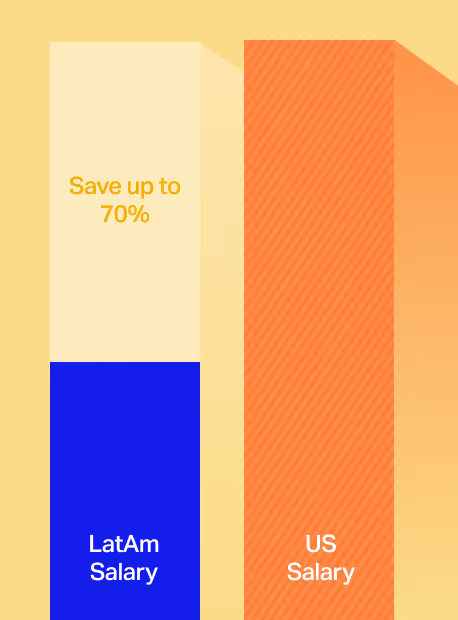
- For remote sales positions, consider expanding your search to Latin America, where many professionals have strong sales credentials, US business experience, and excellent English skills, while expecting compensation up to 70% lower than their US counterparts.
You need to hire sales talent, but you're staring at a blank generic job description template, knowing you need to post this sales role yesterday. But you also know that throwing together a generic "seeking rockstar sales ninja" post isn't going to cut it.
The problem goes deeper than just getting applicants. Poor job descriptions attract the wrong candidates—people who either lack the skills you need or have completely unrealistic salary expectations. Then you spend weeks interviewing candidates who aren't even close to what you're looking for.
Meanwhile, your sales targets keep climbing, your existing team is stretched thin, and every day without the right salesperson on board means missed opportunities and lost revenue.
This guide will walk you through creating a sales job description that speaks directly to serious sales talent, what sections matter most for attracting quality candidates, and common mistakes that drive away the salespeople you actually want to hire.
Why Job Descriptions Matter More Than You Think
Your sales job description isn't just a hiring formality—it's your first opportunity to filter candidates and demonstrate that you understand what good sales work actually looks like.
Here's what a strategic job description does for your sales hiring process:
Sets clear performance expectations
Top sales professionals want to know exactly what success looks like before they apply. Generic descriptions like "exceed sales targets" tell them nothing about your sales process, deal sizes, or realistic quota expectations.
When you're specific about performance metrics—"generate 50 qualified leads per month and maintain a 20% close rate"—you attract candidates who've actually achieved those numbers before.
Demonstrates your sales sophistication
How you describe the role signals how well you understand modern sales. If your job description mentions "making cold calls" but doesn't specify your CRM system, sales methodology, or lead generation process, experienced salespeople will assume you're stuck in the past.
Speeds up your hiring process
A clear job description helps ensure the people who apply can actually do the work, reducing the time you spend on interviews that go nowhere. When candidates can quickly assess whether they're a good fit for your sales environment and compensation structure, you get better quality applications.
What Makes a Great Job Description for Sales Roles?
The difference between good and great sales job descriptions comes down to specificity and understanding what actually motivates sales talent.
Performance-focused language
Great sales job descriptions emphasize outcomes over activities. Instead of "make sales calls," specify "conduct 30 qualification calls per week with inbound leads" or "source and develop 15 new prospects monthly through LinkedIn outreach."
Realistic commission structures
One of the biggest mistakes companies make is being vague about compensation or offering unrealistic earning potential. If you're advertising "unlimited earning potential" but your top performer made $80,000 last year, serious salespeople will see through it immediately.
Clear sales process details
Top sales professionals want to understand your sales methodology, average deal size, sales cycle length, and the tools they'll be using. This isn't just helpful information—it's essential for them to evaluate whether this opportunity aligns with their experience and career goals.
Honest representation of your sales environment
If you're a startup where priorities shift quickly and salespeople need to wear multiple hats, say that. If you're an established company with a structured sales process and dedicated support teams, mention that too. Misrepresenting your environment leads to early turnover when reality doesn't match expectations.

What to Include in a Sales Job Description
Here are the essential components that make sales job descriptions effective and attract the right candidates:
Job title
Your title needs to be both searchable and specific to the type of sales role you're filling. "Sales Representative," "Account Executive," "Business Development Representative," or "Sales Development Representative" work better than creative titles like "Revenue Ninja" or "Deal Closer."
If the role has specific focus areas, include those: "Inside Sales Representative," "Enterprise Account Executive," or "Outbound SDR." This helps qualified candidates find you while helping others self-select out.
Summary of the role
Think of this as your elevator pitch to potential sales candidates. In 2–3 sentences, capture what makes this sales opportunity compelling:
- What they'll be selling and to whom
- How they'll fit into your existing sales team
- What makes this opportunity different from other sales roles
For example: "Join our growing sales team to sell our project management software to mid-market companies. You'll own the full sales cycle from initial outreach through contract signing, working with warm inbound leads and developing your own prospect pipeline. This role is perfect for a hunter mentality salesperson who wants to build something meaningful while crushing quota."
This immediately tells candidates about the product, sales process, lead source, and sales culture.
Key responsibilities
Be specific about the actual work, not generic sales tasks.
Our recruiters find that candidates respond best when they can visualize their day-to-day activities and understand the sales process they'll be working within.
Good examples:
- Generate 40 qualified leads per month through a combination of inbound follow-up and outbound prospecting
- Conduct product demonstrations for 15–20 prospects weekly using our established demo methodology
- Manage a pipeline of 50–75 active opportunities using Salesforce CRM
- Collaborate with our marketing team to provide feedback on lead quality and campaign effectiveness
- Maintain accurate forecasting and provide weekly pipeline reviews to sales management
Avoid vague statements like "drive revenue growth" or "exceed sales targets." Be concrete about what they'll actually be doing on a daily and weekly basis.
Required skills and qualifications
This is where many companies go wrong by listing every possible sales skill they've ever heard of.
Focus on what's truly essential for success in the first 90 days.
Essential qualifications typically include:
- Specific years of B2B or B2C sales experience (be realistic about your expectations)
- Required CRM proficiency (Salesforce, HubSpot, Pipedrive, etc.)
- Industry experience if truly necessary for your product
- Proven track record of quota attainment (be specific about percentages)
According to our recruiters, "Sometimes transferable skills or specific industry knowledge can be easily taught. However, these are often overvalued by companies compared to more critical core skills."
Preferred qualifications
This is where you can mention nice-to-have skills that would help someone excel but aren't deal-breakers:
- Experience with additional sales tools in your stack
- Previous experience in your specific industry vertical
- Knowledge of particular sales methodologies (MEDDIC, Challenger Sale, etc.)
- Additional languages for international markets
Compensation structure
Sales professionals expect transparency about earning potential. Include both base salary and commission structure details:
- Base salary range with OTE (On-Target Earnings)
- Commission structure (percentage, tiered, accelerators)
- Typical ramp period before full quota expectations
- What top performers actually earned last year
For example: "Base salary: $45,000–$55,000 with OTE of $85,000–$95,000. Commission structure: 8% on first $500K annually, 12% on revenue above $500K. 90-day ramp period with reduced quota expectations."
Including salary information isn't just helpful—it's becoming legally required in many states and shows you're serious about transparency.
Plus, SHRM research shows that 61% of candidates expect salary ranges in job descriptions, and with 39% of recruitment challenges stemming from uncompetitive compensation, transparently communicating your total rewards package can significantly improve both application quality and quantity.
Territory and market details
Sales professionals want to understand their market opportunity:
- Geographic territory (if applicable)
- Target customer profile and company sizes
- Average deal size and typical sales cycle length
- Existing account base vs. new business expectations
- Market penetration and growth potential
Tools and sales stack
Give salespeople a clear picture of their daily toolkit:
- CRM platform and any required integrations
- Sales engagement tools (Outreach, SalesLoft, etc.)
- Lead generation and prospecting tools
- Demo and presentation platforms
- Any industry-specific software they'll need to learn
Location and work setup
Be explicit about where sales work gets done, especially since many sales roles can be performed remotely:
For on-site roles: Include the specific city and office location. Mention any flexibility for remote work during certain sales activities.
For hybrid roles: Specify expectations for in-office time, client meetings, and any travel requirements.
For remote roles: Clarify geographical restrictions, time zone requirements (e.g., within 2 hours of EST), and customer interaction expectations.
If you're open to hiring remote sales talent, consider expanding your search globally to access broader talent pools with competitive compensation expectations.
Team structure and sales process
Sales professionals want to understand how they'll collaborate and how deals get done:
- Sales team size and structure
- Reporting relationships and management style
- Lead generation process and marketing support
- Sales methodology and training provided
- How technical or implementation teams support the sales process
Growth and advancement opportunities
Top salespeople are motivated by career progression. Mention:
- Opportunities for territory expansion or account growth
- Career advancement paths (senior AE, sales management, etc.)
- Training and professional development support
- Performance-based promotion timeline
Common Mistakes to Avoid in Your Sales Job Descriptions
These pitfalls can significantly hurt your ability to attract quality sales talent:
Unrealistic performance expectations
Asking for "entry-level sales rep to generate $2M in new business" or "junior SDR with enterprise sales experience" signals that you don't understand sales roles or market realities.
Focus on expectations that match the experience level and compensation you're offering.
Vague compensation details
Statements like "competitive commission" or "unlimited earning potential" without specifics create suspicion among experienced salespeople. They want to see actual numbers, commission rates, and realistic OTE based on your current top performers.
Ignoring the importance of soft skills
While quota attainment is crucial, don't overlook the communication and relationship-building skills that make salespeople successful.
The ability to make 100+ calls a day isn't just about stamina—it's about mental resilience, comfort with rejection, and an inherent drive that some people naturally possess.
Our recruiters look for candidates who "aren't afraid to pick up the phone and make 500 calls a day—the kind of hustle that's impossible to teach but essential for sales success."
Focusing only on years of experience
Companies often overemphasize years in sales when what matters more is actual performance and coachability. A salesperson who's exceeded quota for two years is often more valuable than someone with five years of mediocre performance.
Limiting your search unnecessarily
If the role can be done remotely, restricting your candidate pool to one city or region significantly reduces your options.
Sales is increasingly location-independent, and opening up your search to offshore sales talent can dramatically increase your candidate pool while reducing hiring costs.
Many US companies are discovering that top Latin American sales professionals often have experience working with US companies, strong English communication skills, and competitive sales abilities—while having salary expectations significantly below US market rates.
Sales Job Description Template (Ready to Copy and Customize)
[Job Title - e.g., Account Executive, Sales Representative, SDR]
About us: [Company Name] is [brief description of company and what you do]. We're [current stage, e.g., growing rapidly, scaling our sales team, expanding into new markets] and need a [level of experience] sales professional to [specific goal, e.g., help us reach $XM in revenue, expand our customer base, break into enterprise market].
The role: We're looking for a [specific type of salesperson, e.g., consultative seller, hunter mentality, relationship builder] to [specific responsibility, e.g., own the full sales cycle, focus on outbound prospecting, manage enterprise accounts]. You'll work with [lead source, e.g., warm inbound leads, cold outbound prospects, existing customer base] while [additional responsibility, e.g., developing new territory, expanding existing accounts, building strategic partnerships]. This role is perfect for a [ideal candidate description] who wants to [opportunity/growth potential] in a [company culture/environment] environment.
What you'll do:
- [Specific responsibility with numbers, e.g., "Generate 25 qualified leads per month through targeted outbound prospecting"]
- [Specific responsibility with frequency, e.g., "Conduct 15–20 product demonstrations weekly using our established demo methodology"]
- [Pipeline management responsibility, e.g., "Manage a pipeline of 50–75 active opportunities using [CRM system]"]
- [Team collaboration responsibility, e.g., "Collaborate with our technical team to develop custom proposals for enterprise prospects"]
- [Reporting/forecasting responsibility, e.g., "Maintain accurate forecasting and provide weekly pipeline reviews to sales management"]
- [Additional 2–3 core responsibilities specific to your sales process]
What you'll need:
- [Years of experience] years of [type of sales, e.g., B2B/B2C, inside/outside, industry-specific] sales experience
- Proven track record of [specific achievement, e.g., quota attainment, deal sizes, etc.]
- Proficiency with [required tools, e.g., CRM system, sales engagement tools, etc.]
- Experience selling to [target audience, e.g., SMB, mid-market, enterprise, specific roles]
- [Any industry-specific requirements that are truly necessary]
Nice to have:
- Experience with [additional tools or methodologies that would be helpful]
- Previous experience in [your industry or adjacent industries]
- Knowledge of [specific sales methodology, e.g., MEDDIC, Challenger Sale]
- [Additional languages or certifications that would be beneficial]
Compensation & benefits:
- Base salary: $[X,000–Y,000] annually [based on experience/location]
- OTE: $[X,000–Y,000] [what top performer earned last year if impressive]
- Commission: [percentage/structure, e.g., "8% on all revenue with accelerators at 110% of quota"]
- [Ramp period details, e.g., "90-day ramp period with reduced quota expectations"]
- [Key benefits: health insurance, PTO, professional development budget, etc.]
Territory & market:
- [Geographic territory or vertical focus, e.g., "West Coast territory" or "Financial services vertical"]
- Target customers: [customer profile, e.g., "Mid-market companies ($50M–$500M revenue) in manufacturing"]
- [Deal size and cycle details, e.g., "Average deal size: $25K | Sales cycle: 3–4 months"]
- [Territory type, e.g., "Green field territory with high growth potential" or "Established territory with renewal and expansion opportunities"]
Sales stack:
- [CRM system, e.g., "Salesforce CRM with full pipeline management"]
- [Sales engagement tools, e.g., "Outreach for email sequences and call cadences"]
- [Other key tools, e.g., "Gong for call recording and analysis"]
- [Demo/presentation tools, e.g., "Zoom for product demonstrations"]
- [Any industry-specific tools they'll need to learn]
Location & schedule:
- [Remote/Hybrid/On-site] position
- [Time zone requirements, e.g., "Core hours: 9 AM – 5 PM EST for team collaboration"]
- [Travel requirements if any, e.g., "Quarterly business reviews require in-person attendance"]
- [Any specific schedule needs, e.g., "Some evening calls required for West Coast prospects"]
Growth opportunities:
- [Career advancement paths, e.g., "Clear path to Senior Account Executive with enterprise territory"]
- [Professional development, e.g., "$2,000 annual professional development budget"]
- [Leadership opportunities, e.g., "Opportunity to mentor new sales hires as we scale"]
- [Company growth story, e.g., "Join us as we scale from $5M to $50M ARR over the next 3 years"]
How to apply: Send your resume to [email/application link] and include:
- [Specific information you want, e.g., "Your quota attainment for the last two years"]
- [Example or case study request, e.g., "One example of your largest deal and how you closed it"]
- [Motivation question, e.g., "Why you're interested in selling [your product] to [your market]"]
Our hiring process includes: [Brief overview of your interview stages, e.g., "Initial call → Sales role-play → Final interview with sales leadership"]
[Timeline information, e.g., "We'll review applications on a rolling basis and aim to respond within 48 hours."]
Final Thoughts
A thoughtfully crafted sales job description does more than list requirements—it connects you with sales professionals who can truly drive revenue growth for your business.
But here's what we've learned from working with hundreds of companies: even the best job description won't solve the fundamental challenge most businesses face today. The US sales talent market is brutally competitive, and the candidates who can actually perform are either too expensive or already taken.
AvantStay's VP of Sales Jake Breuner, faced this exact problem. He was struggling with 80% of SDRs missing quota, six-month ramp times, and 33% attrition rates. US candidates wanted too much money, took forever to find, and didn't have the work ethic his team needed.
The solution wasn't better job descriptions—it was expanding his search beyond traditional boundaries.
Jake decided to try hiring from Latin America, despite initial concerns about quality and cultural fit. The results? His first hire, Simon, became a benchmark for the team and was eventually promoted to BD Manager. Jake went on to hire 10 more sales professionals from Latin America, added $20M in ARR, and cut his attrition rate from 70% to 20%.
As Jake put it: "Hiring from Latin was our backup plan, now it's our primary plan."
The reality is that top sales talent exists globally, not just in your local market. While you're competing with every other company for scarce US talent, there are experienced, hungry sales professionals in Latin America who have the skills you need, the work ethic you want, and salary expectations that actually fit your budget.
Top Latin American SDRs, account executives, and sales managers often have experience working with US companies, understand American business culture, and bring a level of dedication that's increasingly rare in the domestic market.
Before you post that job description and limit yourself to local hiring, consider this: you might be operating under assumptions that are costing you access to exceptional talent.
Ready to see exactly what's possible? Read AvantStay's full case study to discover how they built a high-performing sales team with Latin American talent—and why it became their primary hiring strategy.
Frequently Asked Questions
Should I outsource my sales roles or hire direct team members?
The choice between outsourcing and hiring direct team members depends on your business needs and timeline. If you need temporary support for specific campaigns, have short-term pipeline generation goals, or want to test new markets quickly, sales outsourcing can provide immediate access to experienced teams.
However, if you're building a sustainable sales engine with deep product knowledge and strong cultural alignment, hiring your own dedicated sales team often delivers better long-term results. Many companies find that hiring remote sales professionals from Latin America gives them the best of both worlds—dedicated team members at costs similar to outsourcing.
For a detailed comparison of top sales outsourcing providers and when outsourcing makes sense, see our guide to the best sales outsourcing companies.
Can I outsource my BDR and SDR roles instead of hiring?
Yes, outsourcing BDR and SDR roles is a common strategy for companies that need pipeline generation support without building an internal team. Outsourced SDRs typically handle top-of-funnel activities like cold outreach, lead qualification, and appointment setting, while outsourced BDRs focus on closing opportunities. This approach works well for short-term campaigns, market testing, or when you lack the bandwidth to recruit and train an in-house team.
However, outsourcing comes with trade-offs including less control over messaging, potential cultural misalignment, and often higher turnover rates. Many businesses find that hiring their own remote SDRs and BDRs from regions like Latin America provides similar cost benefits while maintaining better team continuity and brand consistency.
For a comprehensive breakdown of BDR and SDR outsourcing, including costs, benefits, and alternatives, read our guide to outsourcing BDR and SDR roles.
What other sales roles should I consider hiring from Latin America?
Beyond the sales roles covered in this guide, Hire With Near helps companies hire a full spectrum of sales professionals from Latin America.
Popular roles include SDRs for outbound prospecting and lead qualification, BDRs for business development and relationship building, account executives for closing deals and managing the full sales cycle, inbound sales representatives for handling warm leads and marketing-qualified prospects, outbound sales representatives for cold outreach and new market penetration, and sales managers for leading and developing your sales teams.
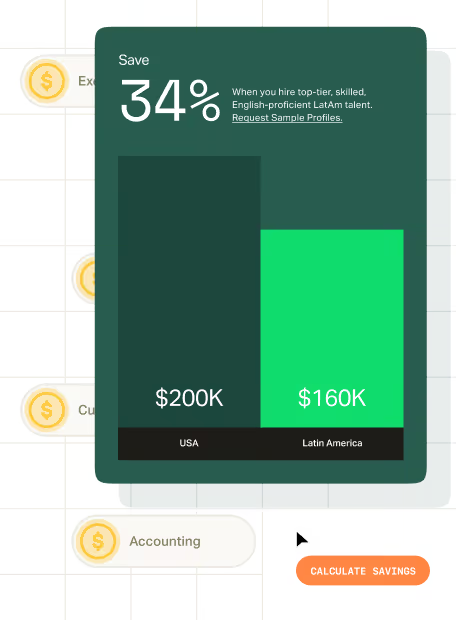
Each role comes with the same rigorous vetting process, cultural fit assessment, and 30-70% cost savings compared to US market rates while maintaining high performance standards.










%203.svg)
.avif)





%20(1).avif)

%20(1).png)