%203.svg)
Key Takeaways
- Finding the right sales rep requires balancing proven track records with adaptability—look for candidates with clear achievements and the ability to learn new industries quickly.
- You can save up to 68% on salary costs by hiring skilled sales representatives from Latin America while maintaining quality and getting better time zone compatibility than other offshore options.
- The best sales reps combine hard skills (prospecting, pipeline management, CRM proficiency) with essential soft skills (resilience, strong communication, strategic thinking) that separate top performers from average ones.
Every month without a solid sales rep means missed revenue targets and increased pressure from leadership to show results.
Maybe you’ve posted the same sales rep job three times in two months. But each hiring cycle drags on for weeks, eating into your team’s productivity as they cover additional territories.
This guide will show you how to find, evaluate, and hire sales representatives who actually deliver results. You’ll learn what skills truly matter, where to find proven performers, and how to structure offers that secure top talent—whether you’re hiring locally, nationally, or internationally.
What Does a Sales Rep Do?
A sales rep is your revenue engine—they identify prospects, build relationships, and close deals that drive your business forward.
“Sales rep” is a broad term, and depending on your company structure, it can mean slightly different things. In many organizations, “sales rep” refers to a full-cycle seller who owns the entire process from first contact to closed deal. In others, it’s used interchangeably with Account Executive (AE)—the closer who takes qualified leads from an SDR and drives revenue.
To make things more confusing, some companies lump all sales-facing roles under the “sales rep” umbrella, even if the day-to-day responsibilities are very different.
So here’s how to break it down clearly:
- Sales Development Reps (SDRs) focus on top-of-funnel activity. Their job is to prospect, qualify leads, and pass them to someone else to close.
- Sales Reps / Account Executives (AEs) handle the middle to bottom of the funnel. They run discovery calls, manage the pipeline, negotiate terms, and close the deal.
- In smaller teams, one person may do it all—and that’s typically who we’re referring to in this guide when we say “sales rep.”
The specific responsibilities can vary significantly based on your industry, sales cycle, and company size.
Typical responsibilities include:
- Prospecting and qualifying leads through cold calling, email outreach, and social selling
- Managing and nurturing relationships throughout the sales pipeline
- Conducting product demonstrations and presentations
- Negotiating contracts and closing deals
- Maintaining accurate records in CRM systems
- Collaborating with marketing and customer success teams to optimize the sales process
What separates effective sales reps from average ones isn’t just their ability to hit quotas—it’s their strategic approach to building relationships, understanding customer needs, and positioning your solution as the clear choice.
How Much Does It Cost to Hire a Sales Rep?
Sales representative compensation packages can quickly add up, especially when you factor in the variable commission structures that top performers expect.
Understanding the full picture helps you budget effectively and structure offers that attract the talent you need.
Understanding sales rep compensation structure
Most sales compensation combines base salary with commission, creating a total package that rewards performance. The typical structure includes:
- Base salary: The fixed annual amount that provides financial stability and covers basic living expenses. This is the guaranteed portion of compensation.
- Commission: Variable compensation based on performance metrics like closed deals, revenue generated, or quota achievement. Commission structures vary depending on your industry, deal size, and company goals.
It’s important to be transparent about how commissions are structured and what it takes to earn them.
In the US, here’s what you can expect for base salaries (before commission):
- Junior Sales Rep (0-2 years): $36,000 – $56,000
- Mid-Level Sales Rep (2-5 years): $56,000 – $62,000
- Senior Sales Rep (5+ years): $62,000 – $72,000
These ranges can vary significantly based on industry, company size, and geographic location within the US. Remember that total compensation will be higher once you add commission earnings.
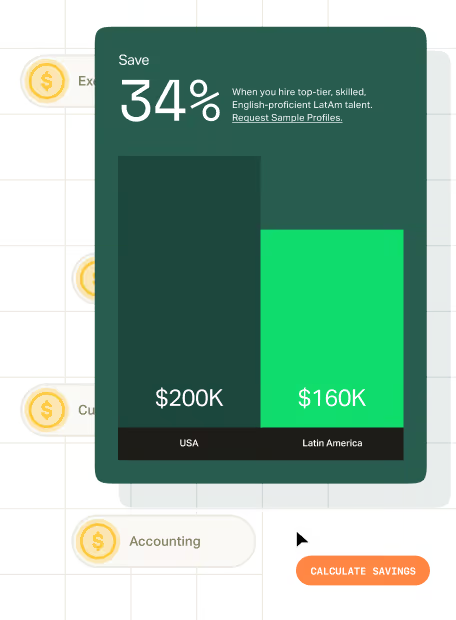
If those numbers feel out of reach, by expanding your search to Latin America, you can access the same caliber of sales talent for significantly less while getting better time zone compatibility than other offshore options. The time zone alignment means no loss in the ability to hop on calls during standard US business hours.
Here’s the cost comparison for base salaries:
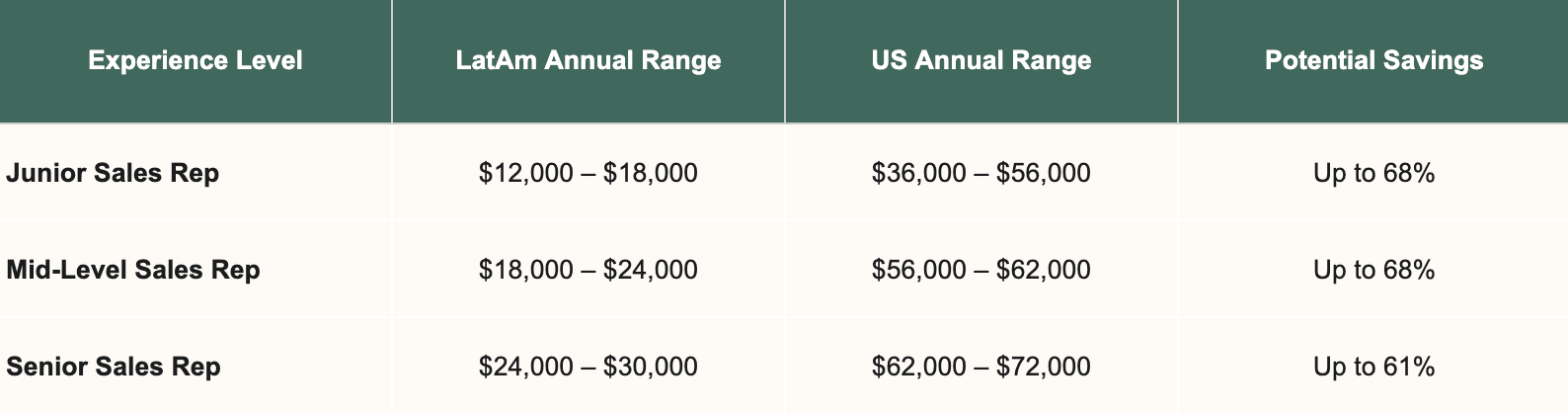
These savings reflect different costs of living, not differences in talent quality or dedication. Many Latin American sales professionals have extensive experience working with US companies and understand American business culture and expectations.
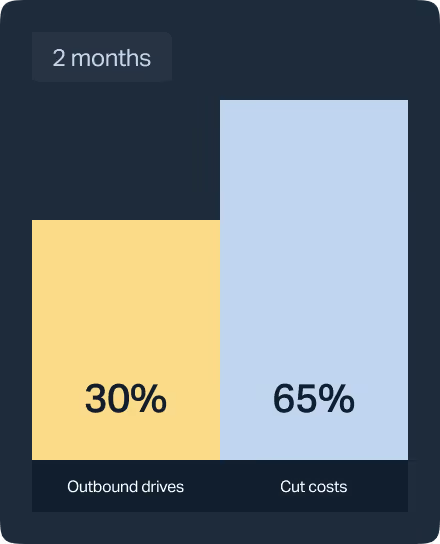
For example, AvantStay’s VP of Sales achieved a 65% cost reduction by hiring Latin American sales professionals while adding $20 million in ARR. He used a compensation structure that balanced competitive base salaries with performance-based commissions, creating a win-win situation that attracted top talent while delivering substantial cost savings.
You can download the compensation plan structure he used to design your own sales rep compensation package.
{{banner}}
What Skills Should You Look for When Hiring a Sales Rep?
Evaluating sales rep skills isn’t a one-size-fits-all approach—it depends heavily on the seniority level you’re targeting.
A junior sales rep might excel at executing established processes and handling routine prospecting activities, but need guidance on complex deal negotiations and strategic account planning.
Meanwhile, a senior sales rep should be able to independently manage entire sales territories, mentor junior team members, and contribute to strategic sales planning initiatives.
Understanding these distinctions helps you evaluate candidates fairly and set realistic expectations for performance. For example, expecting a junior rep to immediately close complex enterprise deals or develop comprehensive territory strategies sets everyone up for frustration. Similarly, hiring a senior rep for tasks that primarily involve basic lead qualification and data entry wastes both their potential and your budget.
The key is matching the right skill level to your specific needs while providing appropriate growth opportunities. Here’s how sales rep skills typically progress across experience levels:

Regardless of seniority level, all sales reps should demonstrate certain fundamental capabilities. Here are the core skills to evaluate:
Hard skills (the must-haves)
The foundation of any successful sales rep includes:
- Prospecting and lead generation: Unless someone else on the team is handling this, they should demonstrate proficiency in cold calling, email outreach, LinkedIn prospecting, and other lead generation methods. Look for candidates who can articulate their approach to building prospect lists and initiating meaningful conversations.
- CRM management: Modern sales requires disciplined pipeline management. Candidates should be comfortable with basic CRM systems like Salesforce, HubSpot, or Pipedrive, and understand how to track activities, update deal stages, and maintain accurate records. This skill is increasingly important as 91% of businesses with 11+ employees use CRM software.
- Communication and presentation skills: The ability to clearly communicate value propositions, conduct product demonstrations, and present solutions to prospects is essential at all levels.
- Basic negotiation abilities: While complexity varies by seniority, all sales reps should understand fundamental negotiation principles and be able to handle standard pricing discussions and contract terms.
- Product knowledge acquisition: The ability to quickly learn and understand your products, services, and industry is crucial for effective selling across all experience levels.
Soft skills (equally important)
The technical skills get them in the door, but soft skills determine their long-term success:
- Resilience and persistence: Sales involves constant rejection. The best reps bounce back quickly, learn from losses, and maintain motivation despite setbacks. In our experience matching hundreds of candidates in this field, we’ve found that resilience is often what separates top performers from those who burn out quickly.
- Communication and listening skills: Effective sales reps ask thoughtful questions, listen actively to responses, and communicate value propositions clearly. They should be able to adapt their communication style to different personality types and business cultures.
- Strategic thinking: Great sales reps think beyond individual deals. They understand market dynamics, competitive positioning, and how to build long-term customer relationships that drive repeat business and referrals.
- Accountability and self-management: Sales reps often work independently and need strong self-discipline to maintain consistent activity levels, meet deadlines, and take ownership of their results.
- Cultural fit and adaptability: Especially important for international hires, candidates should demonstrate the ability to work effectively with diverse teams and adapt to different business environments.
According to our recruiters, the best sales reps aren’t just skilled—they’re energized by what they do:
"People who are passionate about sales, who light up when they talk about it, and who genuinely enjoy connecting with others tend to outpeform"
This kind of energy is contagious—and often a key indicator of long-term success.
Nice-to-have skills (the differentiators)
These skills can give candidates an edge, especially in competitive markets:
- Industry-specific experience: While not always essential, candidates with experience in your industry or with similar customer segments can accelerate their ramp-up time and bring valuable market insights.
- Multi-language capabilities: For companies serving diverse markets, bilingual sales reps can expand your reach and provide better service to non-English speaking customers.
- Technology proficiency: Familiarity with sales automation tools, video conferencing platforms, and productivity apps can improve efficiency and effectiveness.
- Leadership potential: For growing companies, hiring sales reps who can eventually manage teams or train new hires provides additional long-term value.
Where Can You Find and Hire Great Sales Reps?
The key to finding exceptional sales talent is knowing where to look and how to evaluate candidates effectively. Your success depends on choosing the right sourcing strategy for your specific needs, timeline, and budget.
Deciding between local, national, or global talent
Each approach offers distinct advantages depending on your business requirements:
- Local/in-office hiring works well when you need face-to-face collaboration, have complex products requiring extensive training, or serve customers who prefer in-person meetings. However, you’ll face higher costs and a limited talent pool, especially in competitive US markets.
- Remote US-based hiring expands your options significantly while maintaining familiar business practices and time zone alignment. You’ll pay US-level compensation but gain access to talent across the entire country.
- International/offshore hiring offers the largest talent pool and most significant cost savings. In particular, Latin America provides an excellent balance of skilled professionals, time zone compatibility, and cultural alignment with US business practices.
Look for candidates who’ve worked with US clients or English-speaking markets—in our experience, this usually means they can communicate fluently, understand expectations better, and will onboard faster.
If you are considering building a remote sales team, explore the 21 best countries to hire sales talent to better understand the talent landscape across different regions.
Choosing the right sourcing channel
Once you’ve decided where to look for talent, the next step is choosing how to find qualified candidates.
Different sourcing methods work better for different types of sales roles, and understanding these differences can save you significant time and improve your candidate quality.
The key is matching your sourcing approach to your specific hiring needs, timeline, and budget.
Here’s how the most common channels stack up for hiring sales talent:

Job boards like Indeed and LinkedIn work well when you have time to screen candidates and want to cast a wide net.
They’re particularly effective for entry-level to mid-level sales roles, but you need to be prepared to sift through hundreds of applications.
LinkedIn’s advanced search filters let you target candidates with specific industry experience or company backgrounds.
Employee referrals deserve special attention—45% of referred candidates are likely to stay longer than four years with a company compared to 25% for job board hires. Your existing sales team likely knows other talented reps from previous companies or industry connections.
For companies looking to hire Latin American sales reps, specialized recruitment partners can provide access to pre-vetted candidates who’ve already been screened for English proficiency, cultural fit, and sales performance.
How to Hire the Best Sales Rep: Best Practices
Finding the right sales rep requires a systematic approach that evaluates both immediate skills and long-term potential.
Stage 1: Before and during sourcing
Define your true priorities beyond the job description
Many companies create unrealistic “unicorn” profiles that combine multiple specializations. Instead, focus on the 3-4 most critical skills for your specific situation.
Are you looking for someone who can build territory from scratch, or someone who can optimize an existing pipeline?
Craft job descriptions that attract the right candidates
Include specific details about your sales process, target market, and what success looks like in the first 90 days. Including salary ranges can increase your application rate by 64% according to SHRM, as 68% of candidates now expect to see compensation information in job postings.
For more detailed guidance, check out our guide to writing job descriptions for sales roles.
Set realistic compensation expectations
Research market rates for your industry and the experience level you are looking for.
A strong commission structure is key. According to our recruiters, top performers want to know they’ll be rewarded for meeting—and exceeding—targets.
Consider total compensation packages, not just base salary, especially in competitive markets.
Stage 2: Screening and evaluation
Look beyond the resume for measurable achievements
The best candidates have clear, measurable achievements on their resumes—they’ve exceeded targets, brought in big accounts, or led growth initiatives.
They also usually show strong business acumen, not just sales tactics.
Ask for specific examples of deals they’ve closed, quotas they’ve exceeded, and challenges they’ve overcome.
Use role-playing exercises to assess real-world skills
A cold calling simulation or roleplay with a mock client can be very effective for evaluating how candidates handle objections, build rapport, and guide conversations toward desired outcomes. This reveals much more about their abilities than hypothetical questions. AI sales roleplay tools can help here by using realistic roleplays to evaluate candidates based on real performance rather than theoretical responses.
Evaluate cultural fit and remote readiness
For international hires, assess their experience working with US companies, English proficiency, and ability to work during standard US business hours.
Look for candidates who demonstrate self-motivation, clear communication, and professional accountability.
Stage 3: Making the offer and closing the deal
Move quickly once you’ve identified the right candidate
Some companies take too long to make decisions and lose top candidates. In competitive markets, delays often mean losing your preferred choice to faster-moving competitors.
Structure offers that appeal to high performers
Beyond base salary and commission structure, consider professional development opportunities, and career growth paths. Top sales reps are motivated by earning potential and advancement opportunities, not just job security.
Set clear expectations for onboarding and early success
Outline the first 30, 60, and 90 days, including training timeline, initial territory or account assignments, and performance benchmarks. This clarity helps new hires succeed and reduces early turnover.
Top Interview Questions for Hiring Sales Reps
The right interview questions can reveal whether a candidate has the mindset, skills, and track record to succeed in your specific sales environment.
Here are proven questions that go beyond surface-level responses.
“Tell me about your biggest sales achievement and what made it successful.”
This question reveals how candidates define success and their role in achieving it. Listen for specific metrics, the complexity of the deal, and their strategic approach. Strong candidates will mention not just the outcome but the process they used, obstacles they overcame, and how they built relationships to close the deal.
“Walk me through your typical sales process from initial contact to close.”
You’re evaluating their methodology and organizational skills. Look for candidates who can articulate a clear, logical sequence of steps, explain how they qualify prospects, and describe their approach to handling objections.
This reveals whether they’re strategic or just reactive in their sales approach.
“Describe a time when you had to sell to a skeptical or difficult prospect.”
This question tests resilience, problem-solving, and interpersonal skills.
The best answers will show how they diagnosed the root cause of skepticism, adapted their approach, and maintained professionalism throughout the process.
Red flags include candidates who blame prospects or become defensive when facing resistance.
“How do you handle rejection and maintain motivation during tough periods?”
Sales involves constant rejection, so psychological resilience is crucial.
Look for candidates who have specific strategies for bouncing back, learning from losses, and maintaining consistent activity levels.
“What questions do you ask to understand a prospect’s real needs?”
This reveals their consultative selling skills and whether they lead with curiosity rather than just pitching.
Strong candidates will have a repertoire of discovery questions that help them understand business challenges, decision-making processes, and success criteria.
Avoid candidates who focus primarily on product features without understanding customer context.
{{state-latam-hiring}}
Common Mistakes to Avoid When Hiring Sales Reps
Hiring the right sales rep is important. The stakes are particularly high given that, according to the Harvard Business Review, “Estimates of annual turnover among US salespeople run as high as 27%—twice the rate in the overall labor force.”
Even experienced hiring managers make costly errors when recruiting sales talent. Here are the most frequent mistakes and how to avoid them:
1. Focusing too heavily on industry experience
According to our recruiters, while industry knowledge can be valuable, many companies overemphasize industry-specific experience when what really matters is adaptability and core sales skills.
A strong sales rep with experience in a different industry can often outperform someone with industry experience but weaker fundamental skills.
2. Ignoring soft skills and cultural fit
Technical sales skills are easier to teach than personality traits like resilience, hustle, integrity, and collaboration. Don’t hire someone who fits your technical requirements but lacks the soft skills to work effectively with your team or handle the inevitable challenges of sales work.
3. Rushing the hiring process or making decisions too slowly
Both extremes cause problems. Rushing leads to poor hires who don’t fit your culture or performance expectations. But taking too long means losing top candidates to competitors who move faster. Find the right balance between thorough evaluation and timely decision-making.
4. Underestimating the importance of onboarding
Many companies focus heavily on hiring but provide minimal onboarding support.
Sales reps need to understand your product, market, sales process, and internal systems to be effective.
Companies with strong onboarding programs see 82% improvement in new hire retention and 70% increase in productivity. Inadequate onboarding leads to longer ramp-up times and higher turnover, with new sales reps typically taking 6+ months to become fully productive.
5. Setting unrealistic expectations or quotas
Be honest about typical performance timelines and quotas.
Setting unrealistic expectations leads to frustration and turnover.
Consider your sales cycle length, market conditions, and support resources when establishing performance benchmarks for new hires.
6. Overlooking red flags in interviews
Watch for candidates who describe sales as just “pushing” or “insisting” rather than thinking strategically or building value. That mindset usually doesn’t lead to long-term success.
Also be cautious of candidates who can’t provide specific examples of achievements or who blame external factors for past failures.
7. Focusing only on the numbers
According to our recruiters, one of the biggest mistakes companies make is obsessing over KPIs while ignoring soft skills:
“Soft skills are often more important than metrics alone—especially in client-facing roles where relationship-building is key.”
Why Working With a Recruiting Partner Makes a Difference
You can absolutely hire great sales reps on your own—many companies do it successfully.
But if you’re facing time constraints, struggling to find qualified candidates, or considering hiring internationally, a specialized sales staffing or recruiting company can accelerate your success.
This is especially valuable when hiring sales talent from Latin America or other offshore regions, where you’ll need to navigate different job markets, salary expectations, and cultural considerations.
A recruiting partner with experience in offshore hiring for sales positions can help you:
- Access pre-vetted candidates who’ve already been screened for English proficiency, sales performance, and cultural fit
- Understand local market conditions and compensation standards
- Handle international compliance and contracting requirements
- Provide guidance on structuring competitive offers that attract top talent
Working with a recruitment partner also provides access to passive candidates who aren’t actively job searching but might be interested in the right opportunity. These candidates often represent the highest quality talent in the market.
See how one sales-as-a-service company hired a high-velocity consumer sales rep through Hire With Near, at up to 80% below the cost of a comparable US hire.
Final Thoughts
The right sales rep becomes a revenue-generating asset who understands your market, builds genuine relationships with prospects, and consistently delivers results that drive business growth.
But finding that person requires looking beyond impressive resumes to assess how they think, communicate, and execute under pressure. Whether you need someone to build territory from scratch, optimize existing pipelines, or expand into new markets, investing in the right sales talent pays dividends across your entire revenue strategy.
If working with a recruitment partner seems like the right approach, consider a specialized firm that can make the hiring process seamless, efficient, and stress-free.
At Near, we understand that every sales role is unique, and we take the time to understand your specific requirements, company culture, and growth objectives. We then match you with pre-vetted Latin American sales representatives who have proven track records, excellent English skills, and experience working with US companies.
Our candidates work during your business hours, integrate seamlessly with your existing teams, and deliver exceptional results at rates up to 68% lower than US-based sales reps.
Ready to find a sales rep who can drive real revenue growth while fitting your budget? Book a free consultation call with our team today, and we’ll help you find the perfect match within 21 days.
Frequently Asked Questions About Hiring Sales Reps
What’s the difference between hiring an Inbound vs. Outbound Sales Rep?
Inbound sales reps handle leads that come to you—through your website, ads, referrals, or marketing campaigns. Their focus is on qualifying and converting warm prospects who’ve already shown interest.
Outbound sales reps, on the other hand, proactively reach out to cold prospects. They identify potential customers, craft personalized outreach, and open new conversations from scratch.
Should I hire one or two sales reps initially?
If you’re hiring your first sales reps, consider starting with two rather than one.
Hiring two allows you to A/B test different approaches, creates healthy competition, and prevents the isolation that can lead to early turnover.
You’ll also learn faster about what works in your specific market and sales process. While it requires a larger upfront investment, two reps typically generate more revenue than one and provide valuable insights about your ideal candidate profile for future hires.
What are the key performance indicators I should track for new sales reps?
Monitor both activity and outcome metrics during the first 90 days.
Key activity metrics include calls made, emails sent, meetings scheduled, and pipeline creation. Outcome metrics include conversion rates, deal velocity, and quota attainment.
Most reps need 3-6 months to fully ramp up, so focus on leading indicators early: Are they building pipeline? Are they following your sales process? Are they coachable? Set realistic expectations—expecting immediate quota attainment often leads to premature termination of potentially great hires.
What's the difference between hiring a sales rep and an appointment setter?
While both roles support your sales efforts, they serve different purposes in your sales funnel. A sales rep typically handles the full sales cycle—from initial prospecting through closing deals—and focuses on building relationships, conducting discovery calls, and negotiating contracts. They're usually compensated with base salary plus commission based on closed revenue.
An appointment setter specializes in the top of the funnel, focusing on qualifying prospects, scheduling meetings, and passing warm leads to your sales team through high-volume outreach activities like cold calling and email campaigns.
If you're looking to build strong top-of-funnel lead generation, check out our guide on how to hire appointment setters for detailed insights on finding these specialized professionals.







.webp)


%203.svg)
.avif)






%20(1).avif)

%20(1).png)