.avif)


%203.svg)
Key Takeaways
- Remote sales reps are as effective as in-house teams, giving your business access to top talent, reduced costs, and the flexibility to scale globally.
- Key skills to prioritize when hiring remote sales reps include strong communication, time management, problem-solving skills.
- A well-structured hiring process, or partnering with a recruitment agency, ensures you attract high-performing sales reps ready to drive results from day one.
Gone are the days when sales teams needed to be in the same office—or even the same country—to deliver results.
Today, remote sales teams are not just a practical option but a highly effective way to drive sales with the same efficiency as an in-house team.
Remote sales reps can drive sales from virtually any corner of the globe with an internet connection.
With tools like videoconferencing and sales management software, they can seamlessly connect with clients worldwide, offering businesses cost savings, flexibility, and access to a broader talent pool.
In this article, we'll discuss how to hire remote sales team members, including the skills to look for. We’ll also cover the benefits of having a remote sales team and provide strategies to tackle common obstacles you might encounter.
Whether starting from scratch or expanding your existing team, our guide will equip you with actionable strategies for finding the right talent.
What Is a Remote Sales Representative?
A remote sales representative manages the entire sales cycle from outside a traditional office, using technology to connect with prospects, nurture relationships, and close deals from anywhere with reliable internet.
Using phone, email, video calls, and sales management software, remote sales reps can effectively reach potential clients, maintain relationships with existing customers, and close sales from virtually any location.
Their flexible work arrangements allow them to serve customers in different time zones and regions without needing physical travel or in-person sales meetings.
Generally, these reps are broken into two categories:
Inbound sales representatives
As their title suggests, inbound sales reps handle incoming sales inquiries. Their job is often centered around managing leads that come through the company’s marketing channels, such as:
- Website inquiries
- Live chat messages
- Phone calls
- Responses to email campaigns
Inbound sales reps must be skilled at quickly establishing a rapport, assessing customer needs, and providing detailed product or service information.
Outbound sales representatives
Outbound remote sales reps, on the other hand, generate sales proactively. They reach potential customers through cold calls, emails, or social media. Their approach is often more aggressive and focused on volume, as they are tasked with expanding the company’s customer base by identifying and contacting new leads.
Outbound sales representatives require resilience, excellent communication skills, and a strategic approach to personalize their sales pitch to the specific needs and interests of each prospect. Their success is often measured by the number of new customers they can bring.
Further reading: How to Compete with Bigger Budgets When You Can’t Afford US Sales Salaries
Why Should You Hire Remote Sales Reps?
Hiring remote sales reps is a trend for a reason—it’s a smart move that brings serious benefits.
Here’s why businesses are leaning into remote sales:
Expanded talent base
Forget geographical limits. Considering remote sales reps lets you cast a wider net, giving you access to more top-tier talent than confining your search to your local area.
This diversity also brings fresh perspectives and innovative approaches to how you connect with customers and close deals.
The best SDRs aren't always in your backyard. They're in Colombia, Mexico, and Argentina—professionals with the grit, hustle, and raw sales instincts you can't teach. These aren't people looking to coast. They want to prove themselves, and that hunger translates directly into performance.
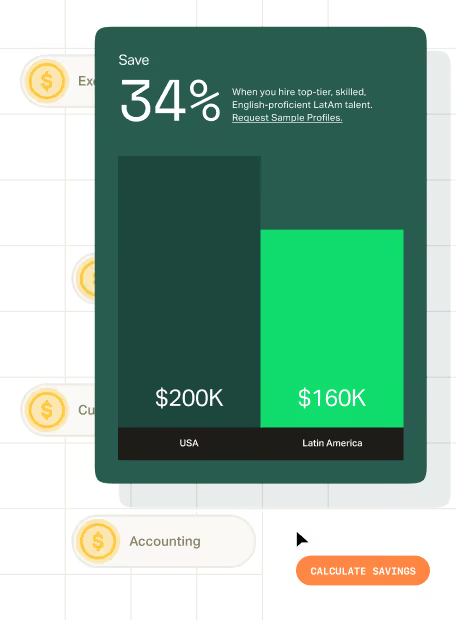
According to Near's State of LatAm Hiring Report, which analyzed over 1,000 placements, companies save an average of $35,000 to $64,000 annually by hiring LatAm sales reps. Sales roles consistently rank among the top departments companies fill internationally, with SDRs and BDRs remaining the most commonly placed positions for the second year in a row.
Cost savings (without compromising on quality)
No office space equals lower overhead costs.
Remote reps save you big on expenses while delivering the same high performance you’d expect from an in-house team.
And if you’re hiring from outside the US, like Latin America or Asia, you’ll benefit from additional costs savings while maintaining exceptional quality. This is because sales reps from regions like Latin America (LatAm) have lower salary expectations than their US-based counterparts.
For instance, junior sales reps in Latin America typically earn $12,000 to $18,000 annually compared to $36,000 to $58,000 in the US. That's up to 68% in savings—not just for entry-level roles, but across mid and senior sales positions too.
Eco-friendly
Remote sales work is inherently more sustainable, as working from home reduces carbon emissions from commuting and travel.
By employing remote sales reps, you can contribute to corporate social responsibility goals and resonate with environmentally conscious customers.
Proven results with LatAm sales talent
Consider AvantStay, a premier short-term rental company. Their VP of Sales, Jake Breuner, was struggling with 80% of SDRs missing quota, 6-month ramp times, and 33% attrition rates. US candidates demanded too much money and lacked the work ethic his team needed.
- After hiring 10 sales professionals from Latin America through Near, AvantStay:
- Added $20M in ARR within 12 months
- Reduced new hire ramp time from 6 months to 2 months
- Cut attrition rate from 70% to 20%
- Achieved 65% cost savings compared to US hires
Jake's first hire, Simon, became such a benchmark that he was promoted to BD Manager.
Read the complete AvantStay case study to see exactly how they built a sales team that drives real revenue growth.
{{banner}}
Challenges of Hiring Remote Sales Reps
Building a remote sales team comes with incredible advantages, but it’s not without its hurdles.
From finding self-motivated candidates to navigating cultural differences, remote hiring presents unique challenges that require thoughtful solutions.
Addressing these obstacles head-on ensures your remote team is not only effective but also seamlessly integrated into your business.
Here are some common difficulties (and suggestions for overcoming them):
Identifying self-motivated candidates
Remote sales roles require high self-motivation, discipline, and accountability. It can be difficult to keep reps productive without the traditional office environment and direct oversight.
During the hiring process, look for candidates who demonstrate a strong history of autonomy. Use behavioral interview questions to assess how they've managed their time and stayed productive in past roles.
When vetting LatAm sales candidates, we specifically screen for professionals who aren't afraid to pick up the phone and make 100+ calls a day if that’s what’s needed. You can teach product knowledge. The right SDRs don't just show up to the job—they show up to win.
Communication and cultural fit
In distributed teams, clear communication becomes more important than ever. Cultural misalignments can lead to misunderstandings or poor team cohesion.
Prioritize candidates with strong communication skills, and consider their compatibility with your company culture.
One of the biggest concerns we hear: "Will prospects notice they're not in the US?" The answer is no—if you hire the right people.
LatAm sales professionals speak fluent English, understand US business practices, and can handle objections and build relationships just like your best US hires. Cultural fit isn't about location. It's about work ethic, hunger, and the ability to own a conversation.
For insights on how accents affect sales performance, watch this Near video.
Onboarding and training
Training and integrating new remote sales reps can be challenging without the ability to interact face-to-face.
To overcome this, create a structured onboarding process that includes clear documentation, virtual training sessions, and regular check-ins.
Pair new hires with a mentor or team lead to provide guidance and support during their first weeks, helping them quickly adapt to your tools, processes, and expectations.
Key Skills To Look For When Hiring For a Remote Sales Team
When hiring remote sales reps to assemble your team, you’ll want to focus on the right skills and qualifications for success.
Here’s what to prioritize in candidates:
- Strong communication skills: Look for candidates who excel in written and verbal communication and can convey complex ideas simply and effectively.
Clear communication is crucial when working remotely to ensure alignment across teams and with clients. - Good time management: The ability to work autonomously with minimal supervision is essential to productivity and success in a remote setting.
Candidates should be able to organize their schedules and consistently meet deadlines without constant oversight. - High technological proficiency: Candidates should be adept with various technologies, including customer relationship management (CRM) systems, videoconferencing tools, and sales enablement platforms.
Proficiency with these tools ensures seamless collaboration and better sales outcomes. - Clear problem-solving abilities: Remote sales reps often face unexpected challenges, such as navigating client objections, adapting to new tools, or handling technical issues during virtual calls.
Look for candidates who demonstrate critical thinking and creativity in resolving these challenges effectively, ensuring they can maintain momentum and close deals even in complex situations. - Strong relationship-building skills: Sales is ultimately about building and maintaining trust with clients.
Your team needs reps who can engage prospects and foster strong connections without the advantage of in-person face-to-face interactions.
Additionally, the usual desirable qualities like resilience, attention to detail, and relevant experience will be critical to success. Prioritizing these skills along with those above ensures you build a team capable of delivering results in a remote environment.
While this isn’t a “skill,” another important factor to consider when hiring remote sales reps is their location.
While you might look for reps from any of the countries known for sales rep talent, time zones can play a significant role in the success of your sales strategy.
For some companies, hiring reps in faraway countries can be advantageous, especially if you want coverage outside of typical US working hours to serve international clients or manage follow-ups overnight.
On the other hand, if your goal is to have reps who can work seamlessly within US working hours, hiring sales professionals in Latin America can be a smart choice.
Sales reps and SDRs in Latin America offer overlapping working hours, allowing for real-time collaboration and more efficient communication. This approach ensures you can leverage the benefits of remote work without sacrificing alignment with your team and clients.

9 Steps For Hiring Remote Sales Representatives Successfully
Building a high-performing remote sales team requires a structured approach to ensure you find the right talent and set them up for success.
From defining the role to onboarding, each step in the hiring process plays a crucial role in building a team that can deliver results from anywhere in the world.
Whether you’re starting fresh or looking for additional reps to scale an existing team, these nine steps will guide you through hiring remote sales reps effectively and efficiently.
1. Define the role and requirements
Begin by crafting a detailed sales job description that outlines the responsibilities, necessary skills, qualifications, and experience in sales required for the role.
Highlight the remote nature of the position and specify details like expected working hours, tools, and experience. For instance, if you need reps who can work US hours, this should be explicit in your job description.
2. Create an ideal candidate profile
Use the skills and qualities outlined earlier—like strong communication, time management, and problem-solving abilities—as the foundation for your ideal candidate profile.
Consider the specific traits that align with your company’s needs and culture, such as the ability to work in certain time zones or experience with your industry’s sales processes.
This tailored profile will guide your recruitment efforts and help you identify the best fit for your team.
3. Decide if you want to work with a recruitment agency
Make a decision whether you will source candidates on your own or get some help.
For a more targeted and headache-free approach, consider outsourcing your recruitment process to a recruitment agency that specializes in sourcing remote sales professionals.
Recruitment and staffing agencies that specialize in finding sales talent, like Near, know how to surface top candidates quickly. For example, Near can help you expedite the search process by presenting you with pre-vetted professionals who match your criteria and company culture within 5 days—effectively removing the need for you to undertake steps 4 to 6 below. (Plus, better agencies will help you with every step listed—at least we do.)
4. Promote the position
If you’re handling recruitment in-house, advertise the open role on job boards, social media, industry forums, and your company’s careers page.
Emphasize the benefits of working for your organization and the unique opportunities of the role.
5. Actively source candidates
Don’t wait for applications to roll in—be proactive.
Use LinkedIn, networking events, and employee referrals to find candidates who meet your criteria.
Personal outreach can go a long way in engaging high-quality candidates who may not be actively job hunting.
6. Screen and assess candidates
Use a structured process to screen candidates, starting with their resumes and moving to virtual interviews.
Assess their skills in remote collaboration tools, their ability to self-manage, and their cultural fit with the rest of the sales team (make sure to include the sales manager in this process).
Behavioral interview questions are particularly effective for gauging qualities like resilience and communication.
7. Test their skills with a mock project
Provide candidates with a practical test, such as creating a sales pitch or conducting a mock sales call.
This helps you evaluate their sales abilities, problem-solving skills, approach to virtual client interactions, and adaptability to your sales process.
8. Finalize the hire and set up contracts
Once you’ve chosen the right candidate, it’s time to finalize the hire.
Draft and sign a clear contract that outlines expectations, responsibilities, and terms of employment.
For international hires, consider how you’ll manage payments and compliance with local labor laws. Platforms like Deel can simplify international payroll and ensure smooth transactions—or some recruitment agencies, like us, will handle this for you.
This step sets the foundation for a professional and legally secure working relationship.
9. Make a decision and onboard
Once you’ve selected your new hire, set them up for success with a structured onboarding process.
This should include an introduction to your company’s tools, sales processes, and goals.
Pair them with a mentor or assign a point of contact to ensure they feel supported as they settle into their role.
{{prevetted-banner}}
Final Thoughts
Building a remote sales team opens up real opportunities: access to top talent, cost efficiency, and the flexibility to scale without the typical hiring headaches.
The strategy works. Companies are doing it successfully every day.
But here's what makes the difference between a remote sales team that delivers and one that doesn't: hiring the right people.
When you hire remotely—especially from regions like Latin America—your budget suddenly goes further. You can afford to hire A-players with proven track records instead of settling for entry-level reps who need six months to ramp up. You're not just saving money; you're upgrading the quality of your team.
The challenge is finding that talent. Not just someone who can do the job, but someone with the grit, communication skills, and sales instincts that actually drive results.
That's where working with a partner who knows how to identify and vet that talent makes all the difference. They've already done the hard work of building relationships in these markets, understanding which skills translate to US sales success, and screening for the qualities that predict performance.
Want to understand more about what hiring LatAm sales talent actually looks like?
Read our guide: "Do LatAm Sales Reps Have Accents? and Other Questions Sales Leaders Ask" to get straight answers about accent concerns, team dynamics, compensation, and what actually matters when building a remote sales team.
Or schedule a free, no-commitment consultation call to find out how Near can help you hire top pre-vetted sales reps in Latin America.
Frequently Asked Questions
How much does it cost to hire LatAm sales reps?
Base salary expectations vary by experience level, but all represent significant savings compared to US rates:
- Junior sales rep (0-2 years): $12,000 – $18,000 annually (vs. $36,000 – $56,000 in the US)
- Mid-Level sales rep (2-5 years): $18,000 – $24,000 annually (vs. $56,000 – $62,000 in the US)
- Senior sales rep (5+ years): $24,000 – $30,000 annually (vs. $62,000 – $72,000 in the US)
These figures represent base salaries before commission structures. You're looking at up to 68% cost savings without sacrificing talent quality.
The key is offering competitive compensation for the local market while still achieving meaningful savings for your business. Companies that try to save 70%+ typically struggle with retention, while those aiming for 30–60% savings build stable, high-performing teams.
How do I handle time zones with a distributed team?
This is why hiring Latin America is such an advantage—from Mexico to Argentina, you're working with teams in US time zones or just 1-2 hours off. No midnight calls, no day-long email delays.
Hire With Near’s report on the top reasons US companies hire in Latin America shows that 26% of companies are looking to hire sales talent in Latin America. This is primarily due to the cost savings, of course, but also because of the time zone alignment with the US.
Should I hire directly or use a staffing agency?
Depends on your resources and timeline. Direct hiring gives more control but requires significant time and expertise in international hiring. Agencies like Hire With Near provide pre-vetted candidates and handle compliance, getting you quality hires in days versus months.
Learn more about working with top sales staffing and recruiting agencies for hiring LatAm sales reps.
What if I want to outsource the entire sales function?
Full outsourcing can accelerate growth, especially for new market entry or rapid scaling. Leading sales outsourcing companies provide complete teams, management, and infrastructure. This works particularly well for B2B sales outsourcing where specialized expertise matters. Learn more about hiring outsourced sales reps.
How do I manage remote sales teams effectively?
Success comes from structure: daily standups, weekly 1:1s, clear KPIs, and robust communication protocols. Consider outsourcing sales management if you lack remote management experience. The right partner brings proven playbooks and leadership.
What other sales roles should I consider hiring?
Beyond remote sales reps, many companies benefit from hiring additional sales roles that complement their outbound and inbound teams:
- Account Executives handle the full sales cycle, from discovery to close, and are crucial for complex B2B deals.
- Account Managers focus on retention, upsells, and relationship management with existing clients.
- Sales Managers lead your team, set strategy, and coach reps to hit their numbers.
- Appointment setters specialize in booking meetings, helping AEs stay focused on closing.
Building a complete sales organization in LatAm gives you the flexibility to scale faster without breaking the budget.







.webp)


%203.svg)
.avif)






%20(1).avif)

%20(1).png)