


%203.svg)
Key Takeaways:
- Outsourced sales reps are third-party professionals who handle sales activities for multiple clients, ideal for short-term projects, market testing, or filling immediate gaps without long-term hiring commitments.
- Finding the right outsourced sales rep requires defining specific needs, screening for sales skills through mock calls, checking references obsessively, and starting with 90-day pilots before committing long-term.
- Building your own dedicated remote sales team often outperforms traditional outsourcing for long-term needs, delivering full control, cultural integration, and team continuity at similar or lower costs than outsourcing.
Your sales pipeline is stalling while you spend another 3 months trying to hire. Empty seats mean lost revenue. You need people prospecting, qualifying, and closing deals—not job postings that go unfilled.
Sound familiar?
Many companies turn to outsourced sales reps to fill the gap quickly. Instead of hiring internally, they contract with third-party professionals, agencies, or freelancers who can start generating pipeline immediately.
It's a fast solution. But is it the right one?
In this guide, we'll show you exactly what outsourced sales reps do, when they make sense, how to find the right fit, and what alternative approaches you should consider before committing.
What Is an Outsourced Sales Representative?
An outsourced sales representative is a professional from a third-party organization, freelance platform, or independent contractor who handles sales activities on your behalf.
Unlike internal hires who work exclusively for you, outsourced reps typically work with multiple clients. They might be part of a sales outsourcing company, work as independent fractional sales professionals, or connect through platforms like Upwork.
These reps can handle various parts of your sales process:
- Full sales cycle management (prospecting through close)
- Lead generation and qualification
- Cold calling and appointment setting
- Following up with inbound leads
- Demo delivery and product presentations
- Specific campaign execution
The key difference from hiring a full-time sales rep: they're not your employees. You're contracting their services, usually through monthly retainers, per-lead fees, or performance-based arrangements.
What Are the Advantages of Hiring Outsourced Sales Reps?
Outsourced sales reps solve immediate capacity problems without long-term commitments.
When you need sales coverage quickly and don't want to navigate 6-month hiring cycles, outsourcing can get you operational fast.
Speed and immediate deployment
Outsourced sales reps can start working within days or weeks. General or specialist B2B sales outsourcing firms already have trained professionals ready to deploy. Freelance reps can onboard quickly. You skip recruitment, interviews, and the usual hiring delays.
If you're launching a new product, testing a market, or facing sudden growth, this speed matters. Getting reps making calls this month beats waiting until next quarter for internal hires.
Lower upfront costs and financial risk
You avoid the overhead of full-time salaries, benefits, office space, and training budgets. Instead, you pay for the sales services you need when you need them.
Traditional outsourcing models charge monthly retainers (often ranging from $3,000 to $12,000, depending on the scope) or performance-based fees tied to the number of meetings booked or deals closed. You can scale up during peak seasons and scale back when things slow down.
Specialized expertise without building it internally
Sales outsourcing firms often bring deep experience in specific sales methodologies, verticals, or go-to-market motions. If you need expertise in complex enterprise sales or high-velocity inside sales, specialized outsourced reps may execute better than generalist hires.
They also come with their own tools, playbooks, and proven processes. You get their accumulated knowledge without developing it yourself.
Flexibility to test and adjust
Outsourced arrangements let you test different sales approaches without long-term commitments. If a campaign or market doesn't work, you can adjust quickly. If results aren't there, you can end the relationship and try something else.
This flexibility is valuable when you're experimenting with new ICPs, testing messaging, or entering unfamiliar markets.

When Should I Hire an Outsourced Sales Rep?
Not every situation calls for sales outsourcing. But certain scenarios make it a smart strategic move.
Before diving into the practical steps of hiring an outsourced sales representative, it’s crucial to identify the scenarios that signal the need for such a strategic move.
You need immediate sales capacity
Your internal team can't keep up with inbound leads. Territories are sitting empty. You need people making calls this month, not in Q3.
Outsourced reps can plug gaps immediately while you figure out long-term hiring strategy.
You're testing a new market or product
Before committing to full-time hires in a new vertical or geography, outsourced reps let you validate demand and refine your approach. If the test succeeds, you can build an internal team. If it doesn't, you haven't made expensive long-term commitments.
You lack in-house sales expertise
If your team doesn't have experience with specific sales motions—like high-touch enterprise sales or high-velocity cold calling—outsourced specialists can execute while you learn what works.
This is especially common for technical founders or product-led companies building their first real sales function.
You need short-term project support
Launching a campaign, attending a major conference, or running a limited-time promotion? Outsourced reps can handle surge capacity without permanently expanding headcount.
Once the project ends, so does the expense.
You're rapidly scaling and can't hire fast enough
If you're growing faster than your HR and recruiting teams can source talent, outsourced reps can maintain momentum. They're not a permanent solution, but they prevent growth from stalling while you build internal teams.
Further reading: How to Compete with Bigger Budgets When You Can’t Afford US Sales Salaries
The Trade-Offs: What You Give Up With Outsourced Sales Reps
Outsourcing solves immediate problems. But it comes with limitations that affect long-term results.
Limited control and visibility
When you outsource sales, you lose day-to-day oversight. You can't sit in on every call, coach in real-time, or adjust approach on the fly. Outsourced reps follow their processes, not necessarily yours.
This distance can create blind spots. You see results but miss the details that would help you improve.
Cultural misalignment and brand representation
Third-party reps work for multiple clients. They can't internalize your company culture or represent your brand the way dedicated employees can. When they're on calls, prospects don't know the difference—but the lack of deep company knowledge shows.
If your sale requires consultative selling, industry expertise, or authentic passion for your product, outsourced reps struggle to deliver.
Shared focus across multiple clients
Outsourced BDRs, SDRs, or sales reps aren't exclusively committed to your success. They're balancing your account with others. When they have quota pressure from multiple clients, your pipeline competes for their attention.
This split focus often means lower urgency and less initiative compared to dedicated team members.
Higher turnover and inconsistency
Sales outsourcing firms experience high rep turnover. The person making calls this quarter might be gone next quarter. Freelance reps move between clients constantly. This churn hurts relationship continuity and institutional knowledge.
Every time reps change, you restart the learning curve.
Potentially higher long-term costs
While outsourcing seems cheaper initially, sustained use often costs more than building your own sales team. Monthly retainers add up. Performance fees compound. Over 12 to 18 months, you might spend as much as hiring internally—without gaining dedicated team members.
7 Steps to Finding the Right Outsourced Sales Representative
If you decide outsourcing makes sense for your situation, choosing the right partner determines whether you get results or waste money.
1. Define exactly what you need
Get specific before you start searching:
- Which part of the sales process needs coverage? (prospecting, demos, closing?)
- What selling motion fits your product? (transactional, consultative, enterprise?)
- What industry knowledge matters?
- What sales volumes do you need? (calls per day, meetings per week, deals per month?)
- What language skills or geographic coverage is required?
Vague requirements lead to poor matches. Precise requirements help you evaluate fit accurately.
2. Set a realistic budget
Understand typical pricing models:
- Monthly retainers: $3,000–$12,000+ depending on scope and provider location
- Per-lead fees: $50–$500+ per qualified lead delivered
- Performance-based: Commission on closed deals (often 10–30% of deal value)
- Hybrid models: Base retainer plus performance incentives
Factor in onboarding costs, CRM access, and any platform fees. Build buffer for unanticipated expenses.
Compare these costs against building your own team before committing long-term.
3. Research providers, agencies, and freelancers
Look across multiple channels:
- Sales outsourcing firms: Established agencies with full teams
- Fractional sales platforms: Networks of independent sales professionals
- Freelance marketplaces: Upwork, Fiverr, specialized sales platforms
- Industry referrals: Ask peers who they've worked with successfully
Check reviews, case studies, and track records. Look for providers experienced in your industry or with similar sales motions.
4. Evaluate proposals carefully
When comparing options, assess:
- Relevant experience: Have they sold similar products or services successfully?
- Process and methodology: Do their approach and playbooks align with your needs?
- Communication style: Do they understand your business and ask smart questions?
- Reporting and visibility: What metrics will you see and how often?
- References and results: Can they provide verifiable examples of success?
Red flags include vague promises, "top 1%" claims without proof, or unwillingness to share references.
5. Conduct thorough interviews
Don't just talk to account managers. Interview the actual reps who'll work your account if possible.
Test their sales skills:
- Have them explain how they'd approach your ICP
- Run a mock cold call scenario
- Ask how they handle specific objections
- Discuss their experience with your industry or sales motion
You want evidence of real sales capability, not just smooth presentations.
6. Check references obsessively
Talk to at least 3 previous or current clients. Ask:
- What results did they deliver? (Be specific: meetings booked, pipeline generated, deals closed?)
- How was communication and responsiveness?
- Did they follow processes or need constant management?
- What didn't work well?
- Would you use them again?
References reveal what proposals hide.
7. Start with a pilot and build from there
Don't commit to year-long contracts immediately. Start with a 90-day pilot with clear success metrics.
Define what "success" looks like:
- Specific activity levels (calls made, emails sent, conversations held)
- Quality metrics (meeting show rates, lead qualification accuracy)
- Pipeline impact (opportunities created, deal value influenced)
If the pilot works, expand. If it doesn't, you've limited your risk.

How to Successfully Work With Outsourced Sales Reps
Hiring outsourced reps is only step one. How you manage the relationship determines results.
Set crystal-clear expectations from day one
Provide detailed documentation:
- Your ideal customer profile and buyer personas
- Common objections and recommended responses
- Your unique value proposition and key differentiators
- Qualification criteria (what makes a lead worth pursuing?)
- Sales process stages and handoff points
Ambiguity creates poor results. Clarity creates alignment.
Establish consistent communication rhythms
Don't just wait for weekly reports. Set up:
- Daily check-ins (10 minutes max) to review activity and blockers
- Weekly pipeline reviews to assess quality and progress
- Monthly strategy sessions to refine approach
Outsourced reps need feedback loops to improve. Create them.
Integrate them with your tools and systems
Give them appropriate access to:
- Your CRM for logging activities and tracking pipeline
- Sales enablement materials and updated decks
- Communication tools (Slack, Teams) for real-time questions
- Meeting scheduling software
The easier you make it for them to work effectively, the better results they'll deliver.
Monitor performance with the right metrics
Track both activity and outcome metrics:
- Activity: Calls made, emails sent, LinkedIn connections, conversations held
- Quality: Meeting show rates, lead-to-opportunity conversion, deal velocity
- Results: Pipeline generated, opportunities created, revenue influenced
If activity is high but quality is low, address approach. If both are low, you might have the wrong partner.
Provide ongoing feedback and coaching
Even outsourced reps benefit from coaching. Listen to calls, review emails, and share specific feedback on what's working and what needs adjustment.
The more you invest in making them better, the better results you'll get.
Common Challenges with Outsourced Sales Reps (And How to Solve Them)
Every company hits similar obstacles. The difference between success and failure is addressing them quickly.
Quality inconsistency across different reps
Problem: Outsourced firms rotate reps. Quality varies wildly between individuals.
Solution: Request specific reps if certain ones perform well. Build contractual minimums for acceptable performance. Don't tolerate consistent underperformance.
Lack of deep product knowledge
Problem: Outsourced reps can't develop the same product expertise as internal teams.
Solution: Record detailed product training. Create objection-handling guides. Schedule regular Q&A sessions. For complex products, consider whether outsourcing fits at all.
Misalignment with your company culture
Problem: Third-party reps don't internalize your values, voice, or approach.
Solution: Share customer stories, company updates, and team wins regularly. Include outsourced reps in appropriate company communications. Make them feel connected even if they're not employees.
Difficulty scaling quality as you add volume
Problem: What works with 2 outsourced reps falls apart with 10.
Solution: Document everything that works. Create playbooks, scripts, and training materials. Insist on structured onboarding for new reps added to your account.
Hidden costs that add up over time
Problem: Retainers plus performance fees plus platform costs exceed initial estimates.
Solution: Calculate total cost of ownership before committing. Compare against building your own team. Consider whether 12 months of outsourcing costs more than hiring dedicated reps.
Alternative Approach: Building Your Own Dedicated Sales Team in Latin America
Here's what many companies discover after trying outsourcing: there's a better way to get cost savings without sacrificing control.
Traditional thinking says you have two choices:
- Expensive US hires with full control
- “Cheaper” outsourced reps with limited control
But there's a third option: build your own dedicated sales team with professionals from Latin America.
Why this often outperforms traditional outsourcing
When you build your own sales team in Latin America, you get both cost savings AND dedicated team members who work exclusively for you.
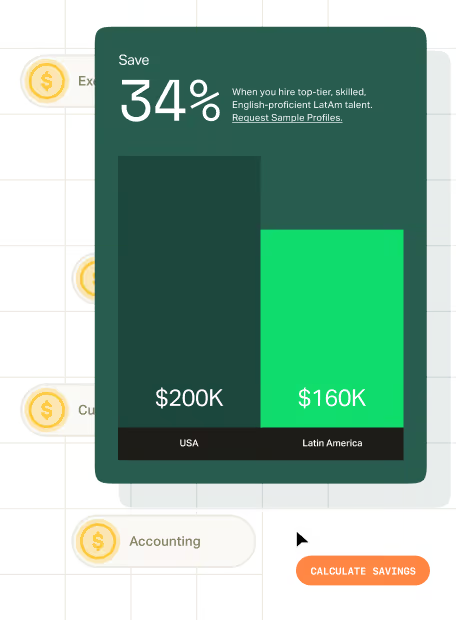
According to Near's State of LatAm Hiring Report, which analyzed over 1,000 placements, sales roles represent 18.9% of all Latin American hires by US companies—making it one of the most commonly filled departments. Companies consistently save $35,000 to $64,000 annually per LatAm hire compared to US equivalents, and 84% of these placements are mid-level or senior professionals who bring real experience.
Consider what AvantStay's VP of Sales, Jake Breuner, discovered. He needed to add $20M in ARR but faced the same problems most sales leaders hit:
- US candidates wanted too much money
- 80% of SDRs missed quota consistently
- 6+ month ramp times for new hires
- 33% attrition rate within first 4 months
Jake decided to try hiring Latin American sales professionals through Near.
The results:
- Added $20M in ARR within 12 months
- Reduced ramp time from 6 months to 2 months
- Cut attrition from 70% to 20%
- Achieved 65% cost savings compared to US hires
- All hires placed in under 26 days
His first hire, Simon, became such a top performer that he was promoted to BD Manager within 7 months and now manages a team of 10.
"Hiring from Latin America was our backup plan, now it's our primary plan," Jake said.
{{banner}}
The key differences that matter when you build your own sales team
- Dedicated team vs. shared resources: Outsourced reps split focus across multiple clients. When you hire dedicated inbound sales reps, or outbound sales reps, they work exclusively on your pipeline, your customers, your goals.
- Cultural integration vs. arm's-length relationship: Dedicated team members internalize your culture, values, and approach. They become real extensions of your company, not vendors you manage.
- Long-term commitment vs. transactional arrangements: Your own hires grow with your business, get promoted, become mentors for new team members. Outsourced reps move between clients constantly.
- Full control vs. limited visibility: You run daily standups, listen to calls live, coach in real-time, and adjust strategy immediately. With outsourcing, you wait for weekly reports and hope things are working.
When building your own team makes more sense
Consider building a dedicated remote team instead of outsourcing when:
- You need long-term sales capacity, not just short-term project support
- Your sale requires deep product knowledge and consultative selling
- Cultural fit and brand representation matter to your buyers
- You want to develop and promote top performers over time
- You plan to scale your sales organization significantly
- Control over processes, coaching, and strategy is critical
Why Latin America specifically?
- Time zone alignment: Latin American sales professionals work during US business hours. Real-time collaboration without anyone working odd shifts.
- Cultural fit: LatAm business culture aligns closely with US expectations around urgency, communication style, and sales approaches.
- English proficiency: Top LatAm sales professionals speak fluent English with neutral accents. Your prospects won't know or care where they're based.
- Hunger and work ethic: LatAm sales reps bring the grit, hustle, and resilience that's increasingly hard to find in the US market. They're not afraid to make 150+ calls a day if that’s what’s needed.
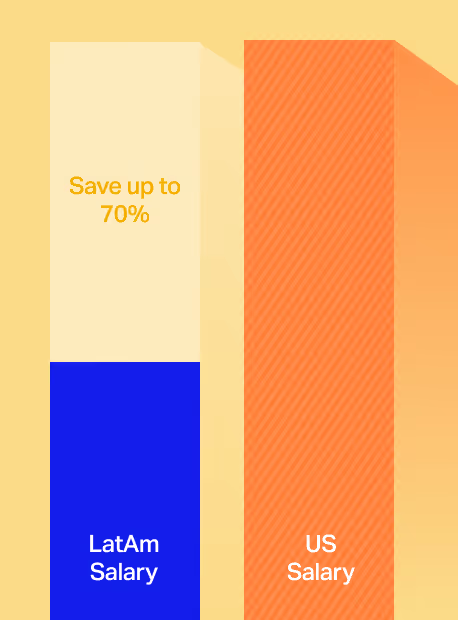
- Cost efficiency: $24K–$30K base comp delivers the same quality as $70K+ US hires. That's 30–60% savings without quality tradeoffs.
See our guide on the best countries to find top remote sales talent to see which LatAm countries to consider.
{{prevetted-banner}}
Final Thoughts
Outsourced sales reps solve immediate capacity problems. They get you operational fast without long hiring cycles. For short-term projects, market testing, or filling gaps while you hire internally, outsourcing can make sense.
But if you need sustainable, long-term sales capacity with full control and cultural alignment, building your own dedicated team often delivers better results.
The question isn't just "Can I save money by outsourcing?" It's "What approach sets up my sales organization for long-term success?"
Many companies start with outsourcing, experience its limitations, then build dedicated teams. You can skip that learning curve by considering both options upfront.
If you're ready to explore building your own high-performing sales team with Latin American professionals, read our guide on what sales leaders want to know about hiring from LatAm. It addresses common concerns about accents, work ethic, cultural fit, and what results you can actually expect.
Or schedule a free consultation to discuss how Near can help you hire top pre-vetted sales reps in Latin America.
Frequently Asked Questions
What's the difference between outsourced sales and building my own remote team?
Outsourced sales means contracting third-party professionals who work for multiple clients. Building your own team means hiring dedicated professionals who work exclusively for you—they're your employees, just based in a different location.
The key differences: control, cultural integration, commitment, and long-term cost. Dedicated teams usually outperform outsourced arrangements for ongoing sales needs.
When does outsourcing sales make sense?
Outsourcing works best for:
- Short-term projects or campaigns
- Testing new markets before full commitment
- Filling immediate gaps while you hire internally
- Accessing specialized expertise you don't have in-house
- Surge capacity for specific events or launches
For long-term sales capacity, building dedicated teams usually delivers better results.
Should I outsource sales or hire from Latin America?
If you need short-term support (3-6 months) or project-specific help, outsourcing might work.
If you need long-term sales capacity with full control, cultural integration, and team members who grow with your business, building a dedicated sales team in Latin America usually delivers better results at similar or lower costs.
Further reading: Hire Top LatAm Sales Reps by Partnering With These 10 Best Companies
What other sales roles should I consider hiring in Latin America?
Beyond sales representatives, US companies successfully hire SDRs, BDRs, account executives, and sales managers from Latin America. Each role brings specific value: SDRs and BDRs excel at high-volume outbound prospecting and qualification, account executives handle full sales cycles and complex deals, while sales managers bring leadership experience to build and scale your entire sales function. Most companies start with one role, see strong results, then expand to build complete sales teams.







.webp)


%203.svg)
.avif)





%20(1).avif)

%20(1).png)