


%203.svg)
Key Takeaways
- Among the best countries to hire remote sales talent, Latin America leads for US companies: LatAm professionals work the same hours as your buyers, and companies save $35,000–$64,000 per hire per year compared to US equivalents.
- Sales is the second-largest department US companies hire for in Latin America, with BDR and SDR roles topping placement data for two consecutive years and Colombia, Brazil, and Mexico as the top three source countries.
- Sales is a synchronous function: Time zone overlap isn't a nice-to-have, it's a structural requirement. Offshore setups with 10–14 hour gaps create pipeline friction that nearshore LatAm hiring eliminates.
For US companies, the best countries to hire remote sales talent are in Latin America. Colombia, Brazil, and Mexico lead on working-hours overlap, cost savings of 30–70% versus domestic equivalents, and placement volume, with business development representative and sales development representative roles topping Near's 2026 State of LatAm Hiring Report for the second year running.
Remote sales talent, as used in this guide, means full-time professionals who work for your company from another country, during your business hours, on your CRM and sales pipeline. They carry quota, join team calls, and function as integrated members of your revenue organization.
If you're looking for the best countries to hire remote sales talent, this guide covers 21 countries organized by region (Latin America, Europe, Asia-Pacific, and Other) so you can compare options efficiently.
Why Should You Hire Sales Talent Based in Other Countries?
Hiring sales talent internationally gives you a larger candidate pool, significant cost savings compared with US rates, and access to professionals with working-hours alignment and market knowledge that domestic hiring can’t always provide.
Here are the main reasons you should hire remote talent abroad:
More candidates
Hiring internationally opens your business up to a wider range of candidates. According to ManpowerGroup, 72% of US employers report struggling to find the skills they need domestically.
Looking abroad expands your options and brings access to professionals with diverse backgrounds, specialized skills, and direct experience in local business norms and buyer behavior.
Cost efficiency
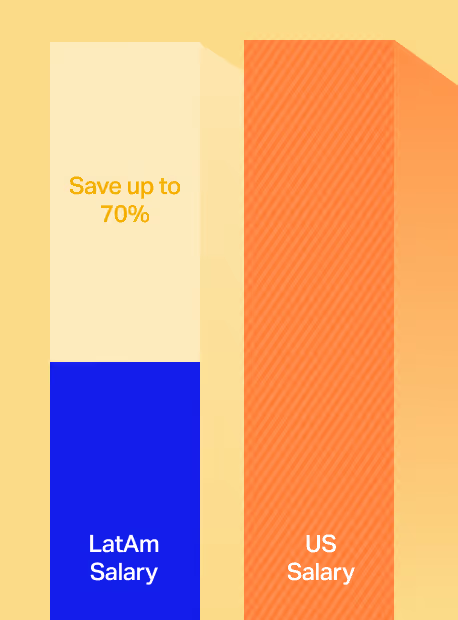
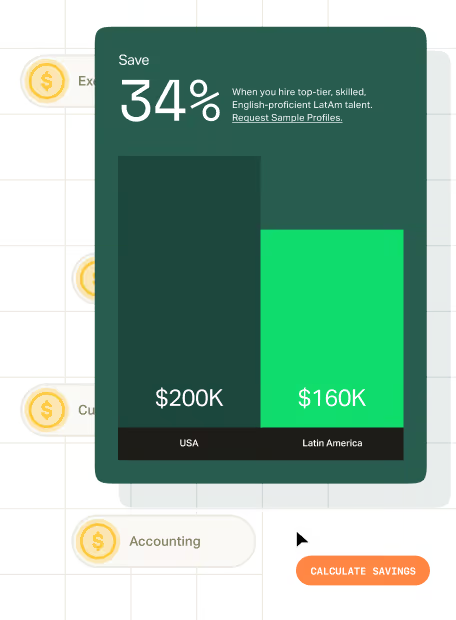
One of the most immediate advantages is more competitive labor costs. The savings vary significantly by region: Companies hiring sales talent from Latin America typically save $35,000–$64,000 per hire per year compared to US equivalents, according to Near's 2026 State of LatAm Hiring Report.
Eastern Europe and Southeast Asia also offer meaningful cost advantages over US hiring. The trade-off is time zone: Eastern Europe runs 6–9 hours ahead of US Eastern time, and Southeast Asia 11–13 hours ahead, which limits same-day collaboration for roles that require real-time interaction.
{{state-latam-hiring}}
Local market knowledge
Team members native to your target market bring insider knowledge of local business practices, cultural nuances, and consumer behavior that you can't replicate from outside that market. They know how decisions get made, what objections are common, and which communication styles build trust with local buyers.
Since sales is built on relationships, this kind of contextual knowledge can directly improve conversion and retention in ways that even the best training can't substitute.
Networking potential
An international sales force can also open doors to new markets before you've built a local presence. These professionals bring existing relationships with buyers, partners, and industry contacts that would take years to develop from scratch.
Their local networks can provide valuable connections, referral opportunities, and channels for market intelligence that you might not otherwise have access to or that would cost significantly more to build through traditional market entry strategies.
Agility
When you're not limited by geography, scaling your sales team up or down becomes a more agile process. You can hire as demand increases or scale back when necessary, without the constraints of hiring and laying off domestic staff.
{{hiring-remotely}}
What Qualities Should You Look for When Hiring Remote Sales Talent?
The strongest remote sales candidates combine core sales skills with the self-direction, communication clarity, and cultural adaptability that make remote work succeed.
Remote sales professionals need a blend of traditional sales skills and attributes that suit a remote working environment. Here's what to look for:
Self-motivation
Sales is a results-driven field, and remote work requires self-starters. Look for job seekers with a history of creativity who can prove their ability to set and achieve goals without direct supervision.
Communication
Sales runs on communication. Candidates need to be able to clearly and persuasively convey messages, listen actively, and build relationships quickly. For remote sales hires specifically, this matters even more: Without the ability to read a room in person, strong verbal and written communication is what keeps deals moving and relationships warm.
Tech savvy
Remote sales professionals need to be comfortable working across the tools your team already uses: Customer relationship management (CRM) software, videoconferencing, sequencing platforms, instant messaging, and other digital tools.
Emotional intelligence
Being emotionally intelligent allows sales professionals to connect with clients more deeply, understand their concerns, and handle negotiations with empathy and tact. These skills matter even more in a remote setting where face-to-face interactions are limited.
Cultural fit
Remote workers may not be in the office, but they still have to integrate into your company culture. They should align with company values and contribute positively to team dynamics, even from a distance.
Lucia Atensia, Sales Recruiter at Near, describes what she consistently sees in LatAm candidates:
LatAm sales professionals are highly adaptable and familiar with international business practices. A lot of our candidates have already been working with US clients. They know the business, they know European and US markets. That makes them much easier to integrate into global teams. They also tend to have a strong work ethic and resilience, which is crucial in fast-paced, target-driven environments.
Ready to find candidates who match these qualities? Browse Near's pre-vetted sales candidates and receive a shortlist within 3-5 days.
21 Best Countries To Hire Remote Sales Talent
The 21 best countries to hire remote sales talent are organized by region to make comparison easier. Latin America comes first: It is the recommended starting point for most US companies due to working-hours overlap, cost savings, and a deep pool of professionals already experienced with US clients.
Europe follows for companies expanding into EU markets, and Asia-Pacific and Other regions round out the list for those with specific global needs.
Latin America
Latin America offers the strongest overall fit for US companies hiring remote sales talent. Most LatAm countries share or fall within one to three hours of US Eastern, Central, or Pacific time, meaning your sales reps work the same hours as your buyers.
And based on our experience, cost savings range from 30% to 70% compared to US-based equivalents.

1. Colombia
Colombia is Near's top destination for remote sales talent in Latin America. Its workforce is well known for warmth, strong customer orientation, and high adaptability to US business norms. Geographic and cultural ties to both North and South America make Colombian professionals effective in both inbound and outbound sales roles.
Time zones span UTC-5, with full overlap with US Eastern and Central hours. Companies hiring in Colombia typically save 65-75% compared to US equivalents for BDR and SDR roles.
2. Argentina
Argentina boasts a highly educated remote workforce with a strong command of both Spanish and English, making it a strategic choice for US businesses targeting a Spanish-speaking market or operating bilingually.
Argentine professionals are recognized for technical depth, analytical thinking, and strong performance in consultative and enterprise sales roles.
Near's placement data shows Argentina represents 21% of all nearshore placements, with strength in finance, marketing, and operations, and a growing share of sales placements.
Time zones run UTC-3, meaning Argentine teams overlap with US Eastern afternoons and US Pacific mornings, making real-time collaboration fully achievable for most US sales operations.
3. Brazil
Brazil's large and diverse population offers a vast pool of remote talent, representing 14% of Near's placements, with notable strength in IT, engineering, marketing, and tech sales roles.
Brazilian professionals often bring a charismatic, relationship-driven approach that transfers well into B2B and tech sales. The country's economic diversity has produced professionals with experience across commodities, technology, SaaS, and enterprise sectors.
For companies selling into or across Latin America, Brazilian professionals bring language range (Portuguese plus strong Spanish in many cases) and regional market knowledge that is difficult to replicate. Time zones are UTC-3, with strong overlap with US East Coast hours.

4. Mexico
Mexico is a prime nearshoring location for US companies due to its geographic proximity, cultural affinity, and overlapping time zones. Its large, dynamic workforce and strong educational system create a solid base for technical sales personnel, especially in the automotive, manufacturing, and software industries.
Mexico represents 9% of Near's placements, with top departments including accounting, finance, and operations, and a growing sales segment. Time zones range from UTC-6 to UTC-8, covering Central and Pacific alignment with the US.
5. Chile
Chile's stable economy and government investment in technology infrastructure have made it one of the most reliable remote work markets in South America. According to WIPO's 2025 Global Innovation Index, Chile ranks first in Latin America, reflecting the country's strength in digital infrastructure, institutional stability, and university-industry collaboration.
Chilean sales professionals are known for their strong work ethic, professional communication style, and comfort with structured sales processes.
The country is a strong fit for companies that need structured, process-oriented sales professionals with experience navigating enterprise or government procurement cycles in Latin America.
Chile's time zone runs UTC-4 (UTC-3 in summer), providing solid overlap with US Eastern and Central hours.
6. Costa Rica
Costa Rica has become a valuable source of remote sales talent, thanks in part to its political stability and sustained investment in education and technology infrastructure.
Its relatively small talent pool means it is best suited for companies hiring one to three sales roles rather than building large teams.
For these positions, the country offers high-quality candidates who are accustomed to working with US clients and comfortable in a direct-hire, remote model.
The country is particularly appealing for US companies given its close time zones (UTC-6, aligned with US Central time) and a growing bilingual professional class.
7. Uruguay
Uruguay might be small, but it's a well-regarded market for remote sales talent. The country is notable for its stable economy, high literacy rate, and strong investment in education and technology.
Progressive laws supporting international business and flexible remote work arrangements make Uruguay a reliable environment for direct-hire employment.
Uruguay runs on UTC-3 (UTC-2 in summer), with strong overlap with US Eastern hours. Its workforce is smaller than Colombia or Brazil, but the quality of talent is consistently high, particularly for companies seeking senior or consultative sales profiles with strong technical backgrounds.
See what that math looked like in practice: an auto repair chain's service advisors got their phones-off-their-plate moment in just 9 days.
Related reading: How US Companies Hire in Uruguay: High English Proficiency, Deep Tech Talent

8. Peru
Peru's reputation as a remote talent source has steadily improved thanks to a skilled, cost-effective workforce. Peruvian sales professionals are often familiar with industries like mining, agriculture, and textiles, and offer niche expertise that can be difficult to source from larger markets.
English proficiency is growing, particularly among university-educated professionals in Lima. Cost of labor is competitive relative to Colombia and Argentina, making it a strong option for companies seeking experienced sales professionals at the lower end of LatAm salary ranges.
Peru operates on UTC-5, providing full overlap with US Eastern and Central working hours.
9. Dominican Republic
The Dominican Republic has a growing economy with increasing foreign investment. Its sales talent is known for being warm, personable, and service-oriented: essential qualities for building customer relationships remotely.
It’s a particularly good fit for companies hiring customer-facing inbound sales roles or reps serving both the US and Latin American markets, since bilingual Spanish-English professionals are increasingly common.
The Dominican Republic runs on UTC-4, with strong overlap with US East Coast hours.
10. Panama
Panama's strategic position as a regional logistics and business hub, combined with its use of the US dollar as legal tender, makes it a low-friction hiring destination. The dollarized economy simplifies salary negotiations and removes currency exchange complexity — a practical advantage for companies new to international hiring.
The country has a sound business infrastructure and a skilled workforce well-suited to customer-facing and relationship-driven sales roles.
Panama operates on UTC-5, aligned with US Eastern time and, although the talent pool is smaller than in Colombia or Mexico, the quality and bilingual proficiency are strong.
11. Guatemala
Guatemala is a rising contender in the remote work landscape. A growing number of well-educated, bilingual professionals make it a cost-effective option for companies seeking remote sales support. Investment in English-language education and expanding technology infrastructure have accelerated this shift in recent years.
Guatemala operates on UTC-6, aligning with US Central time. It’s a particularly strong option for companies in the US South and Midwest that want Central-time overlap and cost-effective bilingual talent for inside sales or appointment-setting roles.

12. Ecuador
Ecuador is an emerging market for remote talent in Latin America. Its low cost of living translates into more affordable labor costs, and ongoing investment in educational reform and technology infrastructure has improved workforce capabilities over recent years.
Ecuador operates on UTC-5, with full alignment to US Eastern time. For companies looking to hire cost-efficient sales support roles such as appointment setters or inbound reps, Ecuador provides a growing pool of bilingual professionals at competitive rates.
For a deeper look at what's driving this shift, see our guide on why US companies hire in Latin America.
Europe
European countries offer strong options for US companies expanding into EU markets or needing multilingual sales capability.
The main trade-off for US-based teams is time zone distance: Most European countries run 4-9 hours ahead of US Eastern time, which limits real-time collaboration during US core hours.
For companies building EMEA-focused sales teams or hiring for EU market expansion, this trade-off is less relevant.
13. Ireland
Ireland is well-regarded for its skilled workforce, particularly in the technology, pharmaceuticals, and finance sectors.
As an English-speaking country with a strong educational system, it has become a European hub for multinational corporations, offering a wealth of experienced sales professionals used to dealing with diverse international markets.
Ireland runs on UTC+1 (UTC in winter), placing it 5-6 hours ahead of US Eastern time. It is best suited for companies building EU-facing sales teams or those that already have a European customer base requiring local-hours coverage.

14. Portugal
Portugal is known for its exceptional quality of life and friendly business environment, which attract skilled remote workers from across Europe.
The Portuguese workforce is well educated, with experienced sales professionals comfortable in English (6th globally, according to the 2025 EF Proficiency Index), Portuguese, and Spanish. This trilingual capability carries real value for companies selling across the Iberian Peninsula and Latin America.
Portugal runs on UTC+1 (UTC in winter), placing it 5-6 hours ahead of US Eastern time. Its lower labor costs relative to Western Europe make it a cost-efficient option for EU-market sales roles.
15. Spain
Spain presents a clear advantage for companies seeking sales professionals who can cover both Spanish and other European markets, thanks to EU membership and a highly multilingual population.
Spain's commitment to higher education and investment in digital infrastructure means remote workers have the skills and tools to succeed in remote sales roles. Spain also offers lower labor costs than other Western European countries.
Spain operates on UTC+2 (UTC+1 in winter), placing it 6-7 hours ahead of US Eastern time. Like Portugal and Ireland, it is best positioned for EU-market sales roles rather than US-facing outbound sales.
16. Poland
Poland has a strong focus on higher education, especially in technical fields, which brings a level of technical literacy to its sales workforce that is advantageous in tech-heavy industries.
Polish workers are known for their strong work ethic and productivity, and the country's location makes it well-positioned for trade within the EU and with Eastern European markets.
Poland runs on UTC+2 (UTC+1 in winter), placing it 6-7 hours ahead of US Eastern time. It's best suited for companies building sales teams focused on Central and Eastern Europe, where Polish professionals have deep local knowledge and established networks.
17. Romania
Romania's business services sector has expanded quickly, and there's a growing talent pool in sales. The country's multilingual population is a major asset: Over 99% of secondary school students learn two or more foreign languages, making Romanian professionals effective across multiple European markets.
Romania operates on UTC+3 (UTC+2 in winter), making it 7-8 hours ahead of US Eastern time. The time zone gap is significant for US-based teams, but for companies building EU-focused sales coverage, Romania offers strong multilingual capability at competitive Eastern European labor costs.
Asia-Pacific
Asia-Pacific countries offer large talent pools and cost advantages, but the time zone gap relative to the US is significant, typically 10-14 hours ahead of US Eastern time.
Sales is a synchronous function: Buyers need to reach your rep during their own business hours, and pipeline reviews require live collaboration. This trade-off is real and worth evaluating carefully.

18. India
India is particularly known for its strong technology industry and has emerged as a hub for IT and software sales roles.
Its most significant draw is cost efficiency, as labor costs are competitive relative to most other regions. India produces a large volume of English-speaking sales professionals, particularly in technology, SaaS, and BPO sectors.
India operates on UTC+5:30, placing it 9.5-10.5 hours ahead of US Eastern time. This time zone gap requires careful role design: India-based reps are best suited for async sales support, inbound lead handling during Asia business hours, or US companies with an Asian customer base.
For US-facing outbound sales requiring real-time buyer availability, the time zone gap is a persistent operational challenge.
19. Philippines
The Philippines has a large English-speaking population (28th globally and 2nd in Asia) and has established itself as a global leader in customer service and BPO industries.
The country's remote workforce is known for its strong work ethic, customer-friendly approach, and comfort with US business culture, qualities that translate well to inside sales and inbound support roles.
The Philippines operates on UTC+8, placing it 12-13 hours ahead of US Eastern time. Because of this gap, the Philippines is a stronger option for companies that need extended-hours coverage, inbound support, or sales roles designed for an Asia-Pacific customer base.
But, when it comes to US-facing outbound or collaborative sales roles, many companies are moving to LatAm specifically for the working-hours overlap.
Other
20. Canada
Canadian sales professionals are nearly identical to their US-based counterparts in terms of education, expertise, and experience. Well known for their professionalism and strong relationship-building skills, they are outstanding at forming quick client connections.
Most Canadian time zones align directly with US regions, eliminating any collaboration friction.
The main consideration for Canada is cost: Labor rates are similar to US equivalents, so the cost savings that drive most international sales hiring decisions are minimal.
Canada is best suited for companies that prioritize cultural similarity and near-zero onboarding friction, and for whom cost reduction is a secondary factor.

21. South Africa
South Africa has developed infrastructure, strong connectivity, and experienced sales professionals across financial services, mining, and technology sectors.
Its competitive labor rates can provide meaningful cost savings compared to US equivalents, and its English-speaking workforce reduces language friction.
South Africa operates on UTC+2, placing it 6-9 hours ahead of US Eastern time, depending on the season. The time zone gap is a real trade-off for US-based sales teams requiring real-time collaboration.
For this reason, South Africa is better suited for companies with European customers, those building EMEA sales coverage, or those seeking extended-hours support that complements a US-hours primary team.
How To Choose the Right Country for Remote Sales Hiring
The five factors that matter most when choosing a country for remote sales hiring are language and cultural compatibility, labor costs, time zone overlap, legal and economic climate, and internet infrastructure, with time zone overlap carrying the most weight for sales roles.
Here are some important factors to consider when choosing a region to search in for hiring remote sales talent:
Language and cultural compatibility
Consider the primary languages spoken in the potential country and how they align with your customer base. Cultural compatibility goes beyond language, shaping how your hire builds rapport, handles objections, and navigates the relationship dynamics that drive sales.
A rep who understands your customers' cultural expectations will close deals that a technically proficient but culturally misaligned hire won't.
Labor costs
Analyze the cost of labor in each country, which can vary widely. Cost savings are often a driving factor in hiring remote sales talent, but this should be balanced against quality and productivity.
A lower salary doesn't automatically mean better ROI: What matters is output per dollar, which depends on experience, communication skills, and how well the hire integrates with your sales process.
Time zones and working hours
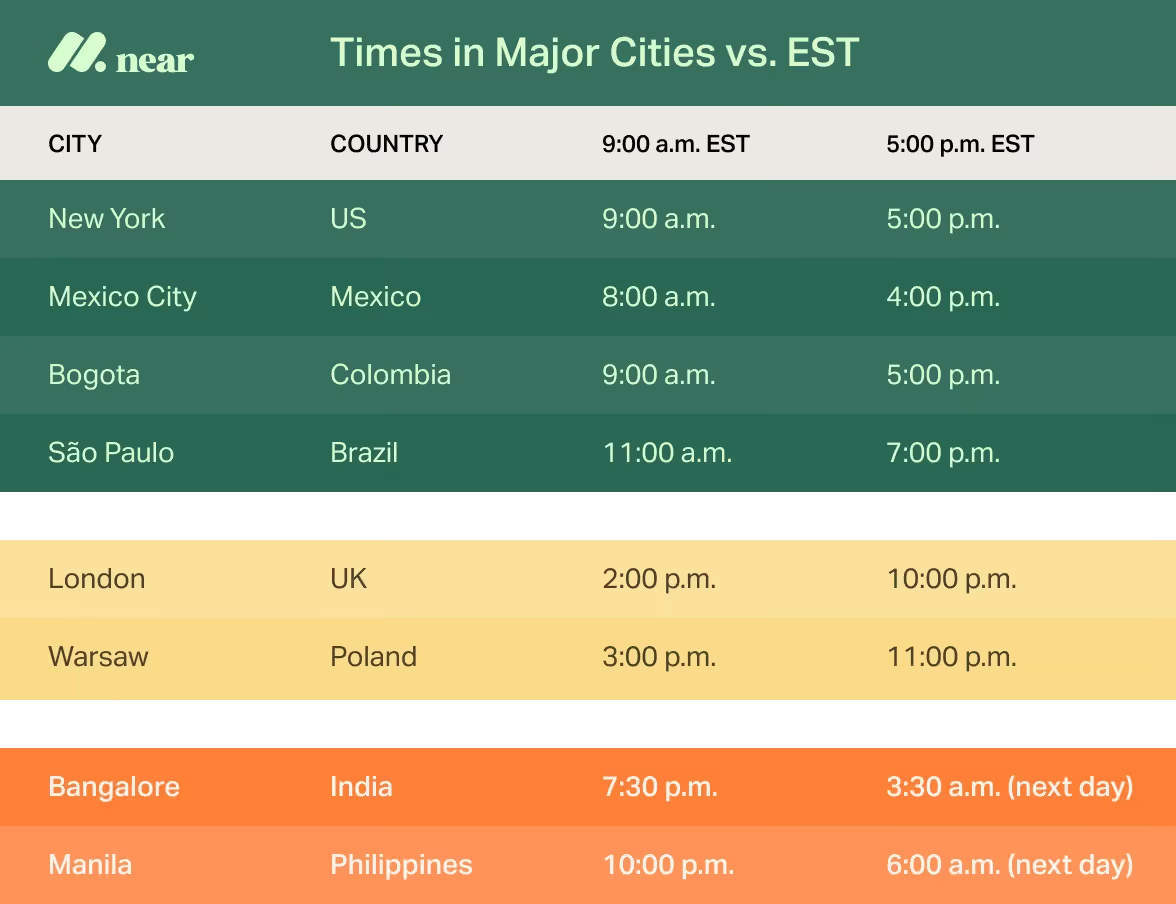
Be aware of time zone differences, especially if you require overlapping working hours for collaboration. Most LatAm countries fall within zero to three hours of US Eastern, Central, or Pacific time, which means your sales reps are available during buyer business hours.
Research from Harvard Business School and INFORMS found that each additional hour of time zone difference reduces real-time communication by 11%. This is especially critical for sales roles, where buyers and prospects need to reach your team during their own working hours.
The table below shows each country's time zone and how it aligns with US Eastern time:
Legal and economic climate
The ease of doing business, employment laws, and economic stability all affect how smoothly you can hire and retain remote sales talent in a given country.
Countries with stable legal frameworks and clear employment regulations make it easier to structure compliant contracts, avoid misclassification risk, and manage ongoing payroll without surprises.
Political or economic instability, on the other hand, can create turnover pressure even among high performers who are motivated to seek more stable income sources.
Internet infrastructure
Reliable internet and technology infrastructure are baseline requirements for any remote sales role. A rep who loses connectivity during a live demo or can't access your CRM reliably is a problem that no amount of talent can fix.
When evaluating a country, look beyond national averages. Connection quality in major cities like Bogotá, Buenos Aires, or Warsaw is generally strong, but it's worth confirming a candidate's specific setup during the hiring process.
How Much Does Remote Sales Talent in Latin America Cost?
To give you a concrete sense of what remote sales talent costs in Latin America vs. the US, here are compensation benchmarks for four common roles.
For a complete breakdown of sales role compensation, see Near's sales roles salary guide.
How to Manage Remote Sales Teams Across Time Zones
The most important factor in managing a remote sales team across time zones is synchronous overlap during buyer business hours. Unlike other functions where async workflows can compensate for time differences, sales runs on live conversations: Missed overlap means missed pipeline.
Four things that keep distributed sales teams running well:
- Anchor your core selling hours to your buyer's time zone, not your HQ. If your customers are in the US, your reps need to be available during US business hours.
- Use asynchronous tools like Loom and Slack for end-of-day pipeline updates and deal notes, but keep live pipeline reviews, coaching calls, and deal strategy sessions synchronous.
- Be fully transparent about commission structure and quota tracking from the start. Lucia Atensia, Sales Recruiter at Near, puts it directly: “They want clear communication about how commissions are structured, what it takes to earn a bonus. Be fully transparent with that from the start, and you'll have a much better experience.”
- Set clear expectations about core collaboration hours while respecting your team members' work-life balance.
For US companies, hiring sales professionals based in Latin America largely eliminates this challenge. Most LatAm countries fall within zero to three hours of US Eastern, Central, or Pacific time, which means your reps are available when your buyers are.
Nearshore vs. Offshore Sales Talent: How To Choose
Nearshore hiring means working with talent in countries geographically close to your own, with overlapping or closely aligned time zones. For US companies, that means Latin America (typically a 0–3 hour gap). Offshore hiring means sourcing from distant regions like India or the Philippines, where the time zone gap runs 10–14 hours.
Both models can work for many business functions. But for sales, the difference is decisive. The time zone math on offshore sales setups simply doesn't work for US-facing outbound or collaborative roles.
There's a second problem specific to offshore hiring arrangements: Reps hired through an agency model often cycle through multiple clients, which means they never develop deep product knowledge or lasting client relationships.
The data reflects this. About 30% of companies that hire through Near previously hired offshore, and 38% of those offshore-to-nearshore switchers are specifically filling sales roles. One CFO who had managed a team in Mumbai described it plainly:
Hiring in LatAm and staying kind of within the same reasonable time zone just makes so much more sense for us.
The results back it up. One SaaS company hired two SDRs from Latin America through Near and doubled its leads in the first five months after moving away from an offshore setup.
Franco Pereyra, COO of Near, captures what makes the difference:
What sets Latin American talent apart from other regions is that you'll find people who are proactive and creative — people who come up with ideas and new solutions, who won't just be a yes man.
Nearshore isn't automatically the right choice for every company, but for US-facing sales roles, the time zone alignment and direct-hire model give it a clear structural advantage.
Final Thoughts
For US companies evaluating the best countries to hire remote sales talent, Latin America is the strongest starting point. The region offers full working-hours overlap with US business hours, direct-hire talent who work exclusively for your company, and cost savings of $35,000-$64,000 per hire per year compared to US equivalents, according to Near's 2026 State of LatAm Hiring Report.
BDR and SDR roles have been the most-filled positions in Near's LatAm placements for two years running, with Colombia and Brazil as the top hiring countries for sales.
If you’re ready to find your next remote sales hire, explore Near's sales hiring options or review our salary guide for a full breakdown of compensation benchmarks by role and seniority.
Frequently Asked Questions
Which country offers the best remote sales talent for US companies?
For US companies, Latin America (particularly Colombia, Mexico, Brazil, and Argentina) offers the best combination of sales talent quality, working-hours overlap, and cost savings.
Colombia is currently the top hiring destination for sales roles specifically, representing 23% of all nearshore placements in 2025, according to Hire With Near's 2026 State of LatAm Hiring Report.
The right country also depends on the specific role and buyer market: LatAm for US-facing sales, Europe for EU market expansion.
How much does it cost to hire a remote sales rep from Latin America vs the US?
A mid-level sales rep based in Latin America typically costs $24,000-$36,000 per year, compared to $82,000-$148,000 for a US-based equivalent, a savings of 71-76%.
Industry compensation benchmarks show companies save $35,000-$64,000 per hire annually when sourcing sales talent from the region, according to Hire With Near's 2026 State of LatAm Hiring Report.
For a full breakdown by role and seniority, see the sales roles salary guide.
What's the best time zone overlap for US companies hiring remote sales reps?
Latin America offers the best working-hours overlap for US companies: Most LatAm countries share or fall within 1-3 hours of US Eastern, Central, or Pacific time, which means your sales reps are available during buyer business hours.
For sales specifically, synchronous overlap matters more than for other remote roles.
Do I need an EOR to hire a remote sales rep in another country?
For most Latin American hiring, you don't need one. The contractor model is widely used in the region and is often the preferred structure for both companies and candidates. LatAm professionals frequently opt for contractor status because it gives them more flexibility around currency and compensation.
EOR arrangements establish full employment status in the candidate's country, which adds compliance overhead and cost. They make sense in specific situations, such as when a role requires local employee benefits or when local labor law creates misclassification risk under a contractor structure.
Hire With Near handles the compliance logistics for both models and will advise you on the right structure based on the country and role.
For more information on getting started, visit Hire With Near's sales hiring page.
What types of companies hire remote sales professionals from Latin America?
Companies across every major industry hire remote sales talent from Latin America. SaaS companies are among the most active, scaling outbound SDR and BDR teams to accelerate pipeline.
Fintech firms build inside sales teams to serve a growing US customer base. Healthcare, insurance, manufacturing, and real estate companies hire bilingual sales reps and account managers to reach Spanish-speaking markets and reduce headcount costs.
Hire With Near's placement data shows that sales is the most cross-industry function in nearshore hiring.
What other sales roles can I hire from Latin America?
Beyond general sales representatives, US companies regularly hire the full range of sales functions from Latin America, including SDRs for outbound prospecting, BDRs for business development, account executives for closing, inbound sales reps for lead handling, and sales managers to lead distributed teams.
LatAm professionals in these roles typically deliver the same performance as US-based equivalents, with the added advantage of full US working-hours overlap and 30–70% cost savings vs. domestic rates.
How do I evaluate English proficiency when hiring a remote sales rep from Latin America?
The most reliable way to assess English proficiency in a sales candidate is through a live interview, not a written test. Request a mock sales call or a short recorded pitch during the screening process, since these reveal fluency, accent, and communication under pressure more accurately than any standardized assessment.
In our experience working with hundreds of US companies, proficiency varies most by country and education level. Colombian, Argentinian, and Costa Rican candidates consistently rank among the strongest English speakers in the region for US-client-facing roles.






.webp)
.webp)


%203.svg)
.avif)





%20(1).avif)

%20(1).png)