


%203.svg)
Key takeaways
- US SDR hiring is broken with 6-month searches, $180K OTE demands, 33% attrition rates, and 80% of reps consistently missing quota. Too many companies spend more time hiring than closing deals.
- Latin American SDRs bring the work ethic, urgency, and commitment that US teams struggle to find, along with real-time collaboration and sustainable salary expectations.
- Companies like AvantStay achieved $20M ARR growth, reduced attrition from 70% to 20%, and cut hiring cycles from 6 months to 2–3 weeks by expanding their search beyond US borders.
Your SDR team is burning through candidates faster than you can hire them.
Six months to fill a role. Entry-level reps demanding $180K OTE. And when you finally make a hire, there’s a good chance they’ll quit within four months or never hit quota consistently.
Sound familiar?
But here’s what most sales leaders haven’t figured out yet: the talent you need isn’t scarce. You’re just looking in the wrong place.
Why Too Many Sales Leaders Overlook LatAm Talent
There’s this assumption that for client-facing roles—especially sales—you need to hire within the US. That prospects will only take you seriously if your SDRs are based domestically.
We get it. Sales feels different from other roles. It’s relationship-based, requires cultural understanding, and demands real-time communication with prospects who might have preconceptions about offshore talent.
But what if those assumptions don’t match reality?
Over the past few years, we’ve seen companies consistently achieve better results with LatAm SDRs than they were getting from their US hires. Not just cost savings—actual performance improvements.
What We’re Actually Seeing in the Market
The companies coming to us are facing the same challenges: US SDR candidates arrive with a sense of entitlement that previous generations didn’t have. They want sales engineers, enablement support, and significant base salaries before they’ve proven they can pick up the phone and have conversations.
Meanwhile, the SDRs we place from Latin America bring something that’s become increasingly rare: genuine drive.
They’re not afraid to make 500 calls a day. They understand that sales is fundamentally a numbers game: if you’re consistently making 300+ calls a day, you’re going to create opportunities. They’re motivated by commission and see sales as a career path, not a stepping stone.
The difference in work ethic is striking. Where US candidates often want guarantees upfront, LatAm professionals are ready to prove themselves through results.
The Skills That Actually Matter for SDR Success
When you strip away assumptions about location, what makes an SDR successful?
- Grit and hustle that can’t be taught. You can train someone on your product, your sales process, even your industry. But you can’t teach someone to have presence on a call or the persistence to work through rejection.
- Communication skills and confidence. The ability to handle objections, build rapport quickly, and guide conversations toward meetings. These are fundamental sales skills that translate across markets.
- Understanding of urgency and quota pressure. SDRs need to know that "call me back in an hour" isn’t a suggestion—it’s a requirement. They need to understand that quarter-end deadlines matter and that activity metrics exist for a reason.
- Coachability and adaptability. The best SDRs take feedback well and continuously refine their approach based on what’s working.
At the end of the day, these core skills—not a candidate’s zip code—determine whether an SDR can consistently create pipeline and hit quota.
The Business Case: Why This Works
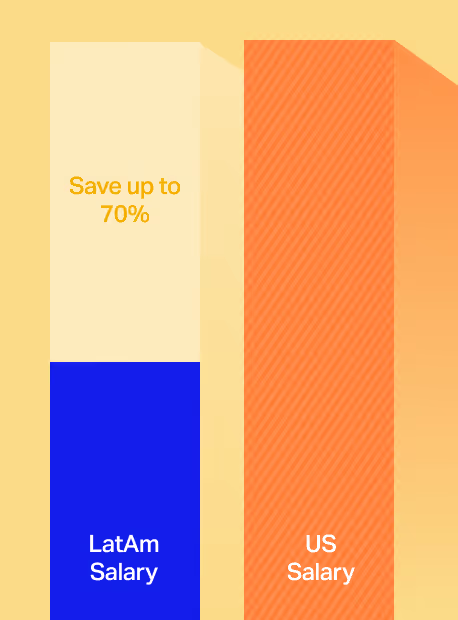
The economics are hard to ignore. Skilled SDRs in Latin America expect fair compensation and commissions, but total compensation still runs 50–60% lower than their US peers. And because they see the role as a career path, not a stopgap, average tenure is longer.
The advantages go beyond cost:
- Faster hiring cycles. Instead of 6-month searches, you can have qualified candidates interviewed and hired within 2-3 weeks when you work with a partner like Near.
- Lower attrition rates. LatAm professionals tend to view their roles as career opportunities rather than temporary positions, leading to better retention.
- Cultural alignment. Many LatAm professionals have experience working with US companies and understand American business practices and communication styles.
- Scalability. When you need to grow your team quickly, the talent pool is significantly larger than what’s available domestically.
A Real Example: What Happened at AvantStay
Jake Breuner, VP of Sales at AvantStay, was facing the same hiring challenges most sales leaders know well. He needed to drive $20M in new ARR but couldn’t find quality SDRs in the US who would work hard and stay longer than a few months.
His first LatAm hire was Simon, an SDR from Argentina. Jake’s initial concerns were typical: "Will prospects notice he’s not in the US? Can he handle objections and build relationships?"
Simon closed 15 meetings in his first 30 days. More importantly, he brought the work ethic Jake had been looking for: 150 dials per day, 10+ meaningful conversations, consistently setting 1–2 qualified meetings daily.
Within 7 months, Simon was promoted to BD Manager. He now manages a team of 10 and has become the benchmark other reps aspire to reach.
The broader results across AvantStay’s LatAm hiring speak for themselves: they added $20M in ARR, reduced new hire ramp time from 6 months to 2 months, and cut their attrition rate from 70% to 20%.
As Jake put it: "Hiring from Latin America was our backup plan, now it’s our primary plan."
The same pattern played out for an energy services company that came to Hire With Near with no sales function at all. They hired a sales manager and account executive from Latin America, and within weeks had a working sales operation and $216,785 in annual savings compared to equivalent US hires.
{{banner}}
Final Thoughts
The question isn’t whether LatAm SDRs can perform—we’re seeing consistent evidence that they often outperform US hires in key metrics.
The real question is whether you’re willing to expand your search beyond traditional boundaries to find the talent you actually need.
Your prospects care about getting their questions answered and feeling confident about next steps. They don’t care whether your SDR is calling from Detroit or Buenos Aires.
If you’re spending months trying to fill SDR roles, dealing with entitled candidates, or watching new hires underperform, it might be time to consider that the talent you need isn’t scarce. You’re just looking in the wrong places.
The companies we work with consistently tell us the same thing: they wish they had discovered this option sooner. The talent exists. LatAm SDRs are motivated and ready to contribute to your growth.
Want to see the complete AvantStay case study? Learn how their VP of Sales built a high-performing LatAm sales team that added $20M in ARR while reducing costs and improving retention. See what’s possible when you expand your search beyond US borders.
Or schedule a free, no-commitment consultation call to discuss how we can help you hire top pre-vetted LatAm SDRs.
Frequently Asked Questions
How much does it cost to hire LatAm SDRs?
Base salary expectations vary by experience level, but all represent significant savings compared to US rates:
- Junior SDR (0-2 years): $18,000 – $24,000 annually (vs. $43,000 – $66,000 in the US)
- Mid-Level SDR (2-5 years): $24,000 – $30,000 annually (vs. $66,000 – $76,000 in the US)
- Senior SDR (5+ years): $30,000 – $42,000 annually (vs. $76,000 – $90,000 in the US)
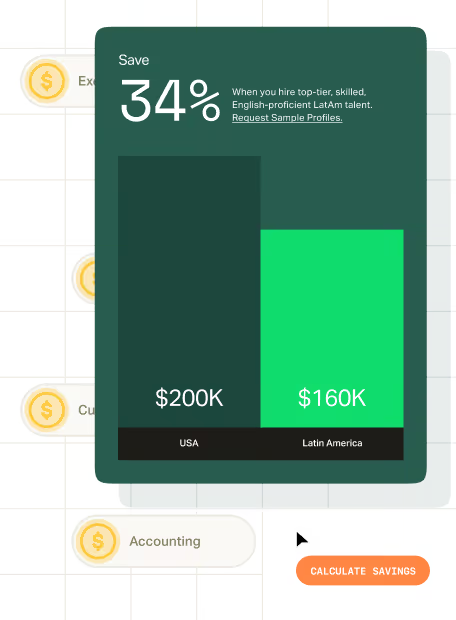
These figures represent base salaries before commission structures. You're looking at up to 64% cost savings without sacrificing talent quality.
The key is offering competitive compensation for the local market while still achieving meaningful savings for your business. Companies that try to save 70%+ typically struggle with retention, while those aiming for 30–60% savings build stable, high-performing teams.
To see how to structure a winning compensation plan, download AvantStay's proven SDR compensation framework that helped their team hit quota in 60 days while adding millions in ARR. Get the complete compensation plan with benchmarks and incentive structure.
How quickly can I hire SDRs in LatAm?
The process moves much faster than most US hiring cycles. Here’s what the process can look like with Hire With Near: after a kickoff call with your recruiter to clarify needs, you’ll get a shortlist of pre-vetted candidates within three days. These aren’t random resumes. They’re professionals already screened for skills, cultural fit, and English fluency. Most companies make a hire within two to three weeks, compared to the six months it can take to land a qualified SDR in the US.
What qualities should I look for in SDR candidates?
The best SDRs combine sales fundamentals with resilience. Look for:
- Strong presence on calls and objection handling
- Persistence with activity targets (calls, emails, outreach)
- Coachability and adaptability to your sales process
- Cultural alignment and professionalism in communication
Resumes alone won’t reveal these traits. Role plays, scenario-based interview questions, and reference checks give a much clearer picture. See our full guide to hiring an SDR for more guidance.
Will a Spanish accent hurt sales performance?
Not at all. Spanish accents are widely accepted in the US, and prospects care more about fluency, confidence, and credibility than a rep’s zip code. With Hire With Near, you see video clips of every candidate before interviewing, so there are no surprises.
Read our article “Do LatAm Sales Reps Have Accents?” and Other Questions Sales Leaders Ask for a deep dive on this.
How do I manage payroll and compliance for LatAm hires?
Paying international team members is straightforward with the right setup. Many companies choose a partner like Hire With Near to handle contracts, onboarding, and payroll end-to-end. Others use Employer of Record services such as Deel. Either way, compliance, tax requirements, and currency conversion are handled for you, leaving you to focus on hitting revenue goals.
What qualities should I look for in SDR candidates?
The best SDRs combine sales fundamentals with resilience. Look for:
- Strong presence on calls and objection handling
- Persistence with activity targets (calls, emails, outreach)
- Coachability and adaptability to your sales process
- Cultural alignment and professionalism in communication
Resumes alone won’t reveal these traits. Role plays, scenario-based interview questions, and reference checks give a much clearer picture. See our full guide to hiring an SDR for more guidance.






.webp)
.webp)


%203.svg)
.avif)





%20(1).avif)

%20(1).png)