


%203.svg)
Key Takeaways:
- Yes, many LatAm sales reps have accents, but Spanish accents are widely accepted in the US and don’t impact sales performance. What matters is English fluency and overall communication skills, which can be properly evaluated before hiring.
- Top LatAm sales professionals have extensive experience with the same processes and tools you use (Salesforce, Outreach, SalesLoft), and the salary differences allow you to hire A-players with proven experience rather than entry-level hires your US budget might require.
- Instead of worrying about accents or location, sales leaders should focus on the questions that predict success: Can they handle objections? Do they understand urgency and quota pressure? These factors determine sales performance regardless of where your rep is located.
You’re under pressure to grow pipeline. Your reps are swamped, comp plans are ballooning, and the candidates you can afford aren’t exactly blowing you away. So you start to explore hiring sales talent in Latin America.
Suddenly, the questions come in fast. What if they have an accent? Will they sound “off” to prospects? Can they really sell to the US market?
These questions might seem surface-level, but behind them is a real, valid fear: making the wrong hire, losing deals, and eroding trust with your customers. You’ve seen what happens when sales hires don’t land: slipped targets, wasted onboarding time, churn that sets your team back by months.
So we’re going to tackle those concerns about hiring LatAm sales reps head-on.
Here are the most common questions we hear from sales leaders, with real data and examples to back up our responses.
“Do LatAm Sales Reps Have Accents?”
Let’s be direct about this. Yes, many LatAm sales professionals have accents. So do people from Boston, New York, and Georgia.
But here’s what’s also true: Spanish accents are perfectly acceptable in the US. In B2B interactions with high-level decision makers or in B2C.
The US has the second-largest Spanish-speaking population in the world. A Spanish accent doesn’t make prospects hang up the phone or question credibility the way other offshore accents might. (Should that be the case? No. But that’s often the reality, even though that person with the “offshore accent” might be down the road.)
The key is evaluating fluency, accent strength, and overall communication skills. With a good evaluation process, you can identify candidates with light, easily understandable accents who communicate effectively, regardless of location.
That’s why we evaluate every candidate’s English proficiency through multiple assessment formats. You hear them speak before you ever interview. Nothing is hidden, and there are no surprises about communication quality.

“Will leads know the sales rep isn’t in the US?”
Short answer: they shouldn’t, and if they do, they won’t care.
Your prospects care about one thing: whether your SDR can solve their problems and move their business forward. They want someone who listens, understands their challenges, and can articulate how your solution helps.
Take Simon from AvantStay. He closed 15 meetings in his first 30 days. Made 150 dials daily. Held 10+ real conversations. Set 1–2 meetings every single day.
The account executives kept saying, “We need more Simons.”
Here’s what they didn’t say: “We need to know where Simon’s calling from.” Because it didn’t matter. What mattered was results.
And Simon’s prospects never knew he wasn’t US-based. Not because he was hiding anything, but because his communication skills, product knowledge, and sales presence made his location irrelevant.
Buyers expect professionalism and competency, not specific geographic coordinates.
If your LatAm hire can handle objections, build relationships, and book qualified meetings, your prospects will be focused on the value they’re getting from the conversation.
“What will my US-based team members think if they know the LatAm talent is being paid less?”
This concern comes up frequently, and it’s worth addressing head-on.
Location-based compensation isn’t about valuing people differently. It’s about global market realities.
A senior SDR in Buenos Aires might earn $40,000. This might give them significantly more purchasing power than someone earning more in San Francisco. They’re not being paid “less” relative to their cost of living and local market.
Your US team already understands this concept. They know a sales rep in Des Moines earns less than one in Manhattan, not because they’re less valuable, but because markets are different.
What matters to your existing team is performance and contribution. When your LatAm hires are exceeding quota, generating pipeline, and helping the whole team hit numbers, location becomes secondary to results.
AvantStay’s team stopped questioning the model and started requesting it. Why? Because LatAm hires were outperforming expectations and helping everyone succeed.
The best-performing sales teams we work with focus conversations on contribution and results, not compensation details. Teams that emphasize collective success see the strongest adoption of hiring in LatAm.
You might also worry that LatAm hires feel resentful about earning less than their US counterparts. We haven’t found that to be true.
In fact, our State of LatAm Hiring Report revealed that LatAm professionals working for US companies typically see salary increases of up to 87% compared to local opportunities.
What’s key is designing a fair compensation plan that reflects local market realities and making sure you understand what those are.
Our AvantStay case study includes the compensation plan they used to create a fair and attractive structure for their LatAm hires.
“Can they handle our sales process and tools?”
Yes, they’re already using the same tools you use.
And the salary differences mean you can afford A-players who are significantly more experienced and proficient than the entry-level hires your budget might require in the US market.
Major US corporations like Microsoft, JP Morgan, and Dell have maintained operations in Latin America for decades. This created a deep pool of professionals who already understand US business practices, communication styles, and sales methodologies.
Your LatAm hire would likely have experience with platforms like ZoomInfo, Salesforce, Outreach, SalesLoft, and LinkedIn Sales Navigator. They’d understand multi-channel sequences, social selling, and video outreach because they’ve been doing it for US companies for years.
Simon logged into AvantStay’s sales stack on day one and immediately started generating results. No extended learning curve. No technology training. Just immediate contribution to pipeline and quota achievement.
“What about cultural fit and team dynamics?”
Of course, you’ll still evaluate cultural fit as part of your hiring process. Just like you would with any hire.
But cultural compatibility is one of LatAm’s strongest advantages for US companies.
This isn’t just about whether they can discuss last night’s game. It’s about understanding the hustle expected in US sales environments and being a team player who contributes to collective success.
Time zone alignment means there’s no discernible difference from your current remote setup.
If you’re already working with a hybrid or distributed team, someone zooming in from Bogotá won’t affect team dynamics any differently than someone joining from Chicago or Atlanta.
The nature of tools like Zoom and Slack doesn’t change when some team members are in LatAm. They attend the same meetings, participate in the same conversations, and work the same hours as your US staff.
Here’s What We Think You Should Be Asking
Instead of focusing on accents or location, here are the questions that predict sales success:
“Can they handle objections and build relationships?”
The best LatAm sales professionals have years of experience navigating complex B2B conversations. They’re well-spoken, confident, and comfortable handling any objections prospects throw their way.
“Do they understand urgency and quota pressure?”
Top LatAm sales talent understands that deadlines matter and quarter-end isn’t just a date on the calendar.
More importantly, they bring the work ethic that many US companies are telling us they are struggling to find domestically.
They’re motivated by commission, hungry to prove themselves, and focused on long-term career growth rather than job-hopping for incremental raises.
They bring the sense of urgency that many US hires seem to have lost. When prospects say “call me back in an hour,” they know that’s not a suggestion—it’s a requirement for closing the deal.
They bring the grit, hustle, and raw sales skills that can’t be taught, and they’re not afraid to pick up the phone and make hundreds of calls a day.
“Will they grow with my business?”
Take again Simon from AvantStay.
He was promoted to BD Manager within 7 months and now manages a team of 10. He runs role-play sessions, sharpens objection-handling skills, and has become the benchmark other reps aspire to reach. Top LatAm professionals aren’t looking for short-term gigs—they want careers.
“Can they adapt to our industry and buyer personas?”
Just like any hire, industry experience helps but isn’t always necessary. What matters is sales competency, learning ability, and understanding your ideal customer profile. Great sales professionals succeed because they can have conversations and build relationships, not because they already know your market inside and out.
“What kind of results can I actually expect?”
AvantStay’s experience shows what’s possible.
Before hiring from LatAm: 80% of SDRs missed quota consistently, 6+ month ramp times, and 70% attrition rates.
After: new hires hit quota in 2 months, 20% attrition rate, and all 20 hires placed in under 26 days while adding $20M in ARR with 65% hiring cost reduction.
As AvantStay’s VP of Sales put it:
Hiring from Latin was our backup plan, now it’s our primary plan. Near found us talent we couldn’t even find in the US. I wouldn’t hire for this role stateside anymore.
Final Thoughts
The question shouldn’t be about accents or location. The real question is: Can they book meetings and close pipeline?
Performance trumps geography every time.
Your prospects don’t care whether your SDR lives in Detroit or Buenos Aires. They care about getting their questions answered, understanding your value prop, and feeling confident about next steps.
Modern sales success requires skills, not the right ZIP code.
You need people who can research prospects, personalize outreach, handle objections, and book qualified meetings. Folks who understand your sales process, integrate with your tools, and contribute to team success.
Geographic diversity actually becomes a competitive advantage. While your competitors fight over the same small pool of US talent, you gain access to motivated, experienced professionals who want to prove themselves and build long-term careers.
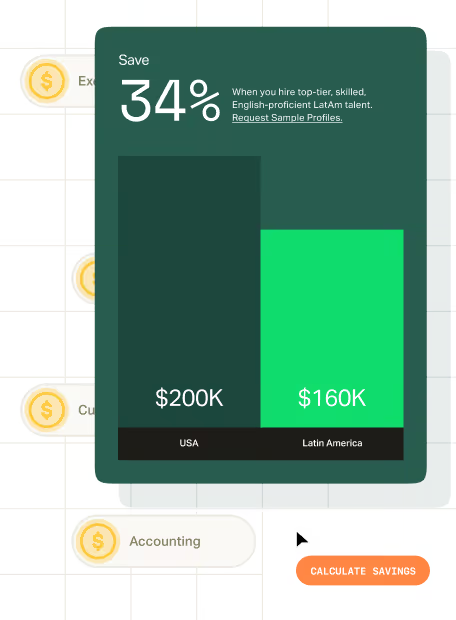
The data supports this approach. We consistently see companies hiring LatAm sales talent achieve faster ramp times, higher retention rates, and better quota achievement—while reducing hiring costs by 30–60%.
Ready to see what’s actually possible?
The biggest risk isn’t hiring someone with an accent. It’s missing out on top performers because you’re focused on the wrong metrics.
Focus your interviews on sales methodology, not location. Test English proficiency through role-playing exercises, and evaluate cultural fit based on work ethic and growth mindset.
Your Simon might be one conversation away.
Read the complete AvantStay case study to discover the exact strategies and results that made hiring from Latin America their primary plan.
Or schedule a free, no-commitment consultation call to discuss how we can help you hire top pre-vetted LatAm SDRs.
Frequently Asked Questions
Should I work with a staffing agency or hire LatAm sales reps directly?
Both approaches work, but they serve different needs. If you want speed and pre-vetted candidates, working with specialized sales staffing agencies can deliver qualified LatAm sales professionals in days rather than weeks. These agencies handle the sourcing, screening, and initial vetting, presenting you with candidates who are ready to interview.
If you prefer more control over the hiring process and want to build relationships directly with candidates, you can hire remote sales reps on your own. This approach takes more time but gives you direct oversight of every step. The choice depends on your timeline, internal resources, and how hands-on you want to be in the recruitment process.
What's the difference between outsourcing BDR/SDR roles and hiring them as full-time team members?
Outsourcing BDR and SDR roles means partnering with a third-party company that provides sales development services on your behalf. The outsourced reps typically work for multiple clients, and you're essentially renting their capacity. This can be a quick way to scale outbound efforts without building infrastructure.
Hiring BDRs and SDRs as dedicated team members means they work exclusively for your company. They integrate into your team culture, use your tools, attend your meetings, and grow with your business long-term. While outsourcing offers flexibility, having dedicated team members usually delivers better retention, deeper product knowledge, and stronger alignment with your sales strategy.
Many companies find that hiring dedicated LatAm sales professionals provides the cost savings of outsourcing with the commitment and integration of in-house teams.
Are there alternatives to building an entire in-house sales team if I need B2B sales support?
Yes, several options exist beyond building a full in-house team. Many companies work with B2B sales outsourcing companies that specialize in handling the entire sales cycle or specific functions like lead generation, appointment setting, or deal closing. These providers can handle everything from prospecting to negotiation, allowing you to access specialized B2B sales expertise without the overhead of hiring full-time staff.
Another increasingly popular option is building a hybrid model: keeping strategic sales leadership in-house while hiring dedicated LatAm sales professionals for SDR, BDR, and AE roles. This approach combines the control and cultural integration of in-house teams with the significant cost savings (30–70% compared to US salaries) that come from hiring in Latin America. Unlike traditional outsourcing where you share resources with other clients, this model gives you dedicated team members who work exclusively for your business.






.webp)
.webp)


%203.svg)
.avif)






%20(1).avif)

%20(1).png)