%203.svg)
Key Takeaways
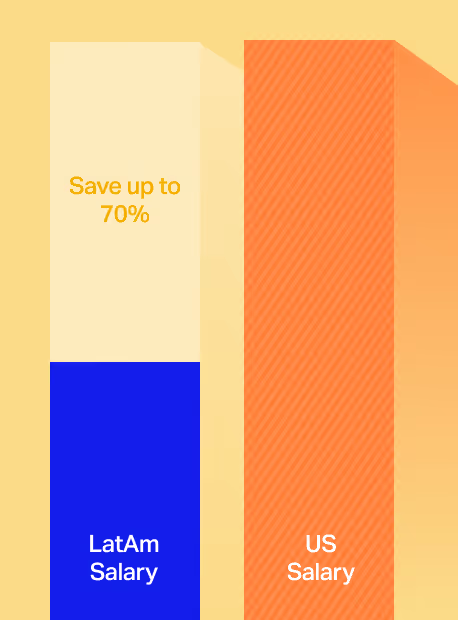
- You can hire iOS developers locally, remotely within the US, or in Latin America, where our salary data shows savings of up to 71% versus US salaries depending on seniority, with a full working day of overlap.
- The best iOS developers combine technical skills (Swift, iOS frameworks, Xcode) with soft skills like problem-solving, communication, and the ability to work independently in remote settings.
- Successful hiring requires practical evaluation beyond portfolios. Use coding tasks, behavioral questions, and clear job descriptions to identify candidates who can execute and collaborate effectively.
To hire iOS developers, settle three things before you post the role: what you’re building, how you’ll test for real Swift and Apple-framework skill, and where you’ll hire from. iOS developers build and maintain the apps that run on iPhone and iPad, so a weak hire shows up in your App Store reviews within a release or two.
The hard part is supply. Fewer than 6% of professional developers work in Swift, so the strong ones rarely stay on the market long. Search locally only and you’re paying US senior rates for a shrinking pool, while every week the role sits open is a release that slips and a backlog your current team absorbs.
That’s the case for widening the search. Hire With Near helps US companies hire iOS developers in Latin America who work during their business hours, at 30% to 70% below US salaries.
Below, I’ll cover what iOS developers actually cost, the skills worth testing for, where to find them, and how to run a process that lands someone still shipping a year from now.
What Do iOS Developers Do?
iOS developers build and maintain apps for Apple’s mobile ecosystem using Swift, Objective-C, and Apple’s development frameworks.
Their primary job is turning product requirements and designs into fully functional iPhone and iPad apps. This includes building user interfaces, integrating with APIs and backend services, implementing features like push notifications and in-app purchases, and optimizing performance for smooth user experiences.
iOS developers work closely with designers to bring mockups to life, collaborate with back-end engineers to integrate data and services, and coordinate with product managers to ensure features align with business needs.
They’re also responsible for submitting apps to the App Store, managing updates, and fixing bugs that arise after launch.
What they don’t typically handle is backend architecture, server management, or cross-platform development. Their expertise is specifically in Apple’s ecosystem: iOS design patterns, device-specific features, and apps that feel native to the platform.
Swift is the primary language for iOS development and your candidate should be fluent in it, especially alongside UIKit, SwiftUI, and Combine.
But only 5.7% of professional developers report working extensively in Swift, according to the 2025 Stack Overflow Developer Survey. That makes experienced iOS developers harder to find, especially if you’re hiring locally or on a tight budget.
How Much Does It Cost to Hire iOS Developers?
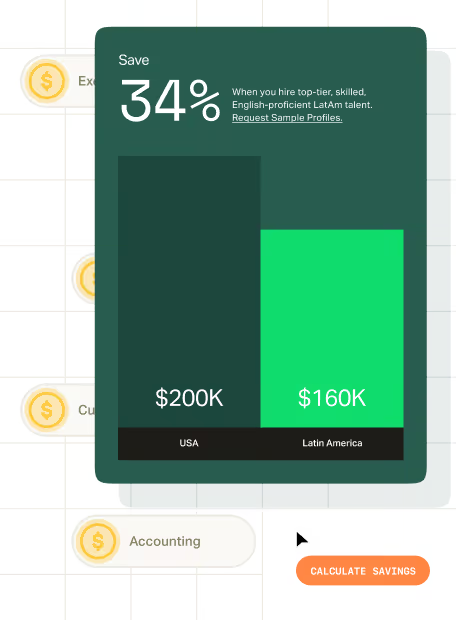
Hiring iOS developers in the US costs between $90,000 and $198,000 a year, depending on seniority and location. In Latin America, the same experience levels run $30,000 to $108,000.
Senior-level developers with deep SwiftUI, Core Data, and complex app architecture skills command salaries at the top of that range, especially in competitive markets.
For companies without a US-scale engineering budget, hiring outside the US gets the same level of experience at salaries 35–71% lower depending on seniority.
Here’s what hiring an iOS developer at each seniority level costs compared to an equivalent US hire, according to Hire With Near’s salary benchmarks:
For the most up-to-date figures, see Hire With Near's US vs Latin America Salary Guide.
If you’re budgeting for a wider mobile team, our breakdown of what other IT roles cost in Latin America covers the adjacent roles.
Hire With Near’s research into why US companies turn to Latin America found budget the number one driver, cited by 41% of companies. One caution on the numbers above: paying at the top of the local band still saves you most of the difference, and it’s what attracts developers who have other options.
These cost differences reflect local economic conditions, not differences in talent quality. Plenty of Latin American iOS developers have worked extensively with US companies, understand US business practices, and bring the same level of technical expertise you’d expect from US-based developers.
For growing companies, the math adds up: hiring a senior developer in Latin America can cost less than a US junior. You can put a small mobile team in place for what a single local hire would run you.
What Skills Should You Look for When Hiring iOS Developers?
Look for three things when hiring iOS developers: fluency in Swift and Apple’s frameworks, the architectural judgment that matches the seniority you’re paying for, and the communication skills to work with designers, product, and back-end engineers.
A junior developer might implement UI components cleanly from Interface Builder but need guidance on complex state management. A senior should be able to architect entire app modules, mentor other developers, and make strategic decisions about frameworks.
Set the bar at the wrong level and you either make a bad hire or pass on a good one.
Here’s how iOS developer skills typically progress across experience levels:
Regardless of the level, every iOS developer should demonstrate these core skills:
Hard skills (the must-haves)
The essential technical skills that separate competent iOS developers from beginners:
- Swift and iOS frameworks mastery: All iOS developers should be comfortable with Swift and key frameworks like UIKit, Foundation, and Core Data. Understanding of iOS architecture patterns like MVC, MVP, or MVVM is essential for writing maintainable code.
- Xcode proficiency: When you hire Xcode developers, you’re really hiring for tooling fluency. Beyond basic code editing, they should know how to use Interface Builder, manage project configurations, debug effectively, and navigate iOS development tools. This includes understanding how to work with simulators and physical devices.
- API integration and networking: Look for experience with URLSession, JSON parsing, handling authentication, and working with REST APIs. Understanding of async/await patterns in modern Swift is increasingly important.
- Version control and collaboration: Git proficiency is non-negotiable for any developer working on a team. They should understand branching, merging, and collaborative development workflows.
- Testing and debugging: While junior developers might write basic unit tests, all iOS developers should understand how to use Xcode’s debugging tools, identify performance bottlenecks, and keep the app stable across different devices.
Soft skills (equally important)
Technical skills get the job done, but soft skills determine how well developers integrate with your team and handle the inevitable challenges of app development.
- Problem-solving mindset: iOS development involves constant troubleshooting, from weird device-specific bugs to App Store review rejections. The best developers approach problems methodically and don’t give up when things get complicated.
- Clear communication: Whether explaining technical decisions to your product manager or founder, or collaborating with designers on UI implementation, strong communication skills are essential. In my nearly four years recruiting technical talent at Hire With Near, I ask every engineer to walk me through a project: what their role was and what they built. I want to see if they can explain it to someone who isn’t a developer, without me having to ask.
- Self-direction and ownership: Great iOS developers take responsibility for their work and proactively identify potential issues. They don’t wait for detailed instructions. They ask smart questions and make informed decisions.
- Adaptability: Apple’s ecosystem changes frequently: new iOS versions, updated App Store guidelines, and framework APIs that get deprecated and replaced. Look for developers who stay current with these changes and adapt their skills accordingly.
- Attention to detail: iOS users have high expectations for polish and performance. Developers who pay attention to small details like smooth animations, proper spacing, and consistent behavior create better user experiences.
Nice-to-have skills (the differentiators)
None of these are dealbreakers, but each one is worth extra weight depending on what you’re building:
- UI/UX design sensibility: Developers who understand design principles can bridge the gap between mockups and implementation, often catching usability issues early and suggesting improvements.
- Backend development experience: While not their primary role, iOS developers with some backend knowledge can better understand API design, help with troubleshooting integration issues, and contribute to technical architecture discussions.
- Cross-platform experience: Knowledge of React Native, Flutter, or other cross-platform frameworks can be valuable for teams considering hybrid approaches or migrating between platforms.
- App Store Optimization (ASO): Understanding how app store algorithms work, how to write effective app descriptions, and how to optimize for discoverability can help your app succeed beyond just functioning well.
- Analytics and crash reporting: Experience with tools like Firebase Analytics, Crashlytics, or Flurry helps developers build apps that provide insights into user behavior and maintain stability in production.
Where Can You Find and Hire Great iOS Developers?
You can find iOS developers through iOS-specific job boards, general tech platforms, freelance marketplaces, referrals, or a specialist staffing partner running the search in Latin America.
The best ones aren’t always found on traditional job boards, and if you’re only looking locally, you’re likely missing out on stronger candidates at better rates.
Local, US-remote, or global
Each approach has distinct advantages:
- Local/in-office hiring offers direct collaboration and simplified onboarding but comes with higher costs and limited talent pools, especially in smaller markets.
- Remote US-based talent widens your candidate pool while maintaining familiar communication patterns and legal frameworks, though you’ll still pay US salary rates.
- International hiring provides access to broader skill sets and salaries 30–70% below US rates. For US product teams, that usually means hiring Latin American developers.
Latin America stands out for software development compared to other regions. Developers there are online during your business hours, wherever your team is based, with strong English and cultural alignment with US business practices. This nearshore hiring approach has clear advantages over traditional offshore models.
Eastern Europe and Southeast Asia also offer skilled developers, but the working day lines up differently. Here’s how overlap with a US working day compares across the regions companies usually weigh:
Workday Overlap With US Teams, by Region
These are standard-time approximations. Because most Latin American countries don’t observe daylight saving time while most of the US does, the exact gap shifts by an hour twice a year.
That live overlap is the biggest reason hiring remotely in Latin America works for teams that tried offshore to a distant location first. Brazil, Mexico, Argentina, and Colombia all have deep mobile talent pools and can be a solution for your team.
No single sourcing channel wins
Job boards get you volume, referrals get you trust, and a staffing partner gets you a screened shortlist without the screening work. Here’s how the most common sourcing channels compare for iOS developer hiring:
Professional networks and referrals often yield high-quality candidates. In fact, according to the JetBrains Developer Lifestyles survey, 30% of developers landed their current job through referrals.
A recruiting partner is worth it
A recruiting partner saves you the weeks of sourcing and screening it takes to find a strong iOS developer on your own, and hands you a pre-vetted short list instead.
You can absolutely hire a great iOS developer independently, and plenty of companies do. If you have internal hiring expertise, clear requirements, and adequate time, a DIY approach works well.
But if you’re short on time, new to iOS hiring, or exploring international talent for the first time, a recruitment partner can cut weeks off your process. Learning a new salary market and handling international contracts takes time you probably don’t have.
It's why most companies that decide to hire software engineering talent in Latin America do it with a partner rather than alone.
A recruitment partner experienced in sourcing iOS talent in Latin America can help you:
- Access pre-screened candidates who’ve already been evaluated for technical skills
- Understand local market conditions and competitive salary ranges
- Navigate cultural and communication differences in international hiring
- Handle compliance and legal requirements for international employment
- Move faster by working through existing talent networks and relationships
Using a partner doesn’t mean lowering your bar. One US healthtech startup we work with kept its full 8-step interview process, including deep technical screens and coding assessments. They still hired seven engineers, among them a senior mobile engineer, at a 14-day average time-to-hire, saving $323,000 a year against US salaries.
The LatAm staffing firms worth your time will tell you upfront which roles they place well and which they don’t.
If you’re hiring internationally, a specialized recruitment partner can be the difference between a smooth hiring process and months of frustration.
{{prevetted-banner}}
How to Hire the Best iOS Developer: Best Practices
Run iOS hiring in three stages: define the role and write the job description before you source, screen with a real-world coding task rather than algorithm puzzles, and move fast on the offer. Hiring great iOS developers requires more than writing a job description and reviewing applications.
Stage 1: Before and during sourcing
The foundation of successful iOS hiring starts before you begin reviewing resumes.
- Define your specific iOS development needs: Are you building a new app from scratch, maintaining an existing codebase, or adding specific features? Do you need someone comfortable with legacy Objective-C code, or can you focus on Swift-only developers? Clear requirements help you attract relevant candidates and avoid writing a listing that expects one person to handle everything.
- Craft job descriptions that attract the right talent: Successful iOS job descriptions go beyond listing technical requirements. Include details about the app’s purpose, the team structure, and what success looks like in the role. Be specific about iOS versions you support, any legacy code considerations, and whether the role involves App Store management.
In our experience, job descriptions that mention specific iOS frameworks (like SwiftUI or Combine) and real project challenges tend to attract more qualified candidates than generic listings.
Stage 2: Screening and evaluation
Technical skills are important, but they’re not the only factor in successful iOS hires.
- Look beyond the portfolio: While app store listings and GitHub repositories provide valuable insight, they don’t tell the full story. Ask candidates to walk you through their development process, explain technical decisions they made, and describe challenges they overcame.
- Use practical coding assessments: Rather than theoretical algorithm questions, give candidates real-world iOS challenges. This might involve debugging existing code, implementing a specific UI component, or integrating with a mock API. Live coding exercises or take-home projects both work well, but be respectful of candidates’ time.
Most rejections I see come down to one of two things: communication in the interview or the technical assessment. In the interview, it's usually a candidate who can't explain what their actual role was on a past project, or can't make a technical decision make sense to someone non-technical. On the assessment, it's someone who gets the take-home working but can't walk me through why they built it that way when we review it together.
According to HackerRank’s 2025 Developer Survey, 66% of developers say they’d rather be evaluated on real-world skills.
- Assess remote readiness: If you’re hiring remotely, pay attention to how candidates communicate during the interview process. Do they ask clarifying questions? Do they respond promptly to emails? Are they comfortable with video calls and screen sharing? Those signals often predict how well they’ll work in a distributed team, and they sit behind most of the questions tech leaders ask about hiring developers in Latin America.
Stage 3: Making the offer and closing the deal
Strong iOS developers often have multiple opportunities, so your offer needs to be compelling beyond just salary.
- Move quickly once you find the right candidate: If you’ve found someone who checks all your boxes, don’t delay. I consistently see companies lose good candidates to competitors who make faster decisions.
- Craft offers that reflect what iOS developers value: Beyond competitive compensation, developers often care about professional growth, flexibility, and the opportunity to work on meaningful projects. If your app solves interesting technical challenges or reaches a large user base, highlight that, along with remote work options and flexible hours.
- Be clear about next steps and onboarding: Once an offer is accepted, provide clear communication about start dates, equipment setup, and early priorities. iOS developers often need access to specific hardware and software licenses, so plan for these logistics early.
Top Interview Questions for Hiring iOS Developers That Reveal the Right Fit
The best iOS interview questions go beyond testing framework knowledge to reveal how candidates think, solve problems, and collaborate with teams.
“Walk me through how you’d approach building a new iOS app from scratch.”
This question reveals architectural thinking. Strong candidates mention target iOS versions, device compatibility, data architecture, and third-party dependencies, then talk about how they’d structure the codebase for maintainability.
“Describe a time when you had to debug a particularly challenging iOS issue.”
Platform-specific bugs are constant in iOS work. The answer shows you the candidate’s persistence, their debugging method, and how well they know iOS-specific tools.
“How do you handle feedback, both positive and negative, from peers or managers?”
How a candidate handles feedback is one of the most telling things I screen for. iOS development involves constant iteration based on user testing, product and design feedback, and code reviews. Strong answers include an example of feedback that led to a better result.
“How do you stay current with iOS development changes and new frameworks?”
New iOS versions and frameworks emerge regularly, so this question reveals whether a candidate keeps learning. Good responses include Apple’s developer documentation, WWDC sessions, iOS developer communities, and experimenting with new frameworks in personal projects.
“Tell me about a time when you had to work with unclear or changing requirements.”
iOS projects often evolve as founders and product leads see early builds and user feedback comes in. This question helps you assess adaptability and communication skills.
Common Mistakes to Avoid When Hiring iOS Developers
The four mistakes that cost companies the most are rigid degree requirements, an over-long interview loop, screening for code while ignoring communication, and treating general mobile experience as iOS experience. Here's how to avoid each:
Two of those deserve more than a table row. I usually tell clients not to make a college degree a must-have for engineering roles. A lot of the strongest Latin American engineers started working before they graduated and never finished, and they're not weaker candidates for it. On process length, the strongest candidates are usually the first to drop out.
The resume signal I do treat as a red flag is a candidate holding two or three jobs in parallel. I look for people who have stayed two or three years on average.
{{state-latam-hiring}}
Final Thoughts
The right iOS developer ships releases that hold up in the App Store and doesn't need rewriting six months later. Getting there means weighing problem-solving, communication, and team fit as seriously as the Swift skill on their resume.
At Hire With Near, we take the time to understand what you need, then match you with pre-vetted Latin American iOS developers who fit your requirements, work style, and budget.
Our candidates work during your business hours, integrate with your team, and deliver at salaries 30–70% lower than comparable US hires. We handle IT and tech recruiting in Latin America for companies from early-stage startups to 1,500-plus-employee enterprises, and most of our clients make a hire in under three weeks.
Want to talk it through? Book a free consultation call with our team. We’ll give you salary benchmarks for the role and explain how the process works.
{{consultation}}
Frequently Asked Questions
What’s the difference between a Swift developer and an iOS developer?
An iOS developer builds mobile applications for iPhones and iPads, typically using Swift and Apple’s iOS SDKs.
A Swift developer, on the other hand, specializes in the Swift programming language and may work across various Apple platforms, not just iOS, but also macOS, watchOS, or even server-side Swift.
If you’re building a mobile app, you’ll want an iOS developer who’s proficient in Swift. But if your project requires deep language-level expertise or spans multiple Apple platforms, a Swift developer may be the better fit.
What’s the difference between hiring an iOS developer vs. a mobile developer?
iOS developers specialize specifically in Apple’s ecosystem. They work with Swift, Xcode, iOS frameworks, and understand Apple’s design guidelines and App Store requirements. They’re your best bet if you’re building native iOS apps or need someone who can work with platform-specific features like Apple Pay, HealthKit, or advanced camera functionality.
Mobile developers, on the other hand, usually focus on cross-platform frameworks like React Native or Flutter. They build apps that work on both iOS and Android from a single codebase, often a faster, more cost-effective option for simpler applications.
Hire a mobile developer when you need to launch on both platforms quickly and your app doesn’t require advanced platform-specific functionality.
If you’re leaning toward cross-platform development, check out our guides on how to hire a React Native developer and how to hire a Flutter developer.
Should I hire a junior, mid-level, or senior iOS developer?
Hire mid-level for most projects: junior only if you have someone to mentor them, senior when you need architecture, performance work, or someone to lead a team.
Junior developers (1–2 years of experience) work well for implementing features under guidance. They’re cost-effective and eager to learn, but need mentorship and clear direction. Expect them to handle basic UI implementation and simple API integration.
Mid-level developers (3–5 years) can own complete features independently, handle App Store submissions, and work with minimal oversight. They’re often the sweet spot for most projects: experienced enough to solve problems but not over-qualified for standard development work.
Senior developers (5+ years) make sense when you need architectural decisions, complex performance optimization, or someone who can mentor others. They’re essential for apps with genuinely hard technical problems or when you’re building a team from scratch.
How much does it cost to hire an iOS developer?
Budget $30,000 to $108,000 a year in salary for an iOS developer in Latin America depending on seniority, against $90,000 to $198,000 for the US equivalent.
Salary isn’t the whole number, though. Add whatever your hiring partner charges (recruiting firms typically bill a one-time fee tied to the hire, staffing partners a recurring monthly rate), equipment, software licenses, and any local employment costs your provider passes through.
Ask any provider for the all-in figure per hire in writing, plus what happens if the person leaves in the first few months.
What’s the real cost difference between hiring locally vs. internationally?
Based on our experience, expect 30–70% cost savings by hiring iOS developers internationally, and the quality bar does not have to move. But cost isn’t the only factor. International hiring often gets you the exact skills you are struggling to find locally within your budget.
The tradeoff in offshoring iOS development is usually in hiring complexity, not work quality. You’ll need to handle international contracts and payment processing unless you are hiring through a staffing or recruiting agency like Hire With Near.
Keep in mind that the lowest rate isn’t the goal. The best international developers have options, and fair pay in their local market attracts better people than lowballing.
Where can I hire iOS developers?
You can hire iOS developers through job boards, freelance marketplaces, referrals, or a specialist staffing partner that runs the search for you. The channel matters far less than what happens before a resume reaches you.
A real search looks like this. A written intake on your stack and seniority. Active outbound sourcing instead of waiting on applicants. A screening call that tests English and whether the candidate can explain their own projects. A technical assessment reviewed by an engineer, then reference checks. Ask any partner to walk you through those steps and tell you how many candidates they screened per shortlist.
How long does it take to hire an iOS developer?
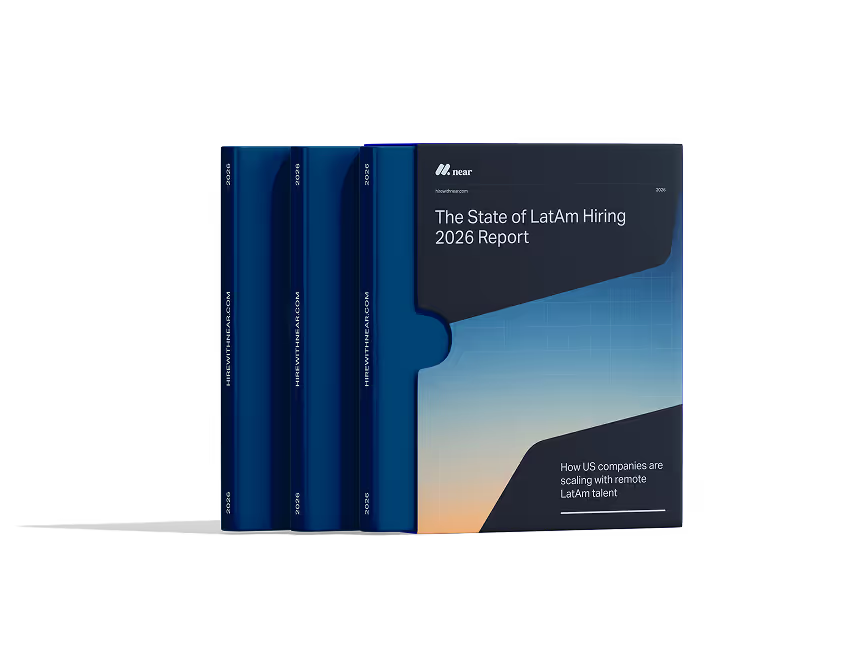
Most companies hiring in Latin America see a shortlist in three to five days and make a hire in under three weeks, against three to six months for the equivalent US search. According to Hire With Near’s 2026 State of LatAm Hiring Report, software engineer roles fill in as little as 21 days.
If you’re shipping against a fixed release date, the search itself is rarely the bottleneck. The delay usually comes from an internal interview loop that can’t schedule fast enough, so block the interview time before the first candidates arrive.
Should I outsource iOS development to an agency or hire a dedicated developer?
Hire a dedicated iOS developer if you plan to keep shipping and maintaining the product; use an agency if you need a one-off build. For a quick MVP or a single project, an iOS development agency can get you to launch faster with less overhead. For a product you’ll own long term, your own developer gives you more control, flexibility, and consistency.
The failure mode we hear most often is the agency that stops fitting once the app is live. The founder of a pre-seed mobile app startup described it this way:
We’ve been working with a boutique company that does; they’re a one-stop shop, they do all types of the full tech stack, UI/UX, AI prompting, engineering. But they’re a little expensive for the work that they’re doing. They’re not meeting deadlines. The app isn’t working as specified. So that’s why I’m looking to hire either a part-time transitional engineer or a full-time senior engineer/AI developer, someone who understands how to work with AI, to help us optimize the app so that it’s stable.
That is why more engineering leaders are moving away from outsourcing shops and building nearshore teams instead. Here’s why forward-thinking CTOs are turning to Latin America to build better engineering teams.






.webp)


%203.svg)
.avif)




%20(1).avif)

%20(1).png)