


%203.svg)
Key Takeaways
- You can hire Flutter developers locally, across the US, or offshore, with Latin America offering strong talent, real-time collaboration, and cost savings of up to 67%.
- The fastest way to hire a Flutter developer at a fraction of US cost is to hire one in Latin America using a specialist recruiting partner.
- The best hiring outcomes come from a clear process: define the role, assess with practical tasks, and move fast once you find the right fit.
If hiring were as efficient as Flutter, hiring a Flutter developer who can do it all from a single codebase would be easy.
Native apps are central to how companies reach users today, and Flutter has become the go-to choice for building sleek, cross-platform experiences quickly.
But while the tech makes development simpler, figuring out how to hire a Flutter developer who can actually deliver results is anything but easy.
Whether you’re looking for someone in-office, hiring remotely within the US, or expanding your search offshore, this guide will walk you through everything that matters.
You’ll learn what Flutter developers do, their salary expectations, which skills to prioritize, where to find qualified candidates, how to evaluate them effectively, and why hiring developers in Latin America might be your best bet.
We’ll also cover the mistakes that can cost you time, money, and momentum.
What Do Flutter Developers Do?
Flutter developers build and maintain cross-platform apps using the Flutter SDK and Dart language. They deliver consistent performance across mobile, web, and even desktop from a single codebase.
The main job of Flutter developers is to turn product requirements and designs into fully functional, smooth-running apps.
That includes building interfaces for iOS and Android, integrating APIs and backend services, optimizing for performance, and troubleshooting bugs.
While mobile is still the primary use case, Flutter's support for web and desktop apps is no longer experimental. Many companies building internal tools or admin panels now look for developers who can confidently ship across platforms.
Product-led and SaaS teams building customer-facing apps are among the most common employers of Flutter talent, which is one reason SaaS recruiting in Latin America has grown so quickly.
Within a team, Flutter developers usually work alongside designers, product managers, and backend engineers. They bring designs to life and make sure the front-end experience supports what the product needs to do.
What they don't do is manage backend architecture, databases, or DevOps infrastructure. Their strength is in building polished, high-performing user interfaces that work across platforms without duplicating effort.
Further reading: Your Guide to Outsourcing Mobile App Development: Benefits, Top Companies & Services to Outsource
How Much Does It Cost to Hire a Flutter Developer?
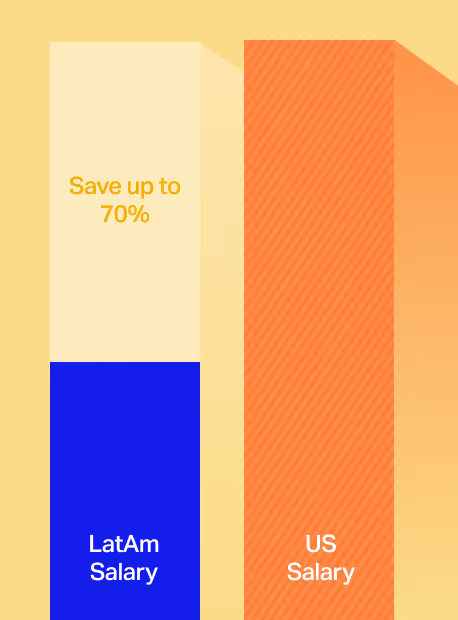
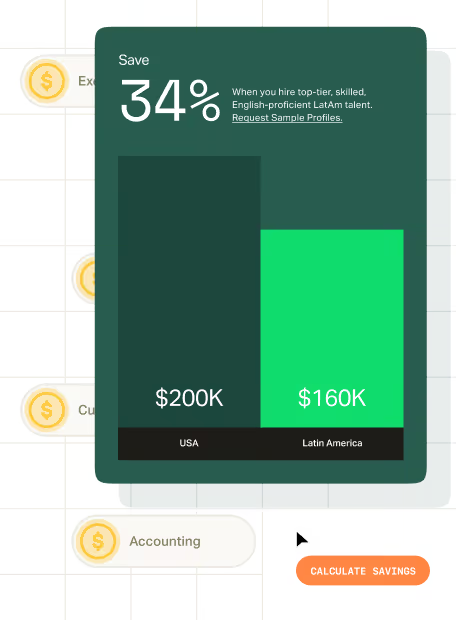
Hiring a Flutter developer in Latin America typically runs $30K to $84K a year depending on seniority, compared with $80K to $189K for an equivalent US hire, savings of up to 67%. That range is what lets you put a senior engineer on the team for what a junior or mid-level developer would cost in the US.
To put that in concrete terms, here's what hiring a Flutter developer costs compared to equivalent US hires, according to Hire With Near's salary benchmarks:
For the most up-to-date figures, see Hire With Near's US vs Latin America Salary Guide.
These lower salary rates reflect differences in local economies, not a drop in quality. Many companies bring on senior-level Flutter developers for the same budget they'd spend on a junior-level hire in the US by hiring developers in Latin America.
That is how most companies use the savings. According to Hire With Near's 2026 State of LatAm Hiring Report, 98% of our engineering placements last year were mid-level or senior. Companies use the budget they save to bring on experienced engineers they couldn't easily afford or find at home, so the savings buy seniority rather than a compromise on quality.
{{latam-hiring-calculator}}
What Skills Should You Look for When Hiring Flutter Developers?
In my nearly four years recruiting technical talent at Hire With Near, I've found that hiring a great Flutter developer takes more than scanning for "Dart" on a resume. You need someone who can build well-structured apps, collaborate across teams, and keep performance in mind, all of which matter when you're building for mobile users who expect speed and reliability.
When I'm evaluating an engineer, I ask them to walk me through a real project: what their role was, what they built, and the decisions they made along the way. If they can explain it clearly to someone who isn't a developer, that tells me as much as any code sample.
I also counsel clients not to make a college degree a hard requirement. Some of the strongest engineers I've placed in Latin America started working before they finished their degree, and their hands-on experience is what carries the work.
The candidates worth flying through your process pair technical depth with the communication habits that keep a distributed team moving. Here's what to screen for in each.
Hard skills (the must-haves)
The best Flutter developers know how to:
- Write solid Dart code: Dart is the foundation of Flutter. Look for developers who understand Dart's async features, type system, and structure. You want clean, readable code that stays easy to maintain as the app grows.
- Master Flutter's framework and widgets: Flutter is built on a rich widget system. A strong developer should be comfortable building custom UIs, managing layouts with widgets, and handling common components like navigation and forms.
- Handle state management: Whether they prefer Provider, Riverpod, Bloc, or another approach, they should know how to manage application state cleanly and predictably. Poor state management leads to bugs and inconsistent UI behavior.
- Integrate with APIs: Almost every production app leans on a backend. Flutter developers should be able to connect
- Write and maintain tests: Testing matters. Look for hands-on experience with unit tests, widget tests, and integration tests. They're what let a team ship changes without breaking what already works.
- Optimize app performance: A polished Flutter app should feel smooth, not sluggish. Developers should understand how to reduce widget rebuilds, optimize animations, and manage memory.
Soft skills (equally important)
Technical skills get apps built. Soft skills keep teams running.
- Clear communication: Flutter developers often work with designers, PMs, and backend engineers. Look for people who can explain technical choices without jargon and ask the right questions early.
- Proactive problem-solving: Good developers don't wait to be told how to fix something. They come with options and explain trade-offs.
- Feedback maturity: Strong developers should be able to reflect on what worked, what didn't, and what they learned. This is even more important when it comes to receiving and applying feedback.
- Collaboration across distributed teams: If you're hiring for a remote role, you'll want someone who can work asynchronously, keep updates clear, and adapt to different communication styles.
- Ownership: The best candidates take responsibility for what they ship. In interviews, listen for language like "I made this decision because…" rather than vague group attributions.
Nice-to-have skills (the differentiators)
Not essential, but great bonuses, especially for product-focused teams.
- Experience with Firebase or Supabase: Many Flutter apps use these backends for auth, real-time updates, and database access. Familiarity here can speed up development and reduce third-party integration time.
- Native iOS or Android knowledge: Sometimes, Flutter apps need custom platform code to access device-specific functionality or SDKs. Developers with native experience can bridge those gaps, reducing the need to outsource work to iOS developers or Android developers separately for one-off tasks or integrations. This can save time, reduce complexity, and keep your team lean.
- Comfort with UI/UX tools like Figma: If your design team hands off mockups, a developer who can read and translate them accurately into Flutter code can reduce back-and-forth and save time.
- Accessibility and performance tuning: A working app is the baseline. Screen for developers who also care whether it loads fast on mid-range Android devices and works with screen readers.
- Experience publishing apps to the App Store and Google Play: Review rejections, signing certificates, and versioning trip up teams shipping their first app. A developer who has been through submission a few times will save you that learning curve.
- Familiarity with Git workflows and CI/CD pipelines: While not essential for every Flutter developer, experience with version control systems (like Git) and mobile-focused CI/CD tools (such as Codemagic, Bitrise, or GitHub Actions) can speed up collaboration and deployment. This is especially valuable on lean teams where developers manage their own builds and releases. On larger teams, these responsibilities are often handled by DevOps or senior engineers, but developers who understand the basics tend to work more efficiently across environments.
Choosing the Right Hiring Model: Why Building Your Own Team Wins
Different hiring models offer different levels of commitment, control, and collaboration, so it's worth zooming out before you decide where to look.
Here's how the main options compare:
You have four realistic paths:
- Source and hire on your own. You handle everything yourself, from sourcing to vetting to onboarding. This gives you full control, and it puts the entire workload on your team.
- Freelance or contractor platforms. Best for short-term, project-based work. Freelancers are quick to bring on, though they're usually splitting their attention across several clients.
- Staff augmentation. Best for flexible or project-based capacity. A provider places a pre-vetted developer on your team for a defined period and handles payroll and compliance behind the scenes.
- A specialist staffing and recruiting partner. Best for a full-time hire who stays with you long-term. The partner finds the talent and handles contracts, payroll, and compliance, so you get recruiting help and hands-off logistics in one relationship.
For most teams building a lasting product, that last path is the one worth choosing.
In our experience helping companies hire hundreds of developers across Latin America, building your own team of full-time Flutter developers delivers the best long-term results.
You get real ownership, better communication, and a team that grows with your business over time.
Want to understand why forward-thinking tech leaders are embracing this model? Here's how CTOs are building engineering teams in Latin America.
Where Can You Find and Hire Great Flutter Developers?
Hiring Flutter developers starts with two decisions:
- Where your candidates will be located
- What channels you will use to source them
Let's start with geography.
Choosing between local, remote, and international talent
You're not limited to your local city or even the US. Flutter is a remote-friendly framework, and developers around the world are building apps with it every day.
Each hiring path comes with trade-offs:
In-office/local developers:
- Easier onboarding and integration with your team
- Face-to-face collaboration is especially helpful for startups or product-led companies
- Simpler payroll and HR administration
- Often the most expensive option, especially in major US tech hubs
Remote US-based developers:
- Broader talent pool than local-only searches
- Aligned with US business practices and team structures
- No international compliance concerns
- Still comes with US-level salary expectations
Offshore developers:
- Significantly wider talent pool and lower costs (often 30–70% compared to US rates)
- Real-time collaboration is possible if you hire in Latin America
- Time zone challenges when hiring from other regions
Further reading: Why US Businesses Should Offshore Mobile App Development
Remote hiring is the norm now, not a fallback. According to the Stack Overflow Developer Survey 2025, 45% of US developers work fully remote, the highest share among the survey's top-reporting countries, while under a fifth are fully in-office. Hiring a developer who sits outside your office is no longer a compromise; it's how most of the field already works.
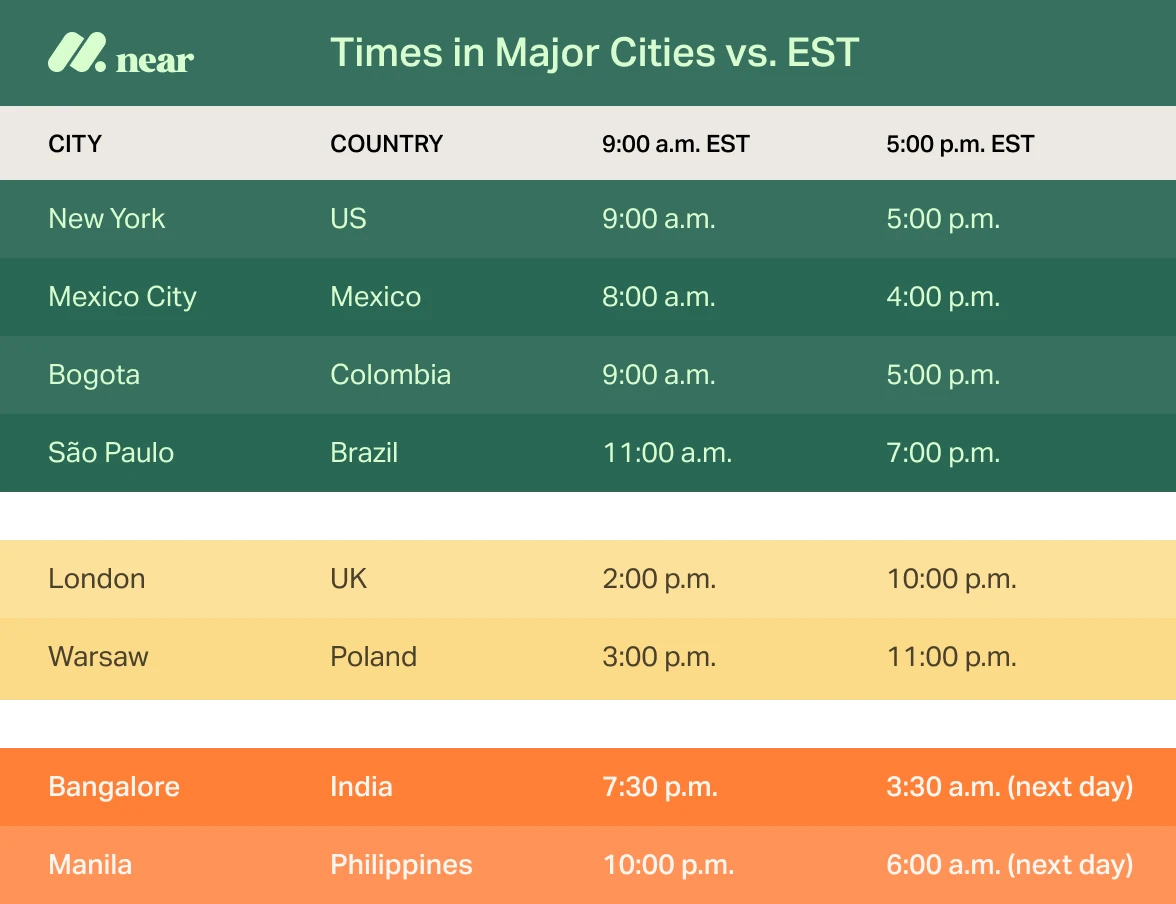
The bigger question is where. Some teams turn to offshore Flutter app development to stand up a full team quickly, but the trade-off is time zones. With an offshore team in Asia, the workday barely overlaps yours, and that gap shows up in the day-to-day.
One startup founder who had been running an offshore engineering team in India described the cost of it:
You lose a day. You lose a day every single time just from a message. I can't do that anymore, at least for the engineer.
For many companies, Latin America strikes the right balance. You get strong technical skills, overlap with your working day wherever your team sits in the US, cultural familiarity, and more budget flexibility than hiring at home. That real-time overlap is a big part of why so many US teams now hire in Latin America instead of going fully offshore.
It also answers the concern behind one of the questions tech leaders ask when hiring developers in Latin America most often: will this person join our stand-ups and iterate with us in real time? Because Latin American developers share your working day, live stand-up participation and same-day turnarounds are the norm.
Regions like Brazil and Mexico have particularly large Flutter communities. In fact, usage data from BuiltWith shows Flutter is more widely used in Brazil and India than in most European countries or the UK, making it easier to find experienced developers in countries with a lower cost of living.
Which country fits best depends on the role, seniority, and budget, so a good hiring partner will point you toward the right talent pool rather than leaving you to guess.
Other regions to consider include Eastern Europe (Poland, Serbia, Romania) and Southeast Asia (India, Vietnam, and the Philippines). You'll need strong asynchronous workflows in place, though, since the large time difference limits real-time collaboration.
Choosing the right sourcing channel
Once you've decided where to search, the next step is choosing how. Here's a breakdown of common sourcing options and how they compare:
For Flutter-specific roles, it's also worth checking niche communities like the FlutterDev subreddit, Flutter's official Discord, or GitHub contributors to prominent packages.
These can be helpful for identifying active developers, especially if you're comfortable doing outreach directly.
Each sourcing option has its strengths, and the best approach often depends on your timeline, hiring goals, and available bandwidth.
Many teams start with referrals or job boards, then bring in freelance help or explore platforms when things slow down. There are also companies that help you hire developers in Latin America end to end, from sourcing through screening.
But if you're hiring for a key role, need to move quickly, or want help evaluating technical fit, a recruitment partner can be a smart next step.
Later in this article, we'll take a closer look at how working with recruitment partners can simplify the process, especially if you're exploring international candidates.
They're not the only effective option, but they can save time, reduce risk, and connect you with talent you might otherwise miss.
How to Hire the Best Flutter Developers: Best Practices
The teams that hire well run the same repeatable process every time, they don't rely on resumes alone or rush through interviews. They follow a clear structure that helps them define what they really need, evaluate candidates effectively, and close offers before top talent slips away.
Here's how we recommend approaching it.
Stage 1: Set the right foundation before sourcing
Know what you're building and who you really need
Before writing the job post, align internally on how Flutter fits into your current or future roadmap. Is this a short-term app build, or will this person be maintaining features long-term? Will they own the UI layer, or collaborate closely with backend and product teams?
If you're still figuring out the scope or direction of your app, working with an external team early can help clarify what kind of developer you need. Specialized talent can help shape requirements, set priorities, and even advise on architecture choices before you commit to hiring in-house.
Write a role-specific job description that attracts the right candidates
Your job description sets the tone for the whole hiring process. It should clearly distinguish between must-have and nice-to-have skills.
Include the specific frameworks, testing tools, and collaboration styles your team uses. Don't forget to speak to the opportunity itself, whether it's a chance to ship a new product or scale an existing one.
Stage 2: Screening and evaluation
Go beyond resumes with real-world tasks
A strong GitHub or portfolio page is a good start. It doesn't show how someone works in your context, though, and with AI-generated resumes everywhere, it's harder than ever to judge from paper alone. That's why I always put top candidates through a short, role-specific task before anyone commits.
That might mean:
- Debugging a broken widget
- Refactoring a small feature to follow SOLID principles
- Building a basic screen from a Figma mockup
- Implementing a simple API call with test coverage
In my experience, a real-world task followed by a collaborative review reveals how a candidate thinks through a real problem.
Live coding sessions can work well for quick logic exercises. However, take-home projects give candidates more space to demonstrate problem-solving. I've found a mix of both works best.
Ask about the decisions behind the work
The strongest Flutter developers can explain why they chose a certain state management approach, how they structured navigation, or why they wrote a test a certain way.
Ask follow-up questions like, "What trade-offs did you consider here?" or "Would you approach this differently next time?"
Ask them to walk through their role in past projects. If they're vague or overly general, it's a sign they may not have owned their work. It could also mean they aren't confident talking about it.
Test for feedback and communication
The question I always ask here is how a candidate handles feedback. I want them to name a specific time they changed course based on team input; if they can't, that's a red flag for me.
Strong candidates will show a willingness to adapt and improve. That's especially important in fast-moving projects where iteration and collaboration matter more than rigid correctness.
Stage 3: Make an offer that developers want to say yes to
Move quickly, and don't go silent
If you've found someone who fits your needs, make it official, and fast. Flutter is in high demand, and delays in feedback or offer letters can push top candidates toward other companies.
Communicate clearly throughout the final stage. Let them know what to expect when you get back to them, and how soon they can start contributing.
Build an offer that reflects what devs want
Top Flutter developers tend to be drawn to flexibility, autonomy, and long-term product ownership. Many also care about learning opportunities and staying connected to the open-source community.
Because Flutter is an open-source framework, many developers are active contributors. In fact, GitHub's 2024 Octoverse report ranked Flutter in the top 10 open-source projects by contributor count.
If your team supports open-source contributions or has internal projects that devs can own, be sure to include that in the offer. It's a major plus for many candidates.
While salary matters, it's not the only lever. Perks like flexible hours, remote-friendly policies, meaningful PTO, and a clear growth path carry real weight.
You can read more about how to make a strong offer that secures and retains top talent in our in-depth guide.
Top Interview Questions for Hiring Flutter Developers
Interviewing Flutter developers goes beyond checking for Dart knowledge or asking which state management library they prefer.
You want to understand how they think, build, and contribute to a team. In a role that blends front-end logic with product experience, this is especially important.
I put these five questions together from the interviews I run with mobile and cross-platform engineers. What I'm really doing with each one is getting the candidate to show how they think and build in practice. One more signal I watch for across any interview: if someone claims to be juggling two or three jobs in parallel, that's a red flag for me. I'd rather see two or three years of focused tenure in a role.
Here are five questions to ask, and what to listen for.
"Can you walk me through a time when you needed to customize or extend a Flutter widget?"
Flutter's composability is powerful, but real-world apps often need something more than the default.
This question helps you understand how the candidate thinks beyond drag-and-drop components. Look for someone who can explain:
- Why the existing widget didn't meet their needs
- How they modified or extended it (composition, inheritance, etc.)
- How they maintained performance and reusability
Red flag: Vague answers that focus on using prebuilt packages without context.
"How do you approach debugging performance issues on mobile?"
Slow or jittery interfaces turn users away fast. This question helps you understand the developer's fluency with performance tuning.
Good answers will include:
- Using Flutter DevTools or the performance overlay
- Diagnosing layout overdraws or expensive rebuilds
- Applying best practices like `const` constructors, widget splitting, and lazy loading
Red flag: Generic answers like "I test it a lot" or over-reliance on trial and error.
"Describe a time you had to optimize build performance in a large Flutter app."
Apps with complex UIs can suffer if widget trees aren't optimized. This question checks for real experience with performance.
Look for insight into:
- Identifying unnecessary rebuilds
- Using tools like Flutter DevTools or the widget inspector
- Splitting widgets and using `const` constructors effectively
Red flag: Overly general statements like "I just used setState carefully" without specifics.
"Tell me about a Flutter app you built from scratch. What were the main challenges?"
This open-ended question reveals ownership, initiative, and real-world problem-solving.
You're looking for candidates who can explain:
- Their role in the project
- How they planned the app architecture
- How they handled unforeseen challenges during development
Red flag: Struggling to describe their contribution, or skipping directly to the end result without context.
"What's something you've contributed to the Flutter ecosystem, or would like to?"
This question helps surface curiosity, initiative, and a developer's connection to the broader community. Flutter has a strong open-source culture, and many devs contribute to or follow discussions.
Listen for:
- GitHub contributions, Stack Overflow activity, or package suggestions
- Interest in improving tooling, accessibility, or testing
Red flag: No awareness of Flutter's community at all. This is quite a large red flag for senior candidates.
{{hiring-remotely}}
Common Mistakes to Avoid When Hiring Flutter Developers
Even teams with a solid process make a handful of predictable mistakes, and most of them show up after the offer is signed, when they're expensive to fix.
Here are five of the most common mistakes we have seen teams make when hiring Flutter developers, and how to avoid them.
1. Prioritizing price over quality
It's tempting to focus on cost when hiring technical roles, especially if you're looking offshore. However, hiring based purely on rate often leads to inconsistent code, unclear communication, and more work for your existing team.
Flutter development is about more than getting an app to run; it comes down to long-term maintainability, scalability, and performance. Paying slightly more for someone who understands architecture and team collaboration will save you from costly rebuilds later.
Offshore hiring can reduce costs. However, the best approach is to weigh value over price alone. Look for developers who deliver strong results, even when they cost a little more than the cheapest option.
2. Filtering out candidates without a formal CS degree
A computer science degree doesn't guarantee real-world coding skills. In fact, according to Stack Overflow's 2024 Developer Survey, 82.1% of developers say they use online resources to learn to code. Many never finished a degree at all.
This is especially true in Latin America, where, as our recruiters note, many talented developers begin working before they graduate. By limiting your search to degree-holders, you risk overlooking capable candidates with years of hands-on experience.
Focus on what they can build, regardless of where or whether they studied.
3. Leaving the tech roadmap out of the conversation
Developers want to know where Flutter fits into your product vision. Is it a core part of the stack long-term, or a short-term experiment?
Failing to clarify this can lead to mismatched expectations, where candidates assume they're building a lasting product only to find they're maintaining a prototype.
Be upfront about your roadmap. You'll attract candidates who want the same outcome you do and are more invested in the result.
4. Ignoring platform-specific constraints during the hiring conversation
Flutter's promise of "write once, run anywhere" is powerful. In reality, however, different platforms come with different challenges.
Android and iOS have unique permission models, rendering quirks, and performance behaviors that still require platform-specific awareness.
This is an issue not just with Flutter, but with other cross-platform frameworks as well. Many companies skip over this in interviews and end up hiring developers who can build for both platforms in theory.
During the hiring process, ask how candidates have handled platform-specific issues. If they've never had to bridge native code or troubleshoot a platform-specific bug, they may not be ready for production-level work.
5. Expecting one person to do everything
Some companies treat Flutter developers as full-stack engineers, expecting them to handle backend services, DevOps, infrastructure, and app store deployments on top of UI.
This stretches the role too far and increases the risk of burnout or underperformance. Flutter developers specialize in building polished, cross-platform interfaces, which is where their value is.
Define the scope clearly and build complementary support around it, whether that's outsourcing your backend engineers or hiring a QA tester.
Why Working With a Recruiting Partner Makes a Difference
A recruiting partner makes the biggest difference when you're hiring under time pressure, building your first mobile team, or expanding outside the US. You can absolutely hire a great Flutter developer on your own, and many companies do.
If you've hired for technical roles before, have time to screen candidates, and understand what makes a strong Flutter developer, a DIY approach can work. For everyone else, working with a recruiting partner makes the process faster and easier.
We've seen this work over and over for hundreds of US businesses that want high-quality results without spending weeks chasing the wrong candidates. A partner focused on IT and tech recruiting in Latin America already knows the market, the salary bands, and where the strong Flutter talent is.
Take Bonfire, an e-commerce platform for custom merchandise and fundraising. Their design and UX lead had hired remotely before, but his DIY process of posting on LinkedIn and remote job boards, reviewing applications by hand, and keeping personal candidate lists ate two to three months per hire.
After bringing in Hire With Near to handle sourcing and initial screening, he filled a senior UX Engineer role in six weeks, about twice as fast. (The search itself was for a UX Engineer, not a Flutter developer, but the sourcing and vetting process is the same one we run for mobile and cross-platform hires.) He saved roughly $53,000 a year compared to a US-based hire, and the person stayed on the team for more than two years. Bonfire stopped running each search as a DIY project and came back for later product and design roles.
As Bonfire's Director of Design and UX put it:
It was shocking to see the difference between the talent Hire With Near brought versus other firms I worked with.
Other teams describe the same DIY fatigue. A digital product agency that had been sourcing its own Latin American engineers through hiring platforms told us:
We have been doing it ourselves and it's getting to be a lot of work... I feel like it would be faster, more efficient, and a better use of our time if these candidates were pre-vetted, pre-screened a little better.
A recruiting partner with experience hiring Flutter developers can help you:
- Pre-vet candidates for both technical and soft skills
- Reduce your time-to-hire by surfacing strong fits early
- Handle international logistics like contracts, payment, and compliance if you're hiring abroad
A partner can guide you through early steps like defining project requirements, setting a budget, and finding and assessing developers in specific markets, which are all essential if you're thinking about hiring offshore app developers.
Recruiters are not the only option, but when speed, quality, and cross-border coordination are priorities, working with one is often the smartest path.
Final Thoughts
The pattern across everything above is simple: decide where your candidates will sit, screen with a real task instead of a resume scan, and move fast once someone clears the bar. Teams that follow those three steps land senior Flutter engineers in weeks; teams that improvise are still sorting applications when the release date arrives.
Whether you're building something short-term or planning to scale a long-term product, the right hire can make a real difference in both speed and results.
If working with a recruitment partner feels like the right move, Hire With Near can help. We connect US companies with pre-vetted Flutter developers in Latin America who bring strong technical skills, overlapping working hours, and savings of up to 67% compared with a US hire.
We take time to understand your needs so we can match you with candidates who are ready to contribute from day one.
You can see how clients rate the experience. Hire With Near holds a 4.9 on G2 from verified reviews.
Book a free consultation to talk through your requirements, and we'll share salary benchmarks and walk you through how the process works so you have what you need to decide.
{{latam-hiring-cta-v2}}
Frequently Asked Questions
Is Flutter still used in 2026?
Yes, Flutter is very much in active use in 2026, powering cross-platform apps for startups and large product teams alike. It remains one of the most widely adopted frameworks for building for iOS, Android, web, and desktop from a single codebase, with an active open-source contributor community and strong adoption in developer markets like Brazil and India. If you're building a mobile or multi-platform product, hiring for Flutter is still a safe, well-supported choice.
What is the hourly rate for a Flutter developer?
A full-time Flutter developer in Latin America typically costs between $30K and $84K per year depending on seniority, according to our salary data, which works out to a far lower effective rate than a comparable US hire at $80K to $189K. Freelance hourly rates swing widely by platform and experience, but for a full-time team member the more useful number is annual salary, since you're paying for an ongoing role rather than one-off project hours.
Will a Flutter developer in Latin America work my time zone and join our stand-ups?
Yes. Latin American developers work hours that overlap with your business day, whether you're on the East Coast, in the Central states, in the Mountain zone, or on the West Coast. That means live stand-ups, same-day answers, and real-time collaboration during your workday.
An offshore team in Asia is logged off while your US office is open, so a question sent in the afternoon waits until the next day. Most of Latin America sits within the same band of hours as the continental US, which is a big reason so many companies switch from offshore engineering to nearshore.
How good is a Latin American Flutter developer's English?
Strong professional and technical English is common among Latin American developers who work with US clients, many of whom collaborate in English every day. The best way to verify it is to ask a candidate to explain a past project on a live call: you'll quickly hear whether they can walk through architecture decisions and trade-offs clearly.
Fluency, meaning being understood and able to hold a technical conversation, matters far more than a perfect accent.
How long does it take to hire a Flutter developer?
It usually takes weeks, not months, when the sourcing and screening are handled for you. Bonfire filled a senior engineering role in six weeks after its own DIY search had been running two to three months per hire.
What happens if a Flutter developer we hire doesn't work out?
Reputable staffing and recruiting partners back their placements with a replacement guarantee and manage the re-search if a hire doesn't stick, so you're not left starting from zero. Ask any provider you're considering how their guarantee works, how long it lasts, and who handles sourcing the replacement before you sign anything.
A partner that vets candidates thoroughly upfront, for both technical skill and how they work with a team, is the best protection against a mis-hire in the first place.
What other developer roles can I hire in Latin America?
Beyond Flutter developers, US companies hire a wide range of engineering roles in Latin America, including React Native developers, the closest cross-platform alternative to Flutter, mobile developers for broader native and cross-platform work, back-end developers to build the services your app relies on, and QA engineers to test what ships. Latin American engineers in these roles typically bring the same technical depth as US-based professionals, with better time zone overlap than offshore alternatives and meaningful cost savings.







.webp)


%203.svg)
.avif)




%20(1).avif)

%20(1).png)