%203.svg)
Key Takeaways
- Outsourcing back-end development means paying an outside team to build and run your server-side systems, and you have three models to choose from: a managed development firm that assigns and supervises the engineers, a staffing and recruiting partner that helps you hire your own back-end developer, and an in-house hire you source and employ yourself.
- What it costs depends on seniority, delivery region, and whether you're paying for a managed-team wrapper or just the engineer's time. Our salary data puts a mid-level back-end developer in Latin America at $48K–$72K a year against $73K–$134K in the US.
- Use the comparison table below to shortlist: it lines up all eleven companies by delivery model, engagement options, best fit, and client rating.
The best way to outsource back-end development depends on how much of the work you want to own: a managed development firm builds and runs it for you, while a staffing and recruiting partner helps you hire your own back-end developer. The eleven companies below span both categories.
Most teams reach the decision to outsource after facing the same issues: your engineers can do the server-side and infrastructure work, but it's eating the invaluable hours they should be spending on the product.
This list covers managed development firms and one staffing partner: what each does best, where they deliver from, and what they charge when that's public. Full disclosure, Hire With Near is one of the eleven, and we'll be straight about where we fit and where another company is the better call.
What Are the Benefits of Outsourcing Back-End Development?
Outsourcing back-end development gives you three things that are hard to get from a local hire: specialist server-side skills on demand, a lower cost for the same seniority, and capacity you can add or drop as the roadmap changes.
Building and maintaining a strong back-end development team in the US is getting harder and more expensive. The SignalFire State of Tech Talent Report - 2025, built on data from more than 650 million professional profiles, found that hiring rebounded in 2024 for mid- and senior-level roles while new-grad hiring kept contracting. New grads now account for just 7% of hires at large tech companies, down 25% from 2023.
The competition is concentrated at the experienced end of the market, which is exactly where back-end and platform work sits.
That's why more companies are looking at outsourcing as a strategic move, not just a cost-cutting measure. Whether you hand a project to a firm or hire your own back-end developer in Latin America, you're solving the same problem: getting experienced server-side capacity without a six-month search.
That said, outsourcing isn't without trade-offs: quality control and communication take real effort to get right. Here's why it's gaining traction anyway.
Access to specialized skills when you need them
Here’s a common situation: you need someone with specific back-end expertise, maybe experience with a particular framework or specialized knowledge in areas like API development or database optimization. Finding this locally often means either:
- Spending months searching for the perfect candidate who might not even exist in your area
- Taking on a full-time hire when you really just need that expertise for specific projects
- Training someone internally, which takes time you don’t have
This is where outsourcing makes sense: you can hire from a wider market that already has the exact experience you're looking for, instead of compromising on skills or waiting out a search that might not pan out.
Think of it as having a specialist on call, without building out an entire in-house team for every skill set your projects might require.
Lower cost for the same seniority
The cost advantages of outsourcing development come from two main factors:
First, the economics are just different in many tech hubs around the world. In Latin America, you can hire exceptional developers who have worked with major US companies, know all the latest technologies, and deliver outstanding work.
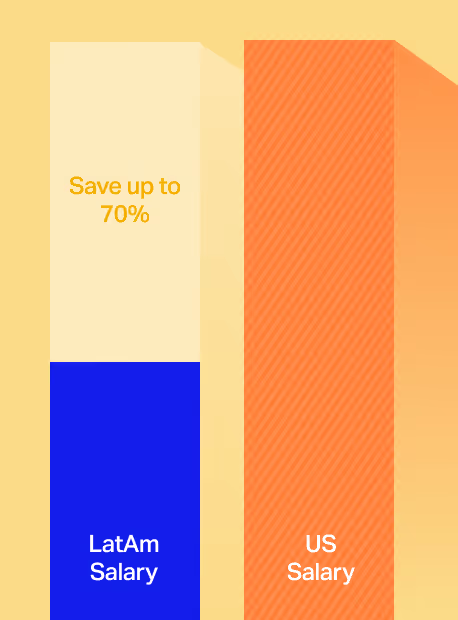
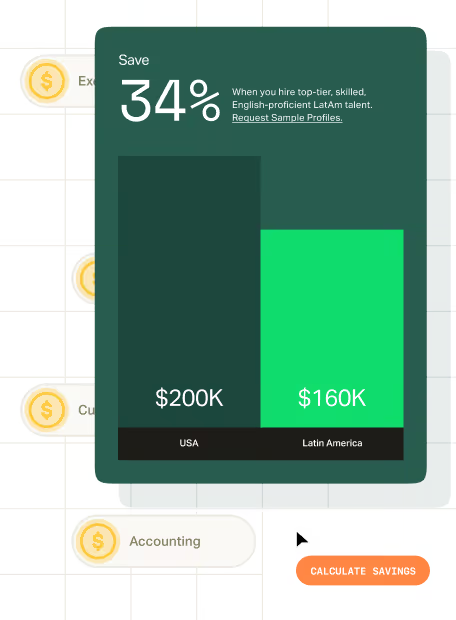
Rates are lower there because the cost of living is lower in their local economies. Our data shows companies typically save up to 62% by hiring back-end engineers in Latin America, driven by regional cost of living rather than lower pay for the same caliber of talent.
If you’re working with full-service development firms, you get additional savings from their economies of scale. These firms supply everything (development teams and project managers, infrastructure, QA) across dozens of projects and clients. That’s much more efficient than trying to build all that capability yourself, especially for specific projects or technologies where you don’t need a permanent in-house team.
Scalability and flexibility
When you’re working with outsourced developers, you’re not locked into traditional employment structures. Need to quickly add three developers for a major project? You can do that without going through months of US recruitment. Need to scale back after? You can do that too.
Free your senior developers for product work
Here’s what often happens with in-house teams: your best developers get pulled into maintenance tasks or small feature updates instead of working on core innovations. With outsourcing, you can build a team specifically for maintenance and routine development, freeing up your local team for strategic initiatives.
Faster time-to-market
Outsourcing shortens your timeline in two opposite ways, and the right one depends on how your team works.
The first is real-time overlap. If your project needs quick iterations and lots of back-and-forth, nearshore development teams in Latin America are ideal: your working hours overlap with theirs for most of the day, so Latin American developers keep teams moving in step with you. Questions get answered immediately instead of waiting overnight.
The second is round-the-clock coverage. Some companies deliberately spread development across multiple time zones so work never fully stops: an Asian team hands off to a European team, who hands off to an Americas team. This suits independent modules and maintenance work better than tightly collaborative builds.
Either approach beats a local hire on speed. You can have the right people working on your project within weeks, not months.
When Should You Outsource Back-End Development vs. Keep It In-House?
Outsource back-end work when it's bounded, non-core, or needs a skill you won't need permanently: a database migration, an API integration sprint, a legacy modernization, or QA and DevOps overflow. Keep it in-house when the back-end is the product, when the code needs institutional memory, or when you need someone who owns the roadmap rather than a ticket queue.
In the editorial work I do turning our recruiters' experience into guidance for hiring managers, one question decides this more often than budget: who does the engineer work for? A marketplace freelancer splits the week across clients, a managed firm may rotate people between accounts as projects start and finish, and a dedicated hire works only for you.
Shared attention is fine for bounded work with a clear finish line and bad for systems that need context, ownership, and continuity, which back-end systems almost always do. Ask any provider whether the engineer is allocated to you full time, and whether that changes between sprints.
A high engineering bar is where the fully managed model strains hardest. One technology leader at a large US manufacturing and technology company described what happened after routing work through an agency:
And we've had experience with contracted labor where we go to an agency. They provide us talent, but they are the supervisors. They run everything. And it's been a bad experience. They haven't met our expectations on quality.
There's a third path, and it's the one most teams settle on: hire your own back-end developer, DevOps engineer, or platform engineer in Latin America, so the person reports to you and works during your business hours.
Hire With Near's research into why US companies turn to Latin American hiring found that 12% made this move specifically to get off outsourcing agencies and hire directly, and IT and engineering makes up 16% of that group.
An operator running several direct-to-consumer e-commerce brands put the objection plainly:
The other company, everything goes through them, and there was too much back and forth. That was a big issue. I also like the idea of us being able to onboard them as our own.
Hiring directly doesn't have to cost you speed or rigor. A US healthtech startup of 101 to 250 employees kept its entire eight-step evaluation process, deep technical screens and coding assessments included, and still brought on seven senior engineers across back-end, DevOps, QA, mobile, and frontend roles, saving $323,000 a year against equivalent US salaries.
SaaS and product teams scaling APIs and infrastructure reach this fork first, which is why nearshore SaaS engineering recruiters often get a call before a dev shop does. Our breakdown of whether to hire an in-house developer or outsource covers the trade-offs, and hiring remotely in Latin America is well-trodden ground at this point.
How Much Does It Cost to Outsource Back-End Development?
Hiring a back-end developer in Latin America costs $48K–$72K a year at mid-level against $73K–$134K for the same seniority in the US, and whatever a provider charges on top of that depends on whether you're buying managed delivery or the engineer's time alone.
For an onshore reference point, the US Bureau of Labor Statistics put the median annual wage for software developers at $133,080 in May 2024.
Here's what a back-end developer costs in Latin America compared to an equivalent US hire, according to Hire With Near's salary benchmarks:
For the most up-to-date figures, see Hire With Near's US vs Latin America Salary Guide.
According to Hire With Near's 2026 State of LatAm Hiring Report, 98% of our engineering placements were mid-level or senior: 47% mid-level and 51% senior.
Companies aren't hiring junior engineers in Latin America to save money. They're hiring experienced people at rates that are competitive locally, which is also why paying at the bottom of the band tends to backfire: the bottom of the band gets you the bottom of the market.
For the wider picture, see back-end developer salaries in Latin America across the engineering function.
Whichever provider you talk to, you'll be quoted one of four structures:
- Fixed-price project: one number for a defined scope. Best when the requirements genuinely won't move, and painful when they do.
- Dedicated team or staff augmentation: a monthly rate per engineer, billed for as long as you need the capacity. Best for ongoing back-end work with a moving backlog.
- One-time recruiting fee: you pay once for a direct hire who then goes on your own payroll. Best when the role is permanent.
- Monthly staffing fee: the partner sources the person and also handles payroll and compliance for as long as they're on your team. Best when you want a dedicated hire without building international HR machinery.
Three things move the total more than anything else: the seniority you need, where the engineers are based, and whether you're paying for a managed-team wrapper (project managers, QA, delivery oversight) or just the engineer.
Our breakdown of how much offshore developers cost and our guide to hiring Latin American developers go deeper on both.
Before you sign anything, ask what happens if you want to convert the person to your own payroll, what happens if they leave in month three, and what portion of the rate reaches the engineer. Clear answers to all three are a good sign.
Back-End Development Services for Outsourcing
You can outsource back-end development as nine separate services, from API development and database management to QA, security, and ongoing maintenance, and you don’t have to hand over all of them.
When people talk about back-end development, they often treat it like one big thing. But in reality, it’s a whole ecosystem of different services.
Start with the capability that’s slowing you down most right now, whether that’s scaling up your infrastructure, improving performance, or launching new features faster.
Here are the main services you can outsource, either individually or as part of a broader development strategy:
- API development and integration: Outsourcing API development connects your applications to other software cleanly, whether building APIs from scratch or integrating existing ones.
- Database management and optimization: Experts can manage, optimize, and maintain your databases, giving you data integrity, enhanced performance, and efficient storage solutions. A specialist in database management and optimization is often the first hire teams make once queries start timing out.
- Performance tuning and scaling: Specialized developers can fine-tune your system’s performance and create scalability, allowing your application to handle increased loads and user demand without lag.
- Server management: Outsourcing companies can handle efficient server management, including setup, monitoring, and troubleshooting, to keep your infrastructure stable and reliable.
- Cloud hosting solutions: A cloud developer can migrate your services to a cloud platform, run them in production, and cut what you’re paying for capacity you don’t use.
- Quality assurance (QA): Outsourcing QA catches problems in your back-end systems before they go live, so releases are more reliable.
- Security implementation: Protect your software with professional-grade security solutions that safeguard against vulnerabilities and comply with industry standards.
- System integration: Connect subsystems so they work together, improving overall system functionality and user experience.
- Maintenance and support: Continuous maintenance and support services keep your back-end systems up to date, resolve issues promptly, minimize downtime, and enhance productivity.
Outsourcing these services lets you take on complex back-end work without overburdening your internal teams.
11 Top Companies for Outsourcing Back-End Development
The eleven companies below split into two models: managed development firms that assign and manage the engineers themselves, and one staffing and recruiting partner that helps you hire your own.
Within the managed firms, there's real variety: from a Python specialist to a legacy-modernization shop to an enterprise delivery partner, and the roster deliberately spans nearshore Latin America, Eastern Europe, and Vietnam so you can see what back-end development outsourcing costs and delivers at each distance.
How we built this list: Every company here meets at least one of two criteria. They either hold at least 40 client reviews on an established review platform (G2, Clutch, Trustpilot, GoodFirms, or ClearlyRated, client ratings only) with an overall rating of 4.5 or above, or they have a verifiable track record with large, recognizable enterprise clients.
The second criterion applies when a company's client roster speaks to a level of delivery quality that enterprise procurement validates in a way review platforms often don't capture: EX Squared is on this list on that basis, with published work for Coca-Cola, Kimberly-Clark, Bechtel, Lennar, and KFC.
From the companies that qualified, we compared back-end and platform engineering capability, delivery regions, engagement models, and published pricing on their own websites.
The companies below are in no particular order, and the numbering implies no ranking. There is no single best option for everyone; the right fit depends on your stack, your budget, your timeline, and how much of the work you want to own. Our goal is to help you build a shortlist worth calling, not to declare a winner. That part only becomes clear in the conversations.
If your need is broader than back-end work, our roundup of nearshore software development companies covers the same category without the back-end filter.
Here's how the eleven compare at a glance:
Note: To keep this list aligned with our selection criteria, we regularly re-check ratings on third-party review sites and update the table as needed.
Because the roster spans three delivery regions, it's worth knowing how nearshore and offshore delivery compare and how hiring remote talent in Latin America stacks up against Eastern Europe before you shortlist. Here's what sets each company apart.
1. Hire With Near

Website: hirewithnear.com
Rating: 4.9/5 on G2 (150+ reviews) as of August 2026
Model: Staffing and recruiting partner: direct hire or monthly staffing
Focus regions: Latin America only
Hire With Near is a full-service staffing and recruiting agency that helps US companies of all sizes hire pre-vetted remote professionals in Latin America across all industries and departments, including back-end development.
We handle sourcing, screening, candidate presentation, payroll, and compliance, so the hire lands on your team rather than on a vendor's org chart.
We're the one company here that doesn't deliver the code. When you outsource back-end development to a firm, that firm picks the engineers, manages them, and owns the relationship.
It's a good arrangement for bounded, well-specified projects. It's a harder one when the back-end is the product and you need someone who learns your systems and stays with them.
We help you hire that person directly: your interview, your decision, your team, working from Latin America in hours that overlap with yours.
Key features
- Senior back-end and platform hires: We place senior back-end, API, DevOps, and data engineers every week, with specialist tech recruiters screening beyond keywords for real-world impact. Whether you need Python, Node.js, Java, or Go, or someone who has run a specific cloud in production, our recruiters know the difference and why it matters for your build.
- Quality-first approach: Our 97% placement rate and 9.1 client satisfaction score come from obsessing over fit, not just skills but the drive, readiness, and cultural match to contribute from day one. Our team does IT and tech recruiting in Latin America full time, and we screen for engineers who raise the bar for everyone around them.
- One partner, one process: Scale across functions, not just engineering, with one dedicated team and a repeatable hiring cadence. First candidates in 3 to 5 days with video introductions, and most hires completed in under three weeks. We remember what worked last time and adapt based on your feedback, so hiring gets easier and more effective over time.
- 180-day replacement guarantee: Double the industry standard. If a hire doesn't work out in the first six months, we find a replacement at no additional cost to you.
Best for: US teams that want to own the relationship with their back-end developer, and teams that expect to hire software engineering talent in Latin America beyond this one role.
Limitations: We don't take delivery ownership. We don't run managed development teams, ship code, or supply project managers, so if you want a vendor accountable for scope and deadlines, a managed firm fits better. We also recruit in Latin America only.
Pricing: No upfront cost. Choose a one-time recruitment fee for a direct hire, or a monthly staffing fee that includes payroll and compliance. You set the salary.
2. AgileEngine
Website: agileengine.com
Rating: 5.0/5 on Clutch (60+ reviews) as of August 2026
Model: Managed development firm
Focus regions: Latin America
AgileEngine is on this list because it pairs a managed delivery model with the strongest review profile of any company here. Clutch named it a Global Winner in 2025, and its reviews carry a 100% positive feedback rate, which is unusual to hold at that volume.
That track record counts for something when you're handing over server-side work you can't easily inspect from the outside, and it's the reason AgileEngine is worth a call early in your process rather than late.
Key features
- Nearshore delivery across four countries: Engineering teams sit in Argentina, Brazil, Mexico, and Colombia, which gives most US teams a working day that overlaps with their own.
- Back-end and platform engineering as a core practice: Both are listed as primary capabilities rather than add-ons to front-end or mobile projects.
- Engagement models: Dedicated teams or staff augmentation, so you can hand over a whole workstream or add engineers to the team you already have.
Best for: Teams that want a managed nearshore team in similar time zones and weigh independent reviews heavily.
Limitations: As with any managed firm, the engineers stay on AgileEngine's payroll and report through its structure, so you're buying delivery rather than building your own bench.
Pricing: Not publicly listed.
3. BairesDev

Website: bairesdev.com
Rating: 4.9/5 on Clutch (60+ reviews) as of August 2026
Model: Managed development firm
Focus regions: Latin America, with delivery across 50 countries
BairesDev earned a spot because it's the largest software outsourcing firm to come out of Latin America and the name most US buyers already know in the nearshore category. It has delivered more than 1,200 projects for over 500 companies and reports a 91% customer satisfaction score.
Scale is the reason to consider it and also the thing to test on your first call: ask who specifically joins your team and how they were selected, because a bench that size covers a wide range of seniority.
Key features
- Team composition: 4,000+ engineers working across 50 countries.
- Engagement models: Staff augmentation, dedicated teams, and full software outsourcing.
- Specialization breakdown: Custom software development (30%), web development (20%), mobile app development (15%), AI development (10%), application testing (10%), DevOps managed services (10%), UX/UI design (5%) (via Clutch).
Client perspective: “*BairesDev provided a team of hardworking, skilled engineers and they were critical for our success.*” - Paul Degnan, Director of Platform Engineering at Celmatix (via Clutch)
Best for: Large or multi-workstream builds where you need several roles filled at once from a single vendor.
Limitations: Back-end work sits inside a broad services mix rather than a dedicated practice, so the fit depends heavily on which team you're assigned.
Pricing: Not publicly listed.
If you're torn between Hire With Near and BairesDev, our comparison of Hire With Near and BairesDev breaks down how the models differ.
4. Cheesecake Labs
Website: cheesecakelabs.com
Rating: 4.9/5 on Clutch (60+ reviews) as of August 2026
Model: Managed development firm (digital product studio)
Focus regions: Latin America and the US
Cheesecake Labs works like a product studio rather than a staffing bench. Its published client work shows back-end and API development delivered inside complete product builds, which is a different engagement from handing over a backlog and waiting.
Clutch ranked it in the top 30 of the Clutch 1000 globally, its highest tier. That combination is worth a look when your server-side decisions and your product decisions are the same conversation.
Key features
- Where the team sits: Engineering in Florianópolis, Brazil, with a San Francisco base serving US clients.
- Back-end and API scope: API design and back-end services delivered alongside front-end and mobile work, per its client case studies.
- Engagement model: Dedicated product teams rather than individual contractor placements.
Best for: Product teams that want back-end and API work delivered with product thinking attached.
Limitations: The model is product-led, so a pure staff-augmentation arrangement where you direct the engineers day to day is less natural here.
Pricing: Not publicly listed.
5. STX Next

Website: stxnext.com
Rating: 4.7/5 on Clutch (100+ reviews) as of August 2026
Model: Managed development firm
Focus regions: Europe, with a nearshore office in Mexico
STX Next is here because it's the closest thing on this list to a pure back-end specialist. Roughly 80% of its work is Python, which makes it Europe's largest Python-focused engineering partner, and it carries 101 client reviews, more than any other company here.
Depth in one stack is a real advantage when your services, data pipelines, and machine learning work all live in the same runtime and you want a partner who has seen your failure modes before.
Key features
- Nearshore option from Mexico: A Merida office supports US delivery alongside the European engineering teams.
- Engagement models: Dedicated teams and staff augmentation.
- Best-fit workloads: Back-end services, data engineering, and platform work inside the Python ecosystem.
Best for: Teams whose back-end is Python and who would rather have a partner go deep than wide.
Limitations: The Python concentration cuts both ways. If your stack is .NET, Go, or Java-first, other firms here are a closer match.
Pricing: Not publicly listed.
6. Innowise

Website: innowise.com
Rating: 4.9/5 on Clutch (70+ reviews) as of August 2026
Model: Managed development firm
Focus regions: Central and Eastern Europe
The reason Innowise made this list is its bench depth. Founded in 2007, the firm now fields more than 3,500 engineers across Eastern Europe, and its back-end and API practice sits alongside the mobile work it's better known for.
Its developers work in Java, Python, and Node.js on projects ranging from cloud platforms to blockchain. When a build needs several stacks and a lot of people at once, that range is hard to assemble anywhere else on this list.
Key features
- Engagement models: Full development process outsourcing and IT staff augmentation.
- Pricing structures: Time and materials, fixed price, or dedicated team.
- Coverage: Full-cycle web and mobile development and technology consulting alongside the back-end practice.
Client perspective: “*The quality of the candidates presented by Innowise for each role was outstanding; everyone was qualified and skilled.*” - Matthew Watson, CTO at Sionic (via Clutch)
Best for: Complex, multi-stack builds that need a deep bench quickly.
Limitations: Delivery is Eastern Europe-based, so overlap with a US working day is partial and depends on how your team schedules its own hours.
Pricing: Time and materials, fixed price, or dedicated team; rates not publicly listed.
7. Netguru
Website: netguru.com
Rating: 4.8/5 on Clutch (70+ reviews) as of August 2026
Model: Managed development firm
Focus regions: Europe
Netguru is here for how explicitly it documents its back-end practice. Fourteen-plus years in, with more than 1,000 projects delivered from Poland, the firm publishes a defined server-side stack instead of a generic custom software pitch.
That specificity is useful when you're comparing vendors on paper, because you can tell before the first call whether your runtime is one they work in every day.
It's also one of the longer-running firms here, and that shows in how standardized the delivery process looks from the outside.
Key features
- Back-end stack: Python, Node.js, Ruby on Rails, and Java.
- Adjacent capabilities: API development, cloud architecture, and DevOps and platform engineering.
- Engagement model: Dedicated teams and project-based delivery.
Best for: Teams that want a documented stack match plus cloud and DevOps capability from the same vendor.
Limitations: Poland-based delivery means partial overlap with US working hours, so plan for asynchronous handoffs for part of the day.
Pricing: Not publicly listed.
8. Onix Systems
Website: onix-systems.com
Rating: 4.8/5 on Clutch (55+ reviews) as of August 2026
Model: Managed development firm
Focus regions: Eastern Europe
Onix Systems stands out on price. At $25 to $49 an hour on Clutch, it publishes the lowest rate band of any company on this list, and it holds a 4.8 rating across 55 reviews at that price.
Custom software development accounts for about 40% of its work and DevOps managed services another 15%, so back-end and infrastructure work is a real part of the mix rather than an afterthought.
Key features
- Team and offices: Roughly 370 staff, headquartered in Ukraine with offices in Poland and Slovakia.
- Full-cycle delivery: Custom software built end to end, plus ongoing DevOps managed services after launch.
- Engagement models: Dedicated teams and managed services.
Best for: Budget-constrained teams that still want a firm with real review volume behind it.
Limitations: Eastern European delivery limits real-time overlap with a US working day, and the lower rate band means more scoping and coordination usually stays on your side.
Pricing: $25 to $49 per hour (via Clutch).
9. Saigon Technology
Website: saigontechnology.com
Rating: 4.9/5 on GoodFirms (50+ reviews) as of August 2026
Model: Managed development firm
Focus regions: Vietnam (offshore)
Saigon Technology is on this list as the offshore comparison point, and it qualified on GoodFirms rather than Clutch. Founded in 2012 in Vietnam, the firm is ISO certified and runs a team of more than 400 engineers.
Offshore delivery at that distance trades real-time collaboration for cost. It's a trade worth making for bounded, well-specified work, and a poor one for anything that needs constant back and forth with your own engineers.
Key features
- Certifications: ISO-certified delivery processes, which helps in regulated or security-reviewed procurement.
- Team size: 400+ engineers.
- Engagement models: Project-based delivery and dedicated offshore teams.
Best for: Well-specified builds and ongoing maintenance work where cost matters more than same-day overlap.
Limitations: Vietnam-based delivery leaves little overlap with a US working day, so the relationship depends on strong written specs and asynchronous discipline.
Pricing: Not publicly listed.
10. Devox Software
Website: devoxsoftware.com
Rating: 5.0/5 on Clutch (45+ reviews) as of August 2026
Model: Managed development firm
Focus regions: Eastern Europe
Devox Software is on this list for one specific capability: modernizing mission-critical legacy systems without taking them offline. That's a distinct back-end problem, and it isn't what most firms here optimize for.
The company holds ISO 9001 and ISO/IEC 27001 certifications and works across fintech, logistics, and AI, with development hubs in Ukraine, Poland, and Romania.
It's also a Clutch top 1,000 company globally. If your constraint is a system that can't go down while it changes, that narrow focus is worth more than a longer capability list.
Key features
- Engagement models: Dedicated team, staff augmentation, IT outstaffing, and full software development outsourcing.
- Specialization breakdown: IT strategy consulting (30%), other IT consulting and SI (30%), custom software development (10%), IT managed services (10%), IT staff augmentation (10%), web development (10%) (via Clutch).
- Security posture: ISO/IEC 27001 certification, which is a practical starting point when your back-end handles regulated data.
Client perspective: “*Their team had a huge portfolio of projects like ours and frequently provided us with feedback and strategic vision.*” - Sammy Axelsson, Co-Founder and CTO (via Clutch)
Best for: Legacy modernization and migrations where downtime isn't an option.
Limitations: The published services mix leans toward consulting and systems integration, so confirm early who is writing the code on your project.
Pricing: Not publicly listed.
11. EX Squared

Website: exsquared.com
Rating: Not rated on review volume; included for its verified enterprise client roster
Model: Managed development firm
Focus regions: US and Latin America
EX Squared is the one company here that isn't on the list for its ratings. It's included because of who it delivers for: Coca-Cola, Kimberly-Clark, Bechtel, Lennar, and KFC Costa Rica are all named clients on its own case-study pages. Enterprise procurement is its own form of vetting, and organizations at that size rarely re-engage vendors that underdeliver.
Key features
- Nearshore delivery arm: EX Squared LATAM delivers from Costa Rica, which gives US teams overlapping working hours.
- Enterprise program experience: Its published work is with large, multi-brand organizations rather than early-stage startups.
- Engagement model: Managed project delivery and dedicated teams that work alongside internal IT groups.
Best for: Enterprise programs where a proven client roster carries more weight than review volume.
Limitations: Third-party review volume is thin next to the rest of this list, so independent validation is limited. The enterprise orientation also makes it a less natural fit for a small team with one bounded project.
Pricing: Not publicly listed.
Final Thoughts
When considering which outsource back-end development company fits your needs, the right choice comes down to what the work is. A managed firm fits a bounded project where someone else should own the deadline. Your own back-end developer fits a system that is the product and needs an owner who stays.
No comparison article can make that call for you. Each company above does something well, and the best fit depends on your stack, your budget, your timeline, and how much of the work you want to own.
Where we help is the direct-hire path. Our recruiters live and work in Latin America, so we know what it costs to hire there and what salary attracts and keeps the region's strongest engineers, usually up to 62% below comparable US salaries without cutting into quality.
If you're comparing options more broadly than back-end work, our roundups of LatAm outsourcing companies and outsourcing to Latin America cover the wider category, and if the role is a VP of engineering or CTO rather than an individual contributor, we run executive-level engineering hires as a separate search.
To see what hiring a dedicated back-end developer in Latin America would look like for your team, book a free consultation: we'll walk through salary benchmarks for the role and how the hiring process works.
{{consultation}}
Frequently Asked Questions
What's the difference between outsourcing back-end development and hiring your own back-end developers?
Outsourcing means a firm owns the engineers and the delivery; hiring your own means the developer works for you and only you.
With a managed development firm, you're buying an outcome: the firm selects the people, supervises them, and moves them elsewhere when the project ends.
With a direct hire, you interview and choose the person; they join your standups, and the context they build stays with your team.
Outsourcing fits bounded projects with a clear finish line. A dedicated hire fits back-end systems you plan to run for years.
How do you vet an outsourced back-end developer's technical skills?
Ask for a small, real-world task reviewed together on a call, not a take-home quiz: debugging a broken service, refactoring something for scalability, or building a basic API with tests.
Hire With Near's engineering recruiters screen for data modeling and database management, SQL versus NoSQL experience, microservices and Docker, active CI/CD use, and how a candidate makes scalability and security calls.
Two red flags come up over and over: candidates who can't explain what their actual role was on a past project, and candidates who avoid discussing mistakes.
Federico Bilello, Software Engineering Recruiter at Hire With Near, describes the filter this way:
I always look for overqualified candidates. If a client asks for a senior back-end developer with five years of experience, I'll look for someone with seven, eight, or nine, so I can be sure the person I'm talking to is actually proficient. Years of experience don't necessarily mean proficiency, but having more than required gives me more confidence.
— Federico Bilello, Software Engineering Recruiter, Hire With Near
Will an outsourced back-end team work in my time zone?
Yes if you hire nearshore, and only partly if you don't. Engineers based in Latin America work during your business hours whether your team runs on Pacific, Mountain, Central, or Eastern time, so standups happen live, code review lands the same day, and an incident gets a response while you're still at your desk.
Five firms on this list deliver from Central and Eastern Europe or Vietnam, where the workday meets yours only at the edges, so plan for detailed written specs and asynchronous handoffs there.
For more, see the questions tech leaders ask about hiring developers in Latin America.
How long does it take to get an outsourced back-end developer started?
A managed firm can usually put an existing team on your project within days, because those engineers are already on its bench, while a dedicated hire takes weeks.
Speed and rigor aren't a trade: one US healthtech startup hiring through Hire With Near averaged 14 days to hire across seven engineering roles while keeping its full eight-step evaluation process intact.
Most of our clients make a hire in under three weeks, with first candidates arriving in three to five days.
What happens if the outsourced developer or team doesn't work out?
Every model carries some form of safety net, and you should get the terms in writing before you sign. A managed firm reassigns someone from its bench. A staffing partner replaces the placement. A direct-hire recruiting engagement typically carries a replacement window, so ask how long it runs and what triggers it.
The protection that isn't in any contract matters just as much: insist on documentation, keep code review shared across the team, and never let one outside engineer be the only person who understands a system.
What other engineering roles can I hire in Latin America?
Beyond back-end developers, US companies hire across the full engineering stack in Latin America, including nearshore back-end engineers, remote Node.js developers, Python developers in Latin America, nearshore Java developers, and remote QA engineers.
Most teams start with one back-end hire and add adjacent roles as the system grows, since the same working-hours overlap applies to every one of them.
Salaries across these roles run 30–70% below comparable US salaries, and the hiring timeline doesn't change.






.webp)
.webp)


%203.svg)
.avif)




%20(1).avif)

%20(1).png)