


%203.svg)
Key Takeaways
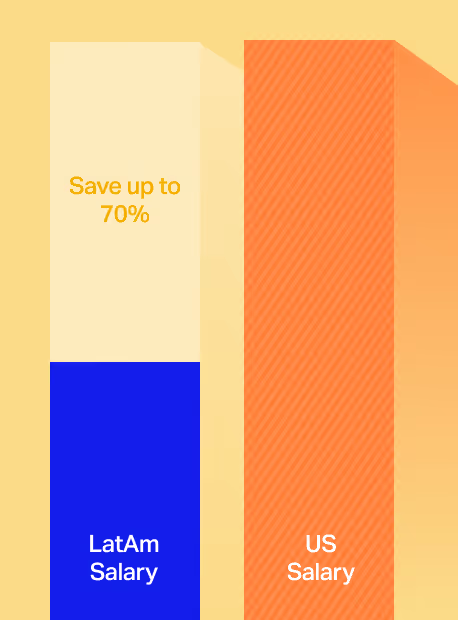
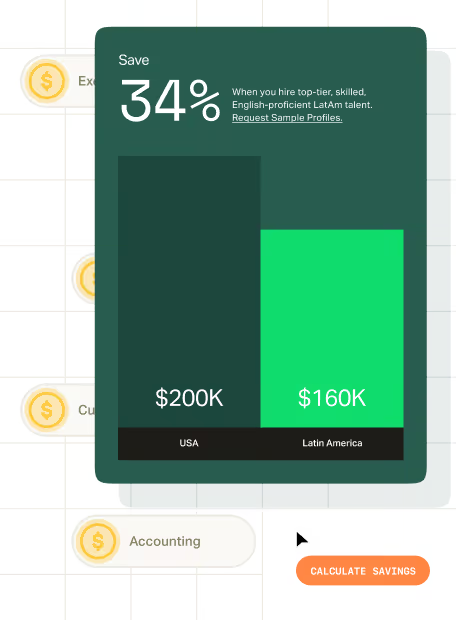
- Outsourcing to Latin America lets US companies hire mid-level and senior professionals at 30–70% below equivalent US rates, with 84% of placements being experienced professionals, not junior labor, according to Hire With Near's 2026 State of LatAm Hiring Report.
- Colombia, Argentina, and Brazil account for 58% of all nearshore placements and lead in sales, finance, and software engineering, respectively. Each country has a distinct talent profile worth understanding before you hire.
- Latin America's biggest practical advantage over India and the Philippines is time zone overlap: Your LatAm team works during your business day, not while you sleep, which makes real-time collaboration possible from day one.
Outsourcing to Latin America means hiring full-time professionals or engaging service providers in countries like Colombia, Mexico, Argentina, Brazil, and Costa Rica to handle roles that would otherwise be filled domestically. It helps companies reduce hiring costs by 30–70% while accessing skilled talent in overlapping time zones.
You've heard about it. Maybe you've seen case studies or a competitor mentioned it in passing. But you're still not sure whether it applies to your situation, which countries to look at, or what it actually costs.
In this guide, I cover all you need to know about outsourcing to Latin America so you can make a solid decision: how LatAm outsourcing compares to other regions, what you should expect to pay, which engagement model fits your needs, and how to pick the right outsourcing partner in 2026.
What Is Latin America Outsourcing?
Outsourcing to Latin America means engaging workers based in Latin American countries to handle business functions or processes remotely for your US company. The type of arrangement varies: Some companies work with an outsourcing agency that manages a team on their behalf, some add individual contractors through staff augmentation, and others hire dedicated full-time remote employees directly.
The unifying element across all of these: the work is handled by talent based in Latin American countries, not in the US. In practice, this looks different depending on the company.

A 20-person SaaS startup might hire a senior software engineer in Colombia who joins their Slack, ships code in their GitHub, and attends standups on Pacific Time. A mid-size accounting firm might place three bookkeepers in Argentina who run the full month-end close. A legal services company might build a team of eight legal assistants in Mexico handling research, contract review, and intake.
Because Latin American countries are geographically close to the US and operate in overlapping or adjacent time zones, this is also called nearshoring. You'll see both terms used interchangeably in this guide, as well as by most service providers in the space.
What Are the Pros of Outsourcing to Latin America?
Latin America's three biggest advantages over other outsourcing regions are cost savings, time zone alignment, and cultural fit with US business norms.
Here's what each of those advantages looks like in practice, and a few more worth knowing:
More senior talent for the same budget
You can hire experienced professionals from Latin America for 30–70% less than equivalent US talent. According to Hire With Near's 2026 State of LatAm Hiring Report, which analyzed 2,000+ placements, 84% of LatAm hires were mid-level or senior professionals, with average annual savings of $35,000–$64,000 per hire compared to US equivalents.

You're not trading quality for price. You're accessing experienced professionals at a rate the US market no longer makes possible for many companies.
Latin American professionals earn salaries that reflect their local cost of living, which is lower than the US. The most successful nearshoring relationships pay competitive local market rates, which keeps talent stable and committed over time.
Time zone alignment that works
When you outsource to India or the Philippines, your team is working while you sleep. Real-time questions go unanswered until the next morning, urgent bugs wait overnight, and code reviews get delayed by a full day.
Latin America operates in the same or adjacent time zones as the US. Your team in Buenos Aires is never more than two hours ahead of New York. Mexico City is in the same time zone as Chicago. Colombia runs on Eastern time. Standups happen live, issues get resolved during the workday, and spontaneous collaboration is possible.
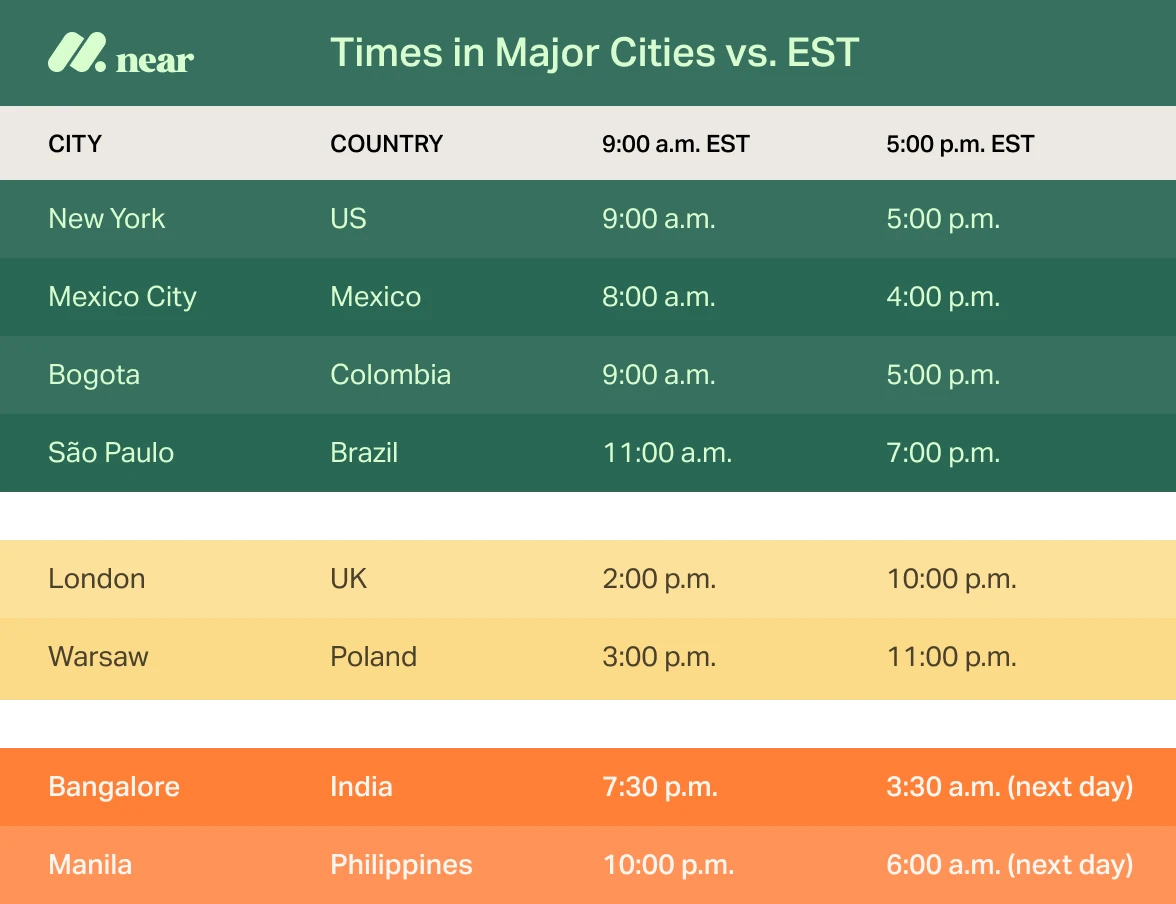
Research from Harvard Business School, published in INFORMS Organization Science, studying 12,038 employees at a large multinational, found that each additional hour of time zone difference reduces real-time communication by an average of 11%. The study recommends distributing teams along a north-south axis, like the US and Latin America, rather than east-west, to preserve workday overlap.
The pattern shows up in Hire With Near's data too. One US hiring manager switching from offshore providers described the tipping point:
We're prioritizing LatAm now because for the roles we need at the moment we want them to work in tandem with our US hires as opposed to off hours. We'd rather they work at the same time.
Cultural and professional alignment with US business norms
In conversations with Hire With Near's recruiting team this year, one pattern comes up consistently when comparing LatAm talent with candidates from other regions: it's not just the technical skills that differ, it's the working style.
Franco Pereyra, Co-Founder and COO at Hire With Near, describes what he sees in LatAm talent:
What sets Latin American talent apart from other regions is that you'll find people who are proactive and creative. People who come up with ideas and new solutions. If you're looking for folks who can bring something to the table, who will push back if they think your idea doesn't make sense, that's what you find in LatAm.
Offshore arrangements often break down not because of technical gaps but because of communication style: responses that lack initiative, deliverables that answer the question asked rather than the problem behind it, and a reluctance to flag issues before they escalate. Cultural alignment helps close that gap.
A deep talent pool, especially in technical fields
Latin America has invested heavily in higher education, and the results show in the talent market.
Mexico produces a higher share of college graduates with STEM degrees than the United States, according to the Georgetown University Center for Security and Emerging Technology (CSET). Argentina has one of the most developed accounting education systems in the hemisphere. Colombia has made substantial government investment in tech education over the past decade. Costa Rica ranks first in Latin America for engineer availability, according to PROCOMER.
That depth shows up in the hiring experience. When Hire With Near places a software engineer from Colombia or a financial analyst from Argentina, those candidates aren't drawing on general business education. Instead, they're coming from programs specifically designed to produce professionals in those disciplines.
For US companies, that means the talent pool isn't a compromise. In many technical and financial roles, LatAm candidates are competitive with US equivalents on skill, while compensation benchmarks are substantially lower due to differences in cost of living.
What Are the Risks and Red Flags to Avoid When Outsourcing to Latin America?
Outsourcing to Latin America is a strong option. But like any region, it comes with risks. The good news: most of them are manageable if you know what to watch for.
These are the main risks you should avoid:
- Language and English proficiency variation: English quality varies across countries and individuals. In senior, client-facing roles, this is the most common reason candidates get rejected at the screening stage. The mitigation: work with a recruiting partner that tests English proficiency rigorously before you ever see a candidate. If you're hiring independently, build an English-language interview stage into your process before extending offers.
- Infrastructure limitations in some areas: Internet reliability and workspace quality vary by country and by city vs. rural area. This is less of an issue in major cities like Buenos Aires, Bogotá, São Paulo, and Mexico City, where the infrastructure is solid. If you're recruiting from less common locations, ask your hiring partner about infrastructure requirements and whether candidates have reliable home office setups.
- Quality and consistency concerns: Any outsourcing relationship carries quality risk if you don't vet partners carefully. The solution is not to avoid LatAm. It's to vet partners the same way you'd vet any vendor: check references, look at time-to-fill data, ask about seniority distribution of their placements, and run a pilot before committing at scale.
- Political and economic instability in specific countries: Venezuela and Ecuador have experienced notable political and economic instability. Most major LatAm outsourcing destinations, including Argentina, Colombia, Mexico, Brazil, Chile, and Costa Rica, are politically stable with functioning economies. Be specific about which country you're hiring in.
- Misaligned engagement model: This is the risk competitors rarely discuss, but it's one of the most common. If you hire an outsourcing agency expecting the output of a dedicated team member, you'll be disappointed. Agency workers handle multiple clients, rotate off projects, and don't feel loyalty to your company. If what you need is someone who shows up every day thinking about your business, an agency model won't deliver that. Choosing the right engagement model up front prevents most of the frustration companies describe after unsuccessful outsourcing attempts.
{{state-latam-hiring}}
Latin America vs. Other Regions: The Outsourcing Comparison
When US companies evaluate outsourcing options, they usually compare LatAm against three alternatives: India, the Philippines, and Eastern Europe.
Here's how the comparison breaks down on the dimensions that matter:
India vs. LatAm
India has strong technical talent and competitive costs. The structural problem is the 9–12 hour time zone gap, which makes any role requiring real-time collaboration difficult to staff effectively. For roles where execution matters more than collaboration, like overnight data processing, batch reporting, and back-end tasks with clear specs, India can work. For anything that touches your US team in real time, it's a constant friction cost.
Philippines vs. LatAm
The Philippines has excellent English and a deep pool of customer support and BPO talent. The 12 to 14-hour time zone gap is severe. For US-facing customer support roles, some providers solve this by running overnight shifts, meaning your support team works at 3 a.m. local time to cover US daytime hours. That works until it doesn't: overnight shifts affect retention, morale, and eventually quality.
Hire With Near's research across 2,000+ hiring conversations found that 30% of US companies choosing Latin America are switching from offshore hiring in India or the Philippines, and the time zone gap is the most commonly cited reason for both. LatAm customer support teams work the same hours as your US customers, without the graveyard shift. For client-facing roles where presence during US hours matters, that's the difference.
Eastern Europe vs. LatAm
Poland, Romania, and Ukraine produce strong engineering talent. Cost savings are typically 30–50% vs. US rates, closer to US pricing than LatAm. The bigger issue since 2022 is geopolitical: the conflict in Ukraine and instability across the region have made Eastern Europe a more complicated foundation for a distributed team.
Delve, a digital consulting firm that works with Hire With Near, had operations in Warsaw and Minsk that were directly disrupted by geopolitical conflict. That disruption accelerated their decision to build their team in Latin America instead: they hired nine roles and saved $500,000 annually.
The bottom line: If your priority is real-time collaboration with your US team, LatAm wins this comparison. If you're choosing primarily on raw cost minimization for roles that don't need synchronous communication, India may be worth evaluating. If you need customer-facing English fluency at scale for overnight coverage, the Philippines has a deep pool. But for the majority of US companies building functional business teams, LatAm's combination of time zone overlap, cost savings, and cultural fit is hard to match.
%20(1)%20(1)_compressed.webp)
Engagement Models for LatAm Outsourcing: Which Structure Is Right for You?
Outsourcing to Latin America doesn't work the same way across every arrangement. The structure you choose determines three things: how much control you have over the work and the people doing it, how integrated those workers feel with your team, and what the real cost and quality outcome looks like over time.
A managed services arrangement gives you output but limited visibility. Staff augmentation gives you flexibility but less commitment on either side. Direct hiring gives you a fully integrated team member but requires more involvement in the sourcing process.
Here's how each model works and when it makes sense:
Outsourcing agency
You hire a firm that manages a team on your behalf. Fast to start, minimal administrative burden. The tradeoff: the workers aren't dedicated to you. They handle multiple clients, rotate between projects, and report to the agency, not to you. Companies that choose this model often find that it produces the output they need in the short term but creates frustration over time.
One US company that made this transition described it clearly: “It ends up not feeling like they're part of the team. They're an agency that works with us. We really want to bring in people that are part of the team but that are just based somewhere else.”
Staff augmentation
You bring individual contractors into your team and manage them directly. This is common in software development: a developer joins your projects, works in your tools, and collaborates with your team, but their employment relationship runs through an augmentation provider.
It works well for tech projects with a defined scope, where you need to add capacity quickly without a long-term commitment.
Employer of record (EOR)
A local entity in the LatAm country employs the worker on your behalf, handling local compliance, payroll, and benefits. The worker is full-time and dedicated to you; you manage the day-to-day work while the employer of record handles the legal infrastructure.
This is the right structure when you want a dedicated employee but don't want to set up a local entity yourself, and when compliance with local labor law matters.
Direct nearshore hiring (Hire With Near's model)
Hire With Near sources, screens, and presents dedicated full-time professionals from Latin America. The hire works your hours, uses your tools, and reports to your managers. They're not a contractor assigned to your account. They're a team member who happens to be based in LatAm.
One US tech founder described the shift that leads companies to this model: “We want to slowly start to wean ourselves off of offshore development shops and hire in-house.”
That's exactly what Hire With Near's nearshore staffing model is built for: the integration and ownership of an in-house hire, without the domestic salary overhead.
Top Roles and Functions Companies Outsource to Latin America
The most commonly placed functions in LatAm are accounting and finance (23.4% of placements), sales (18.9%), marketing (10.5%), and IT and engineering (10.1%), according to Hire With Near's 2026 State of LatAm Hiring Report.
Here's what each function looks like in practice.
- Software engineering: Latin America has a thriving software industry built on Argentina, Brazil, and Mexico as the primary hubs. Developers in these countries work with modern frameworks, including Python, Java, Node.js, and React, and are familiar with US development practices. Software development placement volume has grown year over year, driven by access to senior engineers at 45–55% below US rates.
- Customer support: Time zone alignment makes LatAm a strong fit for customer support outsourcing. Your support team works when your customers are calling, not on a graveyard shift trying to cover US hours from 12 time zones away. For companies serving both English and Spanish-speaking markets, LatAm also has deep bilingual capacity that's difficult to replicate elsewhere.
For current compensation benchmarks, see the customer support salary guide for Latin America.
- Finance and accounting: This is one of the deepest talent pools in the region. Argentina, in particular, has a five-to-six-year accounting degree program and a large pool of CPA-equivalent professionals with Big Four and public company experience. Accountants, financial analysts, controllers, and FP&A specialists are highly sought-after roles, and LatAm delivers at senior levels.
- Marketing: Digital marketing, content, SEO, paid media, and marketing operations are all strong LatAm functions. Latin American professionals are familiar with the tools US companies use, including HubSpot, Salesforce Marketing Cloud, Google Ads, and Meta Business, and produce work calibrated for US audiences.
- Operations and executive assistants: Virtual assistants from Latin America, operations specialists and executive assistants based in LatAm bring the same analytical and organizational skills US companies expect, work during US business hours, and communicate proactively. This is one of the most common entry points for companies new to LatAm hiring.
- Sales and SDRs: Sales reps based in LatAm can call US prospects during US business hours, handle full sales cycles, and bring strong English skills for client-facing roles. Colombia and Argentina are the strongest markets for sales talent.
What Are the Average Salaries for Latin America Outsourcing?
Here's what you can expect to pay for common LatAm roles compared to US equivalents, based on compensation benchmarks for Latin American roles:
*Ranges reflect junior through senior seniority. Actual compensation depends on seniority, location, and specific skill set. For data across all roles and seniority levels, see the full Latin America salary guide.*
Franco Pereyra, Co-Founder and COO at Hire With Near, recommends a simple gut-check: Take whatever you'd spend on a comparable US salary and divide by two. That gets you in the right ballpark for a mid-level hire in most LatAm functions.
What Are the Top Latin American Outsourcing Destinations?
Latin America offers a wide range of countries with distinct talent profiles. Here are the top outsourcing destinations in the region:
1. Colombia
Colombia is now the top nearshore hiring destination in Latin America, accounting for 23% of all placements in Hire With Near's 2026 State of LatAm Hiring Report. Bogotá and Medellín have developed into mature business services hubs, with a large pool of bilingual professionals across sales, accounting, marketing, and customer support.
English proficiency is strong, particularly among younger professionals, and Colombia consistently ranks among the highest in Latin America for cultural and communication alignment with US business norms. It's the top hiring country for BDR/SDR, accountant, executive assistant, financial analyst, and administrative assistant roles.
2. Argentina
Argentina accounts for 21% of placements and remains the strongest country for finance, data, and software engineering talent in the region. Its five-to-six-year university accounting programs produce professionals equivalent to or exceeding US CPAs.
Buenos Aires runs on ART (UTC-3), putting it one hour ahead of New York and four hours ahead of Los Angeles, giving nearly full overlap with the US East Coast and solid coverage for the West Coast morning.
Argentina has a developer community of 1.1M+ on GitHub, with double-digit year-over-year growth. It's the top hiring country for bookkeeper and legal assistant roles, and the first recommendation for FP&A, financial analysis, and data engineering.
3. Brazil
Brazil is the region's IT and engineering powerhouse, accounting for 14% of placements and ranking first for software engineering hires. São Paulo and Belo Horizonte are the primary tech hubs, and Brazil's GitHub developer community exceeds 5.4M, the largest in Latin America by a significant margin.
Brazil also leads in marketing hires alongside Argentina. One important consideration: Brazilian Portuguese is the native language, and English proficiency varies more than in Colombia or Argentina, which is worth factoring into hiring requirements for client-facing roles.

4. Mexico
Mexico accounts for 9% of placements and is strongest for marketing and software development roles. Its proximity to the US, shared Central and Mountain time zones, and strong cultural overlap with US business norms make it a consistent choice.
Mexico's IT sector has grown substantially, with Monterrey and Guadalajara becoming secondary tech hubs alongside Mexico City. Mexico's STEM pipeline is notable: Approximately 38% of college degrees are in STEM fields, compared to roughly 20% in the US, per CSET. The GitHub developer community exceeds 1.9M, with double-digit growth year over year.
5. Costa Rica
Costa Rica is a smaller-volume market but strong for specific use cases: customer support and IT services. The country ranks first in Latin America for engineer availability, according to PROCOMER, and its commercial services exports have grown at an average annual rate of 9.1% since 2005, according to Inter-American Development Bank.
Political stability is among the highest in the region, and the government actively supports foreign investment through CINDE (Costa Rica's Investment Promotion Agency) and a well-established free trade zone regime. For companies prioritizing stability and English proficiency alongside technical depth, Costa Rica is a strong option.
Related reading: Why Nearshoring to Costa Rica Works: Benefits and How to Get Started

6. Chile
Chile is known for political stability and a strong innovation culture, with a growing tech ecosystem centered in Santiago. It's a solid choice for software development and digital transformation projects.
Volume is lower than that of the top three countries, but quality is consistently high for the roles Chile specializes in. Chilean universities, including Universidad de Chile and PUC-Chile, are among the strongest in the region for data and engineering disciplines.
7. Honduras
Honduras is a smaller but growing presence in nearshore hiring, accounting for 5% of placements and ranking fifth overall in the 2026 State of LatAm Hiring Report. It's particularly strong for sales roles: strong English proficiency among its professional class, partly driven by proximity and cultural exposure to the US, makes it a viable option for SDR and outbound sales positions.
8. Jamaica
Jamaica has emerged as a strong option for customer support roles, with native or near-native English fluency and a service-oriented culture. It ranks as the top country for customer support rep placements in Hire With Near's data. For US companies that need strong English and full US-business-hours coverage, Jamaica is worth including in your consideration set.
How to Choose a Latin America Outsourcing Partner
The difference between a successful LatAm outsourcing relationship and a frustrating one often comes down to partner selection. In conversations with our recruiting team, the same selection criteria come up consistently when clients describe both good and bad experiences:
1. Time-to-fill benchmarks. Ask what their average time-to-fill is. For most roles, 7–28 days is a reasonable benchmark. If a partner can't give you a specific number, that's a signal they haven't been tracking it.
2. Seniority distribution of placements. Ask what percentage of their placements are mid-level or senior. This tells you whether their talent pool skews toward experienced professionals or toward entry-level hires. Partners that consistently place senior contributors are a different product than those filling mostly junior roles.
3. Dedicated vs. shared workers. Be explicit about whether the workers will be dedicated exclusively to your company or shared across multiple clients. If you need someone to think about your business every day, a shared-worker model won't produce that.
4. Industry and role understanding. A good partner doesn't just fill open requisitions. They ask the right questions about what you need. Anton Lipkanou, President of Delve, described this directly:
Hire With Near's team gave us confidence that we'd hire great talent quickly. They did a deep dive into our requirements, asked the right questions, and communicated our needs and goals back to us. They advised us on compensation, different talent markets, and our hiring process.
That level of engagement is the signal. If a partner is just asking for a job description and running a search, they're not adding the value a good nearshore partner should add.
5. Compensation transparency. Ask how the partner handles candidate compensation: what currency, how benefits are structured, and how the costs are presented to you. Transparency prevents surprises.
6. References from similar companies. Ask for references from companies in a similar industry or with similar role types. General references are less useful than hearing from a company that hired the same function you're looking to fill.
7. Quality consistency across contacts. Anton Lipkanou of Delve also noted something about Hire With Near's quality that's worth using as a benchmark:
When you're talking to senior management and founders, everything seems perfect. But then, when you get redirected to middle management or junior people, the quality is very different. I didn't see that with Hire With Near.
Consistent quality at every contact level signals a well-run organization, and a good proxy for how your candidates will be treated.
Further reading: The 7 Best LatAm Outsourcing Companies for US Teams in 2026
How Hire With Near Helps You Build a LatAm Team
Hire With Near isn’t an outsourcing agency. When you work with us, you're not handing work off to a managed team. You're hiring dedicated full-time remote employees from Latin America. People who work your hours, use your tools, and report directly to your managers.
That's what makes Hire With Near a nearshore outsourcing alternative rather than another outsourcing vendor.
Here's how it works:
- Brief intake: Hire With Near learns your role requirements, team culture, budget, and what a great hire looks like for this specific role.
- Sourcing and screening: The recruiting team searches across our network of 45,000+ pre-vetted professionals in LatAm, running initial screens on technical skills, English proficiency, and cultural fit.
- Candidate presentation: You receive a shortlist of top candidates, typically 3–5, with the recruiter's assessment and recommendation for each.
- Interviews: You run your own interviews and make the final decision.
- Offer and onboarding: Hire With Near handles compensation guidance, the offer process, and onboarding logistics.
Most roles are filled in 7–28 days. Hire With Near recruits across Colombia, Argentina, Brazil, Mexico, Chile, Costa Rica, Honduras, and other LatAm markets, matching the right country to your role requirements and company culture.
What this looks like at scale
Delve is a Boulder-based digital consulting firm working with clients including Google, Amazon AWS, and Meta. They needed specialized marketing and data roles, including programmatic media traders, data scientists, and AdTech consultants, that were nearly impossible to fill in the US at sustainable rates.
After their Eastern Europe offices were disrupted by geopolitical conflict, they turned to Hire With Near. They started with three hires, expanded to ten, and now save $500,000 annually.
Read the full story: How Delve saved $500,000 per year hiring in Latin America.
The companies that get LatAm hiring right treat their LatAm hires the same way they'd treat any team member: clear expectations, real integration into team processes, and fair compensation for the local market. The location is different. The working relationship is the same.
{{prevetted-banner}}
Final Thoughts
Outsourcing to Latin America works because the fundamentals are strong: a large, educated professional workforce, time zones that match the US workday, and a cost structure that lets companies hire senior talent at rates that would only get them junior hires at home.
The companies that make it work get specific. They pick the right country for the role. They choose an engagement model that matches their goals. They partner with a recruiter who asks the right questions, not just someone who fills seats.
Conversion Logix, a digital marketing agency, had built a team of Filipino contractors that was creating communication problems with clients. They switched to LatAm hiring through Hire With Near, filled 11 roles across the agency, and now save $781,000 annually. The time zone and communication gaps that were threatening client relationships disappeared.
If you're ready to explore what that looks like for your business, start with a free consultation. We'll tell you which roles fit the LatAm market, what they cost, and how quickly we can fill them.
Frequently Asked Questions
How much does it cost to outsource to Latin America?
Outsourcing to Latin America typically costs 30–70% less than hiring equivalent talent in the US, with average annual savings of $35,000–$64,000 per role depending on function and seniority.
A customer support rep might cost $18,000–$36,000 per year in LatAm versus $40,000–$70,000 in the US. A full-stack software engineer runs $48,000–$96,000 per year in LatAm versus $100,000–$180,000 in the US.
For complete salary ranges by role, see the full Latin America salary guide.
What's the difference between nearshoring and outsourcing to Latin America?
Nearshoring is a type of outsourcing: It means delegating work to a nearby country rather than a distant one. When a US company outsources to Latin America, that's nearshoring by definition, because LatAm countries are geographically close and share similar time zones with the US.
Within nearshoring, the engagement model still varies. You can nearshore through an agency, through staff augmentation, or by hiring dedicated full-time employees directly.
For more on how these models compare, see our breakdown of nearshoring vs. offshoring vs. onshoring.
Which Latin American countries are best for outsourcing?
Colombia, Argentina, and Brazil are the top three countries for nearshore outsourcing, accounting for 58% of all LatAm placements by US companies.
Colombia leads for sales and accounting; Argentina is strongest for finance, FP&A, and analytical roles; Brazil leads for IT and software engineering. Mexico is strong for marketing and software development. Costa Rica and Chile are smaller-volume markets but reliable for customer support and tech, respectively. Honduras and Jamaica are growing options for sales and customer support roles where strong English is a priority.
How do US companies pay Latin American contractors and employees legally?
US companies pay Latin American workers through one of four structures: as independent contractors (direct payment in USD, minimal local compliance burden); through staff augmentation providers (the augmentation firm handles the employment relationship while you manage the work directly); through an employer of record (a local entity employs the worker on your behalf, handling local payroll and compliance); or as full-time employees through a nearshore staffing partner that handles local employment logistics.
The right structure depends on your risk tolerance, how long you need the person, and whether you want them dedicated or flexible. If you're hiring through Hire With Near, the team advises on the best structure for your situation.
Is Latin America better than India for outsourcing?
For US companies that need real-time collaboration, Latin America is usually a better fit than India. The 9–12 hour time zone gap between the US and India makes synchronous work genuinely difficult. A question asked at 3 p.m. EST doesn't get answered until the next morning in Bangalore. Latin America operates during US business hours, which means decisions get made the same day, not the next.
India has strong technical talent and competitive costs, but if your role requires daily collaboration, the time zone gap is a real operational constraint, not just an inconvenience.
What are the most common functions US companies outsource to Latin America?
The most commonly placed functions in LatAm are accounting and finance (23.4% of placements), sales (18.9%), marketing (10.5%), and IT and engineering (10.1%).
Customer support is also a major category, particularly for companies that serve Spanish-speaking customers or need bilingual capability. Software development placement volume has grown year over year, driven by access to senior engineers at 45–55% below US rates.
What types of companies outsource to Latin America?
Companies across nearly every industry outsource to Latin America. SaaS companies are among the most active, using LatAm talent for engineering, marketing, and customer success roles. Finance firms hire accounting and FP&A professionals.
Marketing agencies and in-house teams hire specialists for paid media, SEO, and content. IT and tech companies build development teams. Legal practices hire legal assistants and paralegals. Real estate businesses hire operations coordinators and transaction managers. Most US-based companies save 30–70% compared to equivalent US hires, regardless of sector.






.webp)
.webp)


%203.svg)
.avif)






%20(1).avif)

%20(1).png)