


%203.svg)
Key Takeaways:
- Experienced remote customer support professionals in Latin America already have professional home office setups with reliable internet, quiet workspaces, and proper equipment because they’ve been working remotely for US companies for years.
- Many LatAm customer support professionals have accents, but what truly matters is clear communication and the ability to resolve customer issues effectively—skills that can be properly evaluated before hiring.
- Working with a specialized LatAm hiring partner ensures you get customer support reps with verified English proficiency, proper remote work infrastructure, and proven customer service experience, without navigating unfamiliar markets yourself.
Your customer support tickets are piling up. Response times are stretching past acceptable limits, and your team is drowning. You know you need to add capacity, but the cost of hiring US-based support reps just doesn’t fit your budget.
So you start exploring hiring customer support talent in Latin America. Then the questions start: Do they have accents that customers will struggle with? Will their internet connection be reliable enough? Can I trust that they actually know how to use our support tools?
Behind these questions is a real concern: you can’t afford to make customer service worse. You’ve seen what happens when support quality drops: unhappy customers, negative reviews, and churn that damages your business for months.
So let’s tackle those concerns about hiring LatAm customer support reps head-on. Here are the most common questions we hear from companies considering this move, with practical answers to help you make an informed decision.
“Do LatAm customer support reps have accents?”
Yes, many LatAm customer support professionals have accents. But here’s what actually matters: can they communicate clearly and resolve customer issues effectively?
Spanish accents are common among Latin American professionals. They’re also perfectly acceptable to US customers—in fact, the US has the second-largest Spanish-speaking population in the world.
What your customers care about is whether the support rep can understand their problem, communicate solutions clearly, and resolve their issues. Accent matters far less than comprehension, empathy, and problem-solving ability.
The key is evaluating for communication effectiveness, not accent neutrality. Can they handle complex customer conversations? Do they understand subtle context and tone? Can they de-escalate frustrated customers?
With proper evaluation, you can identify candidates with clear, understandable English who communicate effectively regardless of accent.
But we know that this is a concern of our clients, and that’s exactly why we send video interviews with every candidate shortlist. You hear candidates speak, see their communication style, and assess their professionalism before you ever schedule a live interview. No surprises, no wasted time.
According to our recruiters who specialize in placing customer support professionals,
Strong English skills and experience in dynamic environments often go hand in hand with strong organizational abilities and the communication skills needed for excellent customer service.
Your customers don’t need geographically neutral accents. They need support reps who listen carefully, communicate clearly, and solve their problems. Those skills exist across Latin America—you just need a good process to find them.
Related reading: How a Healthcare Practice Hired a Bilingual Patient Support Rep for $1,900/Month
“Do they have experience with the specific tools we use?”
Top LatAm customer support professionals have experience with the same platforms and tools you use, and they can quickly adapt to new systems when needed.
If you’re using Zendesk, Intercom, Freshdesk, Salesforce Service Cloud, or any major customer support platform, you’ll find LatAm professionals who’ve been using these tools for years while supporting US customers.
Major US corporations like Microsoft, Amazon, and American Express have maintained support operations in Latin America for decades. This created a deep pool of professionals who understand US customer expectations, support methodologies, and the tools that come with the territory.
Here’s something else to consider: our recruiters often find that “sometimes clients ask for experience with a specific tool, but candidates might have worked with a similar one, making it easy to learn. Don’t dismiss candidates just for not having that specific experience.”
The more important question isn’t “Have they used our exact CRM?” It’s “Can they learn new systems quickly, and do they understand customer support fundamentals?”
Strong customer support professionals adapt to new platforms efficiently because they understand the underlying principles: ticket management, customer communication, escalation procedures, and service metrics. These skills transfer across tools.
If tool-specific experience is critical for your needs, that’s a valid requirement. Just know that most LatAm customer support talent can learn your systems quickly—especially if they’ve worked with similar platforms before.
“How do I handle payroll and payment logistics?”
Payment and compliance are simpler than you think—especially when you work with the right partner or platform.
This question comes up constantly: “How do I actually pay someone in Colombia? What about taxes? Do I need to set up a legal entity?”
The short answer: you don’t have to figure this out alone.
You have several options depending on your situation:
Work with a staffing partner like Near who handles payroll, benefits administration, and local compliance for you. You pay the partner, they handle everything else, and your customer support rep gets paid correctly every month. For companies new to hiring internationally, this eliminates the learning curve.
Use an Employer of Record (EoR) like Deel or Remote. These platforms manage the legal and tax complexities of international hiring. You hire the person, the EoR handles the paperwork, and your team member gets paid compliantly in their local currency.
Handle it yourself if you’re already working with distributed teams and have the infrastructure. Many companies use platforms like Wise or Payoneer for international payments once they understand the tax implications.
If you’re already managing remote team members, adding a LatAm hire to your existing setup is usually straightforward. The systems you’ve built for remote work generally extend to international team members without major modifications.
The key is choosing the approach that fits your current setup and internal resources. Don’t let payment logistics stop you from accessing great talent—the infrastructure exists to make this easy.
Related reading: How a Fitness Equipment Brand Hired a Bilingual Customer Service Rep for $1,700/Month
“What happens if things don’t work out with the person we hire?”
Most good hiring partners provide replacement guarantees, which protect you if the hire doesn’t work out.
This is a legitimate concern, and the answer depends entirely on who you work with.
When you work through a reputable hiring partner, replacement guarantees are standard. For example, Near offers a 180-day guarantee. If the hire doesn’t work out within that window, we find you a replacement at no additional cost.
This matters because making a bad hire is expensive—not just in direct costs, but in lost productivity, team disruption, and the time spent interviewing and onboarding someone who ultimately doesn’t fit.
A good replacement guarantee means you’re not taking all the risk yourself. The hiring partner has skin in the game—they’re invested in making sure the placement works long-term.
If you’re hiring independently through freelance platforms or job boards, you typically don’t have this protection. You’re on your own if things go wrong, which is one reason many companies prefer working with specialized hiring partners for their first LatAm hires.
The specific terms matter: How long is the guarantee period? What constitutes a valid replacement request? How quickly can they provide replacement candidates? These are questions worth asking before you commit to working with any hiring partner.
“Will they have the right home office setup: quiet workspace, good internet, proper equipment?”
Experienced LatAm customer support professionals who already work remotely for US companies have professional setups because they need them to do their jobs.
This is where working with experienced remote professionals makes all the difference.
If you’re looking at candidates who’ve been working remotely as customer service reps, they already have:
- Reliable, high-speed internet (because they can’t do their jobs without it)
- Quiet workspaces (because customer calls require it)
- Professional equipment like headsets and webcams (because video calls and clear audio are non-negotiable)
- Backup power solutions in areas where power reliability is a concern
Top professionals have invested in their remote work infrastructure because it’s how they earn their living. The good ones wouldn’t survive in remote customer support roles without proper setups.
Most remote hiring partners verify these details before candidates even reach the interview stage. Internet speed tests, workspace checks, and equipment verification happen early in the vetting process—so you know what you’re getting before making any hiring decisions.
That said, there are times when equipment needs aren’t fully met, especially if you have specific technology requirements. This is where working with a partner who provides white-glove service makes a difference.
For example, Near helps with equipment provision—sourcing laptops locally and delivering them directly to new hires. We can also facilitate coworking space arrangements if you prefer your team members working from a professional office environment rather than home.
These aren’t just nice-to-haves—they’re practical solutions that ensure your customer support team can actually deliver great service from day one. Working with local vendors means you avoid customs delays, and if you ever need to retrieve equipment, that process is manageable too.
The bottom line: if you’re hiring experienced remote customer support professionals, infrastructure usually isn’t a problem. And when it is, good hiring partners have systems to solve it.
Related reading: How a Fintech Platform Hired a Member Support Specialist for $2,200/Month
“How can I properly vet offshore customer support reps?”
Proper vetting requires understanding the local market, verifying credentials, and assessing communication skills, which is exactly why most companies work with a specialized partner.
Here’s the challenge with vetting candidates yourself: you’re navigating unfamiliar territory.
When you look at a resume from someone in Colombia or Argentina, do you know which companies are well-regarded? Can you verify their employment history? Do you understand what standard customer support experience looks like in that market?
Even if you could figure all of that out, there’s still the language barrier for reference checks. If you need to call a previous employer in Mexico City, are you prepared to conduct that conversation in Spanish? Can you pick up on subtle cues about a candidate’s actual performance versus polite responses?
This is where working with a partner who specializes in LatAm hiring becomes valuable.
Good hiring partners handle the vetting that’s difficult to do from outside the region:
- Background and reference checks that go deeper than just employment verification. They’re asking previous employers how candidates handled difficult customers, whether they met their support metrics, and if they’d rehire them.
- Communication assessments that evaluate not just English proficiency, but the specific communication skills needed for customer support: empathy, clarity under pressure, and the ability to explain complex concepts simply.
- Red flag identification that comes from experience. Our recruiters watch for warning signs and advise against hiring if they arise.
- Cultural fit evaluation to make sure candidates understand US customer expectations and communication norms.
Could you build these evaluation systems yourself? Technically, yes. But it would take months to establish the relationships, understand the local markets, and develop the expertise to vet candidates effectively.
Most companies find it more efficient to partner with someone who’s already done this work—especially for their first few LatAm hires. Once you understand the market and have experience managing remote international team members, you might choose to handle hiring yourself. But starting with a partner de-risks the process significantly.
{{prevetted-banner}}
Final Thoughts
The questions you’re asking about hiring customer support reps in Latin America are the right ones to ask. They show you’re thinking seriously about this decision rather than rushing into it.
Here’s what we’ve found after helping hundreds of companies make this transition: the concerns are valid, but they’re all solvable.
- Accent? It matters less than communication effectiveness, which you can evaluate.
- Home office setup? Experienced professionals already have what they need.
- Tool experience? They’re using the same platforms you use.
- Payment? Multiple straightforward options exist.
- Vetting? Challenging alone, but manageable with the right partner.
The biggest risk isn’t hiring someone with an accent or from a different country. It’s missing out on talented professionals who could strengthen your customer support team while staying within your budget.
Modern customer support doesn’t require everyone to be in the same office—or even the same country. What it requires is skilled professionals who can communicate clearly, solve problems effectively, and represent your brand well to customers.
Those professionals exist throughout Latin America.
The companies succeeding with LatAm customer support hires focus on the fundamentals: strong communication skills, proven customer service experience, cultural alignment, and proper remote work infrastructure. When you hire for these qualities—regardless of where someone is located—you build strong support teams.
Your ideal customer support rep might be in Honduras, Argentina, or Colombia. The only way to know is to start having conversations.
Ready to build a customer support team that works in your time zone, speaks your language, and fits your budget?
We’ve covered common questions here, but everyone has questions specific to their situation: your support volume, your tools, your budget constraints, your timeline.
The best way to get those answered is on a call. You’ll get exact salary figures for the types of roles you’re looking for, understand the fees and process, and have all the information you need to decide if hiring pre-vetted LatAm customer support reps is the right decision for your business.
Schedule a free, no-commitment consultation call to discuss your specific customer support hiring needs.
Frequently Asked Questions
How long does it take to hire a customer support rep in Latin America?
The timeline is typically much faster than hiring in the US.
When you work with a specialized hiring partner like Hire With Near, you’ll have your first shortlist of pre-vetted candidates within 3–5 days after an initial kickoff call. These aren’t random resumes—they’re professionals who’ve already been screened for skills, experience, English proficiency, and cultural fit.
Most companies make a hire within three weeks from start to finish. Compare that to the typical 6+ weeks (or longer) it takes to fill customer support positions domestically, and you can see why companies are making this switch.
The speed comes from working with partners who already have networks in Latin America and understand how to evaluate candidates efficiently. You’re not starting from zero—you’re leveraging existing infrastructure.
How much does it cost to hire customer support in Latin America?
According to our data, here’s what you can expect to pay for customer support roles in LatAm:
- Entry-level support representative: $1,000 to $1,500/month
- Mid-level support specialist: $1,500 to $2,000/month
- Senior support specialist or team lead: $2,000 to $2,500/month
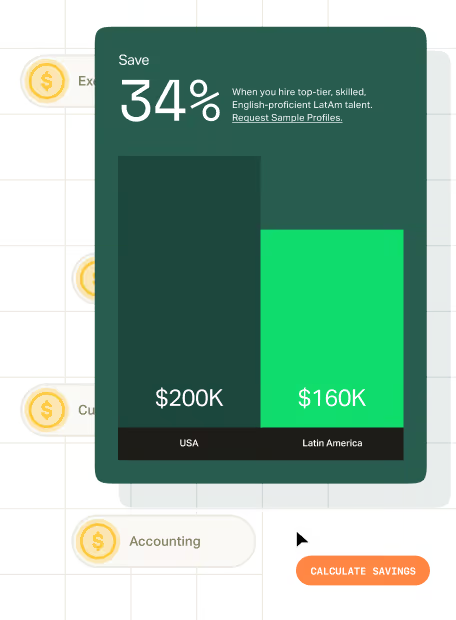
This translates to cost savings of up to 67% compared to hiring US-based customer support representatives, depending on the role’s seniority and required skills.
These are competitive salaries for the local market. Companies that try to pay significantly below these ranges typically struggle with retention and quality. The goal isn’t to pay the absolute minimum—it’s to access great talent at fair market rates that still deliver meaningful savings for your business.
Can LatAm customer support reps handle phone support, or just email and chat?
Absolutely. Many LatAm customer support professionals excel at phone support for US customers.
Latin American professionals have been handling phone support for US companies for decades. Major corporations route customer service calls to LatAm support centers specifically because the combination of Spanish and English proficiency, cultural alignment, and time zone overlap works well for real-time customer conversations.
If phone support is critical for your needs, just make sure to:
- Request video interviews to evaluate speaking ability
- Include a phone screen as part of your interview process
- Test how candidates handle different customer scenarios verbally
- Verify they have the proper equipment (quality headset, quiet workspace, reliable internet)
Will Hire With Near find candidates who can provide bilingual (English and Spanish) customer support?
Yes—this is actually one of the biggest advantages of hiring customer support in Latin America.
Hiring bilingual customer support professionals in the US is expensive and competitive. In Latin America, you’re hiring native Spanish speakers who also have strong English skills, which means they can seamlessly support both your English-speaking and Spanish-speaking customers.
This capability can be transformational for businesses. We’ve worked with clients who were literally turning away Spanish-speaking customers because they couldn’t afford bilingual support teams in the US. After hiring in LatAm, they could suddenly serve an entire market segment they’d been missing—and their revenue grew as a result.
If bilingual support is important for your business, just make sure to:
- Specify this requirement clearly during your hiring process
- Test both English and Spanish proficiency during interviews
- Verify that candidates are comfortable switching between languages during customer interactions
Hire With Near’s customer service recruiters can help you find customer support professionals with the right language combination and regional experience for your specific customer base.
What’s the difference between customer support, help desk, and customer success roles?
These terms are often used interchangeably, but they represent different functions—and Latin America has strong talent pools for all three:
Customer support representatives handle incoming requests, troubleshoot issues, and resolve customer problems across channels (phone, email, chat). They’re reactive, responding to customers who reach out for help.
Help desk specialists focus specifically on technical troubleshooting and IT support. They handle software issues, account access problems, and technical questions. This role requires stronger technical knowledge and often involves using ticketing systems to track and resolve issues systematically.
Customer success managers are proactive rather than reactive. They work to ensure customers achieve their goals with your product, drive adoption and engagement, identify upsell opportunities, and prevent churn. This is typically a more senior role requiring strategic thinking and relationship management skills.
All three roles are highly hireable in Latin America, with professionals experienced in serving US companies. The key is clearly defining which function you need:
- Need someone to answer support tickets and handle customer inquiries? Customer support rep.
- Need technical troubleshooting and IT issue resolution? Help desk specialist.
- Need someone to drive customer retention and expansion? Customer success manager.
Many companies start by hiring customer support reps and later add customer success managers as they scale. Hire With Near can help you hire for any of these roles, depending on what your business needs most right now.





.webp)
.webp)



%203.svg)
.avif)






%20(1).avif)

%20(1).png)