%203.svg)
Key Takeaways
- You don't need to be technical to hire data and AI talent in Latin America. Specialist recruiters screen candidates through project walkthroughs and role-specific technical questions before you see a resume. You interview the finalists and make the call.
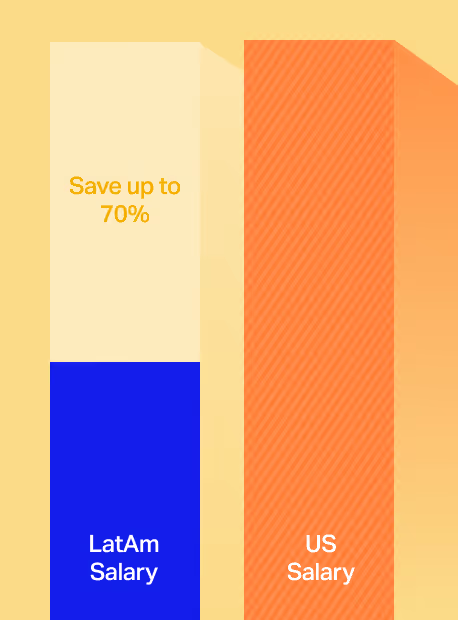
- You can hire Latin American data analysts, data engineers, data scientists, and machine learning engineers who work during your business hours and bring mid- or senior-level experience at salaries 51–75% below US rates.
- A 180-day replacement guarantee backs every hire through Hire With Near, and the retention data suggests you'll rarely need it: Latin American hires stay significantly longer than their US counterparts on average.
Hiring data and AI talent in Latin America gets you experienced data analysts, data engineers, and machine learning specialists who work during your business hours, at salaries up to 75% below US rates for the same experience level.
Still, the questions come fast: What do the fees look like? Who employs the person? Which countries should I hire from? I’m not technical, so how do I know if this person is good?
This article covers the most common questions Hire With Near's recruiting team hears from hiring managers, with real data and practical answers. And you don’t need to be technical to evaluate candidates: that vetting is handled before you see a single resume when you work with a nearshore staffing partner like Hire With Near.
“How much do data and AI salaries run in Latin America?”
According to the Hire With Near Data Roles Salary Guide, data and AI professionals in Latin America earn between $24K and $108K a year, depending on role and seniority. That’s up to 79% less than their equivalent US hires.
If you’re hiring a data analyst, expect to pay $24K to $54K a year. A nearshore data engineer runs $42K to $84K, while a data scientist in Latin America earns $36K to $82K.
Here's the full comparison, from benchmarks published by Hire With Near:
For the most up-to-date figures, see Hire With Near’s US vs Latin America Salary Guide.
Hire With Near's research on why US companies hire in Latin America found that 41% turn to the region primarily because they can’t make the hires they need at US rates.
The context behind it helps explain why. SignalFire’s State of Talent Report 2025, built on a dataset of 650M+ professional profiles, found that demand for experienced engineers continues to rise, with Big Tech doubling down on machine learning and data engineering. When you post one of these roles at US rates, you’re bidding against the deepest pockets in tech.
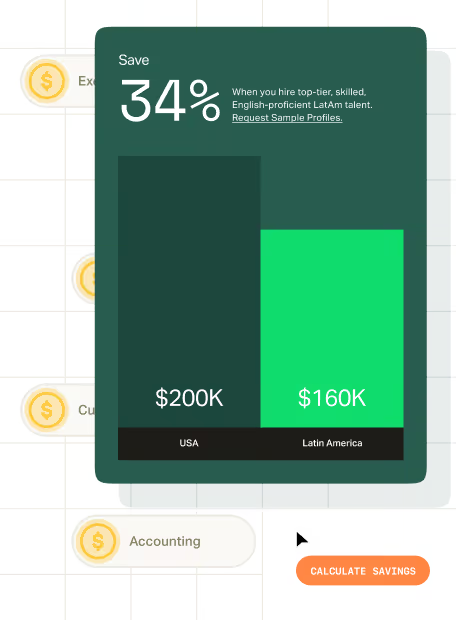
But you should read the table as budget enablement, not simply cost savings: the salary you’d offer a junior US data hire funds a senior professional in Latin America, so the same budget buys more experience.
“Can a nearshore recruiter really fill a niche data or AI role?”
Yes, if the recruiter specializes in technical talent. Hire With Near has filled searches as niche as programmatic media traders and marketing data scientists in Latin America.
The fear here is specific: my role is too unusual for a generalist recruiter. From the editorial work I do interviewing our recruiters, the searches that sound exotic to a hiring manager are usually ones the team has already run, because 3,000+ placements across 411 role types cover a lot of unusual ground.
Delve is the concrete proof. The US-based digital consulting firm, which improves paid marketing ROI for elite clients like Google and Amazon AWS, grew its headcount by 43% in a single year and struggled to find specialized marketing and IT talent at sustainable US salaries.
Through Hire With Near, Delve filled 10 roles, including a data scientist, a senior programmatic media trader, and an AdTech solutions consultant. By expanding into Latin America, they tapped into a highly skilled talent pool while saving $491,000 a year in payroll costs compared to US-equivalent talent.
Anton Lipkanou, Delve’s President and Head of Client Services, described what won his confidence:
Hire With Near’s team gave us confidence that we’d hire great talent quickly. They did a deep dive into our requirements, asked the right questions, and communicated our needs and goals back to us. They advised us on compensation, different talent markets, and our hiring process.
The capability extends upward too: Hire With Near handles executive search for leadership roles like head of data or director of data engineering. If you’re also looking to hire AI-fluent talent outside of engineering (in marketing, finance, or sales), our 2026 midyear data has a surprising finding worth reading.
And if you want to compare providers before committing, check our list of the best data science recruitment and staffing agencies.
“Which Latin American countries have the best data and AI talent?”
For the most competitive searches, like senior AI developers, Brazil and Mexico usually offer the largest candidate pools, while Argentina punches above its size in machine learning research talent.
The depth traces back to specific institutions. Argentina’s Universidad de Buenos Aires and ITBA, along with Brazil’s USP and Unicamp, produce strong machine learning and AI graduates year after year, while Universidad de Chile and Colombia’s Universidad de los Andes anchor deep analytics talent.
The technical communities are large and growing. According to GitHub’s Octoverse 2025 report, Brazil alone has 6.9 million developers on GitHub. Country-level figures for the rest of Latin America weren’t released in the 2025 edition, but the 2024 report counted Mexico at more than 1.9 million, Argentina over 1.1 million, and Colombia over 1 million, all growing at double-digit rates year over year.
Hiring managers regularly raise Argentina’s currency instability, so it’s worth addressing head-on: it shapes local compensation dynamics (and is part of why US-dollar contractor pay is so attractive there), and it says nothing about candidate quality. If a country concerns you for any reason, your search can include or exclude it.
If you’re weighing regions as well as countries, machine learning engineers in Latin America compare well against Ukraine and India on working-hours overlap and rates, and the pattern repeats for data engineers across LatAm, the Philippines, and India.
“How does the hiring process work?”
It depends on whether you’re hiring directly or working with a staffing and recruiting partner.
If you’re hiring directly, you source and vet candidates yourself, then handle the employment side. For a cross-border hire, that means either setting up a legal entity in the country (real upfront cost, three to six months of incorporation filings, and ongoing local legal support) or using an employer of record that becomes the legal employer on paper while you manage the work day to day.
If you’re working with a staffing and recruiting partner like Hire With Near, the process is simpler. The partner handles sourcing, vetting, and once you hire, takes care of payroll, compliance, and employment logistics in the background. You describe the role, review a pre-vetted shortlist, interview the candidates you like, and make the hire. The partner manages everything else.
If you already have a legal entity or EOR in place, the partner can handle sourcing and vetting only, with a one-time placement fee instead of a monthly arrangement.
For most US companies hiring data and AI talent in Latin America for the first time, the partner route is the faster path, especially for niche roles where technical vetting requires specialist knowledge you may not have in-house. Hire With Near typically delivers a pre-vetted shortlist within three to five days and closes most hires in under three weeks.
“Can I hire data and AI talent part-time or for a project?”
Hire With Near is built for full-time, long-term hires, so if you need a fractional analyst or a six-week modeling project, a freelance platform is a better tool for that specific need.
The reason full-time dominates in nearshore hiring is talent quality: the strongest data and AI professionals in Latin America are looking for stable, full-time roles with US companies, and that’s where the best candidates concentrate. If what you need is ongoing capability rather than a one-off deliverable, full-time is also where the salary savings compound most meaningfully over time.
“How do the fees work when you hire through a nearshore recruiter?”
Most nearshore recruiters use one of three pricing models: a one-time placement fee, an ongoing markup on the hire’s salary, or a monthly platform subscription. A trustworthy provider will show you the all-in monthly cost before you commit.
- With a one-time placement fee, you pay the recruiter once for the search and then employ the person directly, so the ongoing cost is simply their compensation.
- With a staffing markup, the agency stays in the middle: your monthly invoice bundles the salary with a recurring fee for as long as the person works with you.
- Platform subscriptions, the Deel-style tools you may already know, charge a flat monthly rate to handle employment logistics, but they don’t find or screen candidates for you.
Whatever the model, pencil out the same all-in monthly number for every provider you compare: the candidate’s salary, the provider’s fee, payroll and compliance costs, and equipment.
Then ask each provider four questions:
- Is the fee one-time or recurring?
- What happens to the fee if the hire leaves early?
- Who is the legal employer?
- And do you pay anything before you make a hire?
If any answer is fuzzy, treat that as your signal.
“What happens if the hire doesn’t work out?”
Replacement guarantees are standard in nearshore recruiting: if the hire resigns or underperforms within the guarantee window, the recruiter runs a new search and replaces them at no additional recruiting fee.
Three terms to check in any provider’s guarantee:
- The length of the window, measured in months, not weeks.
- Whether you get a replacement search or a refund.
- What triggers it: resignation only, or underperformance too.
For data and AI roles, the guarantee matters more than usual because a weak technical hire can look fine for a quarter before the pipelines, models, or dashboards start showing it.
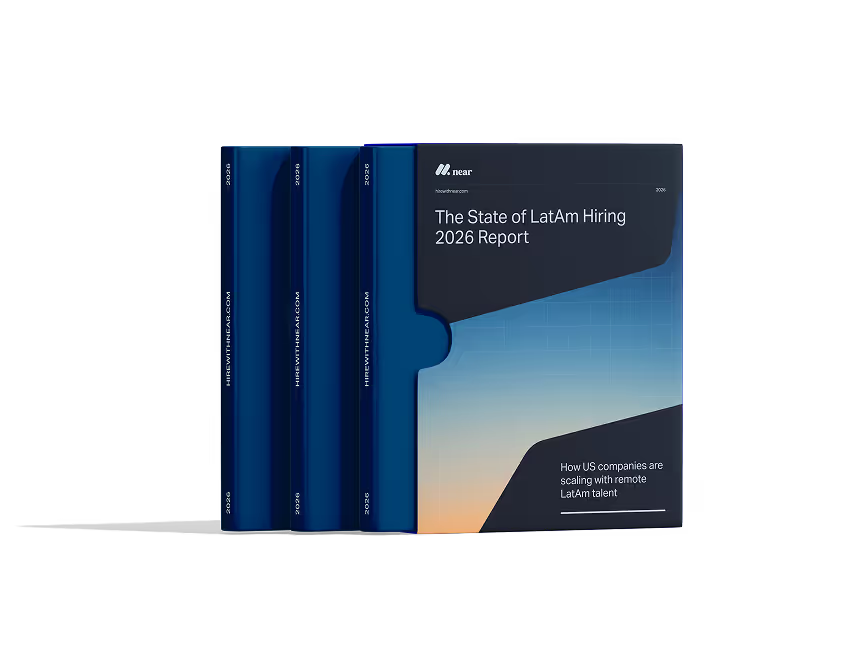
The evidence says you’ll rarely need it. According to Hire With Near’s 2026 State of LatAm Hiring Report, Latin American hires stay 66% longer than their US counterparts, based on more than 2,000 placements.
“How do you vet technical skills we can’t assess ourselves?”
You don’t have to be the technical filter: specialist recruiters screen data and AI candidates through project walkthroughs and role-specific technical questions before you see a resume, and you can layer your own assessment on top.
Hire With Near’s data and AI recruiters run the same first screen on every data and AI candidate: can they explain their work to someone who isn’t an engineer? Natasha Tarapow puts it this way:
We always ask candidates to tell us about a project they’ve worked on, not just that they use this language and that one, but what their role was and what they actually did. It’s important that they can explain their work to someone who isn’t a developer. If they can do that, that tells me a lot.
For a machine learning engineer in Latin America, the screening goes deeper. Recruiters ask candidates to describe a model they built and deployed end to end, how they keep up with a field that changes monthly, and how they handle colleagues who expect more from AI than it can deliver.
Candidates who can’t describe their own projects in plain language, or who go vague when asked what excites them about machine learning, don’t make the shortlist.
Recruiters who focus on AI and machine learning recruitment also know the market’s quirks. Analyst titles are heavily inflated (a BI analyst, a quantitative analyst, and a reporting analyst are often the same level), and a strong mid-level analyst with the right stack frequently serves you better than holding out for a rare seven-year senior.
The second half of the question matters just as much: yes, you can run your own technical assessment. Plug your take-home test, live exercise, or granular filter criteria straight into the screening process.
The recruiter’s screen gets you a shortlist worth your time. Your assessment, if you want one, is the final gate you control.
“How do you handle data security, IP, and confidentiality?”
The same protections that cover any remote employee apply here. Hire With Near can build NDA and IP-assignment clauses into contracts. We also run background and reference checks during vetting. The access policies and equipment controls are yours to set (the same way you’d handle a US hire).
Cross-border doesn’t mean a legal void. US-style confidentiality and IP terms are standard in Latin American employment agreements. For data and AI roles that touch client data or proprietary models, apply the same least-privilege access controls you’d use for anyone on your team.
{{prevetted-banner}}
Final Thoughts
Every question in this article traces back to the same fear: an expensive technical hire going wrong slowly, in a domain you may not be equipped to judge.
The recruiting model answers that fear directly. The screening is concrete and verifiable. You interview and choose the finalist yourself. And if it doesn’t work out, a replacement guarantee backs the decision, though the retention data suggests you’ll rarely need it.
If you want to explore hiring data and AI talent in Latin America, the best next step is to book a free consultation to talk through your specific requirements with our team.
We’ll give you salary benchmarks for the roles you’re considering and explain the process, so you have what you need to decide whether it’s right for you.



.webp)
.webp)


.webp)


%203.svg)
.avif)





%20(1).avif)

%20(1).png)