

%203.svg)
Key Takeaways
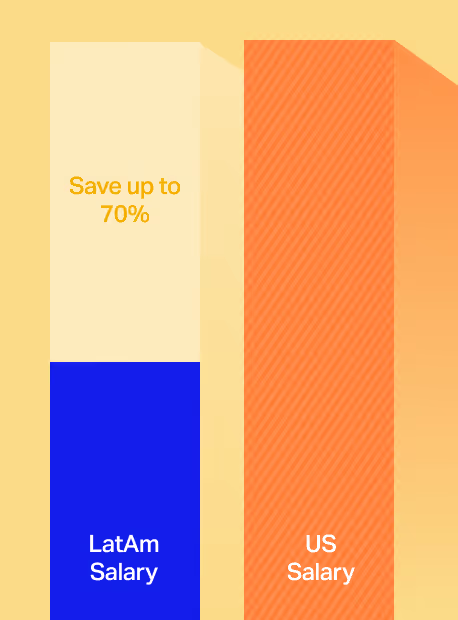
- The same design budget that covers one mid-level US hire can get you a senior, dedicated designer in Latin America: one who works your hours, understands US culture, and integrates as a full-time team member, typically at 30–70% less than US equivalents.
- The fastest route for most companies is a nearshore staffing partner that sources, vets, and employs the hire in one relationship; using an Employer of Record leaves the recruiting work on you.
- The strongest source countries for design are Argentina (senior and creative leadership), Colombia (high volume, Eastern time), Mexico (largest pool, Central time), and Brazil (product, creative, and motion talent).
Finding a strong designer in the US right now is harder than it should be. You post the role, you wait, and the candidates who apply either don't match your quality bar or want more than your budget allows.
That's not just your experience. 72% of US employers report difficulty finding the skilled talent they need, according to ManpowerGroup's 2026 Talent Shortage Survey of more than 39,000 employers.
For design roles, the cost of that gap compounds fast. When you're hiring a product designer or hiring a web designer, that search can drag on for months, your roadmap slips, and your existing team absorbs work they were never meant to carry.
Companies that decide to hire design talent in Latin America instead of stretching their budget on US salaries get senior, US-aligned designers working in their time zone.
Hire With Near has helped 950+ companies do exactly that.
This guide covers why companies are making the move, how to do the hiring, which design roles work best for hiring remotely and what they cost, which countries to source from, and how to handle the concerns you're probably already weighing.
Why Are US Companies Hiring Design Talent in Latin America?
When hiring in Latin America, you get full-time, dedicated designers who work your hours, understand US culture, and you typically save 30–70% compared to equivalent US hires.
That combination is why design has become one of the functions that US companies build in Latin America once they decide to look beyond their local market.
Here's what companies hiring for creative roles point to as the main reasons guiding the shift:
Time zone alignment
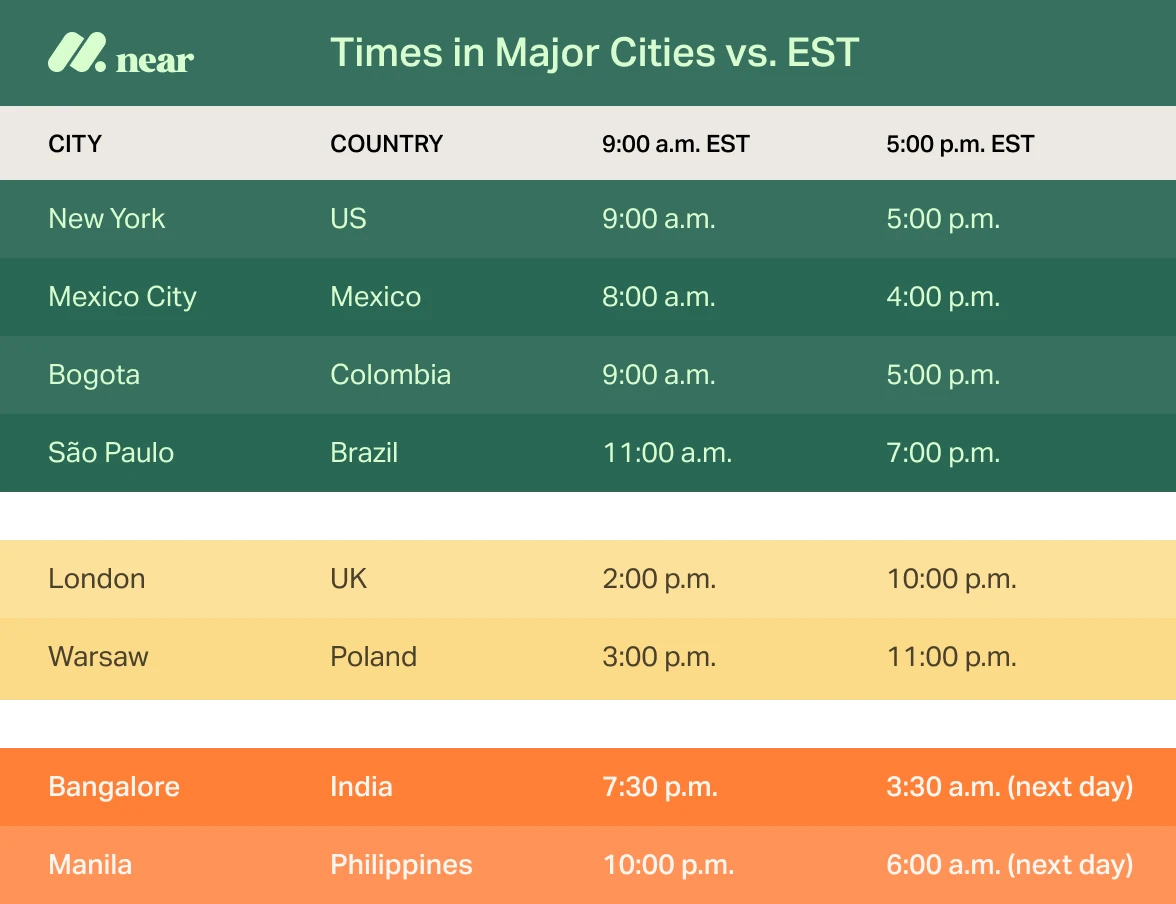
Latin American countries align closely with the US time zones.
When hiring for a design position, you want someone who can join a morning stand-up, turn around a revision before an afternoon client review, and react to feedback in real time instead of overnight.
Here's how that overlap looks across the region:
Cache Merrill, Founder of Zibtek, a software development company based in Salt Lake City that builds distributed engineering and design teams for US clients, put it this way:
When we started hiring designers in Latin America, I expected we'd spend most of our time talking about time zones. We didn't. The conversations that mattered were exactly the same ones we have with designers anywhere else: ‘Do you understand the customer?’ and ‘Can you explain why this design solves the problem?’
There's research behind the instinct. A Harvard Business School and INFORMS study with more than 12,000 employees found that synchronous communication, such as phone calls and video chats, dropped by about 11% for every additional hour of time-zone delay between workers. The same research found that teams distributed north to south (like the US to Latin America) held up better than those stretched east to west.
Design is iterative, collaborative work. A few hours of daily overlap is the difference between shipping this week and waiting until next.
Cost savings
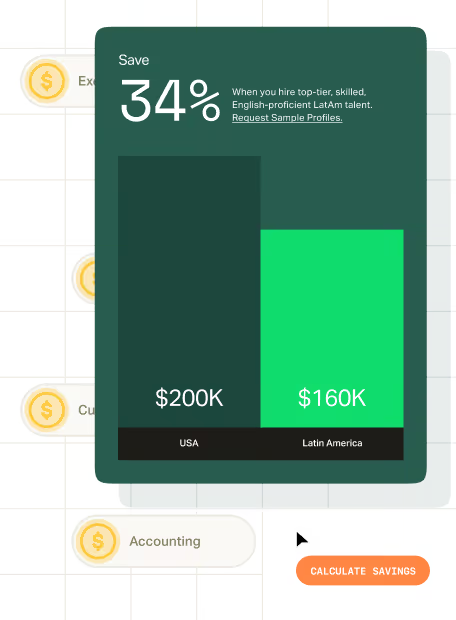
Companies hiring designers in Latin America routinely save well over half the cost of an equivalent US hire. A product designer who would run $81,000 to $202,000 a year in the US can be hired for $24,000 to $60,000 in Latin America, according to Hire With Near's Design Roles Salary Guide.
That means the same design budget that buys you one stretched US generalist can buy a dedicated designer and still leave room to grow the team.
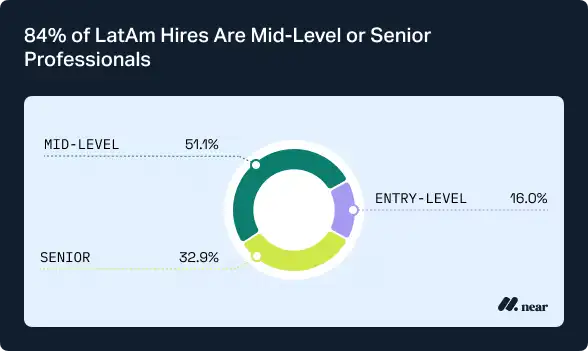
It's important to note that salaries are lower because the cost of living is lower, not because the quality of the work is. In fact, 84% of LatAm placements are mid or senior level.
English proficiency and US cultural fluency
Design is cultural work, and Latin American designers are close to the US market. The people building your interfaces, brand systems, and marketing creative consume the same products, follow the same brands, and operate in the same visual culture as the US audience you're designing for.
That proximity is the single biggest advantage Latin America has over more distant offshore markets for design specifically, where a brand can read as slightly off without anyone being able to say exactly why.
Talent caliber
Companies that run a US search and a Latin American search side by side consistently find the caliber comparable, at a significantly lower cost.
The quality design leaders care about most is the willingness to think, not just execute. Franco Pereyra, Co-Founder and COO at Hire With Near, puts it this way:
What sets Latin American talent apart from other regions is that you'll find people who are proactive and creative. People who come up with ideas and new solutions. If you're looking for folks who can bring something to the table, who will push back if they think your idea doesn't make sense, that's what you find in Latin America.
Cache Merrill saw this firsthand when a designer changed his mind during a product review. Instead of presenting screens, the hire challenged a workflow that was already approved because it added unnecessary steps for users.
The founder said:
That wasn't the feedback I expected from someone working remotely, but it made the product better. Since then, I've stopped thinking about remote hiring as a location decision. I think about whether someone is confident enough to challenge the team when it improves the product.
That instinct to push back on a brief is exactly what separates a designer who raises the bar from one who just fills a seat. It's also why design sits naturally alongside the other creative talent US companies hire across Latin America.
How Do You Hire Design Talent in Latin America?
You have three ways to hire design talent in Latin America: do it yourself, use an employer of record, or work with a nearshore staffing partner.
For most companies filling one or a few design roles, a nearshore staffing partner is the fastest route to a strong full-time hire. Here's how the three compare, from most hands-on to simplest.
Option 1: Hire directly
You handle everything: sourcing, screening, contracts, payroll, and compliance for an international hire.
Most companies start on LinkedIn, then widen the search to nearshore job boards built for Latin American talent. Using freelance marketplaces like Upwork and Toptal is an option for one-off project work, but they pull from a different pool than a full-time hire does, and the talent is splitting attention across several clients.
Direct hiring gives you the most control, but it costs the most time and requires you to know the regional design market and manage cross-border employment on your own.
Option 2: Use an employer of record (EOR)
An employer of record is a third-party company that becomes the legal employer of your hire on paper and handles payroll, tax, and local compliance while you manage the work day to day.
Popular EOR companies include Deel, Globalization Partners, Remote, and Oyster.
The catch for design teams: you still have to source and vet every designer yourself, review every portfolio, and run every interview.
An EOR fits best when you've already found the person, or when you're hiring across several countries and want one standardized payroll setup.
For a full breakdown of how EOR arrangements work, see this guide to hiring remote foreign employees.
Option 3: Work with a nearshore staffing partner
This is the simplest route for most companies, and the one Hire With Near is built for.
A specialist partner handles sourcing, screening, and portfolio vetting, then manages payroll, benefits, and compliance once you hire, through its nearshore staffing and recruiting model. You describe the role, interview a shortlist of pre-vetted designers, and make the hire, while the partner handles the rest.
It's the only option that does both jobs: finding the talent and employing it, in a single relationship.
This is also where teams burned by the agency model tend to land. One company that switched from design agencies to direct nearshore hiring described why:
We worked with several design agencies for a while, and I hated them. It was a very bad experience. It just didn't save us much. It's just a round-robin set of resources. I'm interested in nearshoring and the ability to have dedicated people's time so that we're working with the same team.
If you want to compare providers, our roundup of the best companies to hire design talent in Latin America and our list of the best nearshore staffing companies are useful starting points.
For senior design leadership, such as hiring a creative director or head of design, Hire With Near also runs executive search built around that level of role.
Here’s a quick summary to help you decide which approach works best for your company:
What Are the Most In-Demand Design Roles (and What Do They Cost)?
Hiring a designer in Latin America typically costs between $24,000 and $72,000 a year, depending on the role and seniority, compared with US ranges that climb past $150,000. Companies save 30–70%, which usually translates to $35,000 to $64,000 per hire annually.
Here are the design roles US companies hire most often, what each one does, and why Latin America fits it:
- Graphic designer: Owns brand and marketing visuals, like layouts, social creatives, decks, and prints. A strong, deep talent pool across the region, and the cultural proximity means the work reads as US-native rather than translated.
- UX/UI designer: Designs the interfaces and flows for web and mobile products. One of the most-requested design hires, and Latin America has real depth here, especially designers who've worked with US product teams and know tools like Figma cold.
- Product designer: Goes beyond the interface to shape how a product solves a user's problem end to end. This is a thinking role, not just an execution one, which plays to the proactive, idea-driven streak design leaders find in the region.
- Web designer: Designs and often builds sites, frequently blending visual design with no-code or front-end skills. The hybrid design-and-build profile is increasingly common in Latin America and hard to find affordably in the US.
- Motion designer: Creates animation and motion graphics for product, social, and video. Demand has climbed alongside short-form video, and the region has strong motion and creative talent, particularly in Brazil.
To put that in concrete terms, here's what hiring these roles costs compared with equivalent US hires, according to Hire With Near's salary benchmarks:
For the most up-to-date figures, see Hire With Near's US vs Latin America Salary Guide.
The savings are real, but the more useful point is what they buy. The same budget that covers one mid-level US designer often covers a senior designer in Latin America with room to spare.
What Are the Top Countries to Hire Design Talent in Latin America?
Hire With Near places design talent across Latin America, but four countries stand out for design specifically: Argentina, Colombia, Mexico, and Brazil. Each has a different strength, and the right one depends on the role and your time zone.
Argentina
Argentina is the top source for senior and creative leadership roles.
Argentine designers tend to combine strong craft with the strategic, opinionated thinking US clients want in a creative director or head of design, and compensation expectations are generally lower than in peer markets.
A strong choice when you need someone who can own the design vision, not just produce assets.
Colombia
Colombia is a high-volume market with a deep design and agency ecosystem, especially in Bogota and Medellin. It sits on Eastern time, with full overlap for US East Coast teams.
Especially strong for UX/UI, web, and graphic designers with US-client agency backgrounds.
Mexico
Mexico offers one of the largest talent pools in the region and aligns closely with Central and Mountain time, making it a natural fit for teams in those zones.
Mexico City, in particular, has a large concentration of designers with major brand and agency experience.
Brazil
Brazil produces strong product, creative, and motion design talent. Brazilian advertising agencies, particularly those based in São Paulo, have taken top prizes at Cannes and other international competitions, and that creative culture runs deep into the design talent pool.
For visual-first work like motion, illustration, and product design, it's one of the best markets in the region.
Related reading: Best Countries to Hire Graphic Designers in 2026: Top 10 Compared
What Skills To Look for When Hiring Design Talent
Most hiring managers know which role they need. What's harder to pin down is which skills separate a strong LatAm design hire from one that looks good on paper but struggles in practice.
In dozens of conversations with Hire With Near's design recruiters, a consistent picture emerges of what predicts a strong hire.
Here's how to think about it across three categories:
Core design skills
Not every hire will have all of these, but depending on the role, you're likely looking for at least one:
- Visual design and brand execution: The ability to produce work that looks right for your market, not just technically competent. Candidates with US-client agency experience tend to be strongest here, since they've already calibrated to the aesthetic expectations of American brands.
- UX and product thinking: For product and UX/UI roles, look beyond visual output. The strongest candidates can articulate why they made a design decision, not just what they made. That's the difference between a designer who executes and one who solves problems.
- Motion and animation: Demand has grown significantly alongside short-form video. Candidates from Brazil and Argentina have particularly strong motion backgrounds. Look for tool fluency alongside style range.
- Web design and no-code development: The hybrid design-and-build profile is increasingly common in Latin America. Candidates who can design and build in Webflow or handle basic front-end work are a strong value add for lean teams.
- Brand systems thinking: For roles that will touch multiple channels or manage a brand over time, look for candidates who've worked within established brand guidelines and can enforce visual consistency, not just produce one-off assets.
Technical skills
Platform expertise is verifiable. Ask for specifics. The most commonly required tools in Hire With Near's design searches:
- Figma (industry standard for UI/UX and product design)
- Adobe Creative Suite (Illustrator, Photoshop, InDesign)
- Adobe Premiere Pro or DaVinci Resolve (video editing and motion)
- After Effects (motion graphics and animation)
- Webflow or similar no-code tools (for hybrid designer-builder roles)
- Canva (for social-first or content-heavy roles)
Soft skills
These are harder to screen for but matter more than any tool certification. The strongest LatAm design hires share four traits:
- Taste and aesthetic judgment: Can they tell when something is off, without being told? The candidates who stand out are the ones who can walk you through their portfolio decisions, not just show the work.
- Brief comprehension: Do they ask the right questions before starting, or do they go heads-down and deliver something that misses the point? The former saves revision cycles; the latter creates them.
- Ownership: They treat the brand as theirs to protect, not as a task list to clear. This shows up within the first 30 days and compounds over time.
- Communication: Clear, proactive, direct. For design roles specifically, this means flagging when a direction feels off, not just delivering what was asked when it's too late to change course.
One signal Hire With Near's design recruiters flag consistently: candidates who've worked at agencies handling multiple US clients simultaneously. The combination of high-volume output, varied aesthetic requirements, and direct client exposure produces designers who are adaptable, fast, and used to operating without heavy supervision.
{{prevetted-banner}}
What Are the Most Common Concerns About Hiring Design Talent in Latin America?
Most design leaders weighing a Latin American hire are sitting with the same three worries. Here's a direct answer to each.
“We tried offshore before and it didn't work.”
Latin America is structurally different from distant offshore hiring, like India and the Philippines, in the things that broke before: you get full US time zone overlap, genuine cultural proximity to the US market, and a work style oriented toward ownership rather than waiting for instructions.
The async lag and the cultural gap that made offshore design frustrating mostly disappear when your designer is working your hours and consuming your audience's media.
Companies that hired offshore before often arrive better prepared, with clearer briefs and feedback processes already built.
"Will they match our brand style and understand our market?"
Yes, when you screen for it. In the conversations our recruiters have with US creative leaders, the pattern that emerges is that brand fit is a sourcing and screening question, not a regional one. The talent pool is deep enough to find designers whose portfolios already show US-market work in your category.
Hamid Ali is the founder and CEO of WordLayouts, a template design company that sells premium, ready-to-use business documents. He was planning on hiring abroad and shared this exact concern, but came out with a different answer than he expected:
I honestly didn't know whether the designer outside the US would be able to understand the requirements of the US customers to their product in terms of aesthetics. It turned out that my new designer's portfolio showed that she had been creating designs in the US market for quite some time, and her sensitivity to whitespace, typography hierarchy, and brand restraint exceeded the level of several US freelancers I had worked with.
The job is to evaluate the portfolio against your brand, not to assume distance equals mismatch. Ask for samples in your space and judge them as your customer would.
"How long does the hiring process take?"
Most design searches through Hire With Near close in a few weeks, not months, with the first candidates reaching you within 3–5 days.
Senior or hybrid design-and-build roles can take a little longer, but the timeline is a fraction of a typical US design search.
If you have a hard deadline, say so at intake, and the search gets planned around it.
For more on the worries creative leaders raise, our roundup of the questions creative leaders ask about hiring in Latin America goes deeper.
What Does Hiring Design Talent in Latin America Look Like in Practice?
A real example shows how this plays out. Tribu, a San Antonio creative agency with more than 100 industry awards, needed a web designer with a rare mix of skills: graphic design plus technical web development in HTML, CSS, and JavaScript.
Their US talent pool and multiple job boards turned up no one with that combination, just as a wave of web projects landed and put the role under deadline pressure.
Working with Hire With Near, Tribu hired a pre-vetted UX/UI designer and no-code developer in 24 days (75% faster than their typical timeline) at $37,000 a year less than a comparable US hire.
The designer brought three years of remote experience with US companies and fluency across Webflow, Bubble.io, Figma, Adobe Suite, HTML/CSS, JavaScript, and WordPress.
Carmen Lopez, Recruiter at Tribu, described the experience:
The experience was nothing short of exceptional. From start to finish, the entire process was remarkably smooth, and the team at Hire With Near played a pivotal role in making our hiring journey a success.
The hire integrated fast and made the case internally for more remote Latin American design talent.
Final Thoughts
Many companies and hiring managers turn to Latin American hiring for cost savings (usually 30–70%). That's a valid reason, but it's rarely what keeps them coming back.
Hamid Ali of WordLayouts puts it well:
Don't treat this as a cost issue but a talent issue. The best LatAm designers are not cheaper versions of US designers. They are equally skilled professionals who happen to make your entire creative operation faster.
What companies find once they make the hire is a full-time, dedicated designer working their hours, embedded in their team, pushing back on briefs, and turning revisions around the same day. The savings are real, but the collaboration is what makes it stick.
The hardest part isn't whether strong talent is out there, it's choosing the right way to hire and screening portfolios against your brand.
Get those right, and the rest moves fast, often in weeks rather than months.
If you're ready to explore what a design search looks like for your team, book a free consultation with Hire With Near.
We'll match you with pre-vetted candidates, handle payroll and compliance, and have your first shortlist in front of you within days.
{{latam-hiring-cta-v2}}
Frequently Asked Questions
What other design roles can I hire in Latin America?
US companies hire a wide range of design roles in Latin America. Alongside graphic, UX/UI, product, web, and motion designers, companies commonly hire video editors, illustrators, and logo designers, plus senior leaders like a creative director.
Latin American talent in these roles typically offers the same creative depth as US-based professionals, with better time zone overlap than distant offshore options and meaningful cost savings.
How much does it cost to hire a designer in Latin America?
Most design roles in Latin America cost between $24,000 and $72,000 a year, compared with US ranges that often exceed $150,000 to $200,000.
A product designer, for example, runs $24,000 to $60,000 annually in Latin America versus $81,000 to $202,000 in the US, according to our salary data. Most companies save well over half the cost of an equivalent US hire.
These figures cover salary. A staffing partner typically charges a separate placement fee and can handle payroll and compliance on an ongoing basis.
For a full breakdown of salaries across roles and levels, check our US vs. LatAm Salary Guide.
Which Latin American country is best for hiring designers?
The best country depends on the role: Argentina for senior and creative leadership, Colombia for high volume with full Eastern-hours overlap, Mexico for the largest pool with Central-hours overlap, and Brazil for product, creative, and motion design.
In practice, a good partner sources across several countries at once to find the best fit for your specific brief rather than limiting you to one market.
Do designers in Latin America work US hours?
Yes, Latin America offers nearly full workday overlap with US working hours, with no overnight lag. Designers in Argentina, Colombia, and Mexico work during US business hours, so daily stand-ups happen live, revisions turn around the same day, and feedback doesn't wait until tomorrow.
Your team member in Mexico City closely mirrors Central and Mountain-time working hours. Your team member in Bogotá matches Eastern-time hours for part of the year and Central time during the other.
If distant offshore hiring didn't work for you before, nearshore is a different model built around real-time collaboration.
How do I check the quality of a designer's work before hiring?
Start with the portfolio, then verify it. A portfolio shows craft and range, but you want to confirm the designer did the work they're claiming and can apply it to your problem, so ask about their specific role on key projects and give a short, paid exercise close to your real work.
The strongest signal is a US-market or US-client experience in your category.
A nearshore staffing partner does much of this vetting for you, presenting only pre-screened candidates so you spend your time on final fit rather than filtering.
Can I hire a whole design team, not just one designer?
Yes. Many companies start with one design hire and scale from there into a full team. A staffing partner can place an entire design function over time, from a first graphic or product designer through to a team with specialists by discipline.
Keeping the same recruiter across searches speeds up later hires because the intake work and your standards are already understood.


.webp)


.webp)

.webp)


%203.svg)
.avif)




%20(1).avif)

%20(1).png)