


%203.svg)
Key Takeaways
- Hiring graphic designers in Latin America doesn't mean compromising on brand fit. The right sourcing process screens for aesthetic judgment and style alignment, not just software skills.
- Equipment isn’t your responsibility: Designers in Latin America work on their own hardware and software subscriptions the same way US-based freelancers do.
- Salaries for LatAm graphic designers run $1,500 to $4,000 per month, depending on seniority, compared to $47,000 to $147,000 annually for US-based equivalents.
Your design backlog is growing and your current setup isn't keeping up. Either you're relying on a freelancer who's never fully available, paying a US designer rate that's hard to justify for the volume of work you need, or asking someone on your team to handle design work that isn't really their job.
You’ve heard about hiring from Latin America and the pricing makes the math work. Then the questions start. Design is different from other roles you might hire for remotely, and you know it. You can't just post a job description and screen for certifications. Design work is visible the moment it lands in front of you, and the concern is whether they'll get your brand. Whether the output will look like it belongs to your company or like it came from a template.
In my work recruiting graphic designers and other creative roles for US clients at Hire With Near, I hear some version of these concerns on almost every intake call. Here are my direct answers.
“What if they can't match our brand's specific style?”
Latin American designers regularly work for US brands, and a sourcing process built around portfolio review, style-specific screening, and trial assignments can identify candidates with genuine aesthetic alignment, not just technical competence.
This is the question I hear most from creative directors and agency owners, and it’s the right one to start with. One prospect I spoke with put it plainly: “The creative role is a really tough one. It is hard to find a really good one, and our standards are very high.”
The concern underneath this question is usually one of two things: that the candidate pool is full of generalists who can execute templates but lack trained aesthetic sensibility, or that they won’t understand a specific brand niche, whether that’s luxury beauty, enterprise B2B design with a strict system, or motion-heavy social content.
Both concerns are answerable with an improved screening process.
When I’m reviewing portfolios for a design search, I’m not only checking software proficiency. I'm looking at range across industries, not just depth in one style. That tells you how adaptable they are. I’m also looking at visual hierarchy in their layouts, their typography choices, and if the work looks made or assembled.
And I ask candidates in the interview to walk me through a specific piece: what the brief was, what direction they chose and why, and what they would change now.
Candidates who can answer those questions with concrete examples are the ones who have built actual judgment. Candidates who describe their portfolio in general terms, without connecting individual decisions to specific briefs, are the ones who will execute instructions but not take ownership of the work.
For searches with specific aesthetic requirements, such as a luxury consumer aesthetic or animation for a defined style guide, I explicitly build style matching into the brief. That means showing candidates your actual brand work during the screening stage, not just a job description, and screening for whether they can reason about it.
One agency owner told me she had tried graphic designers through freelance marketplaces before and the problem was consistent: the candidates didn’t have the aesthetic judgment her brand required. But that’s a platform problem, not a LatAm problem. A search built around style-specific criteria produces a different result.
“Who provides the computer and the design software?”
Designers in Latin America work on their own hardware and software, the same way a US-based freelancer would. You don’t need to source, purchase, or ship equipment.
This question comes up in almost every call, and it surprises people that the answer is this clean.
In Latin America, professional designers own and maintain their own workstations, which means you don't need to ship a laptop to Bogotá or Santiago. Adobe Creative Cloud subscriptions, Figma, and other design tools are paid for by the candidate or included as a reimbursed benefit in the employment arrangement, depending on whether you hire directly or through a staffing model. The setup mirrors hiring a US-based freelancer who works from their own equipment.
A few things worth knowing: If the role requires highly specialized hardware, such as a GPU-intensive workstation for heavy motion work or a wide-gamut display for print color work, it’s worth asking about the candidate's current setup during the interview. Some companies offer a one-time equipment stipend for senior hires as a benefit, but this is optional. For most graphic design roles, it's not needed.
If physical reference materials are part of your workflow, like Pantone books for apparel or print production, that is a one-time shipping decision, not an ongoing logistics problem. Most print-adjacent design decisions happen digitally now. Physical proofing only comes into play at the final approval stage.
{{prevetted-banner}}
“How much does it cost to hire a graphic designer in Latin America?”
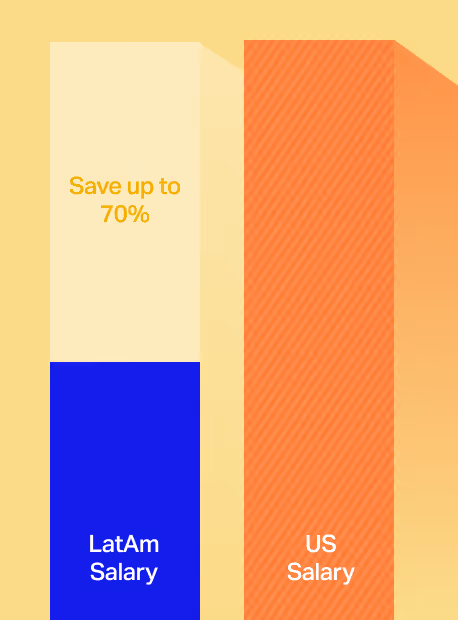
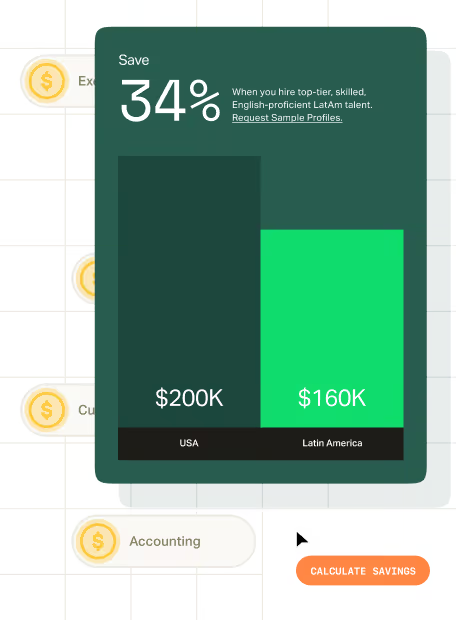
Graphic designer salaries in Latin America run $1,500 to $4,000 per month, depending on seniority, compared to $47,000 to $147,000 annually for US equivalents.
Here are the ranges we see at Hire With Near for full-time graphic designer hires:
For salary ranges across other design and creative roles, see the Hire With Near LatAm vs. US Salary Guide.
These are compensation figures, not total cost. If you use Hire With Near's direct-hire model, there’s a placement fee on top. If you use the staffing model, where we handle payroll, benefits, and compliance, there’s a monthly management fee.
Either way, hiring a full-time nearshore graphic designer from LatAm costs significantly less than US rates, Upwork project volume pricing, and most design agency retainers. For part-time roles (20 hours per week), expect roughly half the full-time rate at the same seniority level.
One thing worth calibrating: Seniority title doesn’t always translate directly across markets. A candidate titled “senior graphic designer” at a small LatAm agency may produce work at a mid-level quality bar by US agency standards. Portfolio review and a paid trial assignment are more reliable indicators of output level than years of experience on a resume. Use the seniority tiers above as a compensation guide, not a substitute for evaluating the work itself.
For senior or director-level creative hires, including creative directors or heads of design, nearshore executive search gives you access to senior LatAm creative talent with real leadership track records.
For a full breakdown of design roles, hiring options, and what to expect from the process, see our guide on how to hire design talent in Latin America.
{{salary-guide-cta}}
“How do I evaluate their work before making a hire?”
Hire With Near provides portfolio samples and video interviews for every candidate before you schedule a live call. For design roles, we also incorporate style-specific screening and, where the brief warrants it, a short paid trial assignment.
This concern is more acute for design than for most functions. A resume tells you almost nothing about whether a designer's output will work for your brand.
In my experience placing designers for US brands, the candidates who stand out are the ones who can articulate the thinking behind their work, not just show it. When I evaluate design candidates, I ask them to walk me through a specific piece from their portfolio: what the brief was, what design decisions they made and why, and what they would do differently now. The answers tell me more than the portfolio or resume alone.
At the shortlist stage, you’ll receive portfolio samples alongside a recorded video interview, so you can see how a candidate communicates before committing your own time to a live call.
For roles with high visual specificity, such as a motion designer with a defined style requirement or an illustrator for a specific brand aesthetic, I recommend including a short paid trial assignment as the final step to evaluate how a candidate handles your kind of brief. It can be, for example, a brief creative problem that takes two to four hours and reflects a scenario close to the role.
When hiring UX/UI designers who present work to stakeholders, I build a presentation component into the interview, since communication and rationale are as important as the visual output in those roles.
If you want a full walkthrough of how to hire a graphic designer from brief to offer, we cover that separately.
“Will they be available during our hours? Design feedback doesn't work async.”
Yes. Most of Latin America falls within one to two hours of US Eastern time. For a design role built on real-time feedback cycles, that overlap matters more than in most functions.
This concern almost always comes from US companies that have previously hired designers based in Southeast Asia or Eastern Europe. When you have been through a revision cycle that took two days because your designer was asleep when the feedback landed, you learn that creative work needs real-time back-and-forth. A study from Harvard Business School and INFORMS back this up: Researches found that each additional hour of time zone difference reduces real-time communication by 11%.
Latin America is different in this specific way. A graphic designer in São Paulo, Buenos Aires, or Mexico City starts their workday when you start yours. They can join a creative brief call at 10 a.m. Eastern, deliver a revision round by the end of the day, and respond to Slack notes in real time.
For design work, time zone overlap changes the shape of the working relationship. Revision cycles compress from two-day async exchanges to same-day turnarounds. Your creative director can run a synchronous review instead of recording a Loom and waiting. Campaign deadline work becomes manageable.
If working hours are important for your team, specify them in the role brief. Most LatAm candidates are flexible within US Eastern to Pacific time windows, and some are open to fully matching your core hours, which is worth confirming early in the process if synchronous availability is non-negotiable.
Related reading: Hiring in Latin America: Answers to Your Questions About Hiring Remote Talent Offshore
Final Thoughts
The questions creative leaders ask about hiring creative talent in Latin America are the right ones to ask. Design is personal in a way that other hiring decisions aren’t.
The talent is there. The work is building a process that surfaces the right fit: portfolio review, style-specific screening, a trial assignment when the brief is specific, and a structured first 30 days.
Beyond graphic designers, which became the third most hired role through Hire With Near in H1 2026, we also place web designers, video editors, product designers, and a range of other creative professionals in Latin America for US companies across industries.
If you want to talk through what a graphic designer search looks like for your specific brand and workload, book a free consultation with Hire With Near. No commitment required.




.webp)
.webp)



%203.svg)
.avif)





%20(1).avif)

%20(1).png)