


%203.svg)
Key Takeaways
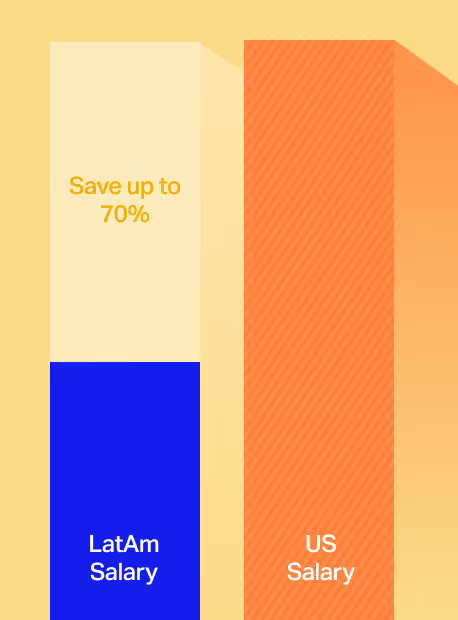
- US companies can hire data and AI talent in Latin America for 30–70% less than US salaries, with professionals who work during overlapping US business hours. For most teams, the fastest path to a great hire is a specialist staffing and recruiting partner that handles both sourcing and employment.
- The most-hired data and AI roles (data scientists, data engineers, data analysts, machine learning engineers, and AI developers) run from roughly $24K to $108K a year in Latin America, compared with $66K to $282K for the same roles in the US.
- The deepest data and AI talent pools in Latin America are in Brazil, Argentina, Mexico, and Colombia. Most placements are experienced mid-level and senior professionals, not entry-level hires stretched into technical roles.
Hiring data and AI talent in Latin America gets you experienced data scientists, engineers, and AI specialists who work in your business hours for 30 to 70% less than US salaries. If you need to build a data or AI team but the numbers keep stopping you, Latin America may be the solution you need.
The region offers the same experienced talent for more affordable salaries, without asking you to compromise on quality or on real-time collaboration.
In this guide, I’ll walk you through why US companies are building data and AI teams there, how to hire, which roles you can fill and what they cost, and the strongest countries for this talent. I’ll also share some common concerns our recruiting team hears frequently.
If your goal is to hire data and AI talent without paying US rates, start here.
Why Are US Companies Hiring Data and AI Talent in Latin America?
US companies hire data and AI talent in Latin America for five reasons: overlapping work hours, strong English, familiarity with US business norms, genuine senior-level experience, and salaries that make roles possible that the US market prices out of reach.
Overlapping work hours
Start with the hours, because it’s the one that sinks offshore experiments.
Data and AI talent in Latin America works during your business day, whether your team runs on Pacific, Mountain, Central, or Eastern time. The table below shows how major Latin American cities align with US time zones across a standard workday:
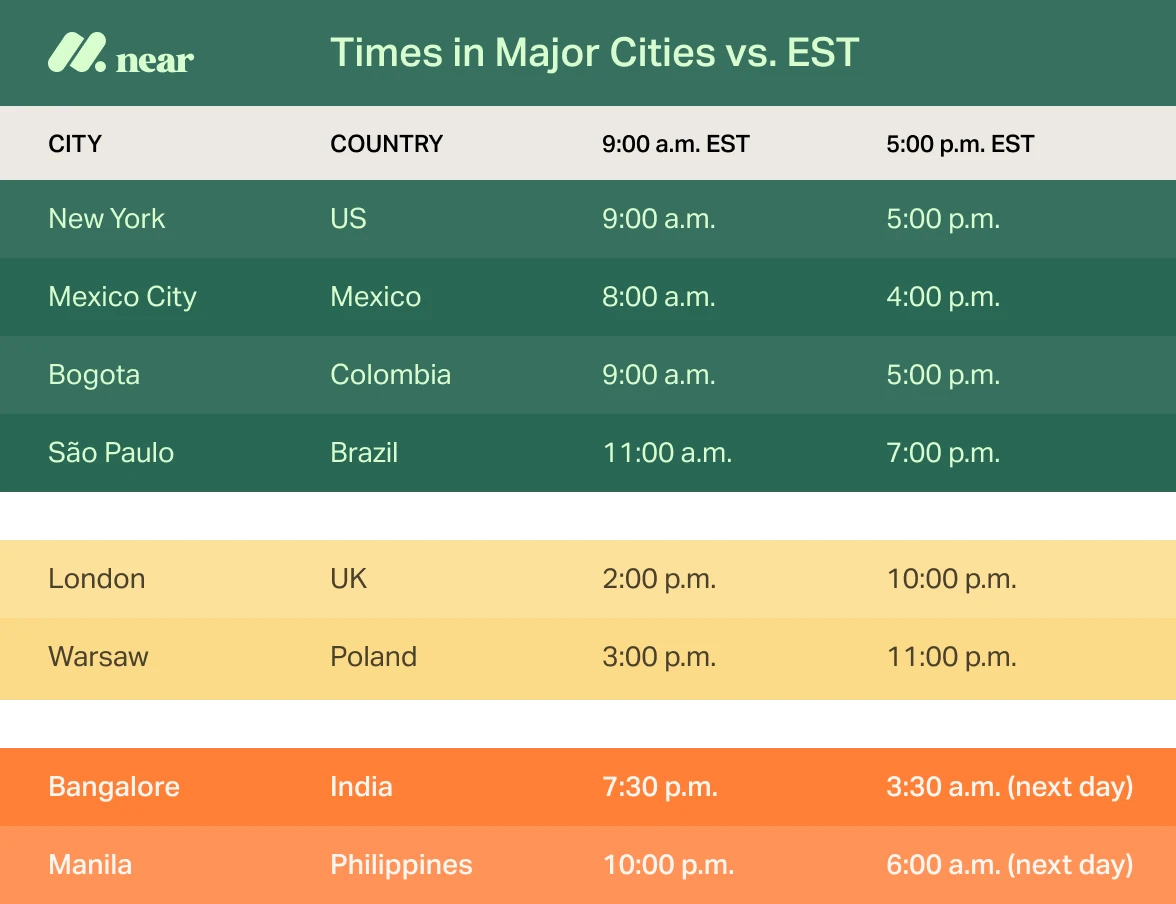
You get live standups, same-hour answers on a broken pipeline, and handoffs that happen while everyone is at their desk, instead of a question sent at 4 p.m. that waits until tomorrow.
That contrast is exactly what pushes technical teams to make the switch. One founder at a payments startup had much of their engineering based in India, but moved after realizing how complicated the time zone difference became:
Right now, a lot of our engineering is based in India, and we have had a few people that we were working with there, but it just becomes too late for them to be productive, especially in the later part of the day here. We’re only able to get EST timings, and we want to get a little bit more PST coverage. Right now it’s 4 a.m., 5 a.m. for them, and they’re complaining that it’s not doable.
A colleague in Latin America is online when you are, so that overnight gap disappears.
Salaries that make the role possible
For many data and AI roles, the US market budget simply won’t stretch to a competitive hire. In Hire With Near’s analysis of 2,000+ conversations with US companies exploring Latin American hiring, 41% pointed to budget constraints as their primary driver, the single largest motivation to hire in Latin America.
The numbers explain why. According to Hire With Near’s salary benchmarks, a mid-level data scientist in Latin America earns $48,000–$72,000 per year, compared to $136,000–$231,000 in the US.
Framed that way, the region is budget enablement: the same spend that hires one stretched US analyst can build a small, senior team.
Strong English skills
English is fluent enough for architecture discussions, technical documentation, and client calls. Most data & AI professionals in the region have worked in English-language environments throughout their careers, through multinational employers, US- facing projects, or academic training, so the language barrier that makes some offshore hires difficult simply doesn’t come up the same way.
Familiarity with US business norms
Most Latin American data and AI professionals have already worked with US companies, so they know the tools, the cadence, and the expectations. Standups, sprint planning, async communication in English, and US-style engineering culture aren’t new to them.
That familiarity shortens ramp time considerably compared to offshore hires, where the cultural adjustment adds weeks of friction.
Genuine senior-level experience
The depth of talent in the region runs further than most US hiring managers expect. Latin America has a growing base of data scientists, ML engineers, and AI practitioners who have worked at multinationals, Big Tech regional offices, and US-funded startups.
The seniority is real: according to Hire With Near’s 2026 State of LatAm Hiring Report, 84% of placements were mid-level or senior roles. This isn’t entry-level talent being stretched into senior positions. It’s experienced professionals who happen to be outside the US.
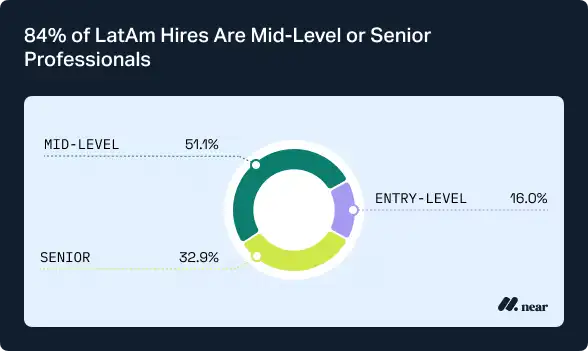
This is part of a broader shift toward hiring remotely in Latin America, and it’s accelerating. Even as US hiring slows, US companies are hiring in Latin America faster than ever, with data and AI among the most in-demand functions.
How Do You Hire Data and AI Talent in Latin America?
You have three realistic ways to hire data and AI talent in Latin America: source and hire directly, use a freelance or contractor platform, or work with a specialist staffing and recruiting partner. For most companies, the third is the fastest path to a great hire.
Here they are, from most hands-on to simplest:
Option 1: Hire directly
You run the search yourself: post on LinkedIn or on a job board for hiring in Latin America, work your referrals, and screen every candidate.
You keep full control, but you carry the full sourcing and vetting burden, which is heavy for niche technical skills like ML engineering or data science.
Because a data or AI hire in another country still needs a legal employer, direct hiring requires you to choose one of two paths for the employment side:
- Set up a legal entity in the country you’re hiring from: This gives you full ownership of the employment relationship, but it comes with real upfront cost, three to six months of incorporation filings, and ongoing local legal and accounting support. It only makes sense when you’re hiring a significant number of people in a single country.
- Use an employer of record (EOR): An employer of record becomes the legal employer on paper while you manage the work day to day, handling contracts, payroll, tax withholdings, benefits, and local compliance. It’s a clean fit when you’ve already found your person and just need the employment logistics handled. But you still have to source and vet every data and AI candidate yourself. Popular EOR companies include Deel, Globalization Partners, Remote, and Oyster. For a full breakdown of how EOR arrangements work, see this guide to hiring remote foreign employees.
Option 2: Freelance and contractor platforms
Platforms like Upwork and Toptal give you fast access to contractors, but they’re built for project or part-time work. The talent is typically splitting attention across several clients, which creates real limitations for a data or AI hire where context, continuity, and deep product knowledge matter.
For a one-off analysis project or a short-term ML task, a contractor platform works. For a full-time data engineer or AI developer embedded in your team, it usually doesn’t, and companies that start here often find themselves rebuilding the search once the engagement ends.
Option 3: A specialist staffing and recruiting partner
This is the simplest option for most US companies, because it closes the gap every other path leaves open: it finds the talent and employs it in one relationship.
You partner with one of the specialist staffing firms for LatAm hiring, like Hire With Near, describe the role, and get pre-vetted candidates back. Once you hire, the partner handles payroll, benefits, compliance, and local requirements, so hiring feels as simple as hiring someone in the US.
For data and AI specifically, that vetting is what makes the difference, which is why companies lean on a partner with real AI and ML recruitment experience rather than a generalist.
It helps to be clear about what this model is and isn’t. It’s full-time nearshore staffing and recruiting, not a marketplace where you browse gig workers, and not a dev shop that keeps the team at arm’s length and bills by the project. The professional joins your team, reports to you, and is managed by you day to day.
Here’s how the three options compare:
Which Data and AI Roles Can You Hire in Latin America (and What Do They Cost)?
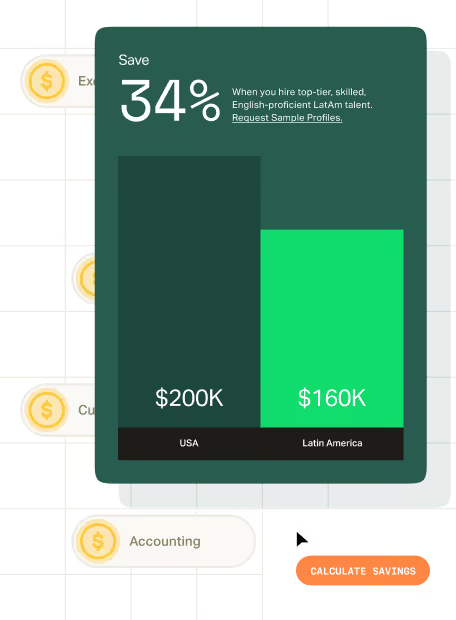
You can hire the full spread of data and AI roles in Latin America for 30 to 70% less than US salaries, which usually translates to $35,000 to $64,000 per hire annually. The savings are largest at the senior end, where US pay climbs fastest.
Below are the roles US companies fill most often when hiring AI and machine learning talent in Latin America, what each does, and why the region fits them:
- Data scientist: A Latin American data scientist builds statistical models and machine learning systems that turn raw data into predictions and decisions. It’s the role US companies compete hardest for at home, which is exactly where Latin America’s cost gap pays off most. Check our “How to Hire a Data Scientist” full guide.
- Data engineer: A nearshore data engineer designs and maintains the pipelines and warehouses that move and clean data so the rest of the team can use it. Strong pipeline talent is common across the region’s larger tech hubs. For more information, read our “How to Hire Data Engineers in Latin America” article.
- Data analyst: A data analyst in Latin America queries data, builds dashboards, and answers business questions with numbers. It’s often the first data hire a company makes, and the LatAm cost savings make it easy to justify. Our “How to Hire a Data Analyst” guide tells you everything about this role.
- Machine learning engineer: A remote machine learning engineer takes models into production and keeps them running at scale, sitting between data science and software engineering. Latin America’s deep software talent pool feeds this role well. Check all the reasons you should hire a machine learning engineer.
- AI developer: A nearshore AI developer builds applications on top of AI models and APIs, from LLM-powered features to automation. Demand for this role is climbing fast, and the region’s developer community has moved quickly into it.
To put the cost in concrete terms, here’s what these roles run compared with equivalent US hires, according to Hire With Near’s Data Roles Salary Guide:
For the most up-to-date figures, see Hire With Near’s US vs Latin America Salary Guide.
If your need runs to the leadership level, a head of data or VP of AI, our executive search covers it.
{{salary-guide-cta}}
Related reading: How an Energy Tech Company Hired a Data and Operations Specialist for $2,500/Month and Saved 62%
What Skills Should You Screen for When Hiring Data and AI Talent in Latin America?
Data and AI is the department where screening matters most and where the gap between a strong hire and a resume-padder shows up latest. A weak data engineer can look fine for a quarter before the pipelines start failing. Here’s what to look for, by role and by trait.
Technical foundation by role
The tools vary significantly across data and AI roles, and conflating them leads to either over-scoping a search or missing the right profile entirely.
- Data analysts need a strong foundation in mathematics, physics, or computer science, advanced SQL, and at least one BI tool, Power BI or Tableau. Python for analysis and visualization is increasingly expected at mid-level and above. One thing worth knowing: senior data analysts with five-plus years are genuinely rare, because at that stage, most people have moved into data science, data engineering, or ML engineering. A strong mid-level analyst with the right stack often serves better than holding out for a seven-year senior who doesn’t exist in the pool.
- Data engineers need strong SQL, ETL and pipeline development experience (Apache Airflow, dbt, Prefect), Python, and cloud platform familiarity, typically AWS, GCP, or Azure. The best signal of a real data engineer isn’t their tool list but their process orientation: can they walk you through how they evaluated and improved an existing data pipeline, not just built a new one?
- Data scientists need hands-on modeling experience, not just theoretical knowledge of algorithms. Python is non-negotiable. The strongest candidates in Latin America typically have backgrounds in mathematics, physics, or engineering, and can explain statistical work in plain language to a non-technical stakeholder.
- ML engineers and AI developers need Python, experience with frameworks like TensorFlow, PyTorch, or Scikit-learn, and cloud ML platform familiarity (AWS SageMaker, GCP Vertex AI). For AI developers specifically, what matters is hands-on experience building with LLMs and generative AI tools, not training models from scratch.
How to evaluate technical depth without being technical yourself
The single most reliable screen for a non-technical hiring manager is the project walkthrough, as Natasha Tarapow, Hire With Near’s Senior Recruitment Consultant, explains:
The strongest ML engineers I’ve interviewed have hands-on model development, training, and deployment experience, not just theoretical knowledge. One thing I use as a genuine technical indicator is communication ability: can they explain complex ML work clearly to someone who isn’t an engineer? If they can’t, it often means they’re naming things without truly understanding them.
Candidates who go vague when walking through their own projects, or who can’t answer “what would you do differently?” with anything specific, are signaling that their resume describes work they observed rather than work they did.
If your team has its own take-home test or coding challenge, it plugs straight into the process alongside the recruiter’s screen.
Proactivity, self-sufficiency, and continuous learning
This is where data and AI hiring differs most from every other department in this series. The field moves monthly. A candidate who was current two years ago may not be current now, and no certification verifies it.
The screen that separates genuinely engaged candidates from ones coasting on prior knowledge is the question: “How do you keep up with advancements in AI and machine learning?”
Strong candidates name specific sources, conferences, research papers, or communities. They describe something they learned recently and how they applied it. Weak candidates give a generic answer about “following the space.”
The related flag: a candidate whose stated area of excitement is completely unrelated to what your company builds. That’s a mismatch you’ll feel after they’re hired.
Self-sufficiency matters just as much. The failure that companies describe most frequently in conversations with our recruiters is a hire who could execute defined tasks but couldn’t operate with ambiguity. One client described needing someone who could “figure out how to deal with ambiguity: okay, this is what you need to happen, but now you’ve got to look at the data and understand what’s actually going on.”
That disposition doesn’t show up on a resume. It shows up in how a candidate talks about past work, and it’s worth a scenario question in every interview.
For AI roles specifically, LLM fluency has shifted from a differentiator to a baseline expectation. Companies now routinely screen for at least one year of hands-on generative AI experience, and several draw a clear line between candidates who use AI tools and candidates who build with LLMs. Know which one your role requires before you start screening.
Which Latin American Countries Are Best for Data and AI Talent?
Brazil, Argentina, Mexico, and Colombia have the strongest data and AI talent pools in Latin America. According to the GitHub Octoverse 2025 report, Brazil now has more than 6.9 million developer accounts on GitHub, more than quadrupling its community over the past five years.
Argentina, Mexico, and Colombia round out the region’s strongest data and AI talent markets. According to the GitHub Octoverse 2024 report, Mexico had more than 1.9 million developer accounts, Argentina more than 1.1 million, and Colombia more than 1 million, each growing at double-digit rates year over year.
Brazil
Brazil has the largest developer community in Latin America and one of the most established data and AI ecosystems in the region. Universities like USP, Unicamp, and UFRJ produce strong STEM graduates with deep technical foundations, and the country has seen major AI and data infrastructure growth over the past five years.
For data and AI specifically, the feedback from companies that have hired from Brazil is consistently positive. “I’ve had some great fortune hiring analytics engineers from Latin America, Brazil specifically,” one data consultancy founder told us.
The strongest fit is for data engineers, analytics engineers, and ML engineers, where Brazil’s technical depth and growing open source community translate into candidates who are already working with current tools and frameworks.
Hire With Near’s placement data puts Brazil at 14% of all nearshore hires in 2025, third overall in the region.
Related reading: Hiring in Brazil: What US Companies Need to Know
Argentina
Argentina is consistently named by US companies as their top choice for senior data and AI talent, and the reputation is earned. Universities like UBA and ITBA have long-standing AI research programs, and Argentine engineers are disproportionately represented in Silicon Valley AI company regional hubs.
Silicon Valley AI companies have established regional hubs in Argentina at a higher rate than almost anywhere else in Latin America. One company that had been building a team in Buenos Aires described their hires as working out “really, really, really well.”
Argentina is also where you find the region’s strongest bench for data scientists and ML engineers at a senior level.
Related reading: Hiring in Argentina: What US Companies Need to Know in 2026
Mexico
Mexico pairs a large and rapidly scaling tech workforce with the closest time zone proximity to US West Coast teams, which makes it the strongest option for companies that need maximum overlap with Pacific or Mountain time.
Mexico City has a long history of hosting US tech company regional offices, which means the candidate pool includes professionals who’ve already worked within US engineering culture and are familiar with US business norms and tooling.
According to the Georgetown Center for Security and Emerging Technology, Mexico surpasses the US in STEM graduates as a share of college degrees, which translates into a wide and deep pipeline for data and analytics roles.
For companies that need bilingual Spanish-English support alongside data work, Mexico is particularly well-positioned.
In the video below, Franco Pereyra, Hire With Near’s COO, shares his thoughts on why Mexico is a great place to hire remote talent:
Related reading: Hiring in Mexico: What US Companies Need to Know
Colombia
Colombia is Hire With Near’s number-one placement destination overall, claiming 23% of all placements in 2025, nearly double its 2024 share. The talent pool is strong for data analysts, business analysts, and analytics engineers, with Universidad de los Andes producing consistently strong graduates for quantitative roles.
Bogotá operates on UTC-5 year-round, meaning it aligns perfectly with US Eastern Standard Time and sits just one hour behind during Daylight Saving Time. This minimal gap ensures your Colombian data hire is active in your standups, code reviews, and Slack channels in real time throughout the business day.
Companies that have switched from offshore arrangements specifically name Colombia for the combination of communication quality, reliability, and time zone fit. “I just recently hired a few from Colombia,” one client told us, adding, “This time zone works way better. I think they’ll just be happier, and I think it’s a better culture fit.”
Related reading: Hiring in Colombia: What US Companies Need to Know
If you’re weighing Latin America against other regions, our comparison of hiring data engineers in LatAm versus the Philippines and India lays out the trade-offs.
What Are the Most Common Concerns About Hiring Data and AI Talent in Latin America?
The concerns US hiring managers raise about data and AI hiring in Latin America are different from the ones they raise for other departments. They’re more technical, more specific, and more grounded in prior bad experiences. Here are the three that come up most often, with concrete answers to each.
“I’m not technical. How do I know the hire is actually good?”
You don’t have to be the technical filter. That’s what specialist screening is for.
Hire With Near’s data and AI recruiters run the same first screen on every candidate: can they explain their work to someone who isn’t an engineer? As Natasha Tarapow puts it:
We always ask candidates to tell us about a project they’ve worked on, not just that they use this language and that one, but what their role was and what they actually did. It’s important that they can explain their work to someone who isn’t a developer. If they can do that, that tells me a lot.
For ML engineers and data scientists, the screen goes deeper: can they describe a model they built and deployed end to end, how they stay current in a field that moves monthly, and how they handle stakeholders who expect more from AI than it can deliver. Candidates who go vague on their own projects don’t make the shortlist.
You also don’t have to take that filter on faith. If your team has its own take-home test, coding challenge, or technical interview, it plugs straight into the process alongside the recruiter’s screen. Your standards, not just the recruiter’s, decide who gets hired.
“We tried offshore before and it didn’t work.”
Nearshore is a different model, not a lighter version of the same one.
With offshoring, your data engineer is 11 to 14 hours ahead, decisions lag a day, pipeline questions queue overnight, and code review back-and-forth stretches across two business days for what should take an hour. That’s a time zone problem, and it compounds over months.
Latin America shares your working hours. With nearshoring, your data team in Bogotá or Buenos Aires is in your standup, reachable when a job fails at 3 p.m., and online for the same collaboration windows your US-based team uses.
This is the specific reason data and AI was one of the most cited functions among companies switching from offshore to nearshore in Hire With Near’s analysis of 2,000+ hiring conversations. The work wasn’t the problem. The hours were.
“Can a nearshore recruiter really fill a niche role?”
Yes, if the recruiter specializes in technical talent. Hire With Near has filled searches as specific as senior programmatic media traders, marketing data scientists, and LLM integration engineers in Latin America.
The fear is understandable: your role is too unusual for a generalist recruiter. In practice, the searches that sound exotic to a hiring manager are usually ones the team has already run. Recruiter intelligence on analyst title inflation alone saves rounds of interviewing: a BI analyst, a quantitative analyst, and a reporting analyst are often the same seniority level, and knowing which to screen for changes the candidate pool significantly.
For a fuller set of answers on fees, replacement guarantees, vetting, and what to ask any partner before you commit, see our guide to the most common questions hiring managers ask about hiring data and AI talent in Latin America.
What Hiring Data and AI Talent in Latin America Looks Like in Practice
Hiring data and AI talent in Latin America delivers real savings without a quality drop, and Delve is a clear example.
Delve is a Boulder-based digital consulting firm whose clients include Google and Amazon AWS. It needed to scale specialized marketing and data roles, but faced a thin, expensive US talent pool and geopolitical disruption to its Eastern European offices.
It turned to Latin America, and Hire With Near filled an initial three roles, including a data scientist. The engagement then grew to ten hires supporting Delve’s 43% headcount growth, all with just 1 to 2 hours of time zone difference.
The result was roughly $500,000 in annual savings, about 50% versus US-equivalent talent, with consistent quality across every level of seniority.
Anton Lipkanou, Delve’s President and Head of Client Services, talked about the partnership:
Hire With Near’s team gave us confidence that we’d hire great talent quickly. They did a deep dive into our requirements, asked the right questions, and communicated our needs and goals back to us. They advised us on compensation, different talent markets, and our hiring process.
Delve isn’t a one-off. Hire With Near has made 3,500+ placements for 950+ companies, so a specialized data or AI search is a path we’ve run many times, not a first attempt.
Final Thoughts
Building a data or AI team in Latin America comes down to one shift in how you see the budget: the same spend that stretches to cover one US hire can put experienced, mid-to-senior-level talent on your team in your own time zone.
The talent pool is deep, the working hours line up, and the quality holds at every level, as companies like Delve found when they saved around $500,000 a year without giving anything up.
The simplest way to start is to get clear on the role and the market. Book a free consultation to talk through your requirements with our team. We’ll walk you through salary benchmarks and the process, and show you what a search for your specific role looks like.
{{latam-hiring-cta-v2}}
Frequently Asked Questions
How do pricing and fees work when you hire data and AI talent through a staffing partner?
Most nearshore staffing and recruiting partners charge either a one-time placement fee or an ongoing management fee on top of the hire’s salary, and the total cost is driven mostly by the salary itself, which for data and AI roles in Latin America runs from about $24K to $108K a year.
When you compare providers, ask how the fee is structured, what it includes (sourcing, vetting, payroll, compliance), and whether there’s a guarantee. For a specific quote on your role, the fastest route is a quick call.
What happens if a data or AI hire doesn’t work out?
Reputable nearshore partners back placements with a replacement guarantee, so if a hire doesn’t work out within a defined window, they find a replacement at no extra placement cost.
Hire With Near’s placements come with a 180-day replacement guarantee, double the common industry standard.
When you evaluate any provider, ask how long the guarantee runs and what triggers it, so a bad fit is their problem to fix, not a cost you eat.
How fast can you hire data and AI talent in Latin America?
Most companies can go from role definition to a hire in under three weeks. With Hire With Near, you typically get a shortlist of pre-vetted candidates in 3 to 5 days, then move through your own interviews at your own pace.
That’s far faster than a US technical search, which often runs two to three months, because the partner handles sourcing and first-round screening in parallel while you focus on final interviews.
Can you hire data and AI talent part-time or for a single project?
The specialist staffing and recruiting model is built for full-time, dedicated hires who join your team long term, so it’s the right fit when you’re adding permanent data or AI capacity.
For a one-off project or fractional need, a freelance or contractor platform is usually the better match, as covered in the ways-to-hire section above.
It’s worth being honest about which you need: most companies building a data or AI capability are better served by a full-time hire than by rotating contractors.
How do you protect data security and confidentiality with a remote data and AI hire?
Data security is handled the same way you’d handle it for any employee who touches sensitive systems: signed NDAs, defined access controls, and clear device and security policies, agreed before day one.
Because a data or AI hire works as a dedicated member of your team under your direction, they operate inside your security setup and your tools, not a separate vendor environment.
Confidentiality and IP protections are covered by standard NDAs and access rules, so you set the same guardrails you would for a US-based hire.
Do data and AI professionals in Latin America work during US business hours?
Yes, Latin American professionals work during US business hours, so they overlap your team’s day whether you’re on the East Coast, in the Central states, in the Mountain zone, or on the West Coast.
Countries like Mexico and Colombia line up closely with US Central and Eastern hours, while Argentina and Brazil run 1 to 2 hours ahead of the East Coast, still sharing most of the workday.
That live overlap is the core reason nearshoring works where distant offshore hiring often doesn’t
What other data and AI roles can you hire in Latin America?
Beyond data scientists, data engineers, data analysts, machine learning engineers, and AI developers, US companies hire a wide range of specialized data and AI roles in Latin America, including nearshore prompt engineers, remote business analysts, Power BI developers in Latin America, remote ETL developers, and nearshore database developers.
Talent in these roles offers the same technical depth as US-based professionals, with better time-zone alignment than offshore alternatives and significant cost savings.





.webp)
.webp)



%203.svg)
.avif)





%20(1).avif)

%20(1).png)