


%203.svg)
Key Takeaways:
- Data scientists typically cost between $118,000–$330,000 annually in the US, but hiring in Latin America can reduce costs by up to 81%.
- The best data scientists combine technical expertise (Python/R, machine learning, statistics) with crucial business skills (communication, problem-solving, and the ability to translate data into actionable insights).
- You can find quality data scientists through specialized job boards, professional networks, or recruitment partners like Near.
You’ve been running the same reports for months. Your leadership team keeps asking for “data-driven insights,” but spreadsheets and basic analytics aren’t cutting it anymore. You know there’s valuable intelligence hiding in your data—customer behavior patterns, optimization opportunities, revenue drivers—but you don’t have anyone who can unlock it.
Meanwhile, your competitors are making smarter decisions faster, and you’re falling behind because you’re still making crucial business choices based on gut instinct rather than solid analysis.
This isn’t just about hiring someone who knows statistics. You need a data scientist who can bridge the gap between complex data and business strategy. Someone who can spot the patterns that matter and communicate findings in ways that drive real decisions.
This guide will show you how to hire a data scientist who delivers results, whether you’re hiring locally, nationally, or offshore. We’ll cover the skills that truly matter, where to find top talent, and how to avoid common hiring mistakes.
What Does a Data Scientist Do?
Data scientists turn raw data into actionable business insights by combining statistical analysis, machine learning, and domain expertise to solve complex problems.
They handle everything from data collection and cleaning to building predictive models and presenting findings to stakeholders. Whether they’re identifying customer churn patterns, optimizing pricing strategies, or forecasting demand, their job is to find meaningful signals in noisy data and translate those discoveries into recommendations that drive business outcomes.
Data science work typically flows through several stages:
- understanding the business problem
- gathering and preparing data
- exploring patterns through analysis
- building and testing models
- communicating results to non-technical teams
A strong data scientist doesn’t just run algorithms. They understand which questions are worth asking and how to frame their findings for maximum business impact.
The role can look different depending on the company. In e-commerce, a data scientist might build recommendation engines or analyze conversion funnels. In finance, they could develop risk models or detect fraudulent transactions. In healthcare, they might analyze patient outcomes or optimize treatment protocols.
This flexibility is why data science skills are in such high demand across industries.
According to the US Bureau of Labor Statistics, employment of data scientists is projected to grow 36% from 2023 to 2033. This is much faster than the average for all occupations. This exceptional growth rate reflects the increasing reliance on data-driven decision-making across virtually every industry.
How Much Does It Cost to Hire a Data Scientist?
Data scientist salaries in the US typically range from $118,000–$330,000 annually, making them one of the most expensive technical hires for growing companies.
These high costs reflect both the specialized nature of the role and the intense market demand.
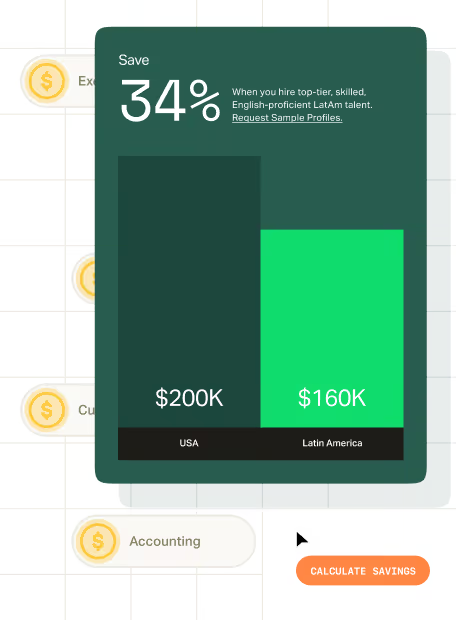
If that salary range feels out of reach for your budget, expanding your search internationally can provide access to the same caliber of talent at significantly more sustainable rates.
Companies open to hiring from Latin America often find data scientists with equivalent skills with salary expectations 69-81% less than their US counterparts.
Based on our experience, here’s what data scientists typically earn in Latin America:
These differences reflect local cost of living rather than skill level. Many data scientists in Latin America have advanced degrees from top universities, experience working with US companies, and fluency in both English and cutting-edge data science tools.
This means you can often bring on senior-level talent at the cost of a junior US hire, giving you more budget flexibility to build out your analytics capabilities or invest in other growth areas.
Similar savings can be found in other regions like Eastern Europe, South Asia, and Southeast Asia, though often with trade-offs in time zone alignment and cultural compatibility that make Latin America particularly attractive for US companies.
What Skills Should You Look for When Hiring a Data Scientist?
Great data scientists need more than technical skills. They also need strong communication, ownership, and strategic thinking to translate complex analysis into business value.
However, skill evaluation depends heavily on the seniority level you’re targeting.
A junior data scientist might excel at data cleaning and basic modeling but need guidance on complex statistical analysis and strategic business insights. Meanwhile, a senior data scientist should be able to design comprehensive analytical frameworks, lead cross-functional data initiatives, and translate complex findings into executive-level strategic recommendations.
Understanding these distinctions helps you evaluate candidates fairly and set realistic expectations for performance. For example, expecting a junior analyst to immediately design sophisticated machine learning pipelines or develop predictive business models sets everyone up for frustration. Similarly, hiring a senior expert for tasks that primarily involve basic data manipulation wastes both their potential and your budget.
The key is matching your expectations to the candidate’s experience level while providing appropriate growth opportunities that align with your business needs and data maturity.
Here’s how data scientist skills typically progress across experience levels:
%2011.43.38%E2%80%AFa.%C2%A0m..webp)
Regardless of seniority level, all data scientists should demonstrate certain fundamental capabilities.
Here are the core skills to evaluate:
Hard skills (the must-haves)
These foundational technical competencies are essential for effective data science work across all experience levels:
- Programming proficiency in Python or R: All data scientists should be comfortable with at least one primary data science language. Look for experience with core data manipulation libraries (pandas for Python, dplyr for R) and basic visualization capabilities. The depth of knowledge will vary by seniority, but fundamental programming skills are non-negotiable.
- SQL and database fundamentals: Data scientists spend significant time accessing and preparing data. Candidates should demonstrate basic SQL proficiency for querying databases and understanding how to work with structured data. They should be able to join tables, filter data, and perform basic aggregations.
- Statistical thinking and analysis: While the complexity will increase with seniority, all data scientists should understand fundamental statistical concepts like hypothesis testing, correlation vs. causation, and basic probability. They should be able to interpret statistical results and understand when findings are statistically significant.
- Data visualization basics: The ability to create clear, meaningful charts and graphs is essential. Whether using programming tools (matplotlib, ggplot2) or business intelligence platforms (Tableau, Power BI), candidates should understand how to choose appropriate visualizations for different types of data and audiences.
- Basic machine learning concepts: All data scientists should understand the difference between supervised and unsupervised learning, when to use classification vs. regression, and basic model evaluation techniques. The specific algorithms and advanced techniques will vary by seniority level.
Soft skills (equally important)
Technical skills get the work done, but these capabilities determine how effectively your data scientist integrates with your team and drives business impact:
- Business acumen and problem-solving: The best data scientists don’t just answer questions—they ask the right questions. Look for candidates who can connect analytical findings to business objectives and identify opportunities that others might miss. They should understand how their work fits into broader company goals.
- Clear communication: Data insights are worthless if stakeholders can’t understand them. Your data scientist should be able to explain complex concepts in simple terms, tailor their message to different audiences, and present findings that lead to action rather than confusion.
- Ownership and self-direction: Data science projects often involve ambiguous problems and iterative solutions. Strong candidates should demonstrate the ability to work independently, manage their own timelines, and take full ownership of their analysis from initial questions through final recommendations.
- Collaborative mindset: Data scientists need to collaborate with engineers, product managers, marketers, and executives. Look for evidence of cross-functional work and the ability to incorporate feedback and business constraints into their analysis.
Nice-to-have skills (the differentiators)
These additional capabilities can give candidates an edge, especially for growing companies with evolving needs:
- Domain expertise: Experience in your specific industry (healthcare, finance, e-commerce) can accelerate time-to-value and provide immediate context for business-relevant insights. While not essential, it can help candidates hit the ground running.
- MLOps and deployment skills: Understanding how to productionize models and work with engineering teams to deploy solutions can be valuable for companies looking to operationalize their data science work. Experience with tools like Docker, Kubernetes, or cloud platforms adds significant value.
- Big data technologies: For companies dealing with large-scale data, experience with tools like Spark, Hadoop, or cloud-based data processing platforms can be important. However, focus on this only if your data volumes truly require these technologies.
- Advanced specializations: Depending on your needs, expertise in areas like natural language processing, computer vision, or time series analysis can be valuable differentiators. These should align with your specific business challenges rather than being general requirements.
Where Can You Find and Hire Great Data Scientists?
You can find strong data scientists through job boards, referrals, and recruiting partners like Near. Your location and sourcing strategy will determine quality and cost.
The best approach depends on your timeline, budget, and internal recruiting capabilities. Here’s how to think about both location and sourcing strategy:
Deciding between local, national, or global talent
Data science work is inherently remote-friendly, which opens up your options significantly.
- Local/in-office hiring: Offers easy collaboration and cultural integration, but limits your talent pool and typically means paying the highest salaries. This approach works well if you have specific needs for in-person collaboration or are in a major tech hub with strong local talent.
- Remote US-based hiring: Expands your talent pool nationally while maintaining familiar business practices and time zones. Expect to pay similar rates to local hiring, but with access to a much broader range of candidates.
- International hiring: Provides access to the largest talent pool and significant cost savings. The key is choosing regions that offer strong technical education, English proficiency, and reasonable time zone alignment.
Latin America stands out for US companies due to time zone compatibility, cultural alignment, and strong technical education systems.
Countries like Argentina, Colombia, and Mexico have well-established data science programs and many professionals with experience working on US projects.
Other regions like Eastern Europe (Poland, Romania) and parts of Asia (India, Philippines) also offer strong talent, though often with greater time zone differences that may affect collaboration.
Choosing the right sourcing channel
Once you’ve decided where to hire, your sourcing strategy determines how quickly you find the right candidates:
%2011.45.11%E2%80%AFa.%C2%A0m..avif)
For most companies, a combination approach works best. Start with your network and specialized boards, then consider recruitment partners if you need help with international hiring or faster time-to-hire.
Why working with a recruiting partner makes a difference
A trusted recruitment partner can help ensure you make the right hire, access more qualified candidates faster, and avoid delays.
Filling a role like data scientist isn’t just about finding someone who can code in Python or run predictive models.
The real challenge is finding someone who can do all that while understanding your business context, communicating effectively with non-technical stakeholders, and hitting the ground running. That combination is rare, especially when you’re hiring outside your local market.
A strstrong data scientist recruiting company changes the equation. Instead of starting from scratch, you get:
- A vetted talent pool of candidates who’ve already been assessed for technical and soft skills.
- Market insight to help you set realistic salary ranges and competitive offers.
- On-the-ground expertise to navigate local hiring nuances, compliance, and expectations.
This isn’t theory. It’s exactly how we helped Delve, a digital consulting firm, when they needed to hire a data scientist along with other specialized roles. They were facing long timelines and steep salary expectations in the US, which would have slowed growth and stretched their budget.
By tapping into our network in Latin America, they were able to quickly secure a top-tier data scientist—plus nine other highly skilled professionals—without compromising on quality.
The result? Nearly $500,000 in annual payroll savings compared to hiring in the US, while still building a team that operates at the same high standard as their US counterparts.
That’s the difference a recruiting partner makes: faster hiring, stronger candidates, and better long-term outcomes. ]
You’re not gambling on whether you can find the right person—you’re leveraging a process that’s already been proven to work.
{{prevetted-banner}}
How to Hire the Best Data Scientist: Best Practices
Following a systematic approach leads to better hires. Define your needs clearly, evaluate beyond technical skills, and move quickly when you find the right candidate.
Here’s what experienced hiring managers do when recruiting data scientists:
Stage 1: Define your needs before sourcing
Clarify the business problems you need solved
Don’t start with “we need a data scientist.” Start with “we need someone who can solve X business problem.” Are you trying to reduce customer churn, optimize pricing, or build recommendation systems? The clearer you are about outcomes, the easier it is to find someone with relevant experience.
Write a job description that attracts problem-solvers
Your job description should emphasize the business impact they’ll have, not just the tools they’ll use. Include specific examples of projects they might work on and how their work will influence company decisions. This attracts candidates who think strategically rather than just technically.
Focus on the 3-4 most important requirements rather than creating an exhaustive wish list.
Research from ERE Media shows that job descriptions between 700-900 words achieve optimal click-to-apply rates of 15%, compared to just 6.7% for descriptions that are too brief or overly lengthy. Additionally, SHRM research revealed that 66% of companies said including salary ranges increased the quality of applications they received.
Stage 2: Screening and evaluation
Test for practical problem-solving, not just technical knowledge
While technical skills matter, the ability to approach business problems systematically is what separates great data scientists from merely competent ones.
Give candidates a realistic business scenario and ask them to walk through their approach from problem definition through analysis and recommendation.
Research shows that structured interviews are twice as effective as unstructured conversations for predicting job performance. Use consistent scenarios and evaluation criteria across all candidates.
Evaluate communication skills early in the process
Data science insights that can’t be communicated effectively have zero business value.
During screening, pay attention to how clearly candidates explain their past projects. Can they describe complex concepts without drowning you in jargon? Do they focus on business outcomes or just technical details?
Look for ownership and self-direction
Data science projects often involve ambiguous problems with no clear starting point. Strong candidates should demonstrate comfort with uncertainty and the ability to structure their own work. Ask about times when they’ve had to define their own project scope or work with incomplete information.
Stage 3: Making the offer and closing the deal
Emphasize growth opportunities and business impact
Top data scientists want to know their work will matter. Highlight how their insights will influence key business decisions and what opportunities they’ll have to expand their skills or take on more strategic responsibilities.
Move quickly for strong candidates
The data science talent market is competitive.
When you find someone who fits the bill, don’t delay. Strong candidates often have multiple opportunities, so a streamlined offer process can make the difference between landing your top choice and starting over.
For more guidance on competitive offers, check out our tips on making a good job offer to hire and retain top talent.
What Are the Top Interview Questions for Hiring Data Scientists?
To find the best data scientist, you need to go beyond resumes. These interview questions uncover how candidates think and collaborate under pressure.
Here are five questions that reveal crucial insights about how candidates approach problems and work with teams:
“Walk me through how you would approach a 20% drop in user engagement. What would your process look like from start to finish?”
This question tests systematic thinking and business intuition. Strong candidates will start by clarifying the context (what type of engagement, over what timeframe), identify potential hypotheses, describe their data gathering approach, and explain how they’d prioritize investigations.
Listen for candidates who ask clarifying questions before diving into analysis and who consider both technical and business factors that could influence engagement.
“Describe a time when your analysis contradicted what stakeholders expected to hear. How did you handle it?”
This reveals intellectual honesty and communication skills under pressure. Great data scientists challenge assumptions with data rather than look to confirm existing beliefs. Look for examples where candidates diplomatically presented uncomfortable truths and helped stakeholders understand the implications.
“How would you explain the difference between correlation and causation to a non-technical executive, and why it matters for business decisions?”
Communication clarity is crucial for data science roles. Strong answers will use concrete business examples, avoid jargon, and demonstrate understanding of why this distinction affects strategy. Candidates should show they can make complex concepts accessible without oversimplifying.
“Tell me about a machine learning model you’ve built that failed or performed poorly. What went wrong and what did you learn?”
This tests learning mindset and self-awareness. Everyone has projects that don’t work out. The best candidates can reflect on why, whether it was data quality issues, wrong problem framing, or unrealistic expectations. Look for ownership of mistakes and evidence of continuous improvement.
“How do you decide when you have enough data to make a recommendation, versus when you need to collect more?”
This reveals judgment and business acumen. Data science isn’t about achieving perfect certainty. It’s about making the best decisions possible with available information. Strong candidates should discuss balancing statistical confidence with business urgency and stakeholder needs.
Common Mistakes to Avoid When Hiring Data Scientists
Even experienced hiring managers make predictable errors when recruiting data science talent.
Here’s how to avoid the most costly ones:
1. Focusing on tools instead of thinking ability
Many job descriptions read like shopping lists of technologies: “Must know Python, R, TensorFlow, Spark, Tableau...” But tools change rapidly in data science, and smart candidates can learn new technologies quickly.
Instead, focus on problem-solving approach, statistical thinking, and the ability to choose appropriate methods for specific business questions.
A candidate who understands the fundamentals can adapt to your tech stack much easier than someone who knows your tools but lacks analytical judgment.
2. Expecting unicorns who can do everything
Data science, data engineering, machine learning engineering, and data analytics are distinct specialties. Trying to hire one person who excels at all of them often leads to candidates who are mediocre at everything.
Be clear about whether you need someone to build data pipelines, create predictive models, or generate business insights. Hire for depth in the areas that matter most for your immediate needs rather than breadth across all possible data roles.
3. Underestimating the importance of domain knowledge
Technical skills without business context often produce analytically correct but strategically irrelevant insights. A data scientist who understands your industry can ask better questions, spot meaningful patterns, and avoid analysis that sounds impressive but doesn’t drive decisions.
While domain expertise isn’t always required, consider how industry knowledge affects the value a candidate can provide, especially in regulated or specialized fields.
And here’s a great tip we found in the Harvard Business Review that you could incorporate into your onboarding process:
Have data scientists spend time with business or product units to better understand the real problems they are facing. This will make them feel like a valued member of the team and will strengthen their analyses and understanding of your business. As a result, they will help make better products and deliver better services to your customers.
4. Overlooking communication and stakeholder management skills
Even brilliant analysts fail if they can’t communicate findings effectively or build relationships with business stakeholders. The best insights are worthless if decision-makers don’t understand or trust them.
During interviews, evaluate how candidates explain their work to non-technical audiences and their experience collaborating with different departments. These soft skills often determine long-term success more than technical capabilities.
5. Setting unrealistic expectations about immediate impact
Data science projects often take longer than expected, especially when dealing with messy real-world data or poorly defined business problems.
Setting expectations for quick wins can lead to frustration on both sides. Be realistic about timelines and make sure candidates understand the current state of your data infrastructure. The best data scientists need time to understand your business, clean your data, and build trustworthy models before delivering high-impact insights.
{{state-latam-hiring}}
Final Thoughts
Finding the right data scientist requires looking beyond technical skills to evaluate how candidates think, collaborate, and execute. Whether you need someone for specific analytical projects or building long-term data science capabilities, investing in the right talent pays dividends across your entire business strategy.
The key is clarity: know what business problems you need solved, understand which skills actually matter for your context, and create an evaluation process that tests for both analytical ability and business judgment.
If working with a recruitment partner seems like the right approach, consider Near.
We take the time to understand exactly what our clients need in a data scientist, whether that’s specialized machine learning expertise, business intelligence capabilities, or hands-on analytical skills. We then present you with pre-vetted Latin American data scientists who fit your specific requirements, work style, and budget.
Our candidates work during your time zones, integrate seamlessly with your team, and deliver exceptional results at rates up to 81% lower than their US-based peers.
If you want to go deeper before booking a call, we've covered the most common questions hiring managers ask in our FAQ on hiring data and AI talent in Latin America.
Book a free consultation call with our team today, and we’ll help you find the perfect match within 21 days. There’s no fee to interview. You only pay once you make a hire.







.webp)


%203.svg)
.avif)






%20(1).avif)

%20(1).png)