


%203.svg)
Key Takeaways
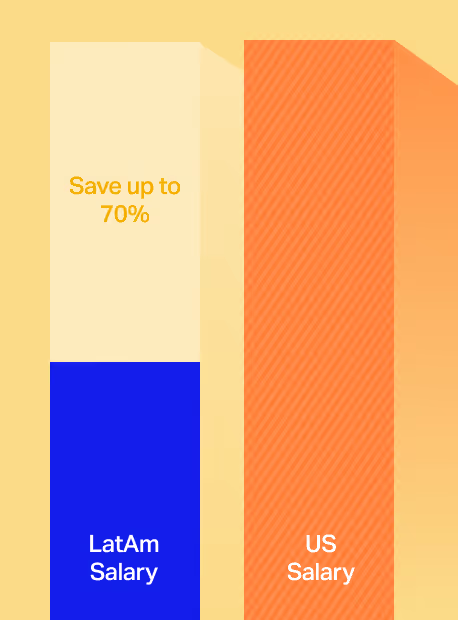
- Companies hiring in Brazil typically save 30–70% on salaries compared to US equivalents, without compromising on seniority or experience.
- Brazil is Latin America’s largest talent pool, and the top source country for software engineer placements in Hire With Near’s 2026 data.
- US companies can hire in Brazil without specialist knowledge: a staffing and recruiting partner finds the talent, handles international payments, and takes care of compliance.
More US companies are looking beyond their borders to build their teams. Rising domestic salaries, a shrinking pool of available talent in key roles, and remote work have made international hiring a practical option for companies that wouldn’t have considered it five years ago.
Latin America, and more specifically, Brazil, keeps coming up as an excellent choice: in the first half of 2026, Brazil became the top destination for nearshore hiring among US companies for the first time.
The broad case for Latin America is well documented. Thousands of US companies are turning to Latin America for the talent they need at rates that make sense.
Brazil stands out as one of the strongest options in the region: the largest talent pool, a mature university system, time zone overlap with the US, and salaries that run 40–70% below US equivalents for comparable roles.
This guide covers everything a US company needs to know before hiring there: the three ways to structure a hire, what the talent looks like, what roles Brazil is strongest in, what you’ll pay, and what Brazilian labor law requires, including the parts that tend to surprise US employers the most.
Why Are US Companies Hiring in Brazil?
I grew up in Brazil, so I’ll say this with some authority: the professional talent coming out of the country’s major cities is genuinely world-class.
And it’s not just my take. When we surveyed 2,000 hiring managers about why they turned to Latin America, the pattern was consistent. You can see it in the data.
Large talent pool
Brazil is the largest talent pool in the region with over 215 million people. The country has a mature university system and carries decades of exposure to US technology stacks and business practices.
This is driven in part by the concentration of multinationals, like Google, Microsoft, JPMorgan, Goldman Sachs, Accenture, operating out of São Paulo, one of the largest corporate and financial hubs in Latin America.
Time zone alignment
Another big advantage is the time zone alignment: São Paulo and Rio de Janeiro run on Brasília Time (BRT, UTC-3), which puts them no more than two hours ahead of Eastern Time, depending on the time of year.
East Coast companies get a solid 6–7 hours of real-time overlap during standard business hours. West Coast companies get 3–4 hours, which is workable, especially if you set clear expectations around core collaboration windows.
English proficiency
English proficiency is more uneven in Brazil than in Argentina or Chile. The EF English Proficiency Index ranks Brazil 75th globally, 16th in Latin America. That country-level number, though, doesn’t tell you much about the talent pool you’re actually hiring from.
In tech, finance, and engineering, mid and senior-level professionals in São Paulo, Florianópolis, Belo Horizonte, and Curitiba commonly work in English daily.
The gap shows up more at junior levels and in industries with less international exposure.
Engineering edge
The country-specific differentiator is engineering depth.
According to Hire With Near’s 2026 State of LatAm Hiring Report, based on over 2,000 placements, Brazil was the top source country for software engineer placements, a role that grew in demand from US companies 250% year over year.
If you’re building a technical team, Brazil belongs at the top of the list.
And if you’re curious about why software development outsourcing to Brazil has accelerated the way it has, the talent density in cities like São Paulo and Campinas explains most of it.
Related reading: How to Hire Developers in Brazil: Cost, Skills, and Ways to Hire
How to Hire in Brazil: 3 Options for US Companies
You have three main options for hiring in Brazil: establish a legal entity, partner with an Employer of Record (EOR), or work with a specialist staffing and recruiting company.
I'll start with the most complex and end with the simplest. If options one and two sound like a lot, option three is where most US companies end up, and it requires no specialist knowledge on your part.
Option 1: Establish a legal entity
Setting up a legal entity means registering your business in Brazil so you can hire employees directly under your company’s name.
This involves establishing a subsidiary or branch office, navigating Brazil’s business registration requirements, and setting up payroll and benefits systems that comply with the CLT, Brazil’s national Consolidation of Labor Laws, which governs every aspect of the formal employment relationship.
This gives you complete control over your Brazilian operations and makes sense if you’re planning to build a significant presence in the country: think dozens of employees, not two or three hires.
For most US companies, this is overkill.
The upfront costs are substantial, the process typically stretches three to six months, and you’ll need ongoing local legal and accounting support to stay compliant as regulations change.
Brazil’s labor law is among the most detailed in Latin America, and non-compliance carries real financial consequences.

Option 2: Use an employer of record (EOR)
An employer of record is a third-party company that becomes the legal employer of your hire on paper, while you retain day-to-day management and direction of their work.
The EOR handles everything on the back end: employment contracts under Brazil’s CLT framework, payroll, tax withholdings, benefits administration, and compliance with local labor law.
That includes mandatory obligations like the FGTS, an 8% monthly contribution into a government-administered severance fund, and the 13th salary, a legally required year-end bonus equal to one month’s pay.
Both are non-negotiable for CLT employees, and both catch US employers off guard the first time. An EOR manages them automatically.
Popular EOR platforms include Deel, Globalization Partners, Remote, and Oyster. You can read our comprehensive guide to hiring remote foreign employees to understand exactly how EOR arrangements work.
The trade-off: You’ll still need to source and vet candidates yourself. The EOR handles the employment logistics, not the recruiting.
So to find the talent to hire, you’ll need to use LinkedIn, a job board for hiring in Latin America, or other means.
Option 3: Work with a specialist staffing and recruiting company
This is by far the simplest option for most US companies.
You partner with one of the specialist staffing firms in Brazil, like Hire With Near, that handles both talent acquisition and the employment structure in one package
Here’s an example of how it works. Hire With Near finds you the right person through our nearshore staffing and recruiting services, and then we also handle everything that sits between you and your new hire, like payroll, compliance, and benefits, so you don’t need to become an expert in Brazilian employment law to make it work. The process ends up feeling as straightforward as bringing on someone in the US.
Of course, some companies take a different route entirely: freelance platforms like Upwork or Fiverr let you find and pay Brazilian professionals without much setup. It's easy to get started, and the platforms handle payments.
But working with freelancers isn’t the same as hiring a dedicated full-time team member. Freelancers are typically juggling multiple clients, working project to project, and not building institutional knowledge of your business over time.
If you want someone fully integrated into your team (attending your standups, owning their function, growing with your company), a specialist staffing partner is a different proposition than a freelance platform.
What to Expect When Hiring Brazilian Talent
Brazil’s tech talent pool is the most prominent in Latin America, and the engineering community specifically has been built in close proximity to US companies for decades.
Multinationals like Google, Microsoft, IBM, Oracle, and SAP all have significant operations in Brazil. Google’s R&D Center in Latin America grew out of Universidade Federal de Minas Gerais’s computer science department in Belo Horizonte. That kind of institutional connection shapes the talent.
The most common roles Hire With Near fills from Brazil are software engineers, with the country ranking as the top placement source for that role in our 2026 data. Demand from US companies for engineers across Latin America grew 250% year over year, with Brazil sitting at the center of that growth. Beyond engineering, we regularly fill financial analyst roles, data scientist positions, and UX/UI designer roles from Brazil.
When you're reviewing Brazilian candidates, university background is a useful signal. These are the institutions that consistently produce strong professionals in the roles US companies hire most:
- USP (Universidade de São Paulo): Brazil’s top-ranked university and the go-to pipeline for elite finance, law, tech, and healthcare professionals. Think Wall Street-caliber financial talent.
- Unicamp (Universidade Estadual de Campinas): Known as the “Brazilian Silicon Valley.” Deep-tech focus, complex software development, industrial and automotive engineering.
- UFMG (Universidade Federal de Minas Gerais): Home to a world-renowned computer science department, the birthplace of Google’s R&D Center in Latin America. Top-tier developers and data scientists come out of here.
- UFRJ (Universidade Federal do Rio de Janeiro): Strong in engineering, oil and gas, logistics, and creative fields. A powerhouse for design and marketing talent in Rio.
- FGV (Fundação Getulio Vargas): One of the most prestigious business and economics schools in Latin America. The standard for corporate finance, accounting, and executive leadership candidates.
If you're new to international hiring, we've also put together answers to the common questions US companies have about hiring remote talent offshore.
What Are the Salary Ranges for Brazilian Hires?
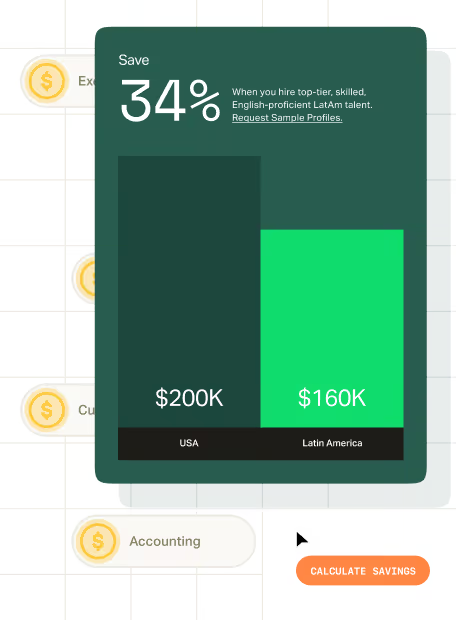
Companies hiring in Latin America typically save 30–70% compared to US equivalents for the same role and seniority level.
According to Hire With Near’s 2026 State of LatAm Hiring Report, the average annual savings per hire runs between $35,000 and $64,000, with 84% of those placements being mid-level or senior professionals.
Here are compensation benchmarks for the roles most commonly filled from Brazil:
Source: Hire With Near's 2026 US vs. Latin America Salary Guide
The savings don’t come from hiring junior talent. They come from the difference in cost of living between Brazil and the US.
To ground these numbers, here’s a cost-of-living comparison between São Paulo and Rio de Janeiro, Brazil’s two largest cities, and Atlanta, Georgia, a comparable US tech and corporate hub:
Source: Numbeo.com
A senior software engineer earning $72,000 in Brazil is living well by local standards. The same role in Atlanta starts around $126,000 and goes significantly higher. That gap is entirely cost-of-living driven, not a difference in skill or output.
For the full role-by-role breakdown, see our full Latin America salary guide.

What Do US Companies Need to Know Before Hiring in Brazil?
Hiring Brazilian professionals means you’re not necessarily bound by the CLT, the country’s national labor law. But understanding what Brazilian workers are used to matters, because it directly affects how you structure compensation and time off in a way that attracts and retains good people.
PTO and statutory leave
Under Brazilian labor law, workers are entitled to 30 calendar days of paid annual leave per year, but there’s an important catch: no vacation can be taken during the first 12 months of employment.
This initial window is called the “acquisition period,” and the employer has the following 12 months to schedule the time off. Note that these are calendar days, not working days, meaning weekends and public holidays that fall during the vacation period count toward the 30-day total.
Under the CLT, workers also receive a vacation bonus equal to one-third of their monthly pay (adicional de férias) when they take time off, plus the right to “sell back” up to 10 days of vacation in exchange for a cash payout, reducing actual time off to 20 days while receiving extra pay.
Maternity leave under CLT is 120 days at full pay, and paternity leave is 5 days, extendable to 20 days for companies enrolled in the Empresa Cidadã program. Worth knowing as context for what Brazilian professionals are used to, even if your specific arrangement differs.
Public holidays
Brazil has 10 mandatory national public holidays. There are also several pontos facultativos: optional days that aren’t legally required for private employers, but are widely observed in practice, especially by larger companies.
Carnival falls into this category: it’s not a national holiday, but most offices do not operate on the Monday and Tuesday of Carnival week.
Mandatory national holidays
- January 1: New Year’s Day
- April 21: Tiradentes Day
- May 1: International Workers’ Day
- September 7: Brazilian Independence Day
- October 12: Our Lady of Aparecida
- November 2: All Souls’ Day
- November 15: Proclamation of the Republic
- November 20: National Zumbi and Black Consciousness Day (national holiday as of 2023)
- December 25: Christmas Day
Good Friday (Sexta-feira Santa) is also a mandatory national holiday. It falls on a different date each year based on the religious calendar, always sometime in March or April.
Widely observed optional holidays (pontos facultativos)
- February/March: Carnival, Monday and Tuesday (dates vary)
- February/March: Ash Wednesday (dates vary, optional until 2 p.m.)
- May/June: Corpus Christi (dates vary)
- December 24: Christmas Eve (optional after 1 p.m.)
- December 31: New Year’s Eve (optional after 1 p.m.)
There are also state and municipal holidays that vary by city.
Given the number of holidays, a practical approach Hire With Near recommends is to offer a set number of floating local holiday PTO days. That way, your hire can decide which to observe and which to work. It respects local customs without tying your team’s schedule to a calendar that may not align with your business.
{{salary-guide-cta}}
The 13th salary
Under Brazilian labor law, formal CLT employees receive a mandatory 13th salary, a year-end bonus equal to one full month’s pay, split into two installments. Contractors aren’t legally entitled to it.
That said, Brazilian professionals know exactly what they’d be giving up by working outside the CLT. Senior talent will factor this into their rate expectations, either explicitly or implicitly. When thinking about what to offer, it’s worth keeping in mind that a competitive annual package in Brazil is typically equivalent to 13 months of base pay: 12 monthly salaries plus one additional month at year end.
Structuring compensation with that in mind goes a long way toward attracting strong candidates and keeping them.
Private health insurance
Brazil has universal public healthcare, but wait times for non-emergency procedures are significant. Private health insurance is the single most valued non-salary benefit among white-collar professionals in Brazil.
It’s not a legal requirement, and not always expected in a contractor arrangement, but offering it, fully or through a co-payment model, is a meaningful way to stand out and retain strong talent over the long term.
How Hire With Near Helps US Companies Hire in Brazil
Hire With Near has placed professionals across Brazil’s major cities, like São Paulo, Rio de Janeiro, Belo Horizonte, Curitiba, and Florianópolis, in roles spanning software engineering, finance and accounting, data, design, and operations.
One client that reflects the broader pattern is Delve, a digital consulting firm that needed to rebuild a team after their existing offshore setup was disrupted. After working with Hire With Near, they filled nine roles and are now saving $500,000 annually.
The cybersecurity company CyberFortress took a similar path. They scaled to a 20-person finance and accounting team hired through Hire With Near, resulting in $1.2 million in annual savings and a 33% faster month-end close.
These aren’t outcomes limited to large companies. Hire With Near works with teams of all sizes: from a six-person startup making their first international hire to organizations scaling entire departments.
The common thread is that the companies that move from curiosity to action typically start with one or two roles, see the quality, and expand from there. One real estate investment firm saw a similar payoff: a financial specialist hired from Brazil for fund accounting ended up running point on multi-million-dollar loan closings and company-wide reporting, well beyond the role’s original scope.
For companies ready to fill senior or leadership roles, Hire With Near also handles executive search in Latin America. If you're comparing firms specifically for a Brazilian search, our shortlist of the best executive search firms in Brazil breaks down each one's actual footprint in the country.
If you’re ready to explore hiring in Brazil, book a free consultation to talk through your requirements with our team. They’ll explain salary benchmarks, role availability, and what the process looks like so you have what you need to decide if it’s right for you.
If you’re also interested in learning about hiring in other markets in Latin America, check our How to Hire in Chile and How to Hire in Argentina guides.
{{latam-hiring-cta-v2}}
Frequently Asked Questions
Is Brazil in a compatible time zone with the US?
Yes. Brazil’s main business cities (São Paulo, Rio de Janeiro, Belo Horizonte, Curitiba) operate on Brasília Time (BRT, UTC-3). That’s one to two hours ahead of the Eastern, depending on the time of year. US East Coast companies have 6–7 hours of same-day overlap during standard business hours. West Coast companies get 3–4 hours, which works well if both sides align on core collaboration windows at the start of the engagement.
Is the 13th salary required in Brazil?
Yes, for employees hired under the CLT, Brazil’s formal employment regime. It’s a mandatory year-end bonus equal to one full month’s salary, paid in two installments. It’s not a discretionary bonus, it’s a legal entitlement.
This applies to formal CLT employees. For professionals hired outside that structure, it’s not a legal requirement, but it’s worth factoring into how you think about total compensation.
Brazilian professionals know exactly what they’d be giving up, and a competitive annual package in Brazil is typically benchmarked against 13 months of pay, not 12.
What roles do US companies most commonly hire from Brazil through Hire With Near?
Software engineering is by far the most common, with Brazil ranking as the top LatAm source for engineer placements in Hire With Near’s 2026 data. Beyond engineering, strong demand exists for data scientists, financial analysts, UX/UI designers, and data engineers.
Brazil has particular depth in roles that require technical precision combined with international work experience, which is the profile that tends to perform best with US clients.
What level of English can US companies expect from Brazilian professionals?
It varies more than in some other Latin American countries. At the mid and senior level in tech, finance, and data roles, working English is common. Professionals in these fields have typically studied in English, worked with international teams, or both.
At the junior level, and in industries with less global exposure, the pool narrows. Hire With Near screens for English proficiency as part of every candidate evaluation.
How long does it typically take to hire through Hire With Near in Brazil?
For software engineering roles, Hire With Near’s 2026 data shows a minimum time-to-hire of 21 days. Across all roles, most placements happen within 7–28 days of starting the search. The timeline depends on role complexity, seniority, and how quickly the client moves through interviews and decisions.
Does Brazil have strong intellectual property protections?
Brazil is a signatory to the major international IP treaties, including the Berne Convention and the TRIPS Agreement. Brazil’s IP framework is broadly consistent with international standards for software, creative work, and proprietary information.
For roles that involve access to sensitive code, processes, or data, Hire With Near recommends including clear IP assignment and confidentiality clauses in the employment or service agreement.







.webp)


%203.svg)
.avif)





%20(1).avif)

%20(1).png)