


%203.svg)
Key Takeaways
- Argentina accounts for 21% of all placements in Hire With Near’s 2026 data, and is the dominant Latin American source for finance, accounting, and legal support roles. The two roles it leads in specifically are bookkeeper and legal assistant.
- Companies hiring Argentine professionals typically save 30–70% on finance and accounting roles compared to US equivalents, with 84% of those hires coming in at mid or senior level. These aren’t junior-talent savings.
- Argentina ranks 1st in Spanish-speaking Latin America for English proficiency on the 2026 EF English Proficiency Index, and its time zone aligns with the full US business day year-round, making real-time collaboration consistent regardless of season.
Argentina has been a fixture in Hire With Near’s hiring data since the company’s earliest placements. It’s not hard to see why.
The country has world-class public universities that produce deeply trained finance and technology professionals, a decades-long track record of working alongside US and European multinationals, and a cost of living that makes experienced talent genuinely affordable.
Add time zone alignment and the strongest English proficiency in Spanish-speaking Latin America, and the picture is compelling.
Argentina’s calling card is financial depth, and it has built a reputation for the caliber and precision of its finance and accounting talent, along with legal support. But this isn’t the only area where the country stands out.
This guide covers what you need to know before hiring there: how to structure the engagement, what the talent looks like, what roles Argentina is best for, what you’ll pay, and which parts of Argentine employment law tend to catch US employers off guard.
Why Are US Companies Hiring in Argentina?
Argentina’s appeal is grounded in a few things that hold true regardless of which role you’re filling: a highly educated workforce, consistent time zone overlap with the US, and salaries that are significantly lower than US equivalents.
The finance and accounting edge
Accounting and finance talent is Argentina’s defining strength.
In Hire With Near’s 2026 State of LatAm Hiring Report, based on over 2,000 placements, Argentina ranks as the top source country for hiring bookkeepers and legal assistants, and sits alongside Colombia as a leading source for hiring accountants and financial analysts.
A lot of that comes down to how Argentina trains its finance professionals. An accounting degree there takes five to six years. It’s a longer and more demanding program than most Latin American countries require.
As Lucas Stepanenko, Sourcing Manager for Finance & Accounting at Hire With Near, who lives in Argentina, explains:
Almost 80% of the accountants I place are from Argentina and some from Brazil. We have great public universities here, and that’s reflected in the talent pool.
The other factor is that all Big Four auditing firms (Deloitte, PwC, EY, and KPMG) operate significant delivery hubs in Argentina.
That means a meaningful share of experienced Argentine finance candidates have trained inside the same GAAP (Generally Accepted Accounting Principles) and IFRS (International Financial Reporting Standards) frameworks that US clients rely on.
Time zone alignment
Argentina runs on Argentina Time (ART, UTC-3) year-round. Like much of Latin America, the country doesn’t observe daylight saving time, so the time difference varies by an hour depending on the season.
East Coast companies share six to seven hours of working day overlap with Buenos Aires during standard business hours.
West Coast companies share three to four hours of working-day overlap, which is workable for most roles if both sides set clear expectations upfront.
English proficiency
Argentina ranks 26th globally and 1st in Latin America on the 2026 EF English Proficiency Index, in the High Proficiency band, the highest of any Spanish-speaking country in the region.
In practice, mid and senior-level professionals in finance, technology, and marketing in Buenos Aires and Córdoba routinely work in English: on client calls, in written reports, and in daily standups.
Where the pool narrows is at junior levels and in sectors with less international exposure.
A talent pool shaped by multinationals
Buenos Aires has long been one of Latin America’s premier corporate cities. Google, Microsoft, IBM, Oracle, Accenture, JPMorgan, and Citibank all maintain significant Argentine operations, as do home-grown multinationals like Mercado Libre and Globant.
Córdoba has developed separately as a technology hub, with Intel running major engineering centers there alongside the Universidad Nacional de Córdoba’s computer science faculty.
The effect is a professional class that has grown up working alongside international teams, in English, on US systems and workflows.
For more on why hundreds of US companies are turning to Latin America for full-time remote hires, that article covers the broader context.
How to Hire in Argentina: 3 Options for US Companies
There are three practical ways to hire full-time remote talent from Argentina. They differ in how much you want to handle internally and whether you need help finding the right people or just help employing them compliantly.
I’ll start with the most complex and end with the simplest. If options one and two sound like a lot, option three is where most US companies end up. It requires no specialist knowledge on your part.
Option 1: Establish a legal entity
Registering a legal entity in Argentina gives you direct control over hiring and operations.
It’s the right structure if you’re building a large, permanent local team, with around 50 or more employees and a dedicated legal and HR infrastructure to manage Argentine employment law on an ongoing basis.
For most US companies making a handful of remote hires, this creates more overhead than it’s worth.
Setup costs are substantial, the process takes several months, and staying compliant with Argentina’s Ley de Contrato de Trabajo (Labor Contract Law) requires ongoing attention as regulations evolve.

Option 2: Use an employer of record (EOR)
An employer of record lets you bring on Argentine talent without setting up a local entity. The EOR becomes the legal employer on paper and handles employment contracts, payroll, tax withholdings, and statutory compliance while you manage the person’s work directly.
Argentine employment law has specific requirements that catch US employers off guard. An EOR absorbs that complexity automatically.
Popular EOR companies include Deel, Globalization Partners, Remote, and Oyster. Our comprehensive guide to hiring remote foreign employees covers how EOR arrangements work in detail.
The one gap an EOR doesn’t fill: finding the candidates. For that, you’ll need LinkedIn, a job board for hiring in Latin America, or a recruiting partner.
Option 3: Work with a specialist staffing and recruiting company
This is where most US companies that are new to LatAm hiring end up, and for good reason.
You partner with one of the specialist staffing firms for LatAm hiring, like Hire With Near, that handles both talent acquisition and employment management in one package.
Hire With Near finds the right candidate through our nearshore staffing and recruiting services, then handles payroll, benefits, and compliance on an ongoing basis.
The process is as simple as bringing on someone in the US.
You get one partner, one monthly invoice, and a team member who attends your standups, owns their function, and builds institutional knowledge of your business.
One more option worth addressing: freelance platforms like Upwork or Fiverr. They’re easy to start, but a freelancer juggling multiple clients on a project basis isn’t the same as hiring a full-time team member.
The difference between a freelance platform and a staffing partner is the difference between someone splitting their time across clients and a dedicated team member who’s fully focused on your business.
What to Expect When Hiring Argentine Talent
Argentine professionals are particularly strong in finance, accounting, legal support, and technology. Most mid and senior-level candidates in those fields are fully conversational in English and work hours that align directly with the US business day.
As Sofía Berardi, Recruitment Manager at Hire With Near, puts it:
Argentina is a top choice for senior roles. Candidates from Argentina tend to have the leadership and personality traits that clients look for in managers and directors — and clients are often pleasantly surprised by that.
Finance and accounting: where Argentina sets the standard
If you’re hiring for a finance or accounting role and sourcing from Latin America, Argentine candidates will almost certainly be in your shortlist. Hire With Near’s finance and accounting recruiters place Argentine professionals in roughly 80% of accounting roles they fill across the region.
The reason is the depth of training. Argentine accounting programs run five to six years, the Big Four have extensive local operations, and finance graduates routinely arrive with US GAAP experience, NetSuite and Quickbooks proficiency, and multi-client backgrounds from local accounting firms.
Clients often come in expecting to be reassured about quality and leave impressed instead.
If you need to hire an accountant in Latin America or hire a bookkeeper, Argentina is typically where Hire With Near’s recruiters look first.
Legal support
Argentina also ranks as a top Hire With Near placement country for legal assistants.
Buenos Aires has a large legal and professional services sector, and the talent it produces tends to be precise, detail-oriented, and accustomed to working within international frameworks.
For US companies running lean legal teams that need experienced support, it’s a reliable source.

Technology: Córdoba’s engineering hub
Córdoba is the country’s technology center. The Universidad Nacional de Córdoba runs one of the strongest computer science programs in Latin America, and multinationals including Intel and Mercado Libre have built engineering operations there specifically to access the graduate pipeline.
Buenos Aires adds the Instituto Tecnológico de Buenos Aires (ITBA), often described as the MIT of Argentina, which produces a steady stream of software engineers, AI researchers, and fintech developers already accustomed to international work environments.
If you need to hire a software engineer in Latin America, Argentina has real depth at the mid and senior levels.
Related reading: How to Hire Developers in Argentina: Models, Costs & Skills
Marketing and operations
Argentina is a consistent source for senior marketing hires. The country’s exposure to global brands and multinational operations has produced marketing professionals who understand US audiences, work comfortably in English, and bring strategic thinking alongside execution, especially in Buenos Aires.
Operations professionals from Argentina often bring something harder to screen for: genuine economic resilience. The country’s economic volatility has produced professionals who manage through uncertainty and take ownership of outcomes.
Top universities to recognize on a resume
University background is a useful signal when reviewing Argentine candidates resumes. These are the institutions that consistently produce strong professionals in the roles that US companies hire most:
- Universidad de Buenos Aires (UBA): Argentina’s top-ranked university and the main pipeline for elite finance, accounting, law, and technology professionals. UBA’s economics and computer science faculties are among the most respected in Latin America.
- Universidad Nacional de Córdoba (UNC): One of the strongest computer science programs in the region, at the center of the Córdoba tech hub. Intel and Mercado Libre recruit directly from UNC.
- Universidad Nacional de La Plata (UNLP): Argentina’s premier engineering university, internationally recognized for electronics, aerospace, and hard engineering disciplines.
- ITBA (Instituto Tecnológico de Buenos Aires): Often called the MIT of Argentina. The leading private source for fintech talent, software engineering, and AI and machine learning.
- Universidad Torcuato Di Tella (UTDT): The top private institution for economics, finance, and law. A strong signal for senior-level corporate finance and accounting candidates.
If you’re working through the process for the first time, we’ve put together answers to common questions US companies have about hiring remote talent offshore.

What Are the Salary Ranges for Argentine Hires?
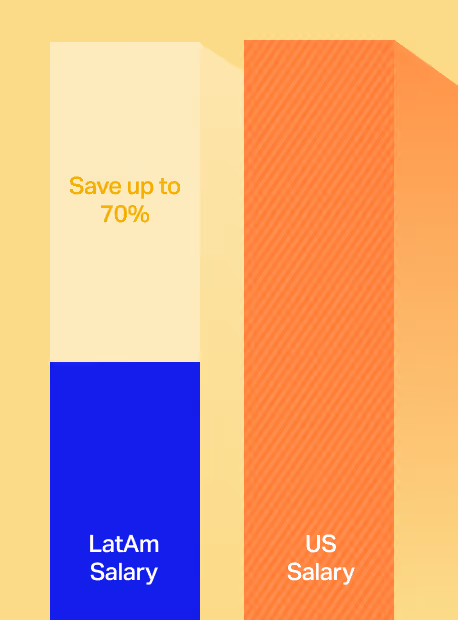
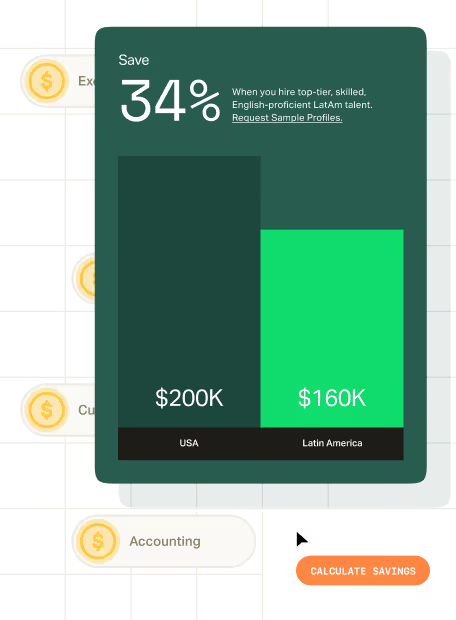
Hiring in Argentina typically costs 30–70% less than hiring the same role in the US.
That gap doesn’t come from bringing on junior talent. According to our State of LatAm Hiring Report, 84% of LatAm placements are mid-level or senior professionals, with average annual savings per hire running between $35,000 and $64,000.
Here are compensation benchmarks for the roles most commonly filled from Argentina:
Source: Hire With Near's 2026 US vs. Latin America Salary Guide
The savings are real, but they make more sense when you look at the cost-of-living context.
A mid-level financial analyst earning $36,000–$48,000 in Buenos Aires is living well. The same role in Chicago starts at $87,000. That gap is driven entirely by what money buys locally, not by any difference in skills or output.
Here’s how Buenos Aires and Córdoba, Argentina’s two largest cities, compare to Chicago, Illinois, on everyday costs:
Source: Numbeo.com
For the full role-by-role breakdown, see our full US vs. Latin America Salary Guide.
What Do US Companies Need to Know Before Hiring in Argentina?
You don’t need to become an expert in Argentine employment law to hire there.
But knowing what Argentine professionals expect and what the law requires directly affects how you structure compensation and time off, and whether your offer is competitive.
PTO and statutory leave
Paid vacation in Argentina is governed by the Ley de Contrato de Trabajo (LCT) and scales with seniority. The annual entitlement is:
- Under 5 years of service: 14 calendar days
- 5–10 years: 21 calendar days
- 10–20 years: 28 calendar days
- Over 20 years: 35 calendar days
These are calendar days, not working days, so weekends and public holidays that fall during the vacation block count toward the total. To qualify for the full annual entitlement, an employee must have worked at least six months in that calendar year.
A few things that tend to surprise US employers: Argentine law requires that vacation begin on a Monday (or the first working day after a public holiday), and the employer must pay the vacation remuneration in advance before the leave starts.
This is worth knowing as context for what Argentine professionals are used to, even if your specific arrangement differs.
Public holidays
Argentina has more public holidays than most Latin American countries, falling into three categories that work differently.
Mandatory national holidays: Fixed, non-negotiable
- January 1: New Year’s Day
- March 24: National Day of Remembrance for Truth and Justice
- March/April: Good Friday (date varies annually)
- April 2: Day of the Veterans and Fallen of the Malvinas War
- May 1: International Workers’ Day
- May 25: May Revolution Day
- June 20: National Flag Day
- July 9: Independence Day
- December 8: Immaculate Conception Day
- December 25: Christmas Day
Movable holidays: Mandatory, shifted to create three-day weekends
- Commemoration of General Güemes (around June 17)
- Commemoration of General San Martín (around August 17)
- Day of Respect for Cultural Diversity (around October 12)
- National Sovereignty Day (around November 20)
Bridge days
The Argentine government designates up to three of these each year to extend long weekends. They are technically optional for employers but universally expected off by corporate employees.
Carnival also falls into this zone: two days in February that aren’t legally required for private employers but are widely observed.
Given the volume, a practical approach is to offer a set number of floating local holiday PTO days. That lets your hire decide which to observe without tying your team’s schedule to a calendar that may not match your business.
{{salary-guide-cta}}
The 13th salary (SAC/Aguinaldo)
Argentina’s mandatory annual bonus is called the Sueldo Anual Complementario (SAC), known colloquially as the Aguinaldo. It equals one full additional month of salary, paid in two installments: 50% by June 30th and 50% by December 18th.
For formal employees, this is a legal entitlement, not a discretionary bonus.
For independent contractors, it isn’t legally required. But Argentine professionals at the senior level understand exactly what they’d be giving up, and they factor it into their expectations.
When thinking about what to offer, it helps to think in terms of 13 months of pay rather than 12: that’s 12 regular monthly salaries plus the Aguinaldo at year end. That’s the benchmark Argentine professionals use when comparing offers.
Private health insurance
Argentina has a universal public healthcare system, but it carries long wait times for non-emergency procedures. Private health insurance, known locally as a prepaga, is the single most valued non-salary benefit among white-collar Argentine professionals.
Companies typically handle this in one of two ways: paying 100% of the monthly premium directly, or redirecting the statutory social security healthcare contribution so the employee can apply it toward a private plan of their choice. For senior hires, full coverage extended to immediate family is often expected.
Offering health coverage when hiring contractors isn’t legally required, but offering it, fully or through a co-payment model, is a way to stand out and retain strong talent over the long term.
How Hire With Near Helps US Companies Hire in Argentina
Hire With Near has placed professionals across Argentina’s major professional hubs, like Buenos Aires, Córdoba, Rosario, and Mendoza, in finance and accounting, technology, marketing, legal support, and operations roles.
Finance and accounting is where Argentine placements are most concentrated. When a US company needs a controller, staff accountant, or an accounts payable specialist who understands GAAP, communicates clearly in English, and works US business hours, Argentina is typically where our recruiters look first.
Two clients that reflect that pattern: Stull CPA, an accounting firm that filled 3 roles through Hire With Near and saved $308,000 annually, and FinanceWithin, a fractional CFO services firm that scaled to 8 roles and saved $535,000 per year.
The strong finance talent, real cost savings, and teams that expand over time is a consistent result across the companies that make their first Argentine hires through Hire With Near.
For companies filling director-level or executive positions, Hire With Near also handles executive search in Latin America across finance, marketing, technology, and operations. You can also see our roundup of the best executive search firms in Argentina.
If you’re ready to explore hiring in Argentina, book a free consultation to talk through your requirements with our team.
They’ll walk you through salary benchmarks, role availability, and what the process looks like, so you have what you need to decide if it’s right for you.
If you’re also interested in learning about hiring in other markets in Latin America, check our How to Hire in Chile and How to Hire in Brazil guides.
{{latam-hiring-cta-v2}}







.webp)


%203.svg)
.avif)





%20(1).avif)

%20(1).png)