

%203.svg)
Key Takeaways
- Mexico accounts for 9% of all placements in Hire With Near’s 2026 data, ranking as one of the top three sources for accounting and finance roles and as the top source for marketing specialist hires across Latin America.
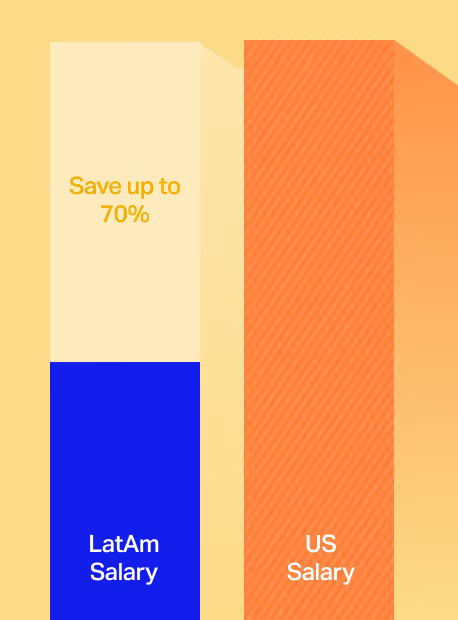
- US companies hiring Mexican professionals typically save 30–70% compared to US equivalents, with the majority of those hires at mid-level or senior level. The savings reflect a cost-of-living difference, not a quality difference.
- Mexico shares a land border with the US and runs on time zones that overlap completely with the US business day. For East Coast companies, Mexico City is one to two hours behind New York. For West Coast companies, it's the same time zone or one hour ahead.
Mexico is one of the closest hiring markets to the US in every sense: geography, time zones, cultural familiarity, and economic integration. That proximity shows up in the talent.
Mexican professionals, particularly in technology, finance, and sales, have grown up working alongside US companies, in English, on US systems and tools. The border isn’t just physical. It’s economic. Mexico is the United States’ largest trading partner, and that relationship has shaped a workforce that understands how American businesses operate.
Add a time zone that runs concurrent with most of the US, some of Latin America’s strongest tech universities, and a growing bilingual professional class in cities like Mexico City, Monterrey, and Guadalajara, and the picture becomes clear.
This guide covers everything you need before hiring in Mexico: how to structure the engagement, what the talent looks like, what roles Mexico is best for, what you’ll pay, and what surprises US employers the first time.
Why Are US Companies Hiring in Mexico?
Mexico gives US companies access to bilingual professionals who work the same hours, share the same economic context, and come with real experience in US-facing roles, which is why nearshoring to Mexico has become one of the most practical hiring moves US companies make today.
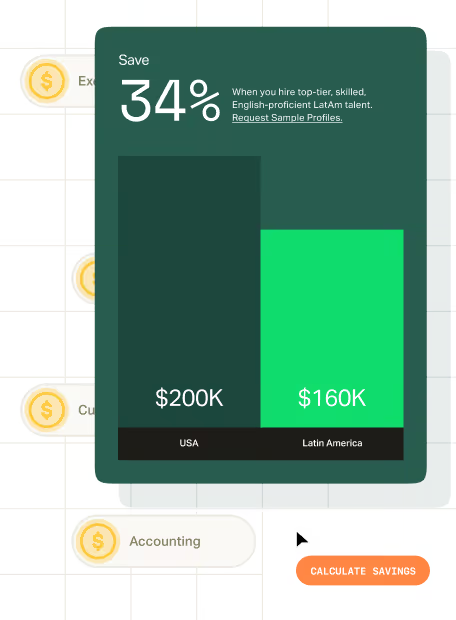
All of that at salaries that typically run 30–70% below US equivalents.
That’s the short version. The longer version is a combination of factors gathered in more than 2,000 conversations with hiring managers that reinforce each other.
Time zone alignment
Mexico's three main talent markets, Mexico City, Guadalajara, and Monterrey, run on Central Standard Time (CST, UTC-6) year-round. Mexico abolished daylight saving time in 2023, so the clock never changes on the Mexico side. The variation you'll feel is entirely driven by the US observing DST.
For a New York company, Mexico City is one hour behind from November through March, and two hours behind from March through November. For companies in Chicago or Dallas, it's the same time zone in winter and one hour behind in summer. For Los Angeles, Mexico City is two hours ahead in winter and one hour ahead in summer.
East Coast companies share seven to eight hours of working-day overlap with Mexico City. West Coast companies share six to seven hours.
English proficiency and bilingual advantage
Mexico ranks 103rd globally on the 2026 EF English Proficiency Index, in the Low Proficiency band overall. That number understates what you’ll find in the professional market.
At the mid and senior level in technology, finance, and sales in Mexico City, Monterrey, and Guadalajara, professional working English is standard.
Multinational corporations, such as IBM, Accenture, Oracle, Cisco, Amazon, and dozens more, run major delivery centers in those cities, and the professionals they recruit work in English every day.
Mexico's workforce is natively Spanish-speaking, which matters more here than anywhere else in LatAm. The US has over 40 million native Spanish speakers, and Mexican professionals share the same cultural context, idioms, and regional familiarity with that customer base in a way that professionals from other LatAm countries typically don't.
A talent pool shaped by US economic integration
Mexico and the United States have had one of the most integrated economic relationships in the world for decades, going back to NAFTA in 1994. The result is a professional class that has grown up working for US clients, inside US workflows, on US tools.
In Monterrey, heavy industry, manufacturing, and financial services companies have long recruited from a workforce trained to serve North American operations.
In Guadalajara, the tech sector (dubbed the Silicon Valley of Mexico) has produced engineers and product teams that ship code for US tech companies.
In Mexico City, the full range of corporate functions runs alongside multinationals with significant local operations.
According to Hire With Near's 2026 State of LatAm Hiring Report, Mexico accounts for 9% of the professionals we placed for US companies in 2025, ranking as a top-three source country for accounting and finance hires and a top source for marketing specialist placements.
How Can a US Company Hire in Mexico?
US companies have three options for hiring in Mexico: establish a legal entity, use an Employer of Record (EOR), or work with a specialist staffing and recruiting company. For most, the third is the fastest path to a great hire. We’ll cover them in order from most to least complex.
Option 1: Establish a legal entity
Setting up a legal entity means registering your business in Mexico so you can hire employees directly under your company’s name. This involves establishing a subsidiary or branch office, navigating local business registration requirements, and setting up compliant payroll and benefits systems.
This gives you complete control over your international operations and makes sense if you’re planning to build a significant presence in Mexico. Think dozens of employees, not just one or two hires.
The reality? This option is typically only viable for larger companies with dedicated legal and HR resources. The upfront costs are substantial, the process can stretch three to six months, and you’ll need ongoing legal and accounting support to stay compliant as regulations change. For most US companies looking to hire a handful of remote employees in Mexico, this is overkill.
Option 2: Use an employer of record (EOR)
An employer of record is a third-party company that becomes the legal employer of your hire on paper, while you maintain day-to-day management and oversight.
The EOR handles everything on the back end: employment contracts, payroll processing, tax withholdings, benefits administration, and compliance with local labor laws. You pay the EOR, and they pay your employee according to local requirements.
In Mexico, two statutory obligations consistently catch US employers off guard: the Aguinaldo (a mandatory Christmas bonus of at least 15 days’ salary, paid by December 20th) and PTU (Participación de los Trabajadores en las Utilidades), a profit-sharing requirement under which eligible employees receive a share of the company’s annual taxable profits. An EOR manages both automatically.
Popular EOR companies include Deel, Globalization Partners, Remote, and Oyster. For a full breakdown of how EOR arrangements work, this guide to hiring remote foreign employees covers the details.
The trade-off? You’ll still need to source and vet candidates yourself, since the EOR doesn’t handle recruiting. That means you’ll need to use LinkedIn or a job board for hiring in Latin America to find people, then bring in the EOR to handle their employment.

Option 3: Work with a specialist staffing and recruiting company
This is the simplest option for most US companies. You partner with one of the specialist staffing firms for LatAm hiring, like Hire With Near, that handles both talent acquisition and all employment logistics in one package.
Hire With Near doesn’t just find you qualified candidates: We also manage payroll, benefits, compliance, and local employment requirements through our nearshore staffing and recruiting services. You describe the role you need to fill, we present pre-vetted candidates, and once you make a hire, we handle the rest so the process feels as simple as hiring someone in the US.
This approach makes the most sense when you need both recruiting expertise and hands-off compliance management, and you’d rather focus on running your business than becoming an expert in Mexico’s employment regulations.
One more option worth addressing: freelance platforms like Upwork or Fiverr. They're easy to start, but a freelancer juggling multiple clients on a project basis isn't the same as a full-time team member.
The difference between a freelance platform and a staffing partner is the difference between someone splitting their time across clients and a dedicated team member who's fully focused on your business.
What Can US Companies Expect from Mexican Professionals?
Mexican professionals are particularly strong in technology, accounting and finance, and sales. Most mid and senior-level candidates in those fields are fully conversational in English, and their working hours align directly with the US business day, making real-time collaboration genuinely easy.
Technology: Guadalajara’s engineering hub
Guadalajara is Mexico’s technology center, and it has earned comparisons to Silicon Valley for good reason. Major US tech firms, including Intel, IBM, Oracle, Hewlett-Packard, and Cisco, run significant engineering and delivery operations there.
The city’s concentration of software engineers, developers, and product teams has made it the primary source of Mexican tech talent for US companies.
Mexico City adds a second major tech ecosystem. The capital hosts the Mexican branches of Google, Amazon, and dozens of global SaaS companies, alongside a growing startup scene that has produced engineers comfortable with modern development practices.
If you need to hire a software engineer in Latin America, Mexico has depth at mid and senior levels, particularly in backend, full-stack development, and data engineering roles.
As Julia Guillen, Recruitment Consultant at Hire With Near, puts it:
Clients are consistently surprised by the caliber of talent that’s available in LatAm. They don’t expect to find senior engineers who’ve worked with major U.S. companies, understand modern development practices, and often have more hands-on experience with specific frameworks than candidates they’d find locally.
Related reading: Nearshore Software Development in Mexico: Benefits, Challenges, and Salaries
Accounting, finance, and sales
Mexico is one of Hire With Near’s top three placement countries for accounting and finance recruiting. Monterrey's finance and accounting industries produced professionals who have grown up working for large multinational manufacturers and financial services firms with North American operations.
Sales is Mexico’s other area of strength. In our placement data, Mexico ranks as a top-two country for sales talent in Latin America. Mexican sales professionals bring a natural bilingual advantage: many are native or near-native in both Spanish and English, which makes them well-suited for US companies with Spanish-speaking customer bases.
LifeSource Water Systems, a manufacturing and direct-to-consumer sales company, hired a bilingual sales representative through Hire With Near to support Spanish-speaking clients. They reduced their time to hire to just 9 days and saved $82,000 annually.
For companies looking to hire a financial analyst in Latin America or a remote accountant, Mexico consistently appears on our recruiters’ shortlists.
Top universities to recognize on a resume
University background is a useful signal when reviewing Mexican candidates' resumes. These are the institutions that consistently produce strong professionals in the roles that US companies hire most:
- Universidad Nacional Autónoma de México (UNAM): Mexico’s most prestigious public university. Finance, tech, legal, and healthcare talent. UNAM’s computer science and economics programs are among the best in Latin America.
- Instituto Politécnico Nacional (IPN): The premier public engineering and technology institution. Known as “El Poli,” it produces rigorous engineers who excel in systems-level development, cybersecurity, and backend infrastructure.
- Instituto Tecnológico y de Estudios Superiores de Monterrey (ITESM/Tec de Monterrey): The leading private university for SaaS, tech startups, product management, fintech, and international business. Produces highly polished, bilingual talent with a strong business mindset.
- Instituto Tecnológico Autónomo de México (ITAM): Mexico’s top school for finance, fintech, economics, and AI talent. ITAM graduates are highly sought by investment banks, consulting firms, and fintech companies for their analytical rigor.
- Universidad Autónoma de Nuevo León (UANL): The powerhouse of manufacturing, supply chain, and logistics industries, positioned in Mexico’s industrial capital of Monterrey. A strong signal for operations, engineering, and supply chain roles.
If you’re working through the hiring process for the first time, we’ve put together answers to common questions US companies have about hiring remote talent offshore.
What Are the Salary Ranges for Mexican Hires?
Hiring in Mexico typically costs 30–70% less than hiring the same role in the US. The numbers below show exactly what that looks like across the roles that US companies hire most:
Source: Hire With Near's 2026 US vs. Latin America Salary Guide
According to Hire With Near’s analysis of 2,000+ placements, average annual savings per hire across Latin America run between $35,000 and $64,000. And 84% of those hires are mid-level or senior professionals. These aren’t junior-talent savings.
To put these numbers in context: a mid-level software engineer earning $48,000–$72,000 in Mexico City or Guadalajara is living comfortably. The same role in the United States starts at $104,000. That gap is driven entirely by the cost of living, not by any difference in output.
Here’s how Mexico City, Guadalajara, and Monterrey compare to Atlanta, Georgia, on everyday costs:
Source: Numbeo.com
For the full role-by-role breakdown, see our full Latin America salary guide.

What Do US Companies Need to Know Before Hiring in Mexico?
Two things consistently catch US companies off guard when hiring in Mexico for the first time: the mandatory profit-sharing contribution (PTU) that isn’t obvious from the salary number, and the sheer number of public holidays (some mandatory under federal law and some that employees expect regardless).
Whether these apply directly to your hire depends on how you structure the engagement, but knowing they exist shapes your budget and your offer.
PTO and statutory leave
Mexico updated its minimum vacation law significantly in 2023. Every worker is now legally entitled to a minimum of 12 working days of paid vacation after completing their first full year on the job.
Note: Mexico measures vacation in working days, not calendar days.
The allotment grows with seniority:
- Year 1: 12 working days
- Year 2: 14 working days
- Year 3: 16 working days
- Year 4: 18 working days
- Year 5: 20 working days
- Years 6–10: 22 working days
There’s also a mandatory financial premium on vacation called the Prima Vacacional. When employees take time off, employers are legally required to pay their standard salary plus an additional 25% of their daily wage for each vacation day taken. Mexican law also prohibits trading vacation days for cash.
Public holidays
Mexico has seven mandatory national holidays, plus several customary holidays that employees universally expect off, especially in the tech and corporate sectors.
Mandatory national holidays
- January 1: New Year’s Day
- First Monday of February: Constitution Day (observed on the first Monday to create a long weekend)
- Third Monday of March: Benito Juárez’s Birthday (observed on the third Monday)
- May 1: Labor Day (total shutdown across all industries)
- September 16: Independence Day (Mexico’s most important national celebration)
- Third Monday of November: Revolution Day
- December 25: Christmas Day
Widely observed but not legally mandatory
- Maundy Thursday and Good Friday (Holy Week): Not required under law, but in tech and corporate sectors, almost no one works. Forcing meetings on Good Friday creates significant cultural friction.
- November 2: Day of the Dead. Not legally mandatory, but culturally Mexico’s most sacred tradition. Most corporate offices close or offer a half-day.
- December 12: Day of the Virgin of Guadalupe. Not in the law, but the most important religious holiday in Mexico. Corporate work slows significantly.
A practical approach Hire With Near recommends is to offer a set number of floating local holiday PTO days. That lets your hire decide which days to observe without tying your team’s schedule to a calendar that may not match your business.
{{salary-guide-cta}}
The 13th salary (Aguinaldo)
Mexico’s mandatory year-end bonus is called the Aguinaldo, a statutory minimum of 15 days’ salary, paid by December 20th each year. Most mid-to-senior corporate roles expect employers to pay 30 days or more.
For formal employees, this is a legal entitlement.
For independent contractors, it isn’t required, but experienced Mexican professionals at the mid and senior level will price it into their expectations.
When thinking about what to offer, it helps to think in terms of 13 months of pay rather than 12: that’s 12 regular monthly salaries plus the Aguinaldo at year's end. That’s the benchmark Mexican professionals use when comparing offers.
Profit sharing (PTU)
PTU, or Participación de los Trabajadores en las Utilidades, is a profit-sharing requirement under Mexican law.
Companies with formal employees are required to distribute 10% of their taxable annual profits to employees, paid out no later than May 30th each year. Employees receive their share based on a formula combining days worked and wages earned.
This is the most commonly missed obligation for US employers hiring through an EOR or going it alone. An EOR absorbs this automatically.
For independent contractor arrangements, PTU isn’t applicable.
Private health insurance
Every formal employee in Mexico is enrolled in the IMSS (Instituto Mexicano del Seguro Social), the public health system. It’s a constitutional right and a legal employer obligation, since they make mandatory payroll contributions to fund it.
But IMSS faces the same challenges as most public health systems in Latin America: overcrowding, long wait times, and limited access to specialists.
Mid and senior-level professionals in the tech and corporate sectors heavily prioritize private health insurance as a benefit. For companies hiring at that level, offering private health coverage, either fully covered or through a co-payment model, is a meaningful differentiator.
What can go wrong
The three most common mistakes our recruiters see from US companies hiring in Mexico for the first time:
- Not accounting for what candidates expect beyond the base salary. Mexican professionals are aware of statutory benefits like the Aguinaldo and PTU, and they factor them into how they evaluate offers, even in contractor arrangements. If your offer doesn't reflect that context, you'll lose candidates to employers who do.
- Setting a salary offer without checking the local context. Mexico City, Monterrey, and Guadalajara have meaningfully different cost-of-living profiles. A senior engineer’s salary expectations in Mexico City will differ from those of someone in a smaller city.
- Underestimating cultural holidays. The weeks around Semana Santa (Holy Week) and the period from December 12 through January 6 function as near-total shutdowns for many Mexican corporate employees. However, these aren't legally guaranteed days off in a contractor arrangement.
Hire With Near’s recruiters set expectations on both sides before an offer is made, which is why offer acceptance and retention rates with our placements are consistently high.
How Does Hire With Near Help US Companies Hire in Mexico?
Hire With Near has placed technology, accounting and finance, and sales professionals in Mexico for US companies across multiple industries, handling everything from sourcing and vetting to payroll and compliance, so the hiring process takes weeks, not months.
Mexico is one of our primary sourcing markets for three distinct talent categories: bilingual sales professionals for US companies with Spanish-speaking customer bases, software engineers and developers from Guadalajara and Mexico City’s tech ecosystems, and finance and accounting professionals, particularly in Monterrey.
The sales category is where Mexico's bilingual advantage stands out most. Lucia Atensia, Hire With Near's Sales Recruiter, works across Latin America and puts it this way:
LatAm sales professionals are highly adaptable and familiar with international business practices. A lot of our candidates have already been working with US clients — they know the business, they know European and US markets. That makes them much easier to integrate into global teams. They also tend to have a strong work ethic and resilience, which is important in fast-paced, target-driven environments.
If you want to hire in Mexico, Hire With Near helps US companies do exactly that, and across Latin America more broadly.
What sets our process apart is how much time your dedicated recruiter spends understanding exactly what you’re looking for before a single candidate is shortlisted. They’ll get into the specifics of the role, the team, and what success looks like for your company; and that groundwork is what produces candidates who match what you were looking for, and often exceed it.
You describe what you’re looking for on a kickoff call. Within 3–5 days, your recruiter sends you a shortlist of pre-vetted candidates with video introductions.
From kickoff to accepted offer, the whole process usually takes three weeks. We handle payroll, benefits administration, and compliance on an ongoing basis once your hire is in place.
What our clients tell us they value most is how much time that frees up, not just on the admin side, but on sourcing and screening, which is where the real burden usually is. Hiring outside the US through Hire With Near ends up feeling no different from making a domestic hire. Just usually faster, and at a fraction of the cost.
For companies filling director-level or executive positions, Hire With Near also handles executive search in Latin America across finance, marketing, operations, and technology.
If you’re ready to explore hiring in Mexico, book a free consultation to talk through your requirements with our team. They’ll walk you through salary benchmarks, role availability, and what the process looks like, so you have what you need to decide if it’s right for you.
{{latam-hiring-cta-v2}}
Frequently Asked Questions
Is Mexico in a compatible time zone with the US?
Yes. Mexico’s major talent markets (Mexico City, Guadalajara, and Monterrey) run on Central Time (CST/CDT).
For East Coast companies, Mexico City is one to two hours behind New York, depending on the time of year, giving seven to eight hours of real-time working-day overlap.
For West Coast companies, Mexico is one to two hours ahead of Los Angeles, which still gives six to seven hours of overlap during a standard business day.
Is the 13th salary required in Mexico?
Yes. The Aguinaldo is a legal entitlement for all formal employees in Mexico: a minimum of 15 days’ salary, paid by December 20th each year. It's not a discretionary bonus. In corporate environments, most companies pay 30 days or more as market practice.
For independent contractors, it is not legally required, but experienced Mexican professionals at the mid and senior level will factor it into their expectations regardless.
What roles do US companies most commonly hire in Mexico through Hire With Near?
Mexico is one of Hire With Near’s top sources for three distinct role categories: technology (particularly software engineers and full-stack developers from Guadalajara and Mexico City), accounting and finance (including accountants and financial analysts from Monterrey), and bilingual sales roles for US companies serving Spanish-speaking markets.
What level of English can US companies expect from Mexican professionals?
English proficiency varies by city, industry, and seniority. In Mexico City, Guadalajara, and Monterrey, at the mid and senior level in technology, finance, and sales, professional working English is standard. Many professionals have worked directly for US-facing companies or multinationals.
At junior levels and in sectors with less international exposure, the pool narrows. Hire With Near screens for English proficiency on every placement.
How long does it typically take to hire through Hire With Near in Mexico?
For most roles, Hire With Near presents vetted candidates within 3–5 days of starting the search. Total time to hire, from kickoff to accepted offer, typically runs two to three weeks, depending on role seniority and how quickly the client moves through interviews.
Mexico is one of Hire With Near’s fastest sourcing markets for bilingual sales and tech roles specifically.
Does Mexico have strong intellectual property protections?
Mexico is a signatory to the Berne Convention, the TRIPS Agreement, and has IP protections consistent with international standards through the USMCA framework.
For roles involving access to sensitive code, processes, or confidential business data, Hire With Near recommends including IP assignment and confidentiality clauses in the employment or service agreement as standard practice.
What industries hire in Mexico through Hire With Near?
Companies across many industries hire Mexican professionals for remote roles, but demand is especially concentrated where Mexico's bilingual workforce, tech ecosystems, and finance talent are most valuable.
SaaS and technology companies hire regularly for software engineering and product roles, drawn by Guadalajara and Mexico City's engineering pipelines. Finance and accounting firms tap Monterrey's deep pool of finance professionals. Manufacturing and logistics companies hire for operations and supply chain roles, where Mexico's industrial base gives candidates direct, relevant experience.
And companies with Spanish-speaking customer bases, across healthcare, real estate, and beyond, hire bilingual sales and customer support professionals from Mexico specifically for that market coverage.







.webp)


%203.svg)
.avif)





%20(1).avif)

%20(1).png)