


%203.svg)
Key Takeaways
- Hiring customer support talent in Latin America means defining the role, sourcing through a staffing partner or on your own, screening for English fluency and support-tool experience, and onboarding on US hours. Most teams make a hire in about three weeks.
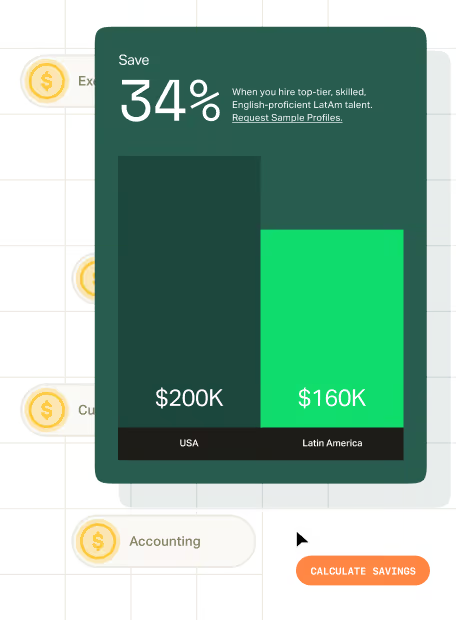
- Customer support reps in Latin America cost roughly $14K–$36K a year versus about $60K–$117K in the US, savings of up to 77%, with similar gaps across success and help-desk roles.
- The nearshore advantage for support is real-time coverage: Latin American agents work in overlapping US hours and often speak strong, bilingual English, so tickets, chats, and phone calls are typically handled in real time.
Most founders don’t start a company expecting to spend a chunk of every day answering the same customer questions. But for a lot of them, that’s where things land once the business starts to grow, while the leadership and strategy work, the decisions that move the company forward, keep getting pushed to next week because the inbox doesn’t stop.
That’s when they realize they need to hire. But hiring in the US feels out of reach on the budget, and if you’ve tried offshore support before, you already know the friction: hours that don’t overlap with your customers, or a team that’s hard for them to understand.
That’s the gap many US companies are closing by learning how to hire customer support talent in Latin America. In this guide, I’ll walk you through why it works, what it costs, which roles and countries fit support, and the practical options for engaging talent, so you can hire customer support talent in Latin America without guessing your way through it.
Why Are US Companies Hiring Customer Support Talent in Latin America?
US companies hire customer support talent in Latin America because it solves the three problems support leaders run into at home: hours, language, and budget. Agents in the region work during overlapping US hours, many are bilingual in Spanish and English, and the same support budget goes considerably further than it does for a US hire.
Offshore teams can’t cover US hours
Time zone overlap is the headline reason companies make this switch. Offshore teams in Asia are often asleep when US customers need help, which turns every escalation into a next-day problem.
Latin America closes that gap. Mexico City and Bogotá track right alongside US Central and Eastern time, while Buenos Aires and São Paulo sit just one to two hours ahead of the East Coast.
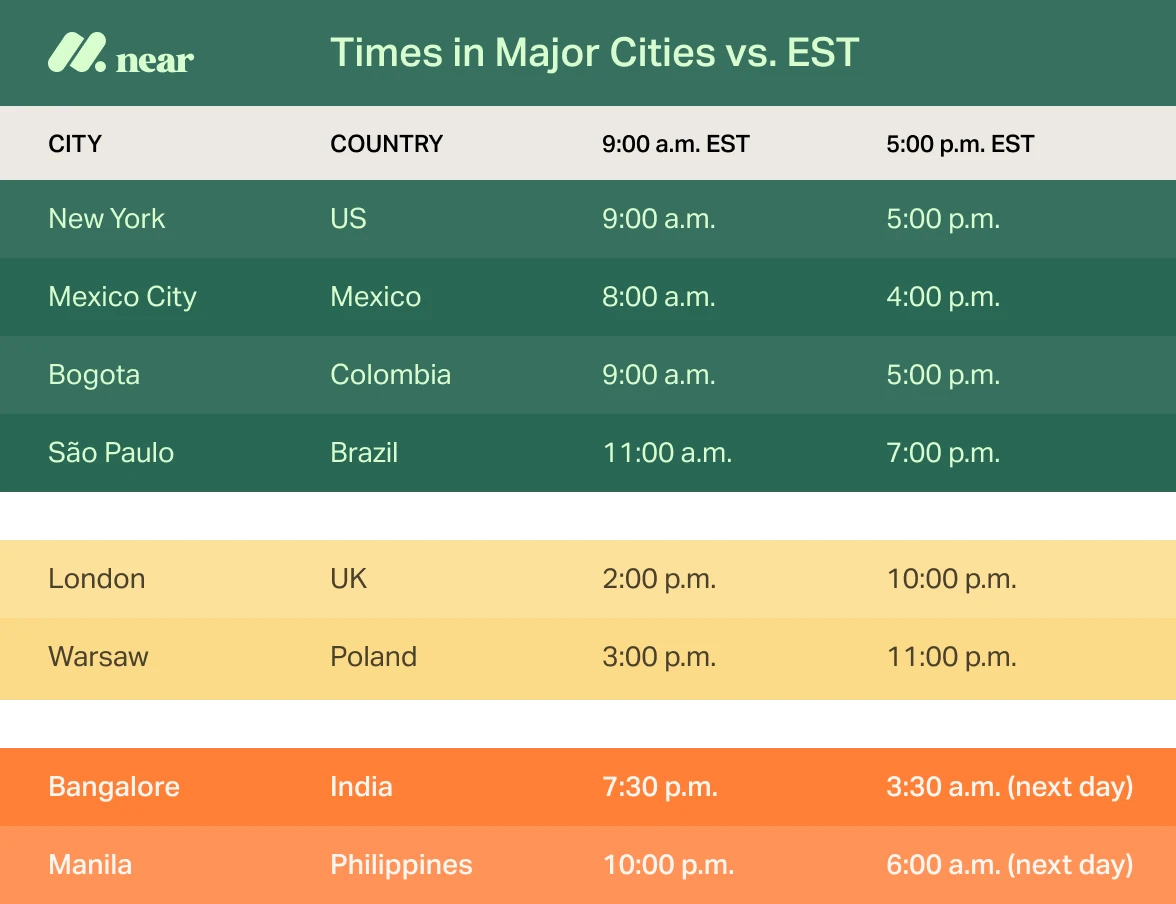
In Hire With Near’s analysis of more than 2,000 conversations with US companies exploring Latin American hiring, 30% of the companies that switch to Latin America are moving away from offshore specifically to get US time zone overlap and real-time collaboration.
One mid-market technology company had its support running out of Eastern Europe while every recent customer win was in the US. Their Head of Operations put the problem plainly:
The U.S. shift right now is supported by the offshore team. The problem is they don’t want to work that shift. Every new client we have had in the last couple of quarters is based in New York or on the East Coast or just in the U.S. in general.
Bilingual talent matches how customers communicate
For any company with a meaningful share of Spanish-speaking customers, language coverage is essential.
Bilingual support in the US can be expensive and hard to find, which means many companies turn away Spanish-speaking customers or ask their one bilingual employee to cover a job that should be a full team’s worth of work.
One client said that being the only Spanish speaker on the team “presented a lot of problems” when trying to step back from day-to-day support, because translation tools “can only go so far” in real conversations with customers.
Latin America’s support talent pool solves this natively. Agents fluent in both English and Spanish are common, not rare, shaped by decades of regional companies and BPOs serving the US market.
Companies that have made this hire report the win shows up directly in revenue: they go from turning away an entire customer segment to being able to serve it, because the language coverage finally exists.
The budget builds more than it replaces
The bigger draw is what your support budget can build, not just who you can find. The same dollars that cover one US hire can fund a fuller bilingual desk in Latin America, and that budget math holds up against a tight US hiring market.
According to ManpowerGroup’s 2026 Global Talent Shortage Survey, 72% of employers worldwide report difficulty finding the skilled people they need, with US employers tracking close behind at 69%. With roughly seven in ten US employers struggling to staff the roles they have, opening the search to Latin America isn’t a fallback. It’s how you fill the seat with someone good, for less than a comparable US salary.
The point, though, isn’t paying less for the same work. It’s the capability that opens up: a fuller team, longer coverage, and bilingual depth you couldn’t otherwise afford.
If you want the broader case, it’s the same logic behind hiring remotely in Latin America across every function, applied to the support desk.
AI is changing which support roles get hired
This is also where AI is reshaping the shape of support teams. After deploying AI agents to handle routine interactions, Salesforce reduced its support workforce by roughly 4,000 roles, with CEO Marc Benioff saying the company “needs less heads.”
As AI absorbs the repetitive tickets, the human roles that remain skew toward judgment, escalations, and relationship work, exactly the higher-value support hires that nearshore talent is well-suited for.
What Are the Most In-Demand Customer Support Roles in Latin America?
Most US companies hiring support in Latin America are filling one of five roles, and they cost roughly 30% to 70% less than the US equivalent. Based on Hire With Near’s placement data, the most-hired support roles are:
- Customer support rep handles the front line: tickets, chats, and calls across email and help-desk tools. It’s the highest-volume role and where most teams start. Latin America fits it well because the work is real-time and English-facing, and the regional pool is deep enough to hire fast, even at scale. Typical tools: Zendesk, Intercom, Freshdesk.
- Bilingual customer service representative does the same work in both Spanish and English, which is why companies serving Spanish-speaking US customers hire them so often. The region’s bilingual depth is hard to match elsewhere at the same cost, and it’s frequently the difference between serving a customer segment and quietly losing it.
- Customer success manager owns retention and account growth rather than ticket resolution: onboarding, renewals, and expansion. It’s a relationship role, so US-hours overlap and clear English matter even more, since the job is built around proactive outreach rather than reactive response.
- Customer success agent supports the success function day to day, following up with accounts and flagging churn risk before it becomes a cancellation. A strong fit for companies that need CSM-level attentiveness on more accounts than one CSM can cover alone.
- Help desk/tier 1–2 support specialist handles technical support and troubleshooting, often for software or hardware products, sitting between pure customer service and IT support. Latin America’s strong technical education pipeline makes this role easier to source here than the generalist CS rep role might suggest.
According to Hire With Near’s 2026 State of LatAm Hiring Report, customer support reps placed in Latin America save US companies roughly $14,000 to $28,000 per year compared to their US equivalents. Of Hire With Near’s 2,000+ placements in 2025, customer success and support made up 8.5% of all hires.
To give you a sense of the numbers, these figures come from Hire With Near’s own salary data comparing customer support talent in Latin America with equivalent US hires:
For the most up-to-date figures, see Hire With Near’s US vs Latin America Salary Guide.
The way to read this table isn’t simply “cheaper labor.” It’s reach: the budget that hires one US support rep can staff a small bilingual team in Latin America, fund longer coverage hours, or free up spend for a customer success manager you couldn’t otherwise justify.
For a fuller breakdown by seniority and role, Hire With Near’s customer support salaries in Latin America guide goes deeper than this summary.
If you’re staffing leadership rather than the front line, the same model covers executive-level hires for customer support and CX leadership, such as a head of customer support or VP of CX, sourced from the region’s senior talent.
{{salary-guide-cta}}
Which Countries Are Best for Hiring Customer Support Talent in Latin America?
For customer support specifically, four countries stand out: Colombia, Jamaica, Mexico, and Argentina. Each brings a different strength, so the right one depends on whether you need bilingual volume, native English, time-zone overlap, or senior CX leadership.
Colombia
Colombia is the region’s leading nearshore destination and one of its biggest customer-support and BPO markets. The talent pool is deep, English is strong, and the time zone lines up with US business hours.
If you’re hiring at any kind of volume, Colombia is usually the first place to look. The market has decades of experience serving US companies at scale, which means both the candidate pipeline and the support infrastructure (call centers, BPO operations, training pathways) are already mature.
Related reading: Hiring in Colombia: What US Companies Need to Know About the #1 Nearshore Talent Market
Jamaica
Jamaica is a top source for customer support reps, largely because English is the native language. For phone-heavy or accent-sensitive support, where clarity on a live call is the whole job, that’s a real edge over markets where English is a second language learned through training.
Jamaica also ranks among the fastest-hiring countries in the region, with Hire With Near placing customer support talent there in as little as one week. For companies that need a support hire fast and need it to sound unmistakably clear on the phone, Jamaica is consistently the strongest fit.
Related reading: Hiring in Jamaica: Native English Talent, Real Cost Savings, and What US Companies Need to Know
Mexico
Mexico offers Central-time overlap with the US and one of the largest bilingual talent pools in the region, which makes it a natural fit for companies serving Spanish-speaking customers and needing same-time-zone coverage.
Mexico City in particular has a long history of supporting US companies directly, which means candidates often arrive already familiar with US business norms, ticketing systems, and customer expectations.
Related reading: Hiring in Mexico: Deep Talent, Close Time Zones, and What US Companies Need to Know
Argentina
Argentina tends to come up for senior customer success and CX leadership roles, rather than high-volume frontline support. English proficiency is high: the EF 2025 English Proficiency Index places Argentina in its “High” band and ranks it 26th globally, the strongest in Latin America.
That combination of language quality and a mature, educated professional class makes Argentina a strong fit for CSM and customer success leadership hires specifically, where the job depends on judgment and relationship management more than ticket volume.
Related reading: Hiring in Argentina: Great Talent, Significant Savings, and What US Companies Need to Know
What Skills Should You Screen for When Hiring Customer Support Talent in Latin America?
The right screening criteria depend on the role, but across support hires, these are the qualities that consistently separate someone who can own the customer relationship from someone who just completes tickets.
Warmth and composure
This is the trait that’s hardest to train and most important to screen for upfront. As Robert Spector, author of The Nordstrom Way to Customer Experience Excellence, puts it:
We can hire nice people and teach them to sell, but we can’t hire salespeople and teach them to be nice. We believe in ’hire the smile, train the skill.’
The same logic applies directly to customer support: you can train someone on your product, your tools, and your ticketing system, but you can’t train someone to genuinely care about the person on the other end of the conversation. That has to already be there.
In practice, this means weighting the interview toward how a candidate naturally responds to a frustrated customer, not just whether they can recite a script.
Ask candidates to walk you through a real difficult interaction they’ve handled and listen for tone, not just resolution.
Systematic problem-solving
The instinct to impress the customer is less valuable than the ability to resolve an issue with minimal friction.
Matthew Dixon, Nick Toman, and Rick DeLisi, authors of The Effortless Experience: Conquering the New Battleground for Customer Loyalty, argue that companies spend too much time trying to delight customers when most customers simply want their problems resolved quickly and with as little effort as possible.
They recommend designing customer service around reducing friction and proactively preventing follow-up issues through “forward resolution.”
Screen for this by asking a candidate to talk through how they’d handle a multi-step issue: do they jump to a generic fix, or do they ask clarifying questions and anticipate what the customer will need next.
Proactivity and independent judgment
This is the single most common failure mode companies report with previous offshore hires: agents who complete tasks mechanically without flagging issues or thinking ahead.
Ask candidates to describe a time they noticed a recurring problem and what they did about it without being told to. The answer separates someone who escalates everything, sits on problems, or investigates and resolves independently.
English communication quality
For phone-heavy or accent-sensitive support, written fluency on a resume says nothing about how someone sounds on a live call.
According to Zendesk’s guide to essential customer service skills, authored by Mozhdeh Rastegar-Panah, Senior Director of Product Marketing, communication is one of the foundational customer service skills, requiring agents to understand which channel fits the situation, when to escalate, and how to strike the right tone.
Request a phone or video screen as a standard part of the interview, not an optional add-on, and test how candidates handle a hypothetical tense call out loud.
Tool proficiency
Most candidates from Latin America have experience with major platforms like Zendesk, Intercom, and Freshdesk, since US corporations have run support operations in the region for decades.
Tool-specific experience matters less than the ability to learn a new system quickly: ask what platforms a candidate has used and how fast they picked them up, rather than ruling someone out for not knowing your exact stack.
How Do You Hire Customer Support Talent in Latin America?
You have three real options for hiring customer support talent in Latin America: build it yourself, use an employer of record, or work with a specialist staffing and recruiting partner.
For most companies hiring full-time support, relying on a staffing partner is the fastest route to a strong hire. Here’s how the three compare, from most to least complex:
Option 1: Hire directly on your own
You handle everything: sourcing, screening, contracts, payroll, and compliance for an international hire. For support roles, sourcing usually starts with LinkedIn and nearshore job boards, but the harder part is evaluating fit. You’re not just checking a resume, you’re testing spoken English, listening for how someone handles a hypothetical angry customer, and confirming they can actually hold a conversation in real time, not just write a polished cover letter.
Freelance marketplaces like Upwork, Toptal, and Fiverr are an option for project work, but they’re built for that, not a full-time support desk. The person answering your tickets is usually splitting attention across several clients at once, and for a function that depends on consistency, coverage, and someone who actually learns your product, that’s a poor fit.
Comparing customer service outsourcing companies shows the same trade-off: it’s coverage you rent, not a teammate you build around.
Direct hiring gives you the most control, but it costs the most time and requires you to source, screen, and vet every support candidate yourself, including testing their English and their ability to de-escalate a frustrated customer. That’s the part that eats your week.
Option 2: Use an employer of record (EOR)
An employer of record is a third-party company that takes on the legal employment of your hire, payroll, tax withholdings, benefits, and local labor law compliance, while you direct the day-to-day work. It removes the entity-setup problem entirely.
What it doesn’t remove is the hardest part of a support hire: knowing whether the person can truly do the job. An EOR has no way to evaluate spoken English on a live call, gauge how someone responds to a hypothetical irate customer, or judge whether they’ve ever worked a ticketing queue under volume. None of that is in their job.
So this route works well once you’ve already identified the person yourself, through a referral or your own outreach, but it leaves you running the entire screening process solo if you’re starting from zero.
For teams that already have a candidate in mind, or that are standardizing payroll across a support team spread over multiple countries, an EOR is a clean fit. Popular EOR companies include Deel, Globalization Partners, Remote, and Oyster.
For a full breakdown of how EOR arrangements work, see this guide to hiring remote foreign employees.
Option 3: Work with a nearshore staffing partner
A specialist staffing and recruiting partner is the only option that does both jobs at once: it finds and vets the talent and handles employment, payroll, benefits, and compliance in one relationship.
You describe the support role your company needs, the partner presents pre-vetted candidates who already clear the bar on English and support experience, you interview and choose, and once you hire, the partner handles the rest. There’s no entity to set up and no candidate pipeline to build from scratch.
This is what Hire With Near does through its nearshore staffing and recruiting services: full-time customer support professionals based in Latin America, recruited and employed for you, working on your hours.
If you’re comparing providers, it’s worth looking at the best customer support staffing companies in Latin America and, for a broader view, the staffing and recruiting firms for customer support reps.
Here’s a summary to help you decide which approach works best for your company:
What Are the Most Common Concerns About Hiring Customer Support Talent in Latin America?
The hesitations about hiring customer support in Latin America are almost always the same four, and each has a straightforward answer. Hire With Near’s recruiting team consistently hears the same objections from US support leaders.
“We tried offshore before and it didn’t work.”
Offshore usually means the Philippines or India, somewhere between 11 and 14 hours removed from US time. For a support desk, that gap shows up immediately: customer messages that come in during your afternoon sit unanswered until the next morning, and any live phone or chat support either runs on a skeleton overnight shift or doesn’t run at all during your peak hours.
Nearshore is a different setup entirely. Latin America aligns perfectly with the US, spanning from just two hours ahead of the East Coast to right in sync with the West Coast. The team is awake, online, and answering tickets while your customers are reaching out, not catching up on a backlog the next day.
Switching from offshore to nearshore is one of the top reasons companies move to Latin America, and customer support is one of the functions where that shift shows up.
“Will their English be clear enough for our customers?”
Yes, for vetted candidates. The variable is screening, not the region.
This is the single most common worry, and it’s fair. A head of operations at a clean-tech startup put the concern this way:
We need someone bilingual, both Spanish and English. I understand when you are sourcing offshore, people are going to have accents, but we do have a variety of people calling in on the phone, especially a large elderly population, and we just need someone to be able to speak very clear English, and a lot of these folks were kind of mixing up words, or I couldn’t fully understand their English.
The fix isn’t avoiding the region, it’s testing for spoken clarity specifically, on a live call, not just a written application. Written English and phone English aren’t the same skill, and a candidate can be strong in one and weak in the other.
That’s exactly where a partner who pre-screens for both earns its keep: request a phone screen as part of the interview process, and ask candidates to talk through a hypothetical difficult call before you commit to a hire.
“Can they really cover our hours?”
Yes, and this is the core nearshore advantage. Across the region, agents work during overlapping US business hours, so live chat, phones, and escalations are handled in real time, not queued for tomorrow.
The practical effect shows up in coverage planning, not just daily overlap. A team in Argentina can comfortably staff your early-morning queue while still working a normal daytime shift, and a team in Jamaica can cover into the evening without anyone working overnight. You can build a coverage schedule around how people live, rather than asking someone to flip their sleep cycle to match yours.
That flexibility is what makes extended coverage realistic: early mornings, evenings, even weekends, staffed by people working their own daytime hours.
“How do we handle sensitive customer data and PII securely?”
This is a fair question, especially if your support team touches payment information, account credentials, or any regulated data. The answer depends more on your setup than on geography: require NDAs as standard practice, restrict access to only the systems a rep actually needs, and consider routing work through a VPN or company-managed device rather than a personal computer.
None of this is unique to hiring in Latin America. It’s the same protocol any remote hire should follow, but it’s worth specifying upfront if your support function handles anything sensitive.
“What if the person we hire doesn’t stick around?”
Turnover is a real cost, especially for a customer-facing role where a new hire needs time to learn your product and your customers before they’re fully effective. The risk isn’t unique to nearshore hiring, but it’s worth asking any partner directly about their retention rate and what happens if a hire doesn’t work out, before you commit.
A clear answer here (a stated retention rate, a replacement policy) is a reasonable thing to expect rather than discover after the fact.
For a deeper list of what to probe, these are the questions customer service managers ask when hiring in Latin America before they commit.
What Hiring Customer Support Talent in Latin America Looks Like in Practice
The clearest proof that hiring customer support talent in Latin America is a great choice is a real placement at a real number.
A US fitness-equipment brand needed bilingual Spanish and English support for its US customer base, at a cost it could sustain as it grew.
Working with Hire With Near, they hired a bilingual customer service representative at a monthly salary of $1,700, which left room in the same budget to invest in coverage and growth as it scaled, with no compromise on the bilingual support its customers needed.
That’s not a one-off. Snap Diagnostics, a sleep-apnea testing provider in Vernon Hills, Illinois, turned to nearshoring after a rapid 30% year-over-year growth surge overwhelmed their HR department. Previous international hiring attempts in India fell short due to language barriers in customer-facing roles.
Switching to Hire With Near, Snap Diagnostics efficiently placed 16 professionals, including 13 customer sales support associates. The move saved their internal HR team 12 hours of sourcing work per candidate, slashed their average time-to-hire to just 19 days, and secured $587,000 in annual overhead savings (a 67% reduction compared to the US market).
Susan Simmermon, their HR Manager, praised the quality of the professionals vetted by our team:
The caliber of talent we received was awesome. Hire With Near really listened to our needs and asked the right questions to ensure they provided the perfect candidates for our team.
Most of those hires stayed more than a year, which is the part that matters most for support: turnover is what erodes service quality, and a team that sticks around keeps getting better at your product.
Another example is a healthcare practice in Utah that hired a bilingual patient support representative through Hire With Near. They restored full Spanish-language coverage for their patients at $1,900 a month, about 48% less than a comparable US hire.
Final Thoughts
Hiring customer support talent in Latin America comes down to a simple shift: instead of stretching a US budget over one or two hires, or wrestling with an offshore team that can’t cover your hours, you build a real support function on your time zone, in clear and often bilingual English, at a cost that lets you grow it.
The hours, the language, and the budget that felt like trade-offs stop being trade-offs.
The fastest way to do it well is to pick the right roles, screen hard for English and support skills, and onboard on your hours, whether you build that process yourself or lean on a partner who already has it.
If you want to see what it would look like for your team, you can book a free consultation to talk through your requirements with Hire With Near’s team.
We’ll walk you through salary benchmarks and the hiring process so you have what you need to decide if it’s the right move.
For the full breakdown of costs, roles, top countries, and how to vet candidates, see our guide to hiring customer support talent in Latin America.
{{latam-hiring-cta-v2}}
Frequently Asked Questions
How do you hire customer support talent in Latin America?
To hire customer support talent in Latin America, define the role and the skills it needs, then either partner with a nearshore staffing firm or source on your own through LinkedIn and job boards, screen candidates for English fluency and support-tool experience, interview your shortlist, and onboard them on US hours.
Most companies make a hire in about three weeks. The fastest path for a full-time role is a specialist partner, because they handle sourcing, vetting, and employment in one relationship instead of leaving you to stitch them together.
How much does it cost to hire a customer support rep in Latin America versus the US?
A customer support rep in Latin America costs roughly $14,000 to $36,000 a year, compared with about $60,000 to $117,000 for a US equivalent, savings of up to 77%. Customer success and help-desk roles show similar gaps, generally 60% to 72% lower than US pay.
The savings come from local cost-of-living differences, not lower-quality work, and the practical effect is that the same budget can fund a larger team or longer coverage hours.
How long does it take to hire customer support talent in Latin America?
Most companies hire customer support talent in Latin America in about three weeks. Working with a staffing partner, you can typically see a shortlist of pre-vetted candidates within 3–5 days, then spend the rest of the time interviewing and onboarding.
Sourcing entirely on your own usually takes longer, since you’re building the candidate pipeline and running every screen yourself.
Is hiring customer support in Latin America better than offshore in the Philippines or India?
For US companies, nearshore Latin America usually beats offshore Asia on the things that customer support depends on: time-zone overlap, English clarity, and cultural fit.
Agents in Latin America work during overlapping US business hours, so tickets and calls are handled live instead of overnight, and many are bilingual in Spanish and English.
Offshore options like the Philippines and India can be lower cost on paper, but the time gap and communication friction often cost more in slow resolutions and frustrated customers, which is why many companies switch.
Related reading: Hiring Remote Talent in LatAm vs. India: The Complete Guide
What English level do customer support agents in Latin America have?
Customer support agents in Latin America commonly have strong, professional English, and bilingual Spanish-English fluency is widespread. Several countries score in the higher bands of the EF English Proficiency Index, with Argentina ranking highest in the region.
That said, fluency varies by individual, so the reliable approach is to assess spoken English on a live call during screening rather than assuming it from a resume, which is standard practice when you hire through a vetting partner.
Do customer support agents in Latin America work in US time zones?
Yes, customer support agents in Latin America work during overlapping US business hours, which is the main reason support teams choose the region over offshore options. Colombia and Mexico, for example, overlap closely with US Eastern and Central time, and agents handle live chat, phone, and escalations in real time.
This makes the region a strong fit for teams that need same-day, real-time coverage rather than overnight ticket handling.
What other customer support roles can I hire in Latin America?
Beyond a frontline support rep, US companies hire a range of customer support roles in Latin America, including nearshore bilingual customer service representatives, remote customer success managers, and Latin American IT support specialists.
These roles cover everything from ticket resolution to retention and account growth, and the same time zone overlap and cost advantages apply across all of them.
Do I have to set up a legal entity to hire someone in Latin America?
No, you don’t need to set up a legal entity to hire customer support talent in Latin America. You can use an employer of record, which becomes the legal employer on paper and handles contracts, payroll, and local compliance, or you can work with a staffing partner that manages employment for you as part of the placement.
Setting up your own entity only makes sense at real scale, when you’re hiring dozens of people in a single country.
Related reading: A Comprehensive Guide to Using an Employer of Record (EOR)


.webp)
.webp)


.webp)



%203.svg)
.avif)






%20(1).avif)

%20(1).png)