


%203.svg)
Key Takeaways
- US companies can hire sales talent in Latin America that works in their time zone, speaks near-native English, and costs 30–70% less than US equivalents; the simplest path is a specialist staffing partner that both finds the talent and employs it for you.
- Sales is the single most common department US companies hire for in Latin America, with strong talent pools for SDRs, BDRs, account executives, account managers, and sales managers across Colombia, Mexico, Brazil, and Argentina.
- The right hire depends on where your company is: early-stage teams need a full-cycle rep who can do everything; growth-stage teams split the motion between SDRs and AEs; and scaling teams add a sales manager to own the number.
You’re still the one taking every discovery call. You need to hand that off, but a US SDR at $75K plus commission isn’t in the budget. You look at offshore options, then realize India and the Philippines are 10–13 hours behind, which is the wrong fit for a role where timing is everything.
That’s when you land in Latin America.
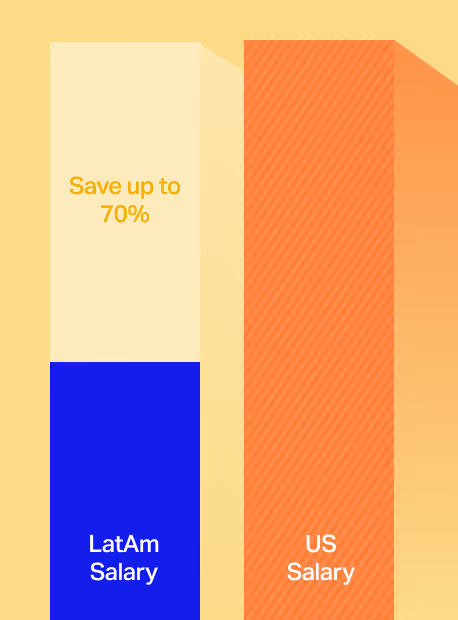
Latin America offers what those other options don’t: sales professionals operating in US time zones, with strong English, enough cultural proximity to US buyers that clients often can’t tell where they’re calling from, and salaries that run 30–70% less than comparable US hires.
But how to hire sales talent in Latin America? How much does it cost? Which country is the best option? Will the English hold up with US buyers? Those are questions Hire With Near’s recruiting team hears all the time and this guide will help you put them to rest.
In this article, I’ll walk you through why companies are hiring sales talent in Latin America, how the hiring works, which roles and countries to look at, and how to handle the concerns you’re probably already sitting with.
Why Are US Companies Hiring Sales Talent in Latin America?
Sales is the number one function that US companies come to Latin America to fill.
In Hire With Near’s analysis of 2,000-plus conversations with US companies exploring why US companies hire in Latin America, sales was the most common department they wanted to build out, cited by 26% of them.
Here are some of the reasons that are driving this change:
Overlapping working hours
The biggest reason is time zone alignment. Sales runs on real-time conversation: live discovery calls, fast follow-up, and a manager who can jump on a deal at risk before it slips. That falls apart across a 10-hour gap.
Research backs this up. According to a study by Harvard Business School and INFORMS, synchronous communication, like phone and video calls, drops about 11% for every additional hour of time-zone difference between teammates.
To avoid this issue, researchers recommend organizing distributed teams along a north-south axis, such as the US and Latin America, rather than east-west. Hiring a Latin American sales rep based in Mexico City or Bogotá means they’re on your clock, not waiting until tomorrow to return a call.
English proficiency and US cultural fluency
Then there’s English and cultural fit. For client-facing roles, near-native English is the whole game, and Latin American sellers who have worked with US companies tend to have it, along with a familiarity with how US buyers think and negotiate. It’s a big part of the case for why US companies should hire remote Latin American talent in the first place.
Lucia Atensia, Team Lead and Recruiter at Hire With Near, explains:
LatAm sales professionals are highly adaptable and familiar with international business practices. A lot of our candidates have already been working with US clients, so they know the business, they know the European and US markets. That makes them much easier to integrate into global teams. They also tend to have a strong work ethic and resilience, which is crucial in fast-paced, target-driven environments.
Budget goes further
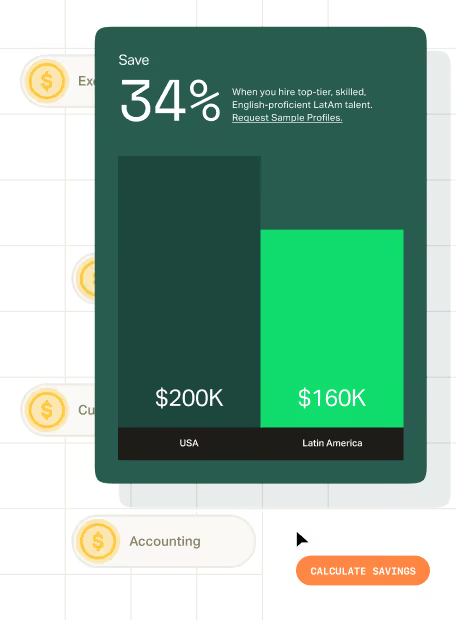
The last reason is budget enablement, and it’s worth framing correctly. This isn’t about cheap labor. It’s that the same budget buys more selling capacity. A US SDR typically runs $75,000 to $80,000 in base salary before commission and benefits. Hiring a comparable LatAm rep costs $24,000–$48,000, according to Hire With Near’s salary data.
Instead of one US SDR, you can often fund two reps in Latin America, cover more of your pipeline, and book the meetings you’ve been missing.
That’s not a marginal efficiency gain; it’s a different growth model. And it’s exactly why companies hire an SDR team in Latin America rather than stretch a single US headcount.
If you want the bigger picture on how to hire in other departments, check our “How to Hire Remotely in Latin America” guide.
What Are the 3 Ways to Hire Sales Talent in Latin America?
You have three ways to hire sales talent in Latin America: build it yourself by sourcing and then becoming the employer, use freelance or contractor platforms, or work with a specialist staffing partner that does both.
For most teams hiring full-time sales talent, the staffing partner option is the fastest path to a great hire.
Here they are from most to least complex.
Option 1: Build it yourself
The do-it-yourself route splits into two jobs you have to stitch together: finding the person, then legally employing them across a border.
For sourcing, you post on LinkedIn or on a job board for hiring in Latin America and screen the candidates yourself.
That means writing the role, filtering resumes, running interviews, assessing English, and checking quota history, for every candidate, before you’ve hired anyone.
For employment, you have two options.
You can establish a legal entity in the country, which gives you full control but is heavy: real upfront cost, three to six months, and ongoing legal and accounting support. It only makes sense once you’re hiring dozens of people in one country.
Or you can use an employer of record service, a third party that becomes the legal employer on paper while you manage the rep day to day. The EOR handles contracts, payroll, tax withholding, benefits, and local compliance, and there are plenty of EOR companies to choose from.
Keep in mind that an EOR handles the employment logistics, not the recruiting. It doesn’t source or vet anyone. You still find, screen, and pick every candidate yourself, then hand the hire to the EOR to put on payroll.
Option 2: Freelance and contractor platforms
Platforms like Upwork or Fiverr give you fast access to contractors and work well for project-based work. For a full-time sales hire, they fall short, splitting their attention across multiple clients, churning between gigs, and leaving you managing quality and retention on your own.
For a quota-carrying rep who needs to learn your product and stick around, specialist staffing gives you fundamentally different results.
Option 3: Work with a specialist staffing partner
This is the simplest option for most US companies. You work with one of the specialist staffing firms for LatAm hiring, like Hire With Near, that handles both talent acquisition and all employment logistics in one relationship.
You describe the role, we present qualified, pre-vetted candidates, and once you make a hire, we handle the rest (payroll, benefits, compliance, and local employment requirements) so it feels like hiring someone down the street.
This option closes the gap the EOR route leaves open: you get the recruiting and the compliance in one place.
If you want to compare options, we have roundups of the best sales staffing agencies and companies that place LatAm sales reps specifically.
What Are the Most In-Demand Sales Roles in Latin America
The sales roles US companies hire most in Latin America are SDRs, BDRs, account executives, account managers, and sales managers.
You can hire all of them in the region: hire an SDR or BDR for outbound, hire an account executive to close, an account manager to retain and grow accounts, hire a sales manager to lead the team, or hire sales reps across the board.
Here’s what each does and why Latin America fits it:
Sales development reps (SDRs) and business development reps (BDRs)
SDRs and BDRs are the outbound engine: prospecting, qualifying, and booking meetings. Many companies use the titles interchangeably, and the exact definition often depends on the organization: some use SDR for pure outbound and BDR for inbound qualification, others treat them as the same role.
What stays consistent is the function: generating a pipeline for closers.
They’re the most-filled sales roles in Latin America, which makes them the natural starting point for most companies. The work is high-volume and measurable, ramps relatively fast, and rewards the kind of creative, persistent outreach that LatAm talent is well suited for.
Latin America also has deep bilingual talent for this top-of-funnel work, which adds a strategic advantage for companies selling into Spanish-speaking markets. You’ll also see appointment setters used for a narrower version of this role, focused purely on the top of the funnel.
If outbound is your gap, the deep dives on how to hire an SDR and hiring SDRs and BDRs in Latin America are the place to go next.
Account executives (AEs)
The AE owns the full sales cycle: discovery, demos, pipeline management, and closing. It’s the most strategic individual-contributor sales hire, and the one where near-native English and US-buyer fluency matter most.
An AE is running real negotiations with real buyers, so client relationship skills and the ability to handle objections naturally are non-negotiable. Latin American AEs with US-client experience can speak to specific deals they’ve closed and how they got there, which is exactly what to probe for in the interview.
How to hire an account executive walks through what to screen for.
Account managers
The account manager retains and grows existing customers: renewals, upsells, and the relationship work that protects revenue you already have. This is the right hire for companies with a book of business to manage rather than purely new logos to chase.
The role rewards consistency, responsiveness, and the kind of relationship-building that LatAm professionals tend to do well, particularly with US clients who value a real human on the other end of the account.
Sales managers
The sales manager leads and coaches the team, runs pipeline reviews, and owns the number. This is the right hire for companies ready to put structure around a growing sales function.
Latin America has a real depth of player-coach sales leaders who have both carried a quota and built one, which matters when you need someone who can manage reps and still model the behavior.
For companies looking to hire at the director or VP level, Hire With Near also runs executive-level hiring so you can bring on a leader, not just individual contributors.
{{prevetted-banner}}
How Much Does It Cost To Hire Sales Talent in Latin America?
According to Hire With Near’s 2026 State of LatAm Hiring Report, SDRs and BDRs, the most-filled roles two years running, save companies about $33,000 to $118,000 a year per hire compared with US salaries.
Here’s how the main sales roles compare, based on our salary data:
For the most up-to-date figures, check Hire With Near’s 2026 US vs. Latin America Salary Guide
The point of these numbers isn’t the discount itself, but what the discount lets you build.
The same budget that funds one US SDR can often fund two professionals in Latin America, which means more meetings booked and more pipeline created, not a cheaper version of what you had.
One head of sales at a US IT services company did the math out loud:
If six meetings a week cost $55,000 in the U.S. plus commission, getting those same meetings at half the price is appealing to us.
Should You Build an SDR Team or Hire Full-Cycle Closers?
The answer depends on where your company is, not which type of hire sounds more appealing. Here’s a simple framework:
Early on, a full-cycle rep who can do a bit of everything is the right call; the volume isn’t there to justify splitting the work, and you’re still learning what closes.
As soon as lead flow outgrows what one person can both generate and close, you separate the motion: dedicated SDRs to book meetings and AEs to run and close them.
The most common mistake is hiring pure closers before you have the pipeline to feed them, or building an SDR team before anyone has proven the deal can be closed at all.
Related reading: How to Compete with Bigger Budgets When You Can’t Afford US Sales Salaries
What Are the Top Countries to Hire Sales Talent in Latin America?
Four countries stand out for sales talent: Colombia, Mexico, Brazil, and Argentina, each with a different strength:
- Colombia is the highest-volume market for sales placements, particularly Bogotá and Medellín, which have built deep bilingual sales and BPO ecosystems over the past decade. The time zone aligns perfectly with New York (EST) in the winter and Chicago (CDT) in the summer, providing full overlap for US teams. Especially strong for SDRs, BDRs, and outbound reps with US-client experience and the call-center-honed phone skills that translate directly to a US sales floor.
Our guide to hiring in Colombia covers the market in detail.
- Mexico offers a large talent pool and aligns primarily with Central and Mountain time zones, making it a strong fit for teams across the US. Deep strength in full-cycle sales and account management, with Mexico City in particular holding a large concentration of professionals who have sold for US companies. Proximity to the US also means many candidates have spent time in the market and understand US buyers naturally.
Our guide to hiring in Mexico has the specifics.
- Brazil is the second-largest source of sales talent in the region and the country with the strongest concentration of US multinational presence, which means a meaningful share of candidates have worked directly with US companies and understand how American business operates. São Paulo, in particular, has a deep pool of professionals with international sales experience. Main cities are 1–2 hours ahead of Eastern Time, which gives solid overlap for US teams.
See the hiring in Brazil guide for the full picture.
- Argentina is the top source for senior and leadership-level sales roles. Candidates from Argentina tend to combine the strategic thinking and polish that US clients look for in sales managers and revenue leaders with compensation expectations that are lower than those of peer markets. Strong for head of sales, sales manager, and senior account executive hires, where you want someone who can both carry a number and build the team that hits it.
Our guide to hiring in Argentina explains the details.
According to our sales recruiters, Argentina and Brazil tend to be strongest on relationship-building and interpersonal communication, while Colombia produces strong, more transactional sellers, so the right country depends on the kind of selling you do.
If you want to go deeper, the best countries to hire remote sales talent guide offers more details on each location.
What Are the Most Common Concerns About Hiring Sales Talent in Latin America?
If you’ve never hired in Latin America before, you probably have a short list of things you’re not sure about. Here’s what comes up most, and what the data shows.
“We tried offshore before and the time zone didn’t work.”
The failure patterns from traditional offshore call centers are consistent: time zone gaps that push selling into the wrong hours, scripted reps who can’t hold a US buyer conversation, and a churn-and-burn model where no one owns the relationship.
Latin America is structurally different on all three: full time zone overlap with US selling hours, genuine cultural proximity to US buyers, and dedicated full-time reps who integrate with your team rather than rotating through a vendor’s floor.
Companies that have been burned offshore often come to LatAm hiring better prepared, with clearer playbooks and scorecards already built. That experience is an asset.
If your prior experience was with a 10-hour offshore gap, the comparison between hiring remote talent in LatAm versus the Philippines is worth reading.
“Will the English be good enough for client-facing calls?”
A revenue leader at a mid-market SaaS company framed the priority well:
It’s not necessarily the skill sets that I’m looking for. It’s the English level. I think we could teach the skill set. It’s the accent part that would probably be the hardest part.
Latin American sales professionals, particularly in Colombia, Mexico, and Argentina, tend to have the strongest English in the region, and many have spent years selling to US buyers.
English proficiency is the single biggest screening filter in Hire With Near’s sales recruiting process, and the most common reason a candidate doesn’t make it through.
By the time you’re interviewing someone, that bar has already been cleared. What you’re evaluating is sales ability, not language.
https://youtube.com/shorts/OArHAk4cpW4?feature=share
“Will they understand US culture and our market?”
Usually, yes, because prior US-client exposure is one of the strongest signals recruiters screen for. In the conversations our recruiters have with US sales leaders, the pattern that emerges is that candidates who have already sold into US markets know the business culture, the cadence, and the buyer expectations, which is why that experience is weighted so heavily in screening.
Our co-founder, Michael Girdley, shares his experience:
The great thing about Latin America is it’s basically the same time zone — and the cultures are very similar. Living in Texas, I deal with people in Mexico and I’m just like, this is just Texas but a little further south. Pretty much the same thing.
“Will reps actually hit quota and stick around?”
The short answer is that LatAm sales professionals, when properly vetted, perform at or above the level of US hires. Hire With Near’s data consistently shows faster ramp times, strong quota attainment, and better retention compared to US SDR hires at the same cost point.
The reason retention holds up is straightforward: a well-compensated role in Colombia or Mexico is a career-defining opportunity, not a stepping stone.
On vetting, the biggest signal recruiters look for is numbers. A resume without quotas, attainment figures, or recognition is a red flag, because the job is to hit a number.
For the full list of what sales leaders ask before they hire, this rundown of the questions sales leaders ask about hiring in Latin America is a good next step.
What Hiring Sales Talent in Latin America Looks Like in Practice
The AvantStay story, a vacation rental platform in Austin with around 400 employees, is the clearest answer to the accent, culture, and quota objections at once.
AvantStay VP of Sales Jake Breuner had a mandate to add $20 million in new ARR, but US SDR hiring was failing him: only 20% of reps hit quota, ramp took more than six months, and one in three quit within four months. He also doubted a foreign accent would land with US buyers or that the hires would fit his close-knit team.
His first Latin American hire booked 15 meetings in 30 days and was promoted to team lead within three months. Senior AEs started asking for more LatAm teammates. The team eventually grew to 18 SDRs, reps ramped to quota in two months instead of six, and the team helped deliver the $20 million ARR mandate with over $1 million in annual payroll savings.
Breuner’s takeaway:
From day one, the talent was extremely sharp and ramped very quickly. Every hire was fantastic right out of the gate. After building my team with Hire With Near, I wouldn’t hire an SDR stateside anymore.
{{banner}}
Another company saw similar results: a sales-as-a-service platform filled a high-velocity consumer sales role in 35 days. Read the case study here.
Final Thoughts
Hiring sales talent in Latin America comes down to a simple shift in how you think about budget: the same spend that buys one US professional can fund a Latin American team that books more meetings, ramps faster, and works on your clock.
The roles, the savings, and the country options are all real, and the companies that build a high-performing sales team this way treat it as a growth strategy, not a cost cut.
The one decision that makes the rest easy is how you hire. You can stitch together sourcing and employment yourself, but for most teams, the fastest route to a great hire is partnering with a nearshore staffing company that does both.
If you want to explore hiring sales talent in Latin America, the best thing to do is book a free consultation to talk through your specific requirements with our team.
We’ll give you salary benchmarks, explain the process, answer all your questions, and have candidates in front of you within days.
{{latam-hiring-cta-v2}}
Frequently Asked Questions
How much does it cost to hire a sales rep in Latin America?
Hiring a sales rep in Latin America typically costs 30–70% less than the US equivalent, with most SDRs and BDRs landing between $18,000 and $48,000 a year versus $75,000-plus in the US.
Account executives generally run $24,000 to $36,000 and sales managers, from $48,000 to $72,000, based on our salary data.
The exact figure depends on seniority, country, and the commission structure you set, but the savings free up budget to fund more selling capacity rather than simply cutting costs.
For more information on salaries, check our Sales Roles Salary Guide.
How long does it take to hire sales talent in Latin America?
Hiring sales professionals in Latin America through a staffing partner typically takes a few weeks, not the several months a US search often runs.
Because a partner like Hire With Near maintains a pre-vetted talent pool, you can be interviewing candidates within 3–5 days of describing the role.
Building it yourself takes longer, since you handle sourcing, screening, and the employment setup on your own timeline.
Are Latin American sales reps’ English good enough for US clients?
Yes, the English of well-screened Latin American sales reps is strong enough for client-facing US roles, which is exactly why English proficiency is the top screening filter.
Our sales recruiters reject more candidates over English than any other factor, because near-native fluency is non-negotiable for demos and negotiations.
Many Latin American sellers have already worked with US companies, so they’re used to US buyers and business norms.
What other sales roles can I hire in Latin America?
Beyond SDRs and AEs, US companies hire a full range of sales roles in Latin America. If you’re hiring a BDR to own pipeline generation, or need an account manager to protect and grow existing revenue, both are well-covered by LatAm talent.
The same goes for hiring an inbound sales rep, hiring an outbound sales representative, or a nearshore appointment setter for the top of the funnel. These roles cover the full revenue motion from prospecting to renewal, with the same time-zone overlap and cost advantages that apply to every other hire in the region.
Which Latin American country is best for sales talent?
Colombia, Mexico, Brazil, and Argentina are the strongest countries for sales talent, and the best fit depends on your selling motion.
Colombia and Mexico offer the closest time-zone overlap and deep outbound pools, Argentina is known for relationship-driven sellers with high English proficiency, and Brazil has the largest talent pool, with extra attention to English screening for client-facing roles.
Many US teams hire across more than one country.
Related reading: Best Countries to Hire Remote Sales Talent: 21 Options for US Companies
Do I need to set up a legal entity to hire a sales rep in Latin America
No, you don’t need to set up a legal entity to hire a sales rep in Latin America. Most companies either use an employer of record, which becomes the legal employer while you manage the work, or work with a staffing partner that handles employment, payroll, and compliance as part of the package. Setting up your own entity only makes sense once you’re hiring dozens of people in a single country.
For a broader context on the nearshore model, our look at what roles US companies can outsource to nearshore locations is a useful reference.




.webp)

.webp)



%203.svg)
.avif)





%20(1).avif)

%20(1).png)