


%203.svg)
Key Takeaways
- US companies hire SDRs and BDRs in Latin America because time zone alignment enables real-time collaboration, cost savings make sales hires affordable, and LatAm professionals bring proven work ethic and sales drive.
- SDRs and BDRs in Latin America work during normal US business hours because most LatAm countries align closely with US time zones, enabling live meetings and instant collaboration with account executives.
- Companies hiring LatAm SDRs/BDRs report faster ramp times (2 months versus 6), lower attrition (20% versus 70%), and significant cost savings ($20,000–$48,000 annually per hire) while building scalable sales teams.
For the second year running, SDR and BDR roles topped Near’s hiring data in our State of LatAm Hiring Report, representing the most-filled positions across over 2,000 placements in Latin America.
If you’re considering your first sales hire or scaling an existing team, it’s helpful to know why so many companies are looking to Latin America first.
What Are SDRs and BDRs?
Before diving into why Latin America has become a go-to region for hiring SDRs and BDRs, let’s clarify what we’re talking about, because we see a lot of confusion in the market.
Companies typically hire sales development representatives (SDRs) to handle inbound leads. SDRs qualify prospects who’ve already shown interest through website visits, content downloads, or demo requests.
For example, someone downloads your newest lead magnet. Your SDR would then reach out to this warm lead to understand their needs, qualify their budget and timeline, and schedule a meeting with an account executive.
On the other hand, if someone is looking to hire a business development representative (BDRs), they usually want someone who will focus on outbound prospecting: cold calling, cold emailing, and reaching out to prospects who haven’t expressed interest yet.
For example, a BDR might build lists of target companies, research decision-makers on LinkedIn, send personalized outreach sequences, and make cold calls to book discovery meetings.
We often see that many companies use these titles interchangeably or just use the term SDR. Some use just one role that handles both inbound and outbound. Others might just say they want to hire a sales rep or even an appointment setter.
What matters most is what the role needs to accomplish. When companies approach Near looking for an SDR/BDR our team asks specific questions: Will they be calling warm leads or cold prospects? Handling initial qualification or booking meetings? Working from lists or building them?
The important thing is defining what work needs to get done.
For this article, we’ll use SDR/BDR to refer to early-stage sales roles focused on generating and qualifying pipeline.
{{state-latam-hiring}}
Three Reasons SDR/BDR Hiring Dominates in Latin America
Reason #1: Latin America offers US-aligned time zones for easy real-time collaboration
You can hire talented sales professionals in many countries. The Philippines has excellent talent. So does India. Eastern European countries offer strong candidates too.
But sales work requires real-time collaboration with your team and real-time conversations with prospects.
When your SDR needs to make calls during US business hours, they’re working overnight if they’re in Manila.
However, you can hire sales talent in LatAm countries that are in the same time zone or only an hour or two off from yours.
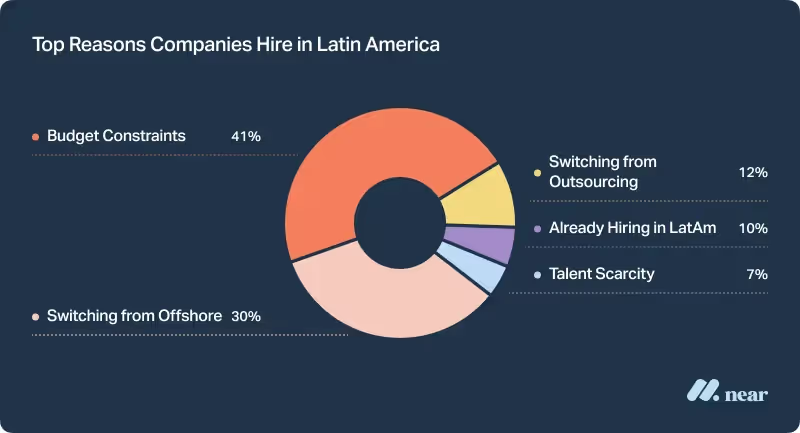
The large time zone difference with Eastern Europe and Asia is exactly why our recent report on why US companies hire in Latin America showed that 30% of companies are actively switching from offshore to “nearshore hiring” (hiring from nearby countries).
Time zone alignment is often the primary reason companies make the move.
As one founder told us when explaining why they were moving away from their Philippines-based team:
Although they may be good, I feel like [having to work nightshifts] is not what we advocate for because we also want our staff to be living a “normal lifestyle.” We want them to sleep at night and not get burnt out.
SDR and BDR roles already have notoriously high turnover. Asking people to work overnight, sleep during the day, and feel disconnected from their team only makes retention worse.
Latin America solves this without requiring anyone to sacrifice their health or personal life. LatAm SDR/BDRs work normal business hours.
They attend your meetings. They’re online when prospects want to talk. They get instant Slack responses when they need help. They can jump on a call with your AE to do a warm handoff.
Aligned time zones help US companies build a sales team that actually functions as a team.
Reason #2: The economics make building a strong sales function possible
Many growing companies know they need to build a team of SDRs/BDRs, but they don’t yet have the budget for US salaries. (We hear some version of “I need to make the numbers work” all the time.)
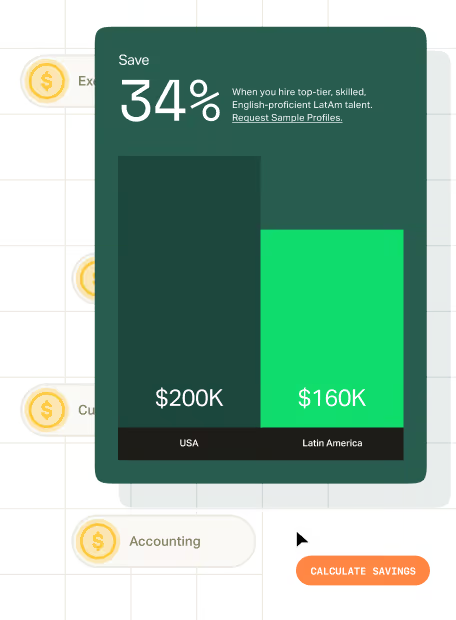
At current market rates, hiring even a junior SDR in the US costs $43,000 to $66,000 in base salary (commission would be on top of that). For companies selling lower-ticket products, testing a new sales motion, or operating without VC funding, this creates an impossible equation.
One founder explained his dilemma:
The problem is, if you hire an American to be a business development rep, they have to target pretty much mid-market and enterprise for them to make any money. I pretty much need them to close almost three deals a week to make it make sense.
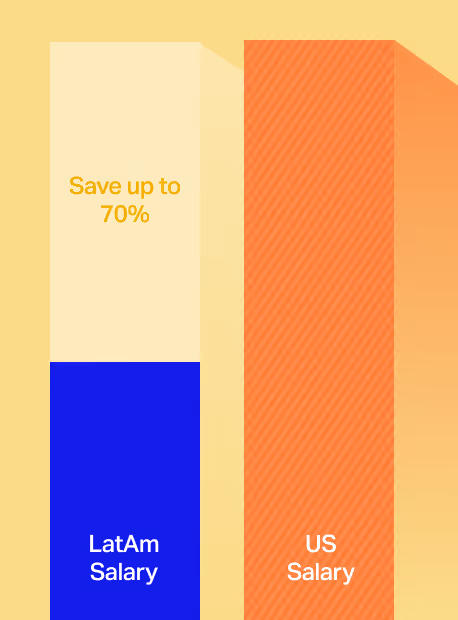
Latin American hiring changes the calculation. In our experience, here is what the LatAm salaries look like compared to those in the US.
Salary Ranges for SDRs and BDRs: US vs. Latin America
These savings reflect differences in cost of living, not talent quality. Top Latin American sales professionals have extensive experience working with US companies and understand American business culture.
With these economics, companies can:
- Hire their first sales role without needing significant funding
- Test an outbound motion they couldn’t afford to try before
- Build a complete high-performing sales team for the cost of a few US hires
- Invest savings into better tools, lead sources, or a more experienced closer
Hiring SDRs and BDRs in LatAm makes growth strategies accessible that were previously out of reach for startups or budget-conscious companies.
Related reading: How to Compete with Bigger Budgets When You Can’t Afford US Sales Salaries
{{salary-guide-cta}}
Reason #3: Companies are finding the sales talent and work ethic they need in Latin America
Companies tell us all the time that they’re struggling to find SDRs/BDRS in the US with the right attitude and work ethic.
The skills that make great SDRs/BDRs—grit, resilience, genuine drive to prove themselves—seem increasingly scarce in the domestic market.
Companies report candidates with minimal experience demanding premium packages and extensive support systems and showing limited willingness to do the hard work of cold outreach.
However, in LatAm, we are consistently able to find professionals with the skills and work ethic our clients are looking for.
LatAm candidates often see working with US companies as a genuine opportunity to build their careers and earn competitive compensation in their local markets. It’s a win-win opportunity, and they put in the effort to keep it.
The proof shows up in the results. Companies consistently report:
- Faster ramp times: For example, AvantStay’s LatAm SDRs reached productivity in 2 months versus the typical 6-month ramp for US hires
- Lower attrition: The same company saw turnover drop from 70% to 20%
- Wanting to scale their LatAm teams: We see companies typically start with 1–2 SDRs/BDRs as a test, then scale to 10, 15, or 20+ team members
AvantStay started with one SDR as a test hire. Within months, they scaled to 10 SDRs. They’re now at 18 and targeting 20. Those first 10 SDRs added $20 million in ARR.
This pattern repeats across industries. Companies hire one SDR, see strong performance, and come back to build entire teams. One energy services company started with a sales manager and an account executive through Hire With Near and is already expanding the team. The combination of lower costs, strong work ethic, and cultural alignment makes it a sustainable approach to scaling sales.
{{banner}}
Final Thoughts
If you’re evaluating whether to hire SDRs or BDRs in Latin America, here’s what matters:
- Time zones enable real collaboration. Your team works together during normal business hours, prospects get responses when they’re available, and nobody sacrifices their personal life to make it work.
- Lower salary costs unlock roles you couldn’t fill before. Whether you’re hiring your first SDR or scaling a team, the cost savings mean you can invest in growth without overextending your budget.
- The talent exists and delivers results. Companies aren’t just saving money. They’re finding professionals with the drive, skills, and work ethic to actually hit quota and stay long-term.
The trend toward hiring SDRs and BDRs in Latin America is about accessing a talent pool that works during your hours, brings genuine hunger to succeed, and stays with your company long enough to become truly valuable team members.
If you’re considering this approach, the data suggests you’re in good company. And the companies making this shift are seeing results that justify doing it again and again.
But you probably have concerns beyond just time zones and cost—like whether prospects will notice accents, how your existing team will react to salary differences, or whether LatAm talent can really handle your sales tools and processes.
We address these exact questions (and more) in our guide: Do LatAm Sales Reps Have Accents? And Other Questions Sales Leaders Ask. It tackles the questions most sales managers have.






.webp)
.webp)


%203.svg)
.avif)





%20(1).avif)

%20(1).png)