


%203.svg)
Key Takeaways
- Knowing what roles to outsource to nearshore locations starts with the data: the 10 most commonly nearshored roles are BDR/SDR, accountant, customer support rep, executive assistant, financial analyst, software engineer, bookkeeper, marketing specialist, legal assistant, and administrative assistant/VA, based on Hire With Near's analysis of 2,000+ placements in the 2026 State of LatAm Hiring Report.
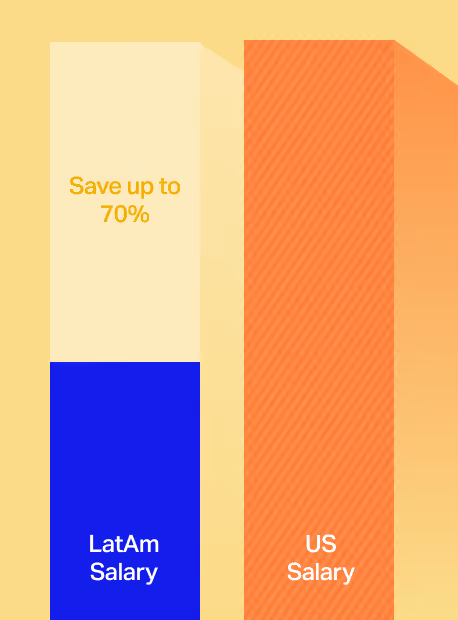
- Nearshoring these roles typically delivers 30–70% in annual salary savings compared to US equivalents, with full time zone overlap and none of the communication lag that makes offshore models difficult to manage.
- The fastest way to evaluate fit is to start with one role where the work is fully remote-executable and the cost gap is largest. Most companies see a return within the first 60 days.
US salaries for certain roles have reached a point where the math no longer works for many growing companies. The good news is that experienced professionals in Latin America are filling those same roles just as well, in the same time zone, with the same tools, integrated directly into the team. The question is not whether to make that move, but which roles to move first.
According to Hire With Near's 2026 State of LatAm Hiring Report, which analyzed 2,000+ placements, the 10 most commonly filled roles for US companies were: BDR/SDR, accountant, customer support rep, executive assistant, financial analyst, software engineer, bookkeeper, marketing specialist, legal assistant, and administrative assistant/VA.
In this article, I share details for each of those roles to help you decide what roles to outsource to nearshore locations. You'll find what the work involves, why it transfers well to Latin America, and what you can expect to pay compared to a US-based hire. Whether you’re hiring a remote employee directly, working with a nearshore staffing partner, or building a small team in the region, we have the roles that US companies are successfully moving out of their US offices first.
What Is Nearshore Outsourcing?
Nearshore outsourcing, or simply nearshoring, is any arrangement where a business function is performed by someone not physically located in a US office, but in a nearby country or region. For most US companies, that refers specifically to hiring remote talent in Latin America.
It’s different from other common outsourcing approaches like onshoring (working with US-based contractors) and offshoring (hiring from distant regions like Asia). Nearshoring gives you the cost advantages of offshoring, with significantly lower compensation costs, combined with the collaboration advantages of onshoring: closely aligned time zones, cultural familiarity, and real-time communication.
Nearshoring can be done through a remote employee based in Latin America, a nearshore staffing agency, or a dedicated regional team, and each model works differently.
Working with a managed-services agency means a third party sources and manages the talent. That works for some companies, but it creates distance. As one RevOps leader at a mid-market SaaS company described it: “It ends up not feeling like they're part of the team — like they're an agency that works with us.”
Hiring a full-time remote employee directly, by contrast, means that person works exclusively for you, reports to you, and operates as an integrated part of your team.
Hire With Near connects US companies with full-time remote professionals based in Latin America. These aren't contractors or outsourced agency staff. They’re direct hires who work exclusively for your business, during your hours, as genuine members of your team.
Why Outsource Roles to Nearshore Locations?
Three benefits make nearshoring consistently attractive to US companies: access to talent they can’t find domestically, significant cost savings compared to US rates, and the time zone overlap that makes remote collaboration practical.
Find and hire experts from different industries
Filling specialized roles in the US is harder than it used to be: Nearly three in four employers globally have reported struggling to find the skilled people they need. For US companies, that talent gap is especially acute in finance, engineering, and customer-facing roles.
Latin America gives you access to a large pool of experienced professionals in fields like accounting, software development, marketing, and customer service. With a talent pool extending across the entire region, in countries like Argentina, Colombia, Mexico, and Brazil, you're not competing against every other US employer for the same narrow group of candidates.
Save valuable time and resources
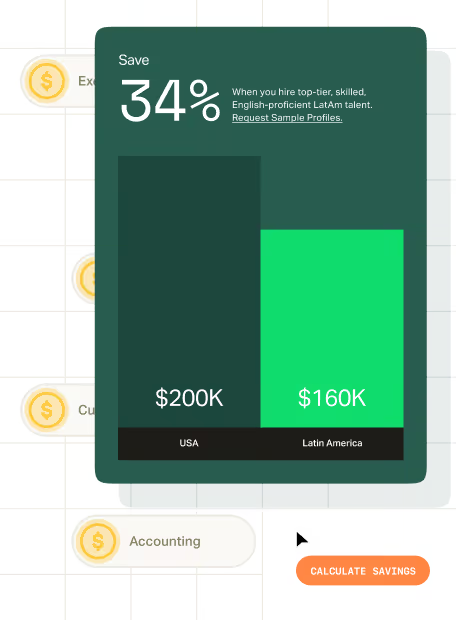
Nearshore hiring cuts costs on two fronts. First, the salary differential is real: depending on the role, you typically pay 30–70% less than the US equivalent, thanks to the lower cost of living in LatAm markets. You can review the specifics in the Hire With Near 2026 Salary Guide and in the comparison table below.
Second, the time-to-hire is faster. Working with a nearshore staffing partner, you can reduce sourcing and screening time. Hire With Near, for example, connects US businesses to qualified candidates within 21 days for most roles.
Because the cost of living in Latin America is lower, compensation costs are lower too, which means US companies can afford senior professionals, not just entry-level talent. In software engineering alone, 98% of Hire With Near's placements are mid- or senior-level.

Overhead costs also drop. Remote hires require no office space, and many US benefits structures don’t apply to internationally-based team members.
Take advantage of external skills and experiences
LatAm professionals bring depth in their fields, not just a cost advantage. Franco Pereyra, Co-Founder and COO of Hire With Near, describes what consistently surprises hiring managers:
What sets Latin American talent apart from other regions is that you'll find people who are proactive and creative — people who come up with ideas and new solutions, who won't just be a yes man. If you're looking for folks who can bring something to the table, who will push back if they think your idea doesn't make sense, that's what you find in LatAm.
In finance, for example, Argentina's accounting programs run for five to six years and produce graduates with Big Four (PwC, EY, Deloitte, KPMG) exposure.
Collaborate remotely with ease
The biggest operational argument for nearshoring over offshoring is time zone alignment. Research from Harvard Business School and INFORMS found that each additional hour of time zone difference reduces real-time communication by approximately 11%. The researchers recommend organizing distributed teams along a north-south axis, such as US-LatAm, rather than east-west to maximize workday overlap.
That finding maps directly to what companies describe in practice. Hire With Near's research into why US companies turn to LatAm hiring found that 30% are switching from an offshore arrangement in the Philippines or India because of time zone gaps and communication issues.
LatAm professionals work during US business hours, which means standups happen live, questions get answered the same day, and urgent issues don't wait until the following morning.
{{latam-hiring-calculator}}
10 Key Roles You Can Easily Nearshore
The 10 roles below are the most commonly placed roles for US companies hiring in Latin America, based on Hire With Near's placement data across 2,000+ hires. Each entry covers what the role does, the most common tasks, why it works well nearshore, and salary benchmarks so you know what to expect.
1. BDR/SDR
A nearshored business development representative (BDR) or sales development representative (SDR) is the professional who fills your sales team's top of funnel: prospecting new leads, qualifying interest, and booking meetings for account executives to close. Some of their tasks include:
- Cold outreach via email, phone, and LinkedIn to generate new pipeline
- Researching target accounts and building prospect lists
- Qualifying inbound and outbound leads against your ICP
- Booking discovery calls and handing off to AEs
This role works exceptionally well nearshore because LatAm sales talent operates in the same time zones as US prospects, which is critical for live outreach. Hire With Near's recruiters consistently flag English proficiency as the primary screening filter for sales hires, and prior exposure to US clients on a candidate's resume is a strong positive signal.
The results speak for themselves: AvantStay's VP of Sales Jake Breuner, hired 18 LatAm SDRs through Hire With Near, adding $20M in new ARR at 3x faster ramp time than his previous US-based hires.
After building my team with Near, I wouldn't hire an SDR stateside anymore.
LatAm salary range: $18,000–$42,000/year vs. $61,000–$136,000 in the US (42–80% savings)
2. Accountant
An accountant manages your company's financial records, ensures regulatory compliance, and provides the reporting you need to make sound business decisions. Some of their tasks are:
- Preparing and reviewing financial statements (income statement, balance sheet, cash flow)
- Managing month-end and year-end close processes
- Ensuring GAAP compliance and overseeing tax filing support
- Providing financial analysis and recommendations to leadership
Argentina produces some of the strongest accounting talent in Latin America, with 5–6-year accounting programs and widespread Big Four exposure (PwC, EY, Deloitte, KPMG). Hire With Near's finance recruiters note that roughly 80% of their finance placements come from Argentina, where an accounting degree is equivalent to a US degree plus postgraduate training.
Add a 49–71% salary savings compared to US-based accountants and you have a compelling case for moving this function nearshore.
LatAm salary range: $24,000–$60,000/year vs. $65,000–$139,000 in the US (49–71% savings)
3. Customer Support Rep
A customer support rep is the frontline voice of your business: handling inbound inquiries, resolving issues, and making sure customers walk away with a positive experience. The role also includes:
- Responding to support tickets via email, chat, and phone
- Troubleshooting product or service issues and escalating complex cases
- Documenting customer feedback and updating CRM records
- Handling returns, billing questions, and account changes
Customer support depends more on real-time responsiveness and communication clarity than on physical location, making it one of the highest-ROI roles to move nearshore. LatAm talent works in US business hours, reducing the handoff delays that plague offshore support teams.
Bilingual candidates who handle English and Spanish are readily available, which is a common need for US companies with Hispanic customer bases.
One health and beauty supplement brand had tried both Philippines-based and LatAm outsourcing platforms before coming to Hire With Near. The revolving-door model meant constant retraining and inconsistent quality. After hiring one dedicated customer support rep through Hire With Near, they ended the cycle and now save $26,000 annually, with a single person who knows the products, the customers, and the brand.
LatAm salary range: $14,000–$36,000/year vs. $60,000–$117,000 in the US (57–77% savings)
4. Executive Assistant
An executive assistant handles the operational and administrative layer around a senior leader so that the leader can focus entirely on strategic work. Some responsibilities are:
- Managing calendars, scheduling meetings, taking notes, and coordinating travel
- Drafting and filtering correspondence and handling follow-ups
- Preparing materials for meetings, presentations, and reports
- Managing vendor relationships and handling ad hoc research requests
This role transfers nearshore with minimal friction. The work is almost entirely remote-native: calendar management, email triage, document preparation, and coordination all happen over digital tools.
LatAm EAs often have strong English communication skills and experience with US business culture, which matters when an EA is representing a senior leader externally.
The time zone overlap means real-time availability during US business hours.
LatAm salary range: $14,000–$42,000/year vs. $62,000–$115,000 in the US (59–81% savings)
5. Financial Analyst
A financial analyst translates raw financial data into models, forecasts, and recommendations that drive business decisions. Their tasks may include:
- Building and maintaining financial models, forecasts, and scenario analyses
- Preparing budget variance reports and presenting findings to leadership
- Analyzing pricing, margins, and capital allocation decisions
- Supporting M&A due diligence, investor reporting, or FP&A functions
The same depth of finance talent that makes LatAm strong for accountants applies to financial analysts. Argentina's universities produce analysts with strong quantitative training, and the region's exposure to volatile economic conditions has, counterintuitively, produced professionals adept at financial modeling under uncertainty.
The analytical work is fully deliverable in digital formats, with no geographic dependency.
LatAm salary range: $24,000–$60,000/year vs. $80,000–$150,000 in the US (48–70% savings)
6. Software Engineer
A software engineer designs, builds, and maintains the applications and systems your business depends on. Some of their tasks are:
- Writing and reviewing code across the stack (frontend, backend, or full-stack)
- Participating in architecture planning and technical design discussions
- Debugging, testing, and shipping features on an iterative development cycle
- Collaborating with product and design on requirements and delivery timelines
Latin America has produced a deep bench of engineering talent. Brazil alone has 6.9M+ GitHub accounts, the largest developer community in the region, with Argentina, Mexico, and Colombia all showing double-digit year-over-year growth according to the GitHub Octoverse 2025.
Mexico's public university system produces more than 130,000 engineers and technical professionals annually, and approximately 37.5% of degrees in Mexico's public higher education system are in STEM disciplines, compared to roughly 20% in the US, according to Mexico's Secretariat of Economy.
Time zone alignment enables real-time collaboration with US engineering teams, which is a significant operational advantage over Asia-based offshore alternatives.
LatAm salary range: $36,000–$108,000/year vs. $100,000–$238,000 in the US (45–68% savings)
7. Bookkeeper
A bookkeeper handles the day-to-day financial recordkeeping that keeps your books accurate and your accountant from having to clean up a mess at year-end. Some of the tasks include:
- Recording daily transactions and reconciling bank and credit card statements
- Managing accounts payable and receivable
- Preparing monthly financial reports and cash flow summaries
- Supporting payroll processing and coordinating with your accountant or CPA
Bookkeeping is high-repetition, process-driven work that is well-suited to remote delivery. The deliverables are digital, the tools (QuickBooks, Xero, NetSuite) are cloud-based, and the work follows predictable monthly cycles.
LatAm bookkeepers bring solid accounting training, and cost savings in this category are among the most straightforward of any back-office function.
LatAm salary range: $22,000–$60,000/year vs. $46,000–$74,000 in the US (19–57% savings)
8. Marketing Specialist
A marketing specialist executes the campaigns, content, and channel strategies that drive traffic, leads, and brand awareness for your business. Some of their responsibilities may include:
- Managing paid search or social campaigns (Google Ads, Meta, LinkedIn)
- Writing and scheduling content for email, blog, and social channels
- Analyzing campaign performance and reporting on KPIs
- Coordinating with designers, agencies, and other marketing vendors
Marketing is one of the most digitally native roles in any company, and it transfers to a remote nearshore model cleanly. LatAm marketing professionals work in the same project management tools, ad platforms, and analytics dashboards as their US counterparts.
Sofía Berardi, Recruitment Manager at Hire With Near, describes what clients notice when they interview Latin American marketing candidates:
When clients interview Latin American candidates, they're often surprised at just how familiar and aligned we are — it makes collaboration feel very natural. We consume the same products, watch the same content, and engage with the same brands.
The creative sensibility for US audiences is strong in markets like Argentina, Brazil, and Mexico, where US media and culture have significant reach.
For a real example, see how a property restoration franchise hired a digital marketing specialist from Latin America for $3,500/month, replacing their outside SEO agency with one full-time hire in 16 days.
LatAm salary range: $24,000–$54,000/year vs. $60,000–$125,000 in the US (46–67% savings)
9. Legal Assistant
A legal assistant supports attorneys by handling the documentation, research, and coordination work that keeps a legal practice or in-house legal team running efficiently. Their tasks may include:
- Drafting, proofreading, and formatting legal documents and contracts
- Conducting legal research and summarizing case law, statutes, or regulations
- Managing case files, deadlines, and court filing calendars
- Coordinating communications between attorneys, clients, and courts
Legal assistant work is largely document-based and well-suited to remote delivery, provided the candidate has strong written English and familiarity with US legal processes.
California Consumer Attorneys (CCA), a personal injury law firm in Los Angeles, hired 9 legal assistants through Hire With Near in just a few months. Operations Manager Kathy Patterson reported:
Near has allowed us to nearly double our caseload without doubling our in-office staff.
CCA saved $314,000 annually and achieved a 7-day average time-to-hire.
LatAm salary range: $18,000–$30,000/year vs. $69,000–$117,000 in the US (68–77% savings)
10. Administrative Assistant / VA
An administrative assistant or virtual assistant handles the day-to-day operational and coordination tasks that keep your team organized and moving. Their responsibilities include:
- Managing inboxes, scheduling, and calendar coordination
- Data entry, database updates, and document organization
- Research tasks, vendor outreach, and internal project tracking
- Providing customer service support via email or chat
This is one of the easiest roles to move nearshore because the work is entirely digital, the scope is flexible, and strong candidates are widely available across LatAm. It’s often the first hire US companies make when exploring nearshore hiring, precisely because the feedback loop is fast and the ROI is visible quickly.
Many companies start with one VA, see results within the first 60 days, and expand from there.
LatAm salary range: $18,000–$26,000/year vs. $44,000–$69,000 in the US (40–68% savings)
Hire an administrative assistant | Hire a virtual assistant
Salary Comparison: LatAm vs. US Rates for the Top 10 Nearshore Roles
The table below compares annual compensation for all 10 roles mentioned in this article based on current industry compensation benchmarks. Savings percentages reflect the difference between a mid-market LatAm hire and a US equivalent in the same role.
Source: Hire With Near 2026 compensation benchmarks
For a full breakdown across all roles and seniority levels, see the US vs. Latin America Salary Guide.
How to Decide Which Roles to Nearshore First
Knowing what roles to outsource to nearshore locations is one thing. Knowing which ones to tackle first is another. From the editorial work I do interviewing our recruiters and synthesizing feedback from US hiring managers, four criteria consistently determine which roles are the right starting point:
1. Remote-execution fit
Can this role's core deliverables be completed over digital tools, without physical presence? Roles where the answer is clearly yes, like bookkeeping, administrative support, customer service, and content marketing, carry the lowest transition risk.
Roles with significant in-person components, like facilities management and on-site IT support, are harder to move and should come later.
2. Specialized skills gap in the US market
If you're struggling to find qualified candidates locally, the talent access case for nearshoring is already made for you. Finance roles in particular, like accountants and financial analysts, are consistently difficult to hire at competitive rates in many US markets.
Latin America, and Argentina specifically, has a deep supply in these categories.
3. Cost savings potential
According to our benchmarks, the highest-savings roles are customer support (57–77%), legal assistant (68–77%), and executive assistant (59–81%). If budget is the primary driver, these are where the dollar savings work fastest.
4. Team readiness for managing remotely
The first nearshore hire is also a learning experience for your team. Choose a role where the manager already has a clear picture of what good output looks like, one where they can evaluate work quickly and give direct feedback.
The administrative assistant and VA roles are often ideal starting points for this reason: the tasks are well-defined, the feedback loop is short, and results show up within the first few weeks.
Once you have one hire working well, the process becomes much easier to repeat. Most companies that build strong Latin American teams started with a single role, saw results, and expanded from there.
{{prevetted-banner}}
Final Thoughts
The 10 roles in this article aren’t the only functions US companies outsource to nearshore locations in Latin America, but they are the ones where the combination of talent depth, time zone alignment, and cost savings has proven most consistent across thousands of placements.
The decision of what roles to outsource to nearshore locations is rarely about finding the perfect fit on paper. It's about picking a starting point, getting one person in place, and learning what your team is capable of when it has the right support. Most companies that build strong Latin American teams started exactly that way.
If you're ready to move forward or just want to talk through which role makes the most sense for your situation, schedule a free consultation with Hire With Near's team. We made 2,000+ placements across all 10 of these roles and others for US companies. We can walk you through salary benchmarks, typical timelines, and which roles are moving fastest for companies like yours right now.
Frequently Asked Questions
What is an example of nearshore outsourcing?
A US company hiring a full-time software engineer based in Argentina, who works during US hours, reports to a US manager, and uses the same tools as the rest of the engineering team, is a clear example of nearshore outsourcing.
Other common examples include hiring a customer support rep in Colombia to handle live inbound tickets during US business hours, or building a small finance team in Mexico to manage accounts payable and bookkeeping.
In each case, the role is performed by someone outside the US but within closely aligned time zones, which is what distinguishes nearshoring from traditional offshore models.
What roles are most commonly outsourced to nearshore locations?
Based on Hire With Near's analysis of 2,000+ placements, the most commonly nearshored roles are BDR/SDR, accountant, customer support rep, executive assistant, financial analyst, software engineer, bookkeeper, marketing specialist, legal assistant, and administrative assistant/VA.
These roles share a common trait: the core deliverables are fully remote-executable, with no geographic dependency. The strongest demand is in finance, sales support, and administrative functions, categories where the combination of talent quality and cost savings in LatAm is most pronounced.
What are the main types of outsourcing?
The four main outsourcing types are onshoring (using US-based contractors or service providers), nearshoring (working with talent in geographically close countries, such as Latin America for US companies), offshoring (hiring from distant regions like India or the Philippines), and business process outsourcing or BPO (contracting an external company to handle an entire function, such as payroll or customer service).
For US companies prioritizing real-time collaboration and cost savings together, nearshoring to Latin America is typically the strongest option because it provides offshore-style cost advantages without the time zone gap that makes offshore models difficult to manage.
Further reading: Offshore vs. Nearshore vs. Onshore Outsourcing: What’s the Difference?
What is nearshore outsourcing?
Nearshore outsourcing is any arrangement where a business function is performed by someone in a nearby country rather than domestically or in a distant offshore location.
For US companies, nearshore outsourcing typically means working with professionals based in Latin America, either by hiring a full-time remote employee directly, engaging a nearshore staffing agency, or building a LatAm-based team.
The defining advantage over offshoring is time zone alignment: LatAm talent works during US business hours, making daily collaboration, real-time communication, and management straightforward.
Which roles save the most money when nearshored?
The roles with the highest salary savings when nearshored to Latin America are legal assistants (68–77% savings), executive assistants (59–81% savings), and customer support reps (57–77% savings).
Administrative assistants and VAs also deliver strong savings at 40–68%, with a much lower US baseline that still results in meaningful budget relief.
On the other end, bookkeeping has the narrowest savings range (19–57%) because the US salary floor for bookkeepers is lower than for most other roles in this list.
What roles should you not outsource to nearshore locations?
Roles that require physical presence, US licensure, or real-time access to US-based systems and facilities are poor candidates for nearshoring. Examples include on-site facilities managers, licensed US attorneys who must appear in US courts, medical professionals bound by state licensing, and roles that require government security clearances.
Roles with heavy regulatory compliance dependencies, such as some types of financial advisory, state-licensed insurance, or healthcare coordination, may also face legal constraints.
Outside these categories, most knowledge work and professional services transfer to a nearshore model without significant friction.
What industries benefit most from nearshore outsourcing?
Companies across a wide range of industries hire in Latin America, but the heaviest demand comes from sectors where knowledge work and remote delivery are central to the business.
Accounting and finance firms were early adopters, driven by the deep accounting talent pool in Argentina. SaaS companies are among the most active users of nearshore engineering and customer success talent.
Legal practices hire document-based support roles at high volume. Marketing agencies and customer service-intensive businesses also find strong returns on nearshore hiring.
Most US companies save 30–70% on annual salaries regardless of sector.






.webp)
.webp)



%203.svg)

.avif)





%20(1).avif)

%20(1).png)