


%203.svg)
Key Takeaways
- Peru is a Latin American developer market most US companies have overlooked, which means less competition for the same caliber of engineer, shorter searches, and less salary escalation at the offer stage compared to Colombia, Argentina, or Brazil.
- You can hire developers in Peru through four routes: freelance marketplaces, hiring directly (a legal entity or an employer of record), nearshore staff augmentation, or a staffing and recruiting firm, with mid-level developer salaries starting at $48K–$72K a year against $87K–$157K in the US.
- Lima concentrates the great majority of Peru’s developer talent and scores 555 on the 2025 EF English Proficiency Index, a full band above Peru’s national score of 519, with particular strength in Python, Java, and PHP development.
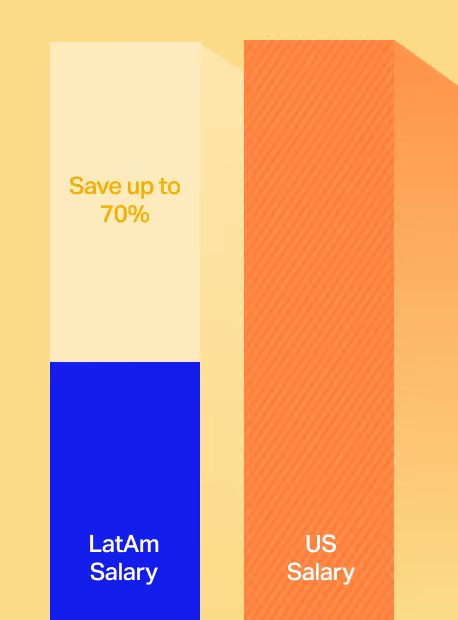
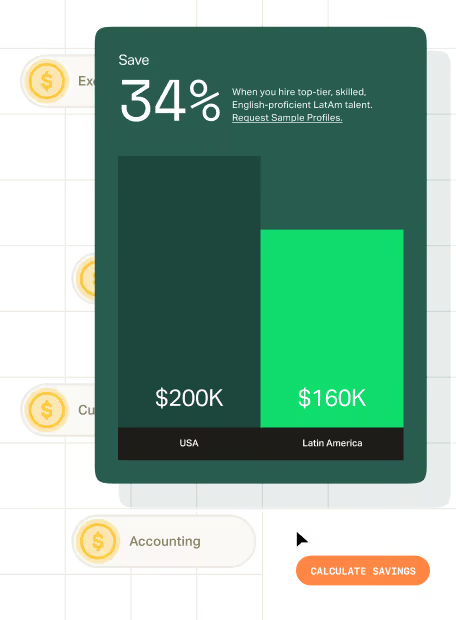
When companies look to hire developers in Peru, they aren’t just targeting 30% to 70% savings compared to domestic US rates. Their biggest advantage is tapping into one of South America’s fastest-growing digital economies, backed by an expanding talent pool of software engineers, data scientists, and systems architects.
Anchored by strong public and private universities, Lima has become a vibrant nearshore engineering hub. Peruvian developers work in near-total overlap with US business hours year-round, which gives most teams close to full-day collaboration regardless of coast.
In this guide, I break down real developer salaries by stack, the core technical skills to look for, the four hiring models available, and the essentials you need to know before making your first hire in Peru.
I’ll also explain how, whether you need senior full-stack developers or specialized cloud engineers, Hire With Near’s nearshore staffing and recruiting services can help you find the perfect candidate.
Why Should I Hire Developers in Peru?
Peru is the Latin American developer market US companies have largely skipped, which means the engineer you want usually isn’t fielding competing offers from a line of US companies.
According to Hire With Near’s 2026 State of LatAm Hiring Report, Colombia, Argentina, and Brazil absorb 58% of all nearshore hiring. Those markets have been worked hard by US recruiters for years. Lima has not, and that shows up as shorter searches and less salary escalation at the offer stage.
Real-time overlap with your workday
Peru sits on UTC-5 year-round, which means its alignment with the US shifts as the clocks change. A developer in Lima aligns with US Eastern Time during winter, and moves to US Central Time during summer Daylight Saving.
That keeps them within just zero to three hours of any continental US team all year long, giving you a shared workday whether you’re in New York, Chicago, Denver, or Los Angeles.
You can see how the four main US time zones align with Peru throughout the year in the table below:
That’s part of why US companies are hiring developers in Latin America: standups happen live and a blocked engineer gets unblocked in minutes.
That’s the opposite of what happens with a distant offshore team, as a founder of an early-stage B2B SaaS company described:
The agency I’m working with is on PET [Philippine Time], so they’re 10 hours ahead of me on Pacific time... now that people are onboarding, it doesn’t work that well. I need somebody who can iterate in my time zone.
Besides the time zone alignment, there’s another aspect that makes hiring in the region a great option for US companies: Latin American developers are easy to work with. Here’s what Hayden Cohen, our co-founder and CEO, has to say about it:
Strong English proficiency
Peru scores 519 on the 2025 EF English Proficiency Index, ranking #52 globally and in EF’s Moderate band. Lima scores 555, the top city score and a full band higher, which reflects the concentration of universities, BPO operations, and tech companies that have built English-heavy work cultures in the capital over the past decade.
That national number also understates the professionals you’d actually interview. A country-wide score blends every skill level and every region, including areas with far less exposure to English-language work. The candidates who make it through a technical hiring process, particularly for software roles, skew well above the national average.
Hire With Near assesses English proficiency for every placement rather than relying on a general country score to predict how an individual candidate will communicate.
A meaningful salary gap
Hiring developers in Peru typically costs 30% to 70% less than equivalent US hires, the same gap that makes the rest of Latin America attractive to US teams.
The difference reflects Peru’s cost of living, not a discount on skill: the same budget that funds one mid-level US developer often covers a senior Peruvian engineer, with room left to grow the team.
You can see how the cost of living in Peruvian main cities compares to Charlotte, North Carolina, a benchmark US city with a comparable role mix, on everyday costs:
Source: Numbeo.com
For the broad regional case, see why hundreds of leading US companies are hiring talent in Latin America and what changes when you hire Latin American developers.
How Deep Is Peru’s Developer Talent Pool?
Peru’s developer market is smaller than Colombia’s, Argentina’s, or Brazil’s and concentrated almost entirely in Lima. But what the market lacks in raw headcount volume, it makes up for in academic specialization and high talent density.
Official data from the OECD shows that 26% of all university students in Peru graduate with STEM degrees, outpacing the overall OECD average. The country feeds this pipeline through top-tier engineering institutions like PUCP and UTEC (a purpose-built engineering university created through a $100M+ private initiative).
International enterprise software companies have been tapping into this concentrated talent for over a decade. Globant has run a major engineering delivery center in Lima’s San Isidro financial district since 2014, joined by tech giants like IBM and Amazon Web Services. That enterprise footprint is the ultimate validation.
One founder of an early-stage semiconductor startup in the San Francisco Bay Area applied the same test to his own city:
I would really like there to be some presence of a company like Intel or Broadcom because otherwise there’s not likely to be the right kind of talent.
Lima passes that test comfortably. Engineers there have spent years shipping production code to international delivery standards, which is the profile tech companies hiring in Latin America look for.
Comparing markets first? The neighbors are worth a look: hire developers in Colombia, hire developers in Argentina, hire developers in Brazil, hire developers in Mexico, hire software developers in Chile, hire developers in Costa Rica, and hire developers in Belize.
Peru’s argument against all of them is the same: less competition for the same caliber of engineer.
What Technical Skills Do Peruvian Developers Have?
Peruvian developers work in the same stacks US companies request most often across Latin America: Python, JavaScript, PHP, SQL, Ruby, C++, Go, Java, and Rust, plus React, Django, Vue.js, Ruby on Rails, and .NET. React dominates front-end demand by a wide margin.
In the conversations I have with Hire With Near’s engineering recruiters, three languages account for most of the developer searches that reach us, and each attracts a different buyer.
Hiring Python developers in Peru
Python is the most-requested language in our placement data, covering three jobs: back-end services (usually Django or FastAPI), data engineering pipelines, and AI and machine-learning work.
Companies hiring Python developers in Latin America are often filling a role between engineering and data, so the screening question that matters is what the candidate has put into production, not which libraries they name.
Hiring Java developers in Peru
Java work skews enterprise: payments, insurance, logistics, anything with a Spring Boot service layer and a decade of business logic behind it.
That’s the profile Lima’s multinational delivery centers have produced for years, so when you need someone who can inherit a large, mature codebase without breaking it, hire a remote Java developer rather than a generalist.
Hiring PHP developers in Peru
PHP runs an enormous amount of the commercial web: Laravel applications, WordPress and WooCommerce builds, and older systems still processing real revenue.
Agencies, e-commerce brands, and SaaS companies hiring in Latin America with a legacy product tier are the ones who need to hire a remote PHP developer, and they need someone who can maintain and modernize at the same time.
Beyond those three, full-stack developers in Latin America are the highest-demand profile we place, usually a React front end over a Python, Node, or PHP back end.
What Does It Cost to Hire Developers in Peru?
Hiring a developer in Latin America costs 30% to 70% less than the equivalent US engineer, depending on role and seniority. Those are the regional benchmarks verified across the region, Peru included.
Here’s what that looks like role by role, according to Hire With Near’s salary benchmarks:
For the most up-to-date figures, see Hire With Near’s US vs Latin America Salary Guide.
A company hiring in Latin America can often add a senior engineer and a remote DevOps engineer for close to what one US mid-level hire costs.
Our research into why US companies turn to Latin America found 41% named budget as the primary driver. On average, US companies save $35,000 to $64,000 per hire by hiring in the region.
Our IT salary benchmarks for the US versus Latin America cover more engineering titles.
{{salary-guide-cta}}
Where Is the Tech Talent? Peru’s Tech Hubs
Peru’s developer talent is concentrated, not spread evenly across the country. Lima holds the great majority of it, with smaller, real pools in a couple of secondary cities worth knowing about if Lima alone doesn’t cover what you need.

Lima
Lima is where any serious search starts, and for most roles, where it ends too. The city’s engineering pipeline runs through Universidad Nacional de Ingeniería (UNI), the traditional engineering school, and UTEC, the newer technology-focused university, with Pontificia Universidad Católica del Perú (PUCP) serving as the broader top-tier signal for graduates in general.

Arequipa and Trujillo
Peru’s two largest cities outside the capital both have real, if smaller, developer communities.
Arequipa has a growing tech presence anchored by Universidad Nacional de San Agustín (UNSA), the highest-ranked university outside Lima with strong Systems Engineering and Computer Science programs, alongside Universidad Católica de Santa María (UCSM).
Trujillo has a smaller but active pool of engineers, often with ties to the city’s manufacturing and agribusiness sectors.
Neither approaches Lima’s depth, but both are worth considering for roles where the stack is common and Lima’s cost or competition for talent has pushed the search wider.
How Can a US Company Hire Developers in Peru?
US companies have four ways to hire developers in Peru: freelance marketplaces, hiring directly, a nearshore staff augmentation company, or a staffing and recruiting firm.
The right choice comes down to one question: do you need short-term help on a project, or a long-term, full-time developer on your team?
Here they are, from most complex to simplest:
Freelance platforms and marketplaces
Upwork, Toptal, Twine, and Lemon.io get you a contractor quickly, and for a short, one-off build that’s the right tool. The trade-off is attention: you get someone splitting the week across several clients, not an engineer who learns your codebase.
For full-time engineering work, the alternatives to freelance platforms in Latin America give you a different result: the vetting happens before you see a candidate.
Hire directly
Hiring a developer directly means you source and vet candidates yourself and also handle the employment relationship. For a cross-border hire in Peru, that requires one of two mechanisms:
- Set up a legal entity: Registering a Peruvian company gives you full control, but it takes about a month to incorporate and carries real legal and accounting overhead. That includes registration with tax authorities, an EsSalud employer registration, and ongoing local accounting support. This route only makes sense once you’re building a substantial in-country presence, not hiring one or two developers.
- Use an employer of record: An employer of record becomes the legal employer on paper, handling contracts, payroll, and compliance without you needing your own entity. In Peru specifically, that means managing a semi-annual severance deposit worth roughly 9.72% of annual salary, two mandatory annual bonuses paid in July and December, and EsSalud health contributions. The catch: an EOR handles employment logistics, not recruiting. You still source and vet every developer yourself, through job boards for hiring in Latin America or your own network. The mechanics of hiring remote employees abroad are the part an EOR covers.
Related reading: 10 Best Employer of Record (EOR) Companies
Nearshore staff augmentation
A nearshore staff augmentation company places a vetted engineer onto your team to work under your direction while the firm stays the legal employer and handles payroll, benefits, and compliance. It’s built for short-term, project-based needs: extra engineering capacity for a sprint, a launch, or a fixed-length build.
Be clear-eyed: most IT staff augmentation firms are built for rotations, with developers moving between clients every few months. Good when short-term is what you need, poor when you want someone to stay and own the work.
Staffing and recruiting firm
A staffing and recruiting firm is best the route for a long-term, full-time developer who joins your team permanently. The firm sources, screens, and places the engineer, then runs payroll, benefits, and compliance in the background.
You describe the role, the partner presents pre-vetted candidates, and once you hire, the professional joins your team as a permanent member. The best LatAm staffing firms also know local salary bands well enough to keep you from mis-offering.
Compare the companies that place developers in Latin America on how they screen technically, not just on speed.
Hire With Near runs nearshore staffing and recruiting for exactly this: permanent hires who join your team and stay, with a first shortlist in three to five days.
{{prevetted-banner}}
What US Companies Should Know Before Hiring Developers in Peru
Three things affect a developer hire in Peru specifically: IP protection, one quirk in local pay, and how to read a candidate without a degree.
Protecting your IP and code security
Treat a developer in Lima exactly as you’d treat one in Denver or San Francisco. Scope repository access by role, issue credentials through your own identity provider with MFA, revoke on your usual schedule, and put IP assignment and confidentiality terms in writing before day one.
A staffing partner handles that paperwork as part of the engagement, along with payroll and benefits.
The pay quirk: gratificaciones
If you hire an employee directly or through an EOR, Peruvian employees receive two mandatory bonuses a year, known as gratificaciones, one in July and one in December, each roughly a month’s salary. Budget around 14 months of salary rather than 12.
This doesn’t apply the same way to project-based or freelance arrangements, so confirm with your partner whether it factors into your specific setup.
The rest of the local statutory picture is covered in the How to Hire in Peru guide, worth reading before you finalize an offer.
Don’t gate on a degree
Natasha Tarapow, Recruitment Consultant at Hire With Near, is direct about what happens when companies get that wrong:
A lot of the great engineers in Latin America don’t have a college degree, and that doesn’t mean they’re bad candidates. The dynamic here is that many of the best engineers started working before they graduated. They got a really good job and didn’t have time to finish. We always recommend to clients that they don’t make a degree a must-have, because they might be losing out on some really good candidates.
— Natasha Tarapow, Recruitment Consultant, Hire With Near
Screen on what someone has shipped and how they reason through a code review. The diploma is a tiebreaker.
Related reading: “Will They Join Our Stand-ups?” and Other Questions Tech Leaders Ask About Hiring Developers in Latin America
How Does Hire With Near Help US Companies Hire Developers in Peru?
Hire With Near runs the search: sourcing from our pool of 160,000+ candidates plus fresh sourcing built around your role, first-round interviews, and coordination, with a shortlist in three to five days and most clients making a hire in under three weeks.
Those are our standard Latin America timelines rather than a Peru-specific promise. US engineering searches are usually measured in months.
The screening is where the time goes. Every candidate is assessed on English and communication first, because an engineer who can’t explain why a pull request broke production isn’t useful no matter how the code reads. Candidates also walk through a real project and the decisions behind it, so you’re evaluating people who’ve already shown they can own their work.
If you want a technical assessment or case study assignment specific to your stack, we can help administer it and advise on what it should look like. Your own evaluation process sits on top of ours either way.
What hiring through Hire With Near looks like
A mid-sized US healthtech startup was scaling engineering with two internal recruiters and refused to shorten an eight-step interview process. We took on sourcing, screening, and coordination across every role, running a shared tracker so their team stayed on evaluation decisions.
They hired seven senior engineers in Latin America across backend, DevOps, QA, mobile, frontend, process, and staff-level roles, kept the full bar, and saved $323K per year, a 33% reduction.
Another example is ParkMobile, part of the global mobility platform Arrive, which had spent years relying on outside development agencies for its back-end and platform engineering. Every time those developers rolled off a project, their knowledge of ParkMobile’s systems left with them, which Mariana Lepassar, Head of Engineering for Mobile Payments and Billing, described as a real business risk.
Working with Hire With Near, they built a nine-engineer team across platform, backend, and iOS roles, with the first candidate shortlists arriving within a week and an average time to hire of 24 days.
The result was $1,066,085 in annual savings, a 73% reduction against US rates. Akshay Gokarnakar, ParkMobile’s TA Lead, put it this way:
Collaboration with Hire With Near is solving the problem of entering a completely new market for us. They have been an invaluable partner in this expansion, helping to successfully close roles quickly. Their deep understanding of the local talent landscape is what allows them to source and vet top-tier candidates efficiently.
— Akshay Gokarnakar, TA Lead, ParkMobile
ParkMobile wanted to hire specifically in Colombia, but the process is the same for Peru. You can watch Akshay Gokarnakar's testimonial here:
Payroll, benefits, and local compliance are part of the model, not an add-on.
When the role is a VP of Engineering or a CTO, that runs through executive search in Latin America.
If you’re weighing the region as a whole, our guide to hiring remotely in Latin America.
Final Thoughts
Peru is a smaller developer market than its neighbors, and that’s exactly the reason to look at it. The engineers in Lima work your hours, work in the stacks you’re hiring for, and usually aren’t fielding competing offers from a line of US companies.
If you want to explore the market, book a free consultation to talk through your specific requirements with our team. We’ll give you salary benchmarks for the stack and seniority you need and explain the hiring process.
{{latam-hiring-cta-v2}}
Frequently Asked Questions
What is the average salary for software developers in Peru?
A mid-level software engineer hired through Hire With Near in Latin America earns $54K to $72K a year, and a senior engineer earns $72K to $108K, against $115K to $195K and $140K to $238K in the US.
PHP, Java, and Python developers at mid-level run $48K to $72K, per our own placement benchmarks.
Is it better to hire freelance or full-time developers in Peru?
Hire freelance for a defined, short project and full-time for anything that touches your core product. The difference is continuity: a full-time developer learns your codebase and answers to one team, while a freelancer usually splits the week across clients.
What tech stacks are Peruvian developers strongest in?
Peruvian developers work in the stacks US companies request most across Latin America: Python, JavaScript, PHP, Java, and SQL, plus React, Django, Vue.js, and .NET. Python leads our request volume across back-end, data engineering, and AI work.
Java skews enterprise, PHP toward Laravel and commerce platforms, and React dominates front-end hiring.
Do Peruvian developers speak English well enough for daily standups?
Yes, for developers with the technical experience most companies are hiring for. Peru scores 519 on the 2025 EF English Proficiency Index, ranking #52 globally in EF’s Moderate band, but that’s a national average across the whole population, not just tech workers.
Lima, where the developer talent is concentrated, scores 555, a full band higher, and English proficiency tends to rise further with seniority and exposure to international clients.
Hire With Near also assesses English on every placement, so you’re not relying on a country-wide score to predict how any individual candidate communicates.
How long does it take to hire a developer in Peru through Hire With Near?
You’ll see a first shortlist in three to five days, and most companies make a hire in under three weeks, against US engineering searches that routinely run months.
These are our standard Latin America timelines rather than a Peru-specific promise, and what moves them is how fast your team runs interviews.
What’s the best way to hire software developers in Peru?
For most companies, working with a staffing and recruiting partner is the fastest and most reliable route. You describe the role, the partner sources and vets candidates against your specific requirements, and you interview a shortlist of people who’ve already cleared a technical and communication screen.
This is faster than sourcing on your own and gives you a full-time developer who joins your team permanently, unlike freelance platforms or staff augmentation, which are better suited to short-term or project-based needs.
What other developer roles can I hire from Latin America?
Beyond generalist developers, US companies commonly hire full-stack developers in Latin America, nearshore back-end developers in Latin America, front-end developers in Latin America, remote DevOps engineers, QA engineers in Latin America, and nearshore software engineers in Latin America from Peru and the wider region.
Most teams that start with one hire add a second within a year, usually on the testing or infrastructure side. The same time zone overlap and salary comparison apply across all of them.


.webp)

.webp)




%203.svg)
.avif)





%20(1).avif)

%20(1).png)