%203.svg)
Key Takeaways
- Peru is one of Latin America's most overlooked professional talent markets: it sits in the US Eastern time band for real-time overlap with your workday, Lima's professionals score a full English-proficiency band above the national average, and salaries run 30–70% below US equivalents.
- US companies have three ways to hire in Peru: set up a local legal entity, use an employer of record, or work with a specialist staffing and recruiting partner that sources the talent and handles employment in one relationship.
- Most companies go from kickoff call to an accepted offer in about three weeks, with a shortlist of pre-vetted candidates in your inbox within three to five days.
Full-time remote professionals who work your business hours at a significantly lower cost than US equivalents, without competing against the crowd of US employers already fishing the same few Latin American markets: that's what's been driving many US companies to hire in Peru over the last few years.
Most US companies weighing a first remote hire in the region land on the same two or three countries, run into the same bidding wars, and walk away convinced nearshore talent is pricier and harder to land than they were promised. Peru, a market with deep professional talent concentrated in Lima, sits comparatively untouched.
This guide covers how to hire employees in Peru: the practical mechanics of hiring remotely in Latin America, what the talent is like, how much professionals earn, and the statutory rules that catch first-time employers off guard.
Why Are US Companies Hiring in Peru?
Peru gives US companies real-time overlap with their workday, professional talent concentrated in Lima, and salaries well below US rates, in a market that far fewer US employers have discovered. That combination is why Peru is becoming a smarter first move than the countries everyone else is already competing for.
An under-fished talent market
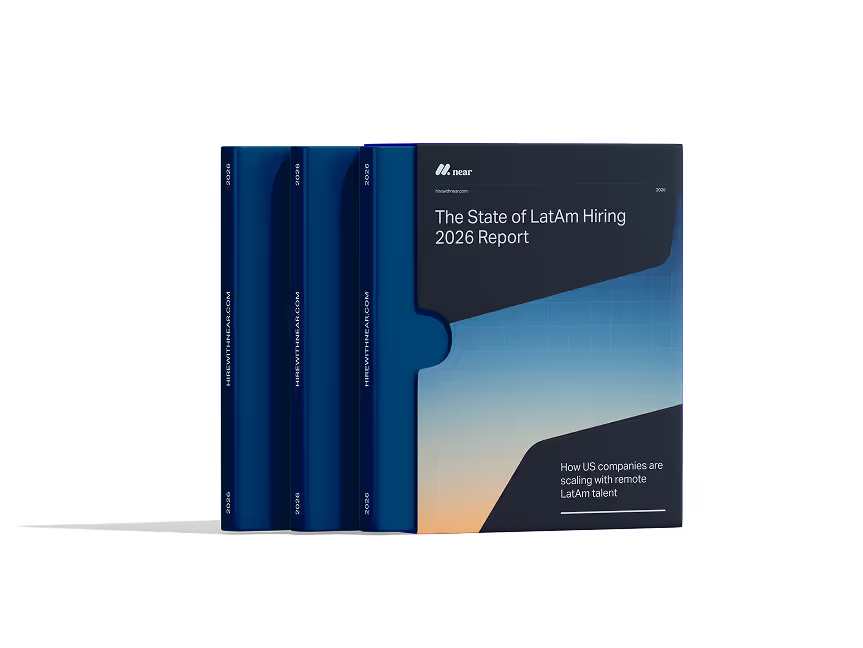
According to the Hire With Near's 2026 State of LatAm Hiring Report, just three countries, Colombia, Argentina, and Brazil, account for 58% of all nearshore hiring. That concentration is exactly why Peru is one of the region's most overlooked professional talent markets: a strong candidate in Lima isn’t fielding four competing offers from US companies the way a candidate in Colombia often is.
For you, an under-fished market means less competition for good people, less salary inflation from bidding wars, and candidates who take your outreach seriously instead of treating it as one of several options. It's the same case thousands of US companies are already making for Latin America, applied to a country most of them haven't looked at yet.
Time zone overlap with your workday
Time zone alignment is a big reason companies choose the region in the first place, and Peru delivers it cleanly. Lima matches US Eastern Time during the winter and matches US Central Time during the summer, meaning real-time overlap year-round.
As one hiring manager told us:
We're prioritizing LatAm now because for the roles we need at the moment we want them to work in tandem with our US hires as opposed to off hours. We'd rather they work at the same time.
A professional in Lima is online and working while your team is, not answering your questions overnight, as you can see in the table below:
Strong English proficiency
Peru ranks 8th in Latin America and 52nd globally on the EF English Proficiency Index 2025, placing it in the Moderate band.
For US companies, that translates to professionals who can handle written communication, documentation, and most working conversations comfortably, with spoken fluency worth confirming directly for client-facing or highly technical roles, the same way you'd screen for it anywhere else in the region.
In the video below, Franco Pereyra, Hire With Near's COO, shares the broader picture of what makes Latin American professionals attractive to US companies:
How Can a US Company Hire in Peru?
US companies looking to hire remote employees in Peru have three options: establish a legal entity, use an employer of record (EOR), or work with a specialist staffing and recruiting partner. For most, the third is the fastest path to a great hire.
Here they are in order from most to least complex.
Option 1: Establish a legal entity
Setting up a legal entity means registering your own business in Peru so you can employ people directly under your company's name, with a local subsidiary, compliant payroll, and local benefits administration.
It gives you complete control over your operations, and it makes sense if you’re planning a substantial, permanent presence in the country, with dozens of employees rather than one or two.
For everyone else, it’s heavy: significant upfront cost, three to six months to stand up, and ongoing legal and accounting support to stay compliant as rules change. For a company hiring a handful of remote professionals, it’s overkill.

Option 2: Use an employer of record
An employer of record is a third-party company that becomes the legal employer of your hire on paper, while you manage the work day to day. The EOR handles employment contracts, payroll, tax withholdings, benefits, and local compliance. You pay the EOR, and they pay your employee according to Peruvian law.
In Peru, navigating local compliance means understanding statutory rules that depend heavily on your chosen hiring structure. Under formal local employment arrangements, two key benefits stand out:
- Peru requires two mandatory bonuses a year, called gratificaciones, each worth roughly a month's salary, one paid in July and one in December.
- Employers make a severance deposit called CTS (Compensación por Tiempo de Servicios) twice a year, in May and November.
An EOR calculates, withholds, and pays all of it on schedule so you don’t have to learn the mechanics. We cover both in plain English in the statutory section below.
Popular EOR companies include Deel, Globalization Partners, Remote, and Oyster, and this guide to hiring remote foreign employees walks through how the arrangement works end to end.
The trade-off is the one every EOR shares: it handles the employment logistics, not the recruiting. You still have to source and vet every candidate yourself, whether through LinkedIn, referrals, or a job board for hiring in Latin America.
Option 3: Work with a specialist staffing and recruiting partner
Working with one of the specialist staffing firms for LatAm hiring that handles both talent acquisition and all employment logistics in one package closes the gap the EOR leaves open, being the simplest option for most US companies.
You describe the role, the partner presents pre-vetted candidates, and once you hire, the partner runs payroll, benefits, compliance, and local employment requirements through its nearshore staffing and recruiting services. It feels as simple as hiring someone down the street.
If you’ve leaned on freelance platforms like Upwork or Toptal before, specialist staffing gives you fundamentally different results for full-time remote hires, where a contractor splitting attention across five clients was never going to work.
What Can US Companies Expect from Peruvian Professionals?
Peruvian professionals are concentrated almost entirely in Lima, and the talent pool reflects the industries that anchor the capital's economy: banking and finance, mining and natural resources, and a growing base of companies delivering technical and business services to international clients.
Most mid- and senior-level candidates you'll interview have built their careers inside that environment, working alongside or directly for multinational companies already operating in Lima.
Finance and banking: a market built for it
Lima is one of the most established banking and financial services hubs in the Andean region, home to major domestic and multinational institutions.
That's produced a deep bench of financial analysts, accountants, and operations professionals trained on rigorous reporting standards and comfortable working directly with US finance teams.
If you need to hire a financial analyst in Latin America, Peru's banking-heavy talent base gives you access to professionals who already think in the language of covenants, reconciliations, and month-end close.
Related reading: How to Hire Finance & Accounting Talent in Latin America
Technology and business services delivery
Peru has built a genuine, if newer, base of technical and delivery talent in Lima. Globant has run a delivery center in the city's San Isidro financial district since 2014, and other international companies have followed, giving Lima's tech professionals real experience on client-facing, US-facing work.
What matters most in that talent isn't just the credential, it's how people operate day to day. As Federico Bilello, Software Engineering Recruiter at Hire With Near, puts it:
The main thing I look for is ownership. I always look for developers who have worked in startups or smaller companies, because those are the people who probably have ownership. If you bring them a problem, they won't ask how to solve it — they'll try their own ideas, they'll be creative. — Federico Bilello, Software Engineering Recruiter, Hire With Near
Related reading: How to Hire Developers in Peru: Cost, Skills, and the Four Ways to Hire
Operations and back-office support
Lima's concentration of banking, mining, and multinational operations has also produced a strong pipeline of operations, administration, and support professionals who are used to working in structured, process-driven environments.
For companies filling operations analyst or administrative support roles, that background translates directly into US workflows.
If you're building out admin or operational support more broadly, see our guide to hiring admin talent in Latin America.
Top universities to recognize on a resume
The professional talent pool is genuinely concentrated in Lima. Arequipa and Trujillo contribute, but the capital is the market. A handful of universities show up consistently on strong resumes:
- Pontificia Universidad Católica del Perú (PUCP): The country's top-ranked university and the strongest general signal across finance, engineering, and business roles.
- Universidad Nacional de Ingeniería (UNI): Peru's premier engineering school, the closest equivalent to a dedicated technical talent pipeline.
- Universidad Nacional Mayor de San Marcos (UNMSM): The oldest and among the most prestigious public universities, strong in economics, law, and public administration.
- Universidad de Lima: Known for business, communications, and finance graduates who move directly into corporate roles.
- UTEC: A newer, tech-focused institution producing engineering and computer science graduates trained on current industry practices.

What Are the Salary Ranges for Peruvian Hires?
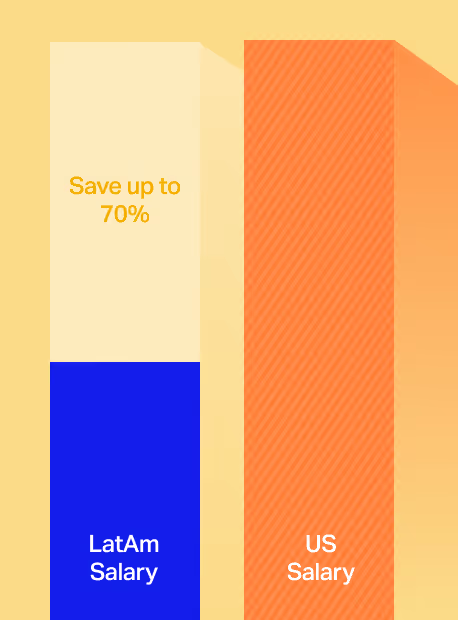
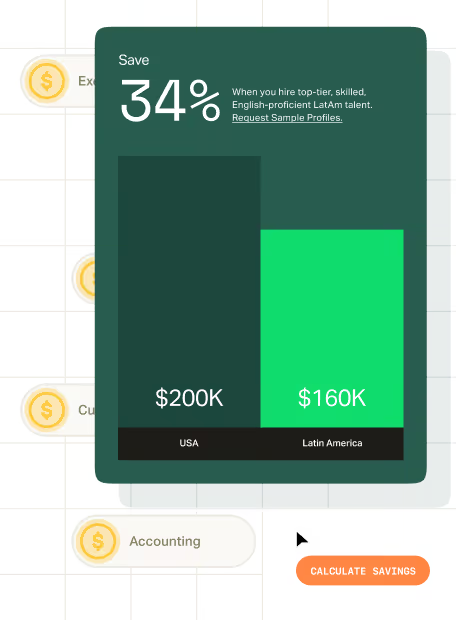
Hiring in Peru typically costs 30–70% less than hiring the same role in the US, and the numbers below show what that looks like across the roles US companies build remote teams around. These figures come from our own US vs. Latin America salary benchmarks:
For the most up-to-date figures, see Hire With Near's US vs Latin America Salary Guide.
According to the 2026 State of LatAm Hiring Report, 84% of hires made by our team are mid-level or senior professionals, with average annual savings per hire running between $35,000 and $64,000. These numbers are our standard Latin America benchmarks, the same ranges we use across the region.
The salary difference makes more sense when you look at the cost of living. A mid-level software engineer earning $54,000–$72,000 in Lima is living very well by local standards. The same role in a US city starts at over $115,000. That gap reflects the cost of living in each market, not a difference in skill or output.
Here’s how Lima, Arequipa and Trujillo compare to Charlotte, North Carolina, a benchmark US city with a comparable role mix, on everyday costs:
Source: Numbeo.com
What Do US Companies Need to Know Before Hiring in Peru?
Two things reliably catch US companies off guard when they hire in Peru for the first time: the country pays two full statutory bonuses a year, not one, and paid leave runs 30 days on top of 16 public holidays. However, these don't apply to every hire. It depends on how you structure the engagement.
Either way, they're worth understanding: Peruvian professionals know exactly what the local market provides, and they factor it into their compensation expectations. Planning for both upfront makes for a smoother offer conversation.
Paid annual leave: 30 days
Employees in Peru are entitled to 30 calendar days of paid annual leave after a year of continuous service. That is among the most generous statutory entitlements in Latin America, well above Argentina's 14 days and Mexico's 12.
Peruvian law explicitly allows employees to split their 30 days into blocks, most commonly two 15-day blocks, with a written agreement between employer and employee. This is just scheduling flexibility, not a reduction in time off.
Under Decreto Legislativo 713, an employee can separately agree, in writing, to reduce their vacation to a minimum of 15 days actually taken, receiving pay for the other 15 days instead. This one does reduce actual time off in exchange for money.
Public holidays: 16 national holidays
Peru observes 16 national public holidays a year. Most fall on fixed dates, but a few move annually because they're tied to the Christian liturgical calendar. Here's the breakdown:
- January 1: New Year's Day
- March/April: Holy Thursday
- March/April: Good Friday
- May 1: Labor Day
- June 7: Battle of Arica and Flag Day
- June 29: Saint Peter and Saint Paul
- July 23: Air Force Day
- July 28: Independence Day (Fiestas Patrias)
- July 29: Fiestas Patrias
- August 6: Battle of Junín
- August 30: Santa Rosa de Lima
- October 8: Battle of Angamos
- November 1: All Saints' Day
- December 8: Immaculate Conception
- December 9: Battle of Ayacucho
- December 25: Christmas Day
Holy Thursday and Good Friday both fall in the days leading up to Easter Sunday, which moves annually.
Note that July and December each carry three holidays, and those are the same two months Peru's statutory bonuses are paid. US companies routinely underestimate how many holidays cluster in these two months, so naming them upfront is useful.
The two mandatory bonuses
Peru requires two statutory bonuses a year called gratificaciones, each equal to roughly one month's salary: one paid in July (around the Fiestas Patrias independence holidays) and one in December.
Furthermore, because social security isn't deducted from bonuses, employers pay an additional 9% “extraordinary bonus” directly to the worker alongside each payout.
In practical budgeting terms, you should plan for roughly 14.2 months of salary per year.
{{salary-guide-cta}}
Other statutory requirements
A few more employer obligations are worth knowing, each explained plainly:
- CTS (severance fund): Employers deposit a mandatory severance amount into the worker's dedicated bank account twice a year (in May and November). This totals roughly 9.7% of annual base salary and serves as an unemployment cushion if the employee leaves.
- EsSalud (social security and healthcare): Employers contribute about 9% of salary to EsSalud, the public health system that covers the employee's healthcare. This one is paid by the employer, on top of salary.
- Pensions: Employees choose between the public pension system (ONP) or a private fund (AFP). This contribution (~13%) is withheld directly from the employee's salary, meaning it’s a deduction, not an added employer cost.
- Profit sharing: Peruvian companies with more than 20 workers and taxable profits must distribute a portion of annual earnings to staff. However, if you hire through an EOR or staffing partner rather than setting up your own local entity, this requirement falls on the partner, not on you.
If you're working through the hiring process for the first time, we've put together the common questions US companies have about hiring remote talent offshore.
How Does Hire With Near Help US Companies Hire in Peru?
If you want to hire in Peru, Hire With Near helps US companies do exactly that, and across Latin America more broadly. Lima is the market for professional talent in the country, and it's where we focus sourcing, drawing on recruiters who know the local pool, which universities signal a strong candidate, and what people at different levels expect to earn.
What makes the process different is how much time your dedicated recruiter spends understanding the role, your team, and what a great hire looks like before a single candidate reaches your inbox. That groundwork is the filter.
You describe what you need on a kickoff call and, within three to five days, your recruiter sends a shortlist of pre-vetted candidates, each with a video introduction so you can judge communication and presence before you spend time interviewing. English is assessed on every placement.
From kickoff to accepted offer, the process usually takes about three weeks, and once your hire is in place, we handle payroll, benefits administration, and compliance on an ongoing basis.
One of our clients saved $159,000 in annual salaries
That combination of speed and time-zone fit is exactly what turned things around for one of our clients. ORBA Cloud CFO, a Chicago-based outsourced bookkeeping, controller, and CFO services firm, needed to fill roles quickly while fixing the time-zone misalignment they had run into with offshoring, without giving up service quality.
Working with us, they hired Latin American professionals who overlapped their clients' hours within one to two hours, cut costs by 65% for $159,000 in annual savings, and filled the roles in a 13-day cycle. Their VP of Client Services put it this way:
Hire With Near helped ensure we were selecting the right people for our team. The ability to interview multiple candidates and watch video recordings of the interviews before making a decision was a very strong point for Hire With Near. — Segdrick Byrd, VP of Client Services, ORBA Cloud CFO
ORBA's hires were not in Peru, but the story proves that an offshore time-zone problem gets solved by nearshore hiring with real-time overlap, which is precisely what Peru offers.
For companies filling director-level or leadership positions, Hire With Near also handles executive search in Latin America across all departments, and if you want to see how we stack up against others, we cover the field in our roundup of the top nearshore staffing companies working in the region.
If you're still researching and considering other Latin American countries, visit our How to Hire in Costa Rica and How to Hire in Nicaragua guides.
If you're ready to explore hiring in Peru, book a free consultation to talk through your requirements with our team. We'll walk you through salary benchmarks for the roles you're considering and show you what a search in Peru looks like in practice.
{{latam-hiring-cta-v2}}
Frequently Asked Questions
Can you hire someone in Peru to work remotely for a US company?
Yes, and you don’t need to set up a foreign entity to do it. You can hire through an employer of record or a specialist staffing and recruiting partner that employs the person locally in Peru and handles payroll, benefits, and compliance while they work as part of your team and report to you.
Those are two of the three options covered above, and for most companies the staffing partner is the simplest because it also finds and vets the candidate.
Is Peru in a compatible time zone with the US?
Yes. Peru aligns with the US Eastern time band and doesn’t observe daylight saving, so a professional in Lima works during your business hours whether your team is on the East Coast, in the Central states, or on the West Coast, with the exact overlap shifting by an hour twice a year.
You get live meetings, same-hour answers, and real-time collaboration, rather than the overnight lag that comes with a truly offshore team.
Is 13th-month salary required in Peru?
Technically, Peru requires two statutory bonuses a year, not just one, but only for employees hired under a formal, direct employment arrangement. If you're hiring through an EOR or setting up local employment, this applies to your hire.
Under that model, employers pay a gratificación in July and another in December, each equal to a full month's base salary plus a mandatory 9% extraordinary bonus. If you're hiring the person as an independent contractor instead, this obligation doesn't apply, though it's worth knowing what the local market expects, since strong candidates factor it into their compensation expectations either way.
In practical budgeting terms, for a direct employment arrangement, you should plan for roughly 14.2 months of pay per year, making it the single most common financial surprise for US companies hiring in Peru for the first time.
What roles do US companies most commonly hire in Peru?
US companies hire the same core professional roles in Peru that they build remote teams around across Latin America, including accountants in Peru, financial analysts in Latin America, nearshore customer support representatives, and software engineers in Latin America.
Lima concentrates the professional workforce, and candidates there routinely do client-facing and technical work for international companies. The right mix depends on your needs, which is a good thing to map out on a kickoff call.
What level of English can US companies expect from professionals in Peru?
Professionals in Lima generally speak strong business English, stronger than Peru's national average suggests. The country scores 519 on the 2025 EF English Proficiency Index, in the Moderate band, but Lima scores 555, a full band higher, and essentially all of these hires come from Lima.
We assess English on every placement, so you can judge a candidate's client-facing communication from their video introduction before you ever interview them.
How long does it take to hire in Peru through Hire With Near?
Most companies go from kickoff call to accepted offer in about three weeks, with a shortlist of pre-vetted candidates in your inbox within three to five days. As a concrete example, ORBA Cloud CFO filled multiple roles through us on a 13-day recruitment cycle. Timelines vary with the role's seniority and specificity, but the sourcing and screening burden is on us, not you.




.webp)




%203.svg)
.avif)





%20(1).avif)

%20(1).png)