.webp)


%203.svg)
Key takeaways
- Top performers are 400% more productive than average employees, and in complex roles like software development and management, that gap widens to 800%, according to McKinsey research covering more than 600,000 workers.
- In the US, an A-player’s salary expectations often exceed a role’s budget, which is why so many hiring plans default to two safer, average hires instead of one exceptional one.
- Hiring in Latin America closes that gap. Salaries there typically run 30–70% lower than comparable US rates, which means you can often hire the best available candidate for less than you’d budgeted for an average one.
You’ve got budget for two hires, and two open roles competing for it. The obvious move is to split the budget and fill both: cover more ground, spread the risk, and avoid betting the whole search on one person. That instinct feels responsible, but it rests on an assumption that turns out to be wrong for a lot of roles: that a hire is a hire, and two solid ones beat one great one by simple math.
The research says otherwise. In complex, judgment-heavy work, a true top performer can produce up to 800% more than an average one, not 10% or 20% more, several times more. When the gap is that wide, splitting your budget across two average hires isn’t the safe play.
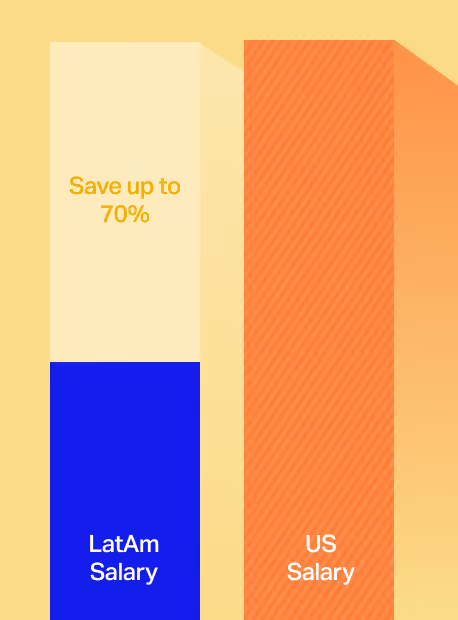
Here’s what makes that math work in practice: according to our benchmark, salaries in Latin America run 30–70% below comparable US rates, so the caliber of hire that would blow your budget domestically often costs no more than what an average US hire would cost. The premium you’d normally pay for exceptional talent disappears into the savings.
This article breaks down the research behind that performance gap, what changes on a team once it closes that gap with one strong hire instead of two average ones, and why Latin America is where a growing number of companies are finding A-players a US search would have priced out.
How Much More Productive Is a Top Performer Than an Average One?
A top performer is 400% more productive than an average employee, and in highly complex roles such as software development and management, that gap widens to 800%. That’s the finding from McKinsey research covering more than 600,000 workers across industries.
Put another way: in the roles where the work is hardest to standardize, a great hire doesn’t just outperform an average one by a little. They do the work of four to eight average employees.
That changes what an exceptional hire is worth paying for. If a great hire produces four to eight times the output of an average one, paying more for that person is the better return on the same hiring budget.
Two average hires might cover more ground on paper: more hours logged, more tickets closed, more seats filled. But if one exceptional hire produces what it would otherwise take four to eight average professionals to produce, that single standout comes out ahead, especially in roles where the work is complex, judgment-heavy, or hard to hand off.
What Do the World’s Top Business Leaders Say About A-Players?
McKinsey’s research measures how much more one person can produce than another. Bill Gates, Microsoft’s co-founder, and Jeff Bezos, Amazon’s founder, have each made a related but bigger claim: that a handful of exceptional people can matter more to a company’s success than headcount ever does.
Bill Gates once said: “Take our 20 best people away, and I will tell you that Microsoft will become an unimportant company.” That’s a striking claim about a company that, at its peak, employed over 200,000 people. Twenty people, in his telling, mattered more than the other 199,980 combined.
Jeff Bezos made a similar point in Amazon’s 1998 shareholder letter, writing that “setting the bar high in our approach to hiring has been, and will continue to be, the single most important element of Amazon.com’s success.”
Neither of them was talking about headcount. They were talking about the difference a small number of exceptional people make to an organization’s trajectory, regardless of how many other employees are on the payroll.
What Changes When You Hire an A-Player Instead of an Average One?
Hiring an A-player instead of an average one gives a leader something the productivity numbers alone don’t capture: time back. It changes what you personally have to manage day to day, not just what gets produced.
In The Science of Scaling, organizational psychologist Dr. Benjamin Hardy and co-author Blake Erickson put it this way: “Working with super talent does at least two things for you and your organization: 1) it elevates the expectation and floor of everyone involved, and 2) it creates slack in the system or margin for error.”
Franco Pereyra, Hire With Near’s COO, has seen this play out inside his own team, not through a stronger hire alone, but through what a strong hire can do once the busywork around them disappears:
An average hire tends to consume management attention: you check in more, you catch more mistakes before they ship, you end up as the safety net more often than you’d like.
A great hire gives that attention back. You delegate something, and it stays delegated. Something goes sideways, and it gets handled before it reaches your desk.
That margin is what lets a leader spend their time growing the business instead of supervising it. That’s the payoff behind Gates’ and Bezos’ comments: fewer exceptional people to manage often means more time to lead and make the hard decisions.
Why Do Companies Settle for Average Hires Anyway?
Companies settle for average hires because hiring a standout candidate in the US typically costs more than the role was budgeted for, so the search drifts toward candidates whose salary expectations fit the original number.
No one decides, on purpose, to build an average team. It happens one budget decision at a time, role by role, until the pattern becomes the team.
A budget built around specific salary expectations usually can’t cover the salary of the specific person who’d make the biggest difference. That’s a mismatch between what US talent costs and what the role was budgeted for, and it’s exactly the kind of mismatch a different hiring market can solve.
How Does Hiring in Latin America Change What’s Possible?
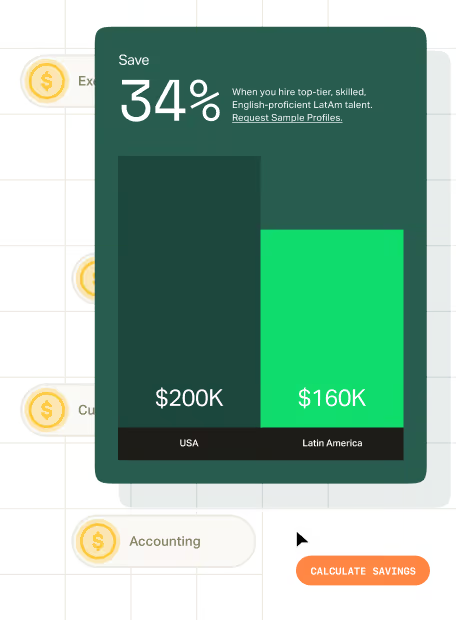
Hiring in Latin America closes the gap between what an A-player costs and what a typical role budget allows. Salaries in the region typically run 30–70% lower than comparable US rates for the same caliber of work, which means the search can start with who’s the best person available, instead of being limited by what a US salary range allows.
Here’s how that math plays out across a few common roles:
For the most up-to-date information, check Hire With Near’s US vs. Latin America Salary Guide.
You get the same caliber of person you’d hire in the US, at a salary equivalent to what an average hire would cost. The savings aren’t the result of paying someone less than their work is worth; they’re a consequence of a lower cost of living, and therefore a different local salary market, than in the US.
We’ve seen this play out with our own team. A few weeks ago, Hire With Near landed at No. 118 on this year’s Inc. 5000 list of the fastest-growing private companies in the US, on the back of 2,421% growth. It’s the same bet we’ve made in our own hiring: exceptional people in Latin America, years before a US-only hiring budget would’ve made those hires possible.
If you want the fuller picture of why so many US companies are making this same move, and which roles they’re filling this way, this guide covers why US companies hire in Latin America in more depth.
{{latam-hiring-calculator}}
A-Player Hiring in Practice: A Senior Developer a US Search Couldn’t Find
The clearest way to see this play out is in a real search. A digital product consultancy had a client project turn into a full platform rebuild, and the role that opened up wasn’t a typical developer hire. They needed someone who combined senior Laravel expertise, front-end range, DevOps experience, and the judgment to advise the client directly. That’s a rare combination, and one they couldn’t find in the US market at an affordable price.
Then, they reached out to Hire With Near and hired a PHP developer based in Colombia with nearly a decade of experience, at 45% less than the comparable US salary. The rare, multi-skilled generalist this consultancy couldn’t find in the US market turned out to exist after all, just not in the US labor market.
For the details of how this search played out, read the full story here: How a Digital Product Consultancy Hired a Senior PHP Developer for $6,500/Month.
That’s the pattern underneath the McKinsey numbers, the Gates and Bezos quotes, and Hire With Near’s own growth: the exceptional candidate usually exists.
Final Thoughts
The research, the Gates and Bezos quotes, and Hire With Near’s own growth all say the same thing: A-players aren't hard to find. The question is whether your search is happening in a market where their salary expectations fit your budget.
That’s the real value of nearshoring to Latin America. It doesn’t just lower the cost of a given hire, it removes the ceiling that a US salary range puts on which candidates you can consider, so the real question becomes who’s the best person for the role.
If you’re dividing a hiring budget across open roles right now, it’s worth asking who the best person for each role is before you commit to two average hires.
If you want to see what that could look like for your specific roles, book a free consultation to talk through your requirements with our team. We’ll walk you through salary benchmarks for the roles you’re hiring and what the search process looks like, including timelines and expectations.
{{latam-hiring-cta-v2}}
Frequently Asked Questions
Is it true that top performers are more productive than average ones?
Yes, and the gap is larger than most people assume. McKinsey research covering more than 600,000 workers found that top performers are 400% more productive than average employees, rising to 800% in highly complex, information-heavy work like software development and management. The more judgment a role requires, the bigger the gap between an average hire and an exceptional one.
Why don’t more companies just hire A-players if they’re worth so much more?
Most companies want to, but a standout candidate’s US salary expectations often exceed what the role’s budget allows, so the search settles for whoever fits the original number instead. The team ends up built from average hires by default, decision after decision.
How much less does it cost to hire an A-player in Latin America compared to the US?
Salaries in Latin America typically run 30–70% lower than comparable US rates for the same caliber of work. That range means a candidate who would cost well above budget in the US market often costs well within it in Latin America, without any compromise on the seniority or skill level of the hire.
For role-by-role figures, check our US vs Latin America salary guide.
Do candidates in Latin America match the quality of top US candidates?
Yes. Latin America has a deep pool of senior, English-proficient professionals across finance, sales, engineering, and other complex functions, working during hours that overlap closely with US teams. Hire With Near’s 2026 State of LatAm Hiring Report breaks down which roles US companies hire there most and why the caliber of talent holds up at the senior level.
What roles benefit most from hiring one exceptional person instead of two average ones?
Complex, judgment-heavy roles see the biggest gap between average and exceptional performance, including software development, engineering leadership, and management roles, where McKinsey’s research found productivity differences of up to 800%. These are also the roles where a great hire creates the most slack, handling ambiguity and unexpected problems without needing constant oversight.
How quickly can a company hire an A-player through Hire With Near?
Most companies working with Hire With Near receive a shortlist of pre-vetted candidates in 3 to 5 days and make a hire in under three weeks. That timeline holds even for the kind of rare, multi-skilled candidates that a US-only search might spend months failing to find at all.









%203.svg)

.avif)





%20(1).avif)

%20(1).png)