%203.svg)
Key Takeaways
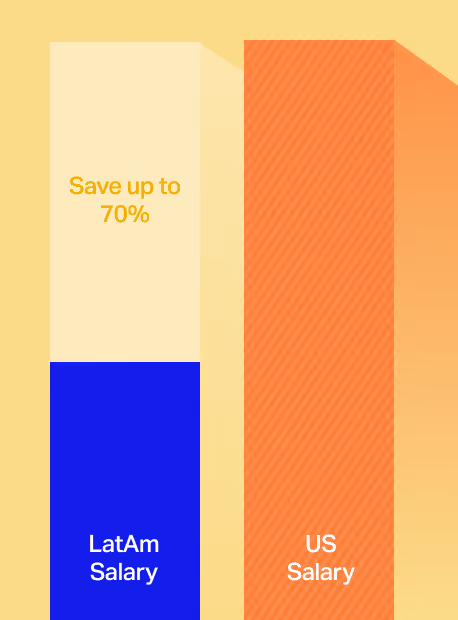
- US companies hiring developers in Honduras get mid-level engineers who work Central Standard Time hours year-round and hold the second-strongest English proficiency in Latin America. Hiring one costs 30–70% less than a US equivalent.
- Honduras isn’t one of the region’s deepest engineering markets, but its mid-level bench in full-stack development and systems engineering is solid, concentrated around San Pedro Sula’s technology corridor.
- You have four ways to hire: freelance platforms, direct hiring, a nearshore staff augmentation company, or a staffing and recruiting firm. Only the last one finds the developer and handles employment for a long-term hire.
As Central America’s nearshore IT landscape grows, Honduras has become one of the region’s more competitive engineering markets for US tech teams. The country matches US Central Time for half the year and US Mountain Time for the other half and consistently ranks among the top three countries in Latin America for English proficiency.
Honduran developers are used to working directly with client stakeholders and US business workflows, not just executing tickets handed down from someone else, but taking technical ownership of their work and integrating into agile remote teams without much ramp-up.
In this guide, I cover everything you need to evaluate before hiring your first developer in Honduras: where top technical skills are concentrated, developer salary benchmarks by seniority, the four primary hiring models, and the key compliance and legal details to keep top of mind.
Why Hire Developers in Honduras?
Honduras works for US engineering teams for three reasons: the region’s second-strongest English proficiency, Central Standard Time year-round with no daylight saving, and a technology corridor around San Pedro Sula.
Hire With Near’s full guide to hiring in Honduras covers the broad country case, so this article stays on hiring developers.
The strongest English proficiency in Central America
Honduras ranks 32nd globally on the 2025 EF English Proficiency Index with a score of 553, which puts it in EF’s High proficiency band and second in Latin America, behind only Argentina.
City scores run higher still: San Pedro Sula at 570 and the capital Tegucigalpa at 565.
That’s a strong starting point, and it’s worth confirming candidate by candidate. The best sign of real fluency isn’t the accent or vocabulary. It’s whether someone can walk a non-developer through why a pull request broke production and hold their own in a live architecture review. Ask every candidate to do exactly that before you make an offer, and you’ll see the country-level strength show up individually too.
Real-time overlap with your workday
A developer in Honduras is online for most of your business day, wherever your team sits in the US. Honduras runs on Central Standard Time (UTC-6) all year with no daylight saving, so the gap stays small and predictable: during US standard time, Honduras and Chicago share a clock, and during US daylight saving time, Honduras sits an hour behind Chicago. Teams on both coasts get six to seven hours of live overlap a day.
That flexibility runs both ways. Most companies set core collaboration hours with their Honduran hires and leave the rest of the schedule to the individual, the same way they would for a US hire.
The contrast with far-offshore engineering is a matter of clock mechanics: a team in Asia finishes its day before your standup, so an afternoon question waits until tomorrow. That’s the case for offshore software development moving to Latin America.
The San Pedro Sula technology corridor
The city of San Pedro Sula anchors a mature, working technology cluster. The core of this ecosystem is the Altia Smart City technology park, regional IT services integrators like GBM, and an established business-process network that includes Teleperformance, Allied Global, ibex Global, and PartnerHero.
This local infrastructure creates a talent pool that is already calibrated for US tech operations. Developers emerging from this ecosystem have worked with US-facing employers for years. They understand the operational cadence of domestic software teams.
That prior experience shows directly in how they manage pull requests, lead agile stand-ups, conduct code reviews, and communicate clearly on live client calls without any onboarding friction.
How Deep Is Honduras’s Developer Talent Pool?
According to Hire With Near’s 2026 State of LatAm Hiring Report, Honduras represents 5% of overall placements in Latin America, making it a focused, highly specialized hiring market rather than a high-volume engineering center.
While sales roles make up a significant portion of local hires, engineering placements happen regularly, with the strongest concentration in mid-level full-stack development and systems engineering.
Understanding the limits and advantages of the market comes down to three factors:
- Concentrated tech hubs: Tech talent is concentrated almost entirely in two cities: Tegucigalpa and San Pedro Sula. Regional universities like UNAH and UNITEC produce steady pipelines of systems engineers, but overall developer volume remains smaller than in markets like Colombia or Mexico.
- Mid-level sweet spot: The local market excels at mid-level software talent. Finding specialized senior leads, data scientists, or niche infrastructure engineers requires more sourcing time than generalist full-stack developers.
- Strong baseline alignment: What Honduras lacks in raw developer count, it offsets with operational readiness. High regional English proficiency and established exposure to US-facing business processes mean local developers integrate quickly into daily workflows.
Honduras is best treated as a target of opportunity for mid-level software roles where fast onboarding, strong English, and daily real-time overlap are the primary priorities.
If you’re hunting a staff-plus specialist or a bench of ten engineers at once, start with the larger markets: Costa Rica is the deeper Central American engineering market, and Brazil, Mexico, Colombia, Argentina, and Chile carry most of the region’s senior engineering volume. Neighboring Guatemala sits in the same time zone with a similar profile.
That’s also why nearshore SaaS recruiting tends to work well here: product teams on a mainstream stack find what they need, and teams hiring for one exotic specialization usually don’t.
{{state-latam-hiring}}
What Technical Skills Do Honduran Developers Have?
When you hire software engineers in Honduras, you’re hiring into the same mainstream stacks as the rest of the region, with local depth in full-stack development and systems engineering. Across Hire With Near’s engineering placements in Latin America, these are the languages and frameworks clients request most:
- Languages: Python (the most requested), JavaScript, PHP, SQL, Ruby, C++, Go, Java, and Rust.
- Frameworks: React (dominant on the front end), Django, Vue.js, Ruby on Rails, and .NET.
- Where Python shows up: Back-end work (often with Django), data engineering, and AI and machine learning projects.
- Honduras-specific strength: Full-stack development and systems engineering, including infrastructure and integration work.
If your stack is mainstream, you’ll find Python developers and React developers here without much trouble.
One warning before you write the job spec: niche framework versions get overemphasized in screening. An experienced developer who understands core principles picks up your framework quickly, so a screen built on framework trivia filters out strong engineers. Test how a candidate reasons about tradeoffs instead.
What our recruiting team flags as the biggest signal in developer interviews is ownership. Federico Bilello, Recruiter for Software Engineering at Hire With Near, puts it this way:
The main thing I look for is ownership. I always look for developers who have worked in startups or smaller companies, because those are the people who probably have ownership. If you bring them a problem, they won’t ask how to solve it, they’ll try their own ideas, they’ll be creative.
— Federico Bilello, Software Engineering Recruiter, Hire With Near
Strong candidates can walk you through what they actually did on a project, in plain language, and speak with real depth about the specific tools they’ve worked with rather than claiming an implausibly wide range.
Recruiters who specialize in engineering roles are trained to spot that depth, and to catch it when it’s missing, before a resume ever reaches you.
Where Is the Developer Talent in Honduras?
Honduras’s software talent pool is concentrated across two main cities, each playing a distinct role in the country’s economic and educational ecosystem:
- San Pedro Sula: The technology, export, and ITO/BPO capital.
- Tegucigalpa: The administrative capital, seat of government, and commercial center.
Understanding how these two markets differ helps US engineering leaders target their hiring effectively.

San Pedro Sula: The technology hub
San Pedro Sula serves as the primary tech engine of Honduras. The local economy has evolved from manufacturing into nearshore IT operations, software engineering, and digital services.
- The Altia Smart City ecosystem: Developed by GK Global, this specialized technology park operates as a primary hub for nearshore operations. It houses IT service providers like Altiatek and regional integrators like GBM, alongside international organizations such as Allied Global, ibex, and PartnerHero.
- Integrated talent pipeline: The park’s design pairs corporate infrastructure directly with higher education. A UNITEC campus sits inside the Altia footprint, allowing computer science students to move smoothly from coursework to internships and full-time roles with US-facing companies.
- English proficiency advantage: San Pedro Sula consistently leads the country in English fluency, driven by a high concentration of bilingual private schools and decades of exposure to multinational employers.
- Developer mindset: Because developers here routinely work within US-facing business units, they arrive familiar with agile stand-ups, pull request protocols, and direct client communication.

Tegucigalpa: The capital and corporate hub
Tegucigalpa is the nation’s political and administrative center. While its technology density is lower than San Pedro Sula’s, it remains a critical secondary source of engineering talent.
- Corporate and public sector focus: Tech roles in Tegucigalpa often center on internal enterprise IT, financial services systems, government platforms, and regional corporate administration.
- Developer distribution: Developers in the capital are typically graduates of the main public university system. They often bring strong foundational skills in computer science, backend systems, and database management, though fewer have worked directly within US-style agile software product teams.
- Expanding tech infrastructure: Altia Smart City now operates a second campus in Tegucigalpa adjacent to the local UNITEC campus. This is gradually building a similar integrated tech hub in the capital.
Where do the graduates come from?
Honduras produces software engineers through three main university systems, each with a distinct focus:
- Universidad Tecnológica Centroamericana (UNITEC) is the private university technology employers recruit from most, with a project-based curriculum and a campus adjacent to Altia Smart City. Its computer science, data science, and software development graduates are the ones most often hired into US-facing roles.
- Universidad Nacional Autónoma de Honduras (UNAH) is the oldest and largest university in the country. It serves as the primary engineering pipeline, producing graduates with deep theoretical foundations in systems engineering, mathematics, computer science theory, and low-level architecture.
- Universidad Tecnológica de Honduras (UTH) is the largest private system in the country, with a strong presence in San Pedro Sula. It focuses on practical systems engineering, industrial tech integration, and database administration, offering flexible evening programs that allow students to work while earning their degrees.
What Does It Cost to Hire Developers in Honduras?
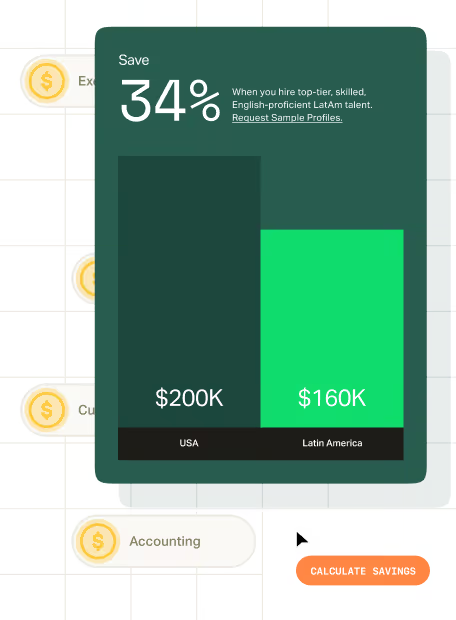
According to Hire With Near’s 2026 salary data, a mid-level software engineer in Latin America earns from $54K to $72K a year, compared to $115K to $195K in the United States.
A senior engineer earns $72K to $108K, compared to $140K to $238K. That’s a saving of roughly 49 to 63% at the same seniority.
Those are Latin American figures, including placements made in Honduras.
Here’s the full range by specialization, compared with equivalent US hires, according to Hire With Near’s salary benchmarks:
For the most up-to-date figures, see Hire With Near’s US vs Latin America Salary Guide.
The $72K to $108K senior band in Latin America sits below the $115K to $195K US mid-level band, so the same role opens up a level of seniority the US range doesn’t. That’s the trade most engineering leads care about when they plan a roadmap.
Where companies get this wrong is at the bottom of the range. A below-market offer doesn’t get you a discount on a strong engineer; it gets you a re-hire in eight months, because developers here know what US-facing work pays. Offers in the mid-level band or above are what put you in front of engineers who have already worked with US teams.
Our breakdown of software engineer salaries in Latin America covers the rest of the technical roles.
Cost of living explains most of the gap, which is why these salaries are competitive locally rather than a discount on someone’s worth. You can see that difference directly in the table below, comparing everyday costs in Tegucigalpa and San Pedro Sula against San Antonio, Texas:
Source: Numbeo.com
How Can a US Company Hire Developers in Honduras?
US companies have four ways to hire remote developers in Honduras: freelance marketplaces, direct hiring, a nearshore staff augmentation company, or a staffing and recruiting firm.
The best choice for your company comes down to one question: do you need short-term help on a project, or a long-term, full-time developer on your team?
Here they are, from most complex to simplest:
Route 1: Freelance and contractor platforms
Platforms like Upwork, Toptal, and Fiverr give you fast access to freelance developers in Honduras, which is useful for a defined project or a few weeks of overflow work. They’re built for project work, so you carry the quality and retention risk yourself and the developer is splitting attention across clients.
For a full-time team member, specialist staffing gives you fundamentally different results for full-time remote hires.
Route 2: Direct hiring
Hiring directly means you source and vet candidates yourself and take on the employment relationship. In Honduras, that comes down to one of two mechanisms:
- Register a Honduran subsidiary: This gives you full control over employment, payroll, and benefits, but it takes months to set up and carries ongoing legal and accounting costs, so it only pays off at a sustained in-country presence of roughly 50 people or more.
- Use an employer of record: An EOR handles payroll, tax withholding, local benefits, and compliance while the developer works as part of your team under your day-to-day management. This is where Honduras’s dual bonus structure matters: the country requires both a 13th-month salary (Aguinaldo, paid December 10 to 20) and a 14th-month salary (Catorceavo, paid by June 30), so annual payroll runs closer to 14 months of pay than 12. An EOR absorbs that calculation, and the range of EOR companies serving Latin America is wide.
Worth knowing up front: an EOR handles employment logistics, not sourcing and vetting. You still find and screen every candidate yourself, whether through your own network or a job board for hiring in Latin America.
This guide to hiring remote foreign employees covers the rest of the obligations that come with a cross-border hire.
Route 3: Work with a nearshore staff augmentation company
A nearshore staff augmentation firm places a pre-vetted developer onto your team to work under your direction while the firm stays the employer and handles payroll, benefits, and compliance.
It fits a defined project, a temporary capacity gap, or a team you expect to scale up and down, with far more vetting and accountability than a marketplace.
Most nearshore staffing companies offer some version of it.
Route 4: Work with a staffing and recruiting firm
For a long-term hire, this is the simplest path. A staffing and recruiting partner sources and vets the developer, then handles payroll, benefits, and local compliance once you hire, so finding the person and employing the person stop being two separate projects.
The real advantage is what you don’t have to build yourself: a local employment structure, a compliance calendar for Honduran labor law, and a sourcing pipeline in a market you don’t know well. You describe the role, review a shortlist of pre-vetted candidates, and the developer joins your own team as a permanent hire, not a rotating contractor.
Hire With Near works this way through our nearshore staffing and recruiting services, and we’re one of several specialist staffing firms for LatAm hiring you can compare.
What Do US Companies Need to Know Before Hiring in Honduras?
Two Honduran rules catch US companies off guard more than any others: the country requires two annual bonus payments for some arrangements, and it consolidates three October holidays into one continuous shutdown.
- Plan around Semana Morazánica: Three separate October holidays are legally consolidated into a single block: Soldier’s Day on October 3, Columbus Day on October 12, and Army Day on October 21. The private sector closes from Wednesday at noon through Friday rather than observing the dates individually. If you have an October release, put that week in the plan now.
- Budget for roughly 14 months of pay, not 12: Honduras mandates a 13th-month salary (Aguinaldo), one month’s average pay, paid December 10 to 20, and a 14th-month salary (Catorceavo), a second month’s average pay, due by June 30 on a July-to-June cycle. Both are prorated for new hires and largely tax-exempt. Honduras is one of the few countries in the region that requires both.
These bonuses only apply if you hire directly through your own entity or an EOR. If you hire through a staffing partner that engages the developer as a contractor, they don’t apply, and what you’re paying instead is the partner’s placement or monthly fee.
Even so, it’s worth knowing that Honduran developers factor Aguinaldo and Catorceavo into how they think about total compensation, so a contractor rate that ignores them entirely can look lower than it should when a candidate is comparing offers.
The rest is simple. Vacation scales with tenure, from 10 working days at one year to 20 at four or more, taken consecutively and scheduled within six months of the work anniversary.
There are 11 public holidays a year, paid at double time if worked, plus three mandatory consecutive days off during Semana Santa.
A staffing partner absorbs all of this. Hire With Near handles the bonus schedule, the holiday calendar, payroll, and local compliance as part of the placement.
Our guide to hiring remotely in Latin America covers what changes when your team spans borders, and the questions US companies ask about hiring remote talent offshore are collected in one place.
How Does Hire With Near Help US Companies Hire Developers in Honduras?
When relying on Hire With Near to hire your own developers based in Honduras, you get a shortlist of vetted developers within three to five business days of kickoff, and most searches go from kickoff to accepted offer in two to three weeks.
Our recruiters source against your requirements, screen English in a live conversation rather than off a resume claim, and handle references and compliance before you see a profile. You review a shortlist of people who have already cleared a technical and communication bar.
We also screen for how a candidate works, not only what they’ve shipped. Natasha Tarapow, Recruitment Consultant at Hire With Near, describes the core of it:
We always ask candidates to tell us about a project they’ve worked on, not just that they use this language and that one, but what their role was and what they actually did. It’s important that they can explain their work to someone who isn’t a developer. If they can do that, that tells me a lot.
— Natasha Tarapow, Recruitment Consultant, Hire With Near
If you want a hands-on evaluation on top of that, we can build in a small real-world task, debugging a piece of code, refactoring for scalability, or implementing a basic API with tests, live or as a take-home, reviewed together on a call at your request. One counter-warning that serves you rather than us: if you do add a coding exercise, keep it to one. Long, multi-round processes lose the strongest candidates before you get to an offer.
A real case: ParkMobile saved $1 million with nine hires in Latin America
What holds most hiring managers back isn’t whether developers in Latin America can code. It’s whether they can run a hiring process in a country they’ve never recruited from. ParkMobile, the global mobility and parking platform, ran into exactly that.
Its back-end and platform work had run through third-party agencies for years, and its engineering leadership wanted to bring that work in-house with their own senior engineers instead. But US rates of $148K to $214K per role were out of reach, and ParkMobile had never sourced talent from Latin America before.
Hire With Near closed that gap: we advised on seniority, availability, and pay, ran sourcing and English screening inside ParkMobile’s own applicant tracking system, and handled references and compliance.
Nine senior engineers later, across platform, backend, and iOS, ParkMobile had $1,066,085 in annual savings against US rates, a 73% reduction, and a 24-day average time-to-hire. Their TA Lead put it this way:
Collaboration with Hire With Near is solving the problem of entering a completely new market for us. They have been an invaluable partner in this expansion, helping to successfully close roles quickly. Their deep understanding of the local talent landscape is what allows them to source and vet top-tier candidates efficiently.
— Akshay Gokarnakar, TA Lead, ParkMobile
Those placements were in Colombia, not Honduras. The transferable part is the method: entering a market a client doesn’t know is work we do repeatedly, and it runs the same way in Tegucigalpa as in Bogotá.
If you’re building beyond individual contributors, we hire software engineering talent in Latin America across the function, and executive search in Latin America covers engineering leadership roles like VP of Engineering, CTO, and engineering managers.
We’ve also written up nine lessons learned from hiring in Latin America if you want the unglamorous version first.
Final Thoughts
Honduras is a good fit if you need a mid-level full-stack, back-end, or systems engineer who works your hours and communicates clearly, and if the region’s second-best English matters more to you than the region’s bigger talent pools. It’s the wrong first stop for a senior specialist, a staff-plus lead, or a full engineering org built in one quarter; the larger Latin American markets carry that depth.
If Honduras looks right, the fastest way to test it is with candidates and salary numbers for your own role. Book a free consultation to talk through your requirements with our team. We’ll give you salary benchmarks for the specialization you’re hiring, explain how the search runs, and give you what you need to make a decision.
{{latam-hiring-cta-v2}}
Frequently Asked Questions
How much does it cost to hire a developer in Honduras?
Hiring a developer in Honduras typically costs between $30K and $108K a year in salary, depending on specialization and seniority, compared with $66K to $238K for the equivalent US hire.
Our IT Roles Salary Guide breaks down the salary ranges role by role.
What is the average software developer salary in Honduras?
A mid-level software engineer in Latin America earns $54K to $72K a year and a senior engineer $72K to $108K, according to Hire With Near’s salary data, which is 49–68% below the equivalent US range. Honduran developer salaries sit inside those regional bands.
Is Honduras in a compatible time zone with the US?
Yes. Honduras runs Central Standard Time (UTC-6) year-round with no daylight saving, so a developer there is online for most of your business hours whether your team is on Pacific, Mountain, Central, or Eastern time.
During US standard time, Honduras and Chicago share the same clock; during US daylight saving time, Honduras sits an hour behind Chicago. Both coasts get six to seven hours of daily overlap, enough for live standups, same-day answers, and real-time handoffs.
Do Honduran developers speak English well enough for daily standups?
Yes. Honduras ranks 32nd globally and second in Latin America on the 2025 EF English Proficiency Index, in the High proficiency band, with San Pedro Sula scoring above the national average. That’s strong enough for standups, architecture discussions, and client-facing calls.
Still screen for technical articulation: ask a candidate to explain a past project to someone who isn’t a developer, since conversational fluency and explaining an engineering decision aren’t the same skill.
Is 13th and 14th-month salary required in Honduras?
If you hire directly through your own entity or an employer of record, Honduras requires both: the 13th-month salary (Aguinaldo), one month’s average pay paid December 10 to 20, and the 14th-month salary (Catorceavo), a second month’s average pay due by June 30 on a July-to-June cycle.
Both are prorated for new hires and largely tax-exempt, so budget closer to 14 months of pay than 12 for anyone you employ directly.
If you hire through a staffing partner that engages the developer as a contractor, these bonuses don’t apply, and what you’re paying instead is the partner’s placement or monthly fee.
What tech stacks are Honduran developers strongest in?
Honduran developers are strongest in full-stack development and systems engineering. They work in the same mainstream stacks as the rest of the region: Python, JavaScript, PHP, SQL, Ruby, C++, Go, Java, and Rust, with React, Django, Vue.js, Ruby on Rails, and .NET on the framework side. Python is the language US companies request most across our engineering placements, and React dominates front-end requirements.
How long does it take to hire a developer in Honduras through Hire With Near?
You’ll have a shortlist within three to five business days of kickoff, and most searches close from kickoff to accepted offer in two to three weeks. That’s weeks rather than the 60 to 90-day notice periods common in far-offshore markets, which is usually what decides whether a hire lands before a release.
Speed varies with how specialized the role is: in ParkMobile’s nine-role engineering search in Colombia, our fastest placement closed in 18 days.
What other developer roles can I hire in Honduras?
Beyond general developers and software engineers, US companies hire a range of technical roles across Latin America, including remote DevOps engineers, nearshore QA engineers, and React Native developers.
Systems and infrastructure work is one of Honduras’s stronger developer categories, so DevOps and platform roles are a natural fit.
Data engineers, mobile developers, and technical leads are commonly placed elsewhere in the region, at the same cost advantage and workday overlap.










%203.svg)
.avif)





%20(1).avif)

%20(1).png)