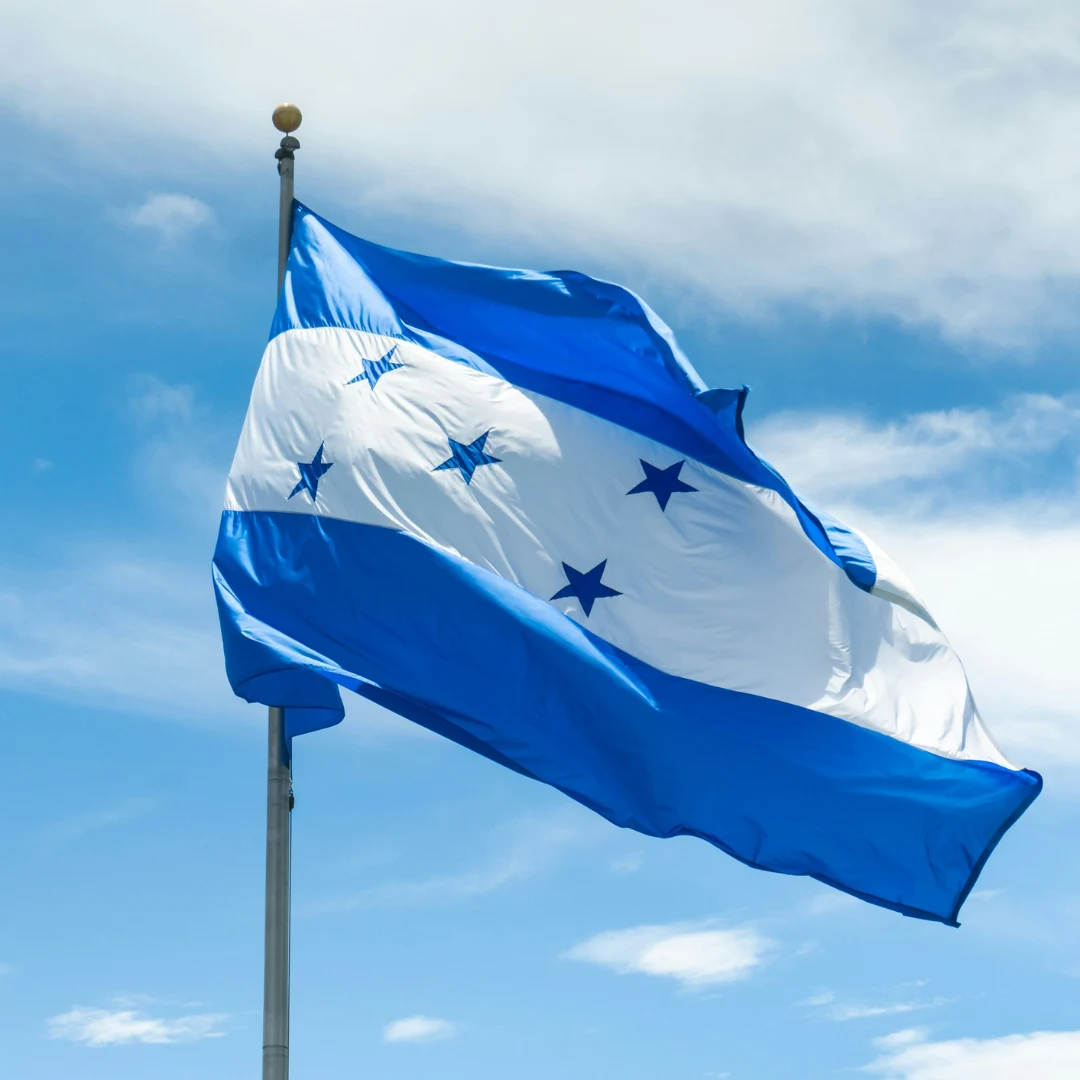


%203.svg)
Key Takeaways
- Honduras ranks 2nd in Latin America on the 2025 EF English Proficiency Index in the High Proficiency band, and its BPO sector has produced a professional class that treats English as a working language, making it one of the strongest LatAm markets for bilingual sales and customer-facing roles.
- Honduras operates on CST (UTC-6) year-round with no daylight saving time, staying within one to two hours of Eastern Time and giving East Coast companies a full workday of real-time overlap.
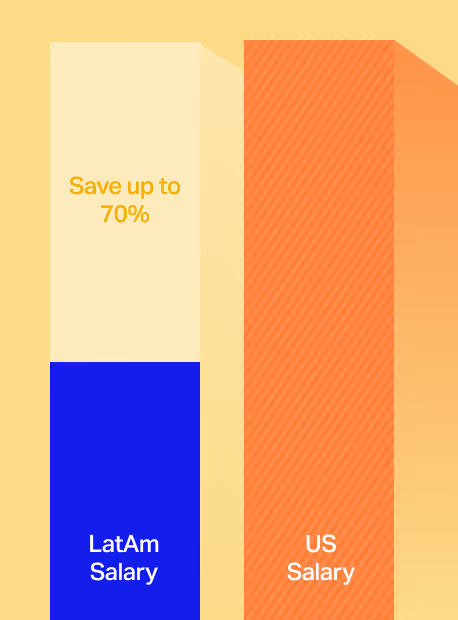
- Hiring in Honduras typically costs 30–70% less than hiring the same role in the US, driven by a lower cost of living rather than any gap in skills or output.
Honduras isn’t the first country most US companies think of when they start exploring Latin American hiring, but the country deserves a closer look: it produces a steady pipeline of bilingual professionals, particularly in sales, customer support, and technology, who work hours that align almost perfectly with the US business day.
A growing business process outsourcing (BPO) and nearshore services sector has drawn major multinationals to its major cities, Tegucigalpa and San Pedro Sula, and the workforce that built up around those operations is now available to smaller US companies hiring remotely.
In this guide, I cover what you need to know before hiring in Honduras: the talent profile, what the roles look like, what you’ll pay, and which parts of Honduran employment law tend to catch US employers off guard.
Why Are US Companies Hiring in Honduras?
Honduras gives US companies access to bilingual, business-ready professionals, particularly in sales and customer-facing roles, working a time zone that’s essentially indistinguishable from the US Central and Eastern business day, at salaries that typically run 30–70% lower than US equivalents.
Time zone alignment
Time zone is the starting point. Honduras runs on Central Standard Time (CST, UTC-6) year-round. Because the country doesn’t observe daylight saving time, the offset shifts slightly relative to US markets when the US clocks change in spring and fall.
During US Standard Time (November to March), Honduras and Chicago are in the same time zone. During US Daylight Saving Time (March to November), Honduras is one hour behind Chicago.
Either way, East Coast and West Coast companies alike enjoy six to seven hours of real-time working day overlap, depending on the season. Day-to-day collaboration, standups, and client calls work smoothly without any scheduling gymnastics.
The sales and bilingual support edge
Honduras has one of the largest and most established BPO sectors in Central America.
Companies including Teleperformance, Allied Global, ibex Global, and PartnerHero have built significant operations there specifically for their English-language customer service and sales delivery. Citibank has maintained a corporate banking presence in Honduras since 1965.
The professionals who have come up through those environments, handling US customer calls, running outbound sales sequences, and supporting business clients in real time, are available and ready to join US companies hiring remotely, as Lucia Atensia, a recruiter specializing in Sales at Hire With Near, puts it:
LatAm sales professionals are highly adaptable and familiar with international business practices. A lot of our candidates have already been working with US clients — they know the business, they know European and US markets. That makes them much easier to integrate into global teams. They also tend to have a strong work ethic and resilience, which is crucial in fast-paced, target-driven environments.
English proficiency
Honduras ranks 32nd globally and 2nd in Latin America on the 2025 EF English Proficiency Index, in the High Proficiency band. That’s a stronger result than most of the region, and it shows up in practice.
Mid and senior-level professionals in sales, customer success, and technology in Tegucigalpa and San Pedro Sula routinely work in English on client calls, in written communication, and in daily standups.
A large part of that comes from the BPO sector: years of working on US client accounts have produced a professional class that treats English as a working language, not a secondary skill.
The pool narrows outside those two cities and outside sectors with direct US client exposure. But for the roles US companies hire most from Honduras, business-level English is the norm.
Cost savings
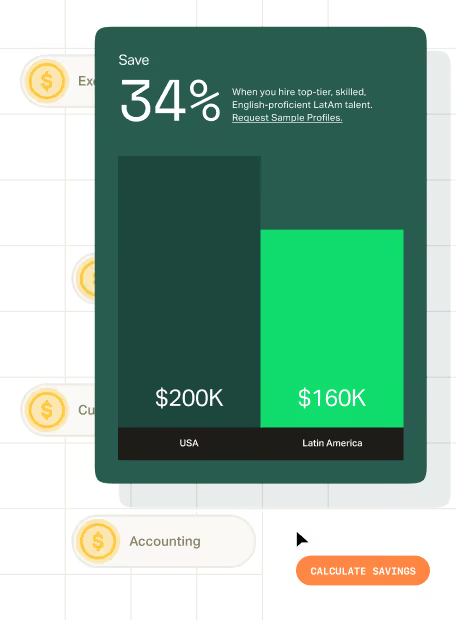
According to Hire With Near’s 2026 State of LatAm Hiring Report, companies hiring in Latin America save an average of $35,000–$64,000 per hire annually compared to US equivalents, with 84% of placements being mid or senior-level professionals.
Those numbers hold in Honduras, where salaries are competitive with the broader LatAm market, while purchasing power locally makes those compensation levels genuinely attractive to candidates. We’ll address specific numbers in a later section.
For more context on why hundreds of US companies are turning to Latin America for full-time remote talent, that piece covers the broader picture.
How Can a US Company Hire in Honduras?
US companies have three options for hiring in Honduras: establish a legal entity, use an employer of record (EOR), or work with a specialist staffing and recruiting firm. For most companies, the third is the fastest path to a great hire.
We’ll cover them in order from most to least complex.
Option 1: Establish a legal entity
Setting up a legal entity means registering your business in Honduras so you can hire employees directly under your company’s name. This involves establishing a subsidiary or branch office, navigating local business registration requirements, and setting up compliant payroll and benefits systems.
This gives you complete control over your international operations and makes sense if you’re planning to build a significant presence in Honduras, with dozens of employees, not just one or two hires.
In practice, this option only makes sense for larger companies with dedicated legal and HR resources. Setup costs are substantial, the process can stretch three to six months, and staying compliant with Honduras’s Labor Code requires ongoing attention as regulations evolve.

Option 2: Use an employer of record (EOR)
An employer of record is a third-party company that becomes the legal employer of your hire on paper, while you keep day-to-day management and oversight.
The EOR handles employment contracts, payroll, tax withholdings, benefits administration, and compliance with local labor laws. You pay the EOR, and they pay your team member according to local requirements.
Honduras has a few compliance requirements that catch US employers off guard, like the two mandatory annual bonuses. An EOR handles both automatically, so the obligations don’t create surprise costs at year’s end.
Popular EOR companies include Deel, Globalization Partners, Remote, and Oyster. For a full breakdown of how EOR arrangements work, this guide to hiring remote foreign employees covers the details.
The trade-off: you’ll still need to source and vet candidates yourself. That means using LinkedIn or a job board for hiring in Latin America to find people, then bringing in the EOR to handle their employment.
Option 3: Work with a specialist staffing and recruiting company
This is the simplest option for most US companies. You partner with one of the specialist staffing firms for LatAm hiring, like Hire With Near, that handles both talent acquisition and all employment logistics in one package.
For example, Hire With Near finds the right candidate through our nearshore staffing and recruiting services, then handles payroll, benefits, and compliance on an ongoing basis.
You describe the role you need to fill, we present pre-vetted candidates, and once you make a hire, we manage the rest so the process feels as seamless as hiring someone in the US.
You get one partner, one monthly invoice, and a team member who attends your standups, owns their function, and builds institutional knowledge of your business.
There’s also a fourth option I need to mention: freelance platforms like Upwork or Toptal. However, a specialist staffing firm gives you fundamentally different results for full-time remote hires. A freelancer splitting their time across clients isn’t the same as a dedicated team member who’s fully focused on your business.
What Can US Companies Expect When Hiring Honduran Talent?
Honduran professionals are particularly strong in sales, bilingual customer support, and technology. Most mid and senior-level candidates in those fields communicate confidently in English, and their working hours overlap directly with the full US business day.
Sales and business development
Sales is the top department for Honduran hires in the 2026 State of LatAm Hiring Report. The reason is the BPO ecosystem.
Companies like Teleperformance and Allied Global have spent years training Honduran sales professionals on US client accounts, running outbound sequences, handling objections, and managing pipelines. That experience translates directly to the kind of SDR and BDR work US companies hire for.
If you need to hire an SDR or hire a BDR in Latin America, Honduras belongs on your shortlist.
Customer support and bilingual roles
Honduras is also a consistent source for bilingual customer support professionals. The BPO sector has built a deep bench of English-speaking support specialists who understand US customer expectations and can work US-aligned schedules.
For companies building out a customer success or support function, Honduras offers real depth at competitive rates.

Technology
Honduras has a growing technology sector, anchored in San Pedro Sula’s Altia Smart City tech park, home to BPO and IT operations for companies including GBM, the leading IT services integrator for Central America.
UNITEC (Universidad Tecnológica Centroamericana), the country’s premier private university for tech, sits adjacent to Altia and produces graduates with strong backgrounds in computer science, data science, and software development who are actively sought out for US-facing roles.
If you need to hire a software engineer in Latin America, Honduras isn’t the deepest engineering market in the region, but it has real talent at the mid-level, particularly in full-stack development and systems engineering.
Related reading: Hire Developers in Honduras: A US Company’s Guide to Cost and Talent
Top universities to recognize on a resume
University background is a useful signal when reviewing Honduran candidates’ resumes. These are the institutions most associated with the roles that US companies hire the most:
- Universidad Tecnológica Centroamericana (UNITEC): The premier private university for corporate and technology talent. Internationally recognized, project-based curriculum, strong bilingual graduate output. Top choice for US client-facing technical roles and SaaS development.
- Universidad Nacional Autónoma de Honduras (UNAH): The country’s oldest and largest public university. The primary pipeline for finance, accounting, engineering, and healthcare professionals. Graduates come with rigorous foundational training.
- Universidad Tecnológica de Honduras (UTH): The largest private university system, with a major presence in San Pedro Sula. Strong in systems engineering, business administration, and digital marketing. Produces execution-focused talent for operations and mid-level technical roles.
- Escuela Agrícola Panamericana Zamorano: An internationally elite institution drawing students from across Latin America, with particular strength in agribusiness, biotechnology, and supply chain. A strong signal for roles in those sectors.
If you’re working through the process for the first time, we’ve put together answers to common questions US companies have about hiring remote talent offshore.
What Are the Salary Ranges for Honduras Hires?
Hiring in Honduras typically costs 30–70% less than hiring the same role in the US.
The numbers below show exactly what that looks like across the roles that US companies hire most from Honduras:
Source: Hire With Near's 2026 US vs. Latin America Salary Guide
For the full role-by-role breakdown, see our full US vs. Latin America Salary Guide.
The savings are real, but they make more sense when you look at the cost-of-living context.
A mid-level sales professional earning $24,000–$30,000 in Tegucigalpa is living well. A one-bedroom apartment in the city center rents for around $450–$550 per month, versus $2,400 in Chicago, Illinois.
That gap is driven entirely by what money buys locally, not by any difference in output or work ethic.
Here’s how Tegucigalpa and San Pedro Sula compare to Chicago on everyday costs:
Source: Numbeo.com
What Do US Companies Need to Know Before Hiring in Honduras?
Two things consistently catch US companies off guard when hiring in Honduras for the first time: the mandatory dual bonus structure, a 13th and a 14th month salary required under Honduran labor law, and the October holiday block, which creates a near-week-long nationwide shutdown that doesn’t map to anything in the US calendar.
It’s important to note that neither applies directly to the contractor arrangements most US companies use when hiring through Hire With Near.
But both shape what Honduran professionals are used to, and understanding them helps you know what candidates factor into their expectations when evaluating an offer.
PTO and statutory leave
Employees in Honduras are entitled to paid annual leave that scales with seniority, calculated in working days (weekends and holidays that fall during the vacation period don’t count against the balance):
- 1 year of service: 10 working days
- 2 years: 12 working days
- 3 years: 15 working days
- 4 or more years: 20 working days
Vacation must be taken consecutively and scheduled by the employer within six months of the employee’s work anniversary.
Unused vacation days cannot be cashed out while the employment relationship is active, only upon termination.
Public holidays
Honduras has 11 mandatory paid public holidays per year, governed by the Código del Trabajo, the country’s labor code.
No employee can be required to work on an official holiday; if they do work by agreement, they must receive double pay.
Standard fixed holidays
- January 1: New Year’s Day
- April 14: Pan-American Day (Día de las Américas)
- May 1: Labor Day
- September 15: Independence Day
- December 25: Christmas Day
Semana Santa (Holy Week block)
The Labor Code mandates three consecutive mandatory days off for the private sector in the spring:
- Maundy Thursday (Jueves Santo) — date varies
- Good Friday (Viernes Santo) — date varies
- Holy Saturday (Sábado Santo) — date varies
Semana Morazánica (the October holiday block)
Honduras has a unique structure worth knowing about. Three separate October holidays are legally consolidated into a single continuous block called Semana Morazánica:
- October 3: Soldier’s Day
- October 12: Columbus Day
- October 21: Army Day
Rather than observing them on their calendar dates, the private sector takes a break starting Wednesday at noon and running through Friday.
The 13th and 14th month salaries
Honduras is one of the few countries in Latin America that legally requires both a 13th and a 14th month salary. Both are separate mandatory payments:
- 13th-month salary (Aguinaldo): One additional month’s average pay, paid between December 10 and December 20. Calculated over the January 1–December 31 cycle. New hires receive a prorated amount.
- 14th-month salary (Catorceavo): A second additional month’s average pay, paid by June 30. Calculated over a July 1–June 30 fiscal cycle. Also prorated for new hires.
Both payments are largely exempt from income tax and social security withholdings, which means the employee receives nearly the full amount.
From a budgeting standpoint, think of total annual compensation as 14 months of pay rather than 12.
{{salary-guide-cta}}
Private health insurance
Honduras has a public health system that provides baseline coverage for formally employed professionals. In practice, the public system faces chronic underfunding and long wait times, and any professional with the financial means uses private health insurance for primary care.
Private health coverage is the most valued non-salary benefit you can offer a Honduran professional. Mid-level candidates typically expect either full employer-paid coverage or a co-payment model where the company covers the core premium.
Senior-level candidates often expect coverage extended to immediate family.
How Does Hire With Near Help US Companies Hire in Honduras?
Hire With Near has placed professionals in Honduras for US companies across sales, customer support, technology, and operations, handling everything from sourcing and vetting to payroll and compliance, so the hiring process takes weeks, not months.
Sales and bilingual customer-facing roles are where Honduran placements are most concentrated. Our recruiters know this market well: which profiles to source for which roles, what candidates at different levels expect to earn, and where the strongest bilingual sales and support talent is concentrated. That knowledge cuts the guesswork on your end.
What working with Hire With Near typically looks like
When looking for an SDR, a BDR, or another role, we start with a detailed description of the professional you need on a kickoff call with a dedicated recruiter. Within five days, you receive a shortlist of pre-vetted candidates with video introductions.
You interview the ones you want to meet, make a pick, and from kickoff to accepted offer, the whole process usually takes just three weeks. Compare that to the three to six months a search might take in the US.
Once you've made your hire, we handle payroll, benefits administration, and compliance on an ongoing basis.
We also know how to structure offers that win. Our recruiters set expectations on both sides before an offer is made, which is why acceptance rates and retention on our placements are consistently high. The pattern we see repeatedly: companies make one hire with us, see the quality we can find for them, and expand from there.
One client's experience: 18 SDRs, $20M ARR, three times faster ramp
AvantStay, a vacation rental platform, is one example.
Their VP of Sales needed to add $20M in new ARR and built an 18-person SDR team entirely through Hire With Near. New hires hit quota in two months and ramped three times faster than their previous US-based SDRs, saving over $1M in annual payroll.
When a US company needs an SDR or BDR who can run outbound sequences fluently in English, handle objections confidently, and work US business hours, Honduras is one of the first markets our recruiting team considers.
Their VP of Sales at AvantStay, Jake Breuner, put it directly:
After building my team with Hire With Near, I wouldn’t hire an SDR stateside anymore.
For companies filling director-level or executive positions, Hire With Near also handles executive search in Latin America across sales, marketing, technology, and operations.
If you’re ready to explore hiring in Honduras, book a free consultation to talk through your requirements with our team. They’ll walk you through salary benchmarks, role availability, and what the process looks like.
If you’re still weighing your options, check some of our country guides: How to Hire in Costa Rica, Hiring in Nicaragua, and Hiring in Belize.
{{latam-hiring-cta-v2}}
Frequently Asked Questions
Is Honduras in a compatible time zone with the US?
Yes. Honduras runs on CST (UTC-6) year-round and doesn’t observe daylight saving time.
During US Standard Time (November to March), Honduras and Chicago are in the same time zone. During US Daylight Saving Time (March to November), Honduras is one hour behind Chicago and two hours behind New York.
East Coast and West Coast companies alike get six to seven hours of real-time overlap during standard business hours. For most roles, collaboration is straightforward.
Does Honduras require a 13th-month salary?
Yes, and it also requires a 14th-month salary, which is less common across Latin America. The Aguinaldo (13th month) is paid between December 10 and December 20. The Catorceavo (14th month) is paid by June 30.
Both equal one full month’s average salary and are prorated for employees who haven’t completed a full cycle. Budget for 14 months of pay annually, not 12.
What roles do US companies most commonly hire from Honduras through Hire With Near?
Sales is the dominant category. SDRs and BDRs are the most-placed roles, followed by bilingual customer support professionals.
Technology roles, particularly full-stack engineers and systems professionals, are placed regularly as well.
The BPO and nearshore services background of the workforce makes Honduras especially strong for US client-facing positions.
What level of English can US companies expect from Honduran professionals?
Mid and senior-level professionals in sales, customer support, and technology in Tegucigalpa and San Pedro Sula routinely work in English, including on client calls, in written communication, and in daily standups.
The depth of English proficiency is tied closely to exposure to the BPO and nearshore services sector.
Hire With Near screens for English proficiency on every placement.
How long does it typically take to hire through Hire With Near in Honduras?
For most roles, Hire With Near presents vetted candidates within 3–5 business days of starting the search. Total time to hire, from kickoff to accepted offer, typically runs two to three weeks, depending on role seniority and how quickly the client moves through interviews.
Does Honduras have strong intellectual property protections?
Honduras is a signatory to international IP agreements and its legal framework broadly protects software, creative work, and proprietary business information. For roles involving access to sensitive code, data, or confidential processes, Hire With Near recommends including IP assignment and confidentiality clauses in the service agreement as standard practice.
What industries hire in Honduras?
Companies across many industries hire Honduran professionals for remote roles, but demand is strongest where bilingual communication and US-aligned hours matter most.
Recruiting for customer service and sales is among the most active, drawn by Honduras’s deep BPO-trained talent pool for support and sales functions.
Finance and accounting firms hire for back-office roles, while IT and tech recruiting is increasing in popularity due to the growing engineering pipeline coming out of UNITEC and San Pedro Sula’s tech corridor.
Marketing teams and logistics operations also hire from Honduras regularly for operations and coordination roles.


.webp)






%203.svg)
.avif)





%20(1).avif)

%20(1).png)